
Research article · 2025 · Full text
International Journal of Geography Geology and EnvironmentIntegrated coastal zone management and stakeholder perceptions along the Adriatic coast
Volume 7(5) · Pages 99–103 · DOI: 10.22271/27067483.2025.v7.i5b.598 ↗
Research areasCoastal and Marine ManagementCoastal and Marine DynamicsPublic Policy and Administration Research
Abstract
Author-writtenLeading coastal governance scholars have argued that integrated coastal zone management (ICZM) can only succeed when it reflects the priorities of the people who depend on the coast for their livelihoods. This research assessed stakeholder perceptions of ICZM effectiveness along five coastal segments of the eastern Adriatic Sea, spanning portions of Croatia, Montenegro, Albania, and the Italian Puglia region. A structured survey was administered to 384 respondents from four stakeholder groups—government officials, NGO representatives, private-sector actors, and local community members—between April and November 2022. Respondents rated satisfaction with five ICZM components (environmental protection, economic development, tourism management, fisheries regulation, and public access) on a five-point Likert scale, and governance effectiveness was scored across five indicators for each coastal segment. Results revealed significant differences among stakeholder groups (ANOVA, p<0.001): government officials rated economic development most favourably (4.1/5), while local communities prioritised public access (4.6/5) and NGOs valued environmental protection (4.3/5). Governance effectiveness varied geographically, with Italian and Croatian segments scoring highest (means 3.5 and 3.3) and Albanian and Montenegrin segments lowest (2.1 and 2.5). Policy coherence and enforcement capacity emerged as the weakest governance dimensions across all segments. These findings suggest that ICZM frameworks in the eastern Adriatic remain fragmented and unevenly implemented, with substantial gaps between stated policy goals and on-the-ground governance capacity—particularly in the southeastern segments where institutional resources are thinnest.
Summary
Source-checkedPlain-language reading of the full paper, prepared with AI and checked against the text. Each point links to the authors' own words.
Why it matters
- Integrated coastal zone management (ICZM) has been promoted since the early 1990s as a way to manage the Adriatic coast, though adoption levels vary among states. View evidence ↗
- ICZM is based on the principle that coastal issues like tourism, fisheries, and pollution are interconnected and cannot be managed in isolation. View evidence ↗
- Despite decades of use, there remains a significant gap between official ICZM policy documents and the actual outcomes of management. View evidence ↗
The question
- The study aimed to evaluate how different stakeholder groups perceive ICZM effectiveness across five Adriatic coastal segments and identify the strongest and weakest governance dimensions. View evidence ↗
What they did
- The researchers used a structured survey translated into Italian, Albanian, Montenegrin, and Croatian to ensure accuracy across the study regions. View evidence ↗
- The study targeted four stakeholder groups: government officials, NGO staff, private-sector representatives, and local community members living within 2 km of the coast. View evidence ↗
- Between April and November 2022, 384 surveys were collected from five segments: Istria, Dalmatia, the Montenegrin coast, the Albanian Riviera, and Puglia. View evidence ↗
- Governance effectiveness was measured using Olsen's framework, focusing on policy coherence, stakeholder engagement, enforcement capacity, data availability, and adaptive management. View evidence ↗
What they found
- Enforcement capacity was the weakest governance dimension in almost every segment, except in Puglia where data availability was slightly lower. View evidence ↗
- There was a positive correlation (0.67) between governance effectiveness and stakeholder satisfaction, with the strongest link being between enforcement capacity and fisheries regulation (r = 0.74). View evidence ↗
What it means
- The authors recommend investing in monitoring capacity and enforcement infrastructure in southeastern Adriatic segments to improve stakeholder confidence and environmental results. View evidence ↗
- The study's sampling design ensured group representation but did not guarantee that the respondents were statistically representative of the entire population in each segment. View evidence ↗
- The findings rely on stakeholder perceptions of governance rather than objective institutional audits, meaning perceived quality might differ from actual performance. View evidence ↗
Visual summary
2 visualsIllustrations explain the paper; charts are replotted from the paper's own table values.
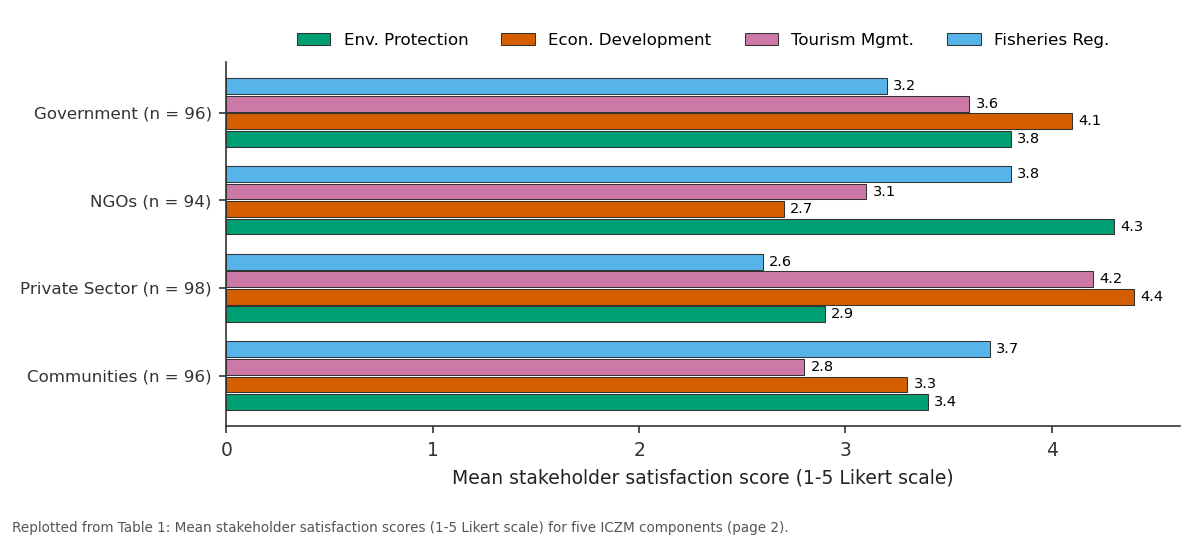
Env. Protection and Econ. Development and more: Government (n = 96) vs NGOs (n = 94) vs Private Sector (n = 98) vs Communities (n = 96)
Replotted from Table 1 (page 2) of the original paper. Every bar is the paper's own table value.
View source evidence ↗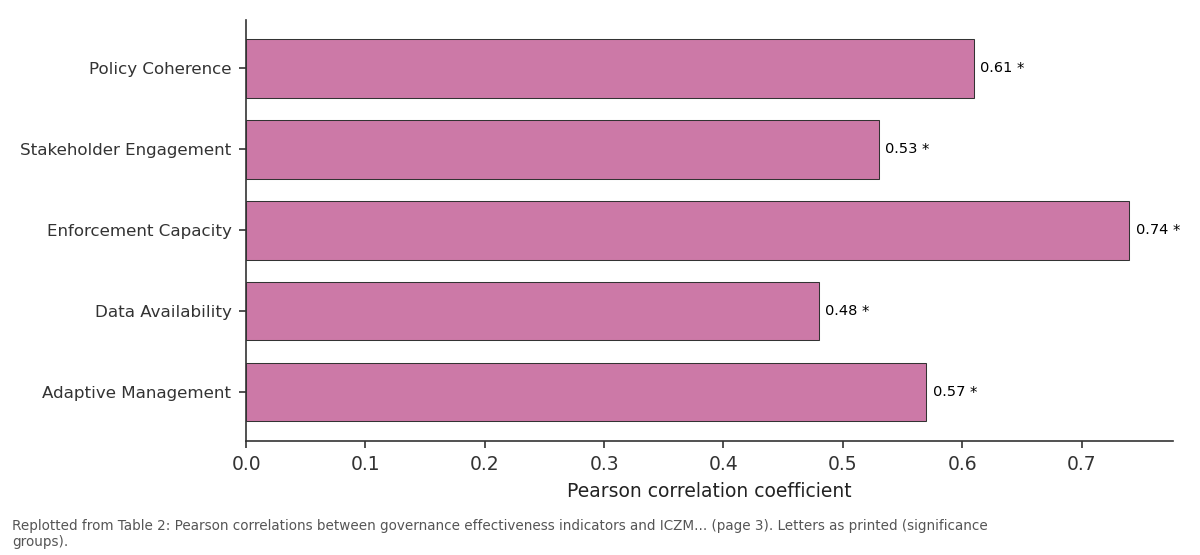
Fisheries: Policy Coherence vs Stakeholder Engagement vs Enforcement Capacity vs Data Availability vs Adaptive Management
Replotted from Table 2 (page 3) of the original paper. Every bar is the paper's own table value.
View source evidence ↗Figures & tables
From the original paper Table 1
 Table 2
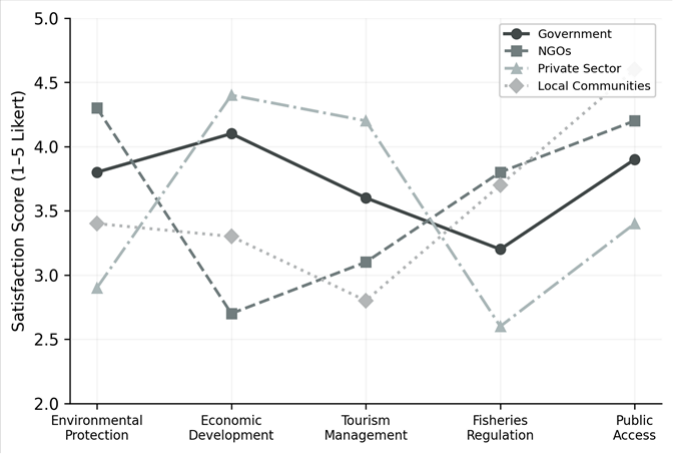 Figure 1
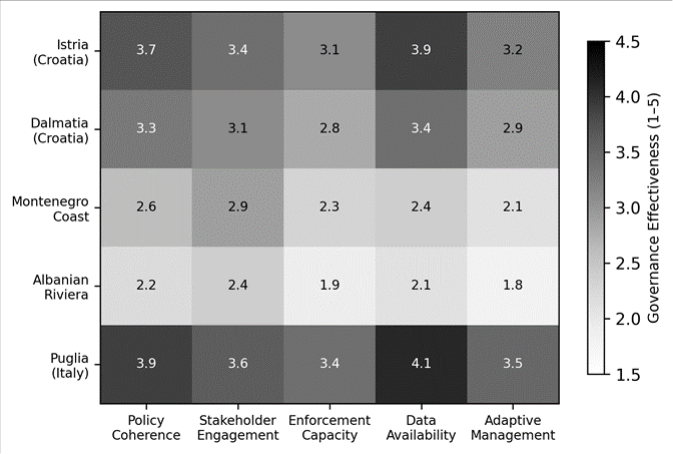 Figure 2
Introduction
As the coastal geographer Biliana Cicin-Sain once observed, managing coastlines is less about controlling nature than about managing human expectations of what the coast should provide [1] . The Adriatic Sea exemplifies this tension. Its eastern shoreline supports competing demands-mass tourism in Croatia, industrial port expansion in Albania, artisanal fisheries in Montenegro, and marine conservation throughout-and no single governance framework has managed to reconcile them satisfactorily. Integrated coastal zone management (ICZM) was promoted as the answer from the early 1990s onward, championed by the Mediterranean Action Plan and adopted in varying degrees by all Adriatic states [2] . But three decades later, the gap between ICZM policy documents and actual management outcomes remains wide in many locations. ICZM rests on the principle that coastal issues are interconnected-that fisheries, tourism, pollution, erosion, and habitat conservation cannot be managed in isolation because interventions in one domain produce consequences in others [3] . Effective integration requires coordination across administrative sectors and government levels, meaningful participation of affected stakeholders, and adaptive management based on monitoring feedback. These conditions are difficult to achieve even in wealthy nations with strong institutional capacity; in countries undergoing rapid economic and political transition, they are harder still [4] . The eastern Adriatic coast is a useful test case for evaluating ICZM performance because it spans a steep gradient in governance capacity within a relatively compact geographic area. Croatia, an EU member since 2013, has transposed the ICZM Protocol for the Mediterranean into national legislation. Montenegro and Albania, at earlier stages of EU accession, have adopted ICZM strategies on paper but face challenges in enforcement and inter-ministerial coordination [5] . Italy's Puglia region represents a mature institutional context with well-established planning frameworks. Comparing stakeholder perceptions across these settings reveals how institutional capacity and political context shape ICZM outcomes. This research aimed to assess how stakeholders from different sectors perceive the effectiveness of ICZM along five Adriatic coastal segments, to identify which governance dimensions are strongest and weakest, and to explore whether perceptions differ systematically among stakeholder groups. The work was conducted through the Casablanca Academy of Geographic Research, with field surveys administered by local research partners in each country.
Theoretical Framework
This research adopted the governance effectiveness framework developed by Olsen [6] , which evaluates ICZM outcomes across five dimensions: policy coherence (the alignment of sectoral policies with ICZM goals), stakeholder engagement (the extent and quality of participatory processes), enforcement capacity (the ability to monitor and enforce regulations), data availability (access to reliable coastal monitoring data), and adaptive management (the capacity to revise strategies based on new evidence). The framework was chosen because it explicitly links procedural governance qualities to management outcomes, rather than focusing solely on ecological indicators that may respond to many drivers beyond management action. Each dimension was operationalised as a scored indicator (1-5 scale), with descriptive anchors calibrated during a presurvey expert consultation with six Adriatic coastal management practitioners. The framework assumes that governance effectiveness mediates the relationship between ICZM policy adoption and environmental or socioeconomic outcomes-that is, having a policy on paper is necessary but not sufficient; it must be implemented through competent, participatory, and adaptive governance processes [7] . This assumption was tested indirectly by examining whether segments with higher governance scores also reported higher stakeholder satisfaction.
Materials and Methods
Materials and Methods
Materials
A structured survey instrument was developed in English and translated into Croatian, Montenegrin, Albanian, and Italian by certified translators, with back-translation verification for accuracy. The survey comprised 28 items divided into three sections: respondent demographics and coastal engagement profile (8 items), satisfaction ratings for five ICZM components on a five-point Likert scale (10 items), and governance effectiveness ratings for five indicators on a five-point scale (10 items). The target population included four stakeholder groups: government officials responsible for coastal planning, environmental NGO staff, private-sector representatives (tourism operators, fisheries businesses, port authorities), and local community members living within 2 km of the shoreline. Surveys were administered between April and November 2022 across five coastal segments: Istria (Croatia), Dalmatia (Croatia), the Montenegrin coast, the Albanian Riviera, and Puglia (Italy). Sampling used a stratified purposive design with approximately equal representation of the four stakeholder groups in each segment, yielding a total of 384 completed surveys (range 72-82 per segment) [8] .
Methods
Data were analysed at the Casablanca Academy of Geographic Research using R 4.2.3. Internal consistency of the Likert scales was verified by Cronbach's alpha (α = 0.84 for satisfaction items, α = 0.81 for governance items). Differences in satisfaction scores among stakeholder groups were tested using one-way ANOVA with Tukey HSD posthoc comparisons. Differences in governance effectiveness among coastal segments were tested similarly. Pearson correlation coefficients were computed between governance effectiveness scores and satisfaction scores to evaluate the framework's assumption that governance quality mediates stakeholder satisfaction. Effect sizes were reported as etasquared (η²). All tests used a significance threshold of p<0.05. Missing data were below 3% for all items and were handled by pairwise deletion. and environmental protection (range 2.9-4.3), reflecting the well-known tension between conservation and development priorities in coastal governance. Enforcement capacity was the weakest dimension in every segment except Puglia, where data availability scored marginally lower (3.4 versus 3.5 for enforcement).
Results
Results
Discussion
The divergence in satisfaction scores among stakeholder groups confirms a pattern widely reported in the coastal governance literature: different actors bring fundamentally different expectations to the table, and ICZM processes that appear successful to one group may seem inadequate to another [9] . Government officials, whose professional incentives often align with economic growth targets, rated economic development highest; NGOs, whose mandates centre on environmental protection, scored that dimension most favourably. This isn't surprising, but it matters because it means that aggregate satisfaction scores can mask deep disagreements about what the coast should be managed for. Any evaluation of ICZM effectiveness that relies on a single stakeholder perspective risks drawing misleading conclusions.
The geographic gradient in governance effectivenesshighest in the EU member segments (Puglia, Istria) and lowest in the pre-accession countries (Albania, Montenegro)-aligns with the institutional capacity hypothesis embedded in the Olsen framework. Croatia and Italy have had longer to develop planning legislation, train coastal managers, and invest in monitoring infrastructure. Albania's ICZM strategy was adopted only in 2014, and its enforcement mechanisms remain underfunded [10] . That enforcement capacity scored lowest across nearly all segments is telling: it suggests that the Adriatic's ICZM challenge is not primarily one of policy design-most countries have reasonable strategies on paper-but of implementation, which requires sustained institutional investment that political cycles often fail to deliver [11] . The positive correlation between governance effectiveness and stakeholder satisfaction (r = 0.67) supports the theoretical assumption that governance quality mediates outcomes. The strongest individual correlation-between enforcement capacity and fisheries satisfaction (r = 0.74)makes intuitive sense: fishers care most about whether regulations are actually enforced because unregulated extraction by others directly threatens their livelihoods [12] . For environmental protection, enforcement and adaptive management both scored highly, suggesting that perceived willingness to act and to adjust based on monitoring data both matter to conservation-minded stakeholders.
Limitations
Several limitations should be acknowledged. First, the stratified purposive sampling design, while effective at ensuring representation of all four stakeholder groups, does not guarantee statistical representativeness of the broader population within each segment. Selection bias may have favoured respondents with stronger views about coastal management. Second, the governance effectiveness ratings were based on stakeholder perceptions rather than on objective institutional audits; perceived governance quality may differ from actual administrative performance [13] . Third, the survey captured a single cross-sectional snapshot; longitudinal tracking would be needed to assess whether governance improvements over time translate into rising satisfaction. Finally, the five coastal segments differ not only in governance capacity but also in environmental conditions, economic structure, and tourism intensity, making it difficult to isolate governance effects from confounding contextual factors.
Conclusion
This research assessed stakeholder perceptions of ICZM effectiveness along five eastern Adriatic coastal segments, revealing significant differences both among stakeholder groups and among geographic settings. Government officials, NGOs, private-sector actors, and local communities each prioritised different ICZM components, reflecting the competing expectations that coastal governance must reconcile. Governance effectiveness scores followed a gradient from the more institutionally mature EU-member segments to the less-resourced pre-accession segments, with enforcement capacity and adaptive management emerging as the weakest dimensions across most of the coastline. The positive correlation between governance effectiveness and stakeholder satisfaction supports the theoretical proposition that governance quality-not just policy adoption-drives perceived ICZM outcomes. Enforcement capacity, in particular, showed the strongest link to satisfaction with fisheries regulation, suggesting that stakeholders judge management frameworks primarily by their ability to translate rules into action on the ground. These findings carry practical implications for Adriatic coastal governance. Investing in enforcement infrastructure and monitoring capacity in the southeastern segments would likely yield the greatest returns in stakeholder confidence and, potentially, in environmental outcomes. Cross-border learning mechanisms-such as twinning programmes between established and emerging ICZM institutionscould accelerate capacity building without requiring each country to reinvent governance frameworks from scratch. Future research should adopt longitudinal designs to track how governance investments translate into satisfaction changes over time, and should incorporate objective institutional indicators alongside perception-based measures to triangulate findings [14] .
Acknowledgement
Acknowledgements Funding SourcesThis research was supported by general institutional research funds from the Casablanca Academy of Geographic Research. No external competitive grants were applied.
Figures and tables from the paper
| Stakeholder Group | Env. Protection | Econ. Development | Tourism Mgmt. | Fisheries Reg. | Public Access |
|---|---|---|---|---|---|
| Government (n = 96) | 3.8 | 4.1 | 3.6 | 3.2 | 3.9 |
| NGOs (n = 94) | 4.3 | 2.7 | 3.1 | 3.8 | 4.2 |
| Private Sector (n = 98) | 2.9 | 4.4 | 4.2 | 2.6 | 3.4 |
| Communities (n = 96) | 3.4 | 3.3 | 2.8 | 3.7 | 4.6 |
| Overall (n = 384) | 3.6 | 3.6 | 3.4 | 3.3 | 4.0 |
Table text extracted from the original PDF; superscript letters are shown inline. The original table image is below.
View original table image
| Governance Indicator | Env. Protection | Econ. Dev. | Tourism | Fisheries | Public Access |
|---|---|---|---|---|---|
| Policy Coherence | 0.62* | 0.54* | 0.58* | 0.61* | 0.49* |
| Stakeholder Engagement | 0.59* | 0.47* | 0.51* | 0.53* | 0.68* |
| Enforcement Capacity | 0.71* | 0.48* | 0.56* | 0.74* | 0.52* |
| Data Availability | 0.55* | 0.41* | 0.43* | 0.48* | 0.38* |
| Adaptive Management | 0.64* | 0.52* | 0.61* | 0.57* | 0.55* |
Table text extracted from the original PDF; superscript letters are shown inline. The original table image is below.
View original table image
References
14 in the original paper- Cicin-Sain B, Knecht RW. Integrated coastal and ocean management: Concepts and practices. Island Press. 1998;1:1-517.
- UNEP/MAP. Protocol on Integrated Coastal Zone Management in the Mediterranean. United Nations Environment Programme, Mediterranean Action Plan. 2008;1:1-28.
- Kay R, Alder J. Coastal planning and management. Taylor and Francis, 2nd Edition. 2005;1:1-380.
- Sorensen J. Baseline 2000 background report: The status of integrated coastal management as an international practice. Urban Harbors Institute Publication. 2002;1:1-169.
- Rochette J, Wemaëre M, Billé R, du Puy-Montbrun G. A contribution to the interpretation of legal aspects of the Protocol on ICZM. UNEP/MAP PAP/RAC. 2012;1:1-72.
- Olsen SB. Frameworks and indicators for assessing progress in integrated coastal management initiatives. Ocean and Coastal Management. 2003;46(3-4):347361.
- Ehler CN. Indicators to measure governance performance in integrated coastal management. Ocean and Coastal Management. 2003;46(3-4):335-345.
- Creswell JW, Creswell JD. Research design: Qualitative, quantitative, and mixed methods approaches. SAGE Publications, 5th Edition. 2018;1:1275.
- Tompkins EL, Few R, Brown K. Scenario-based stakeholder engagement: Incorporating stakeholders preferences into coastal planning for climate change. Journal of Environmental Management. 2008;88(4):1580-1592.
- Qiriazi P, Sala S. Environmental problems of Albania. Developments in Earth Surface Processes. 2000;4:1330.
- Shipman B, Stojanovic T. Facts, fictions, and failures of integrated coastal zone management in Europe. Coastal Management. 2007;35(2-3):375-398.
- Jentoft S, Chuenpagdee R. Fisheries and coastal governance as a wicked problem. Marine Policy. 2009;33(4):553-560.
- Brewer GD, DeLeon P. The foundations of policy analysis. Brooks/Cole Publishing. 1983;1:1-476.
- O'Hagan AM, Ballinger RC. Implementing Integrated Coastal Zone Management in a national policy vacuum: Local case studies from Ireland. Ocean and Coastal Management. 2010;53(12):750-759.