
Research article · 2026 · Full text
International Journal of Horticulture and Food ScienceAn economic analysis of the livelihood of vegetable-growing farmers in Almora district, Uttarakhand
Volume 8(4) · Pages 43–47 · DOI: 10.33545/26631067.2026.v8.i4a.509 ↗
Research areasAgricultural Economics and PracticesAgricultural Innovations and PracticesAgricultural Development and Management
Abstract
Author-writtenThe structure of Agriculture in hill areas of Uttarakhand state is mainly characterized by family-based farming practices. The role of women is significant in agriculture and traditional techniques are often used. In these hilly areas mostly, agriculture is hampered by small marginal and scattered fields, rainfed farming, lack of modern technology, and limited adoption of modern fertilizers and pesticides. Overall, this leads to low yields and a subsistence farming model. Mostly the agricultural output is primarily for household consumption and a little surplus is for sale, trapping farmers in poverty. The scarcity of non-farm income opportunities results in out-migration, as family members seek work elsewhere to meet basic needs. Both using primary and secondary data this research explores the economic challenges that the respondent vegetable growers farmers face for their livelihood. The finding highlights the need for tailored interventions for addressing the specific vulnerabilities of these respondents in study area, supporting sustainable livelihoods and contributing to local food security.
Summary
Source-checkedPlain-language reading of the full paper, prepared with AI and checked against the text. Each point links to the authors' own words.
Why it matters
- Agriculture in the hill areas of Uttarakhand is primarily based on family farming practices. View evidence ↗
- Hilly agriculture in this region is limited by rainfed farming, a lack of modern technology, and small, scattered fields. View evidence ↗
- Vegetable farming has become increasingly important for household income and nutrition due to the limitations of traditional agricultural practices. View evidence ↗
The question
- The study aims to analyze the socio-economic structure of vegetable growers, their economic dependence on vegetable cultivation, and the challenges they face. View evidence ↗
What they did
- The research was conducted in the Almora district of the Kumaon division in Uttarakhand, located in the Mid-Himalayan range. View evidence ↗
- The study used judgment sampling for the region and randomly selected 50 vegetable-growing farmers from the Hawalbagh development block. View evidence ↗
- The researchers used descriptive and inferential statistics, managed via statistical software, to analyze the data. View evidence ↗
What they found
- Farmers earned an average annual net income of ₹55,000.00 from selling vegetables, which averages to ₹4,583.33 per month. View evidence ↗
- The average respondent was 50 years old with a household size of 5 persons and a small average farm size of 0.16 hectares. View evidence ↗
- A significant majority of the farmers (86.0%, or 43 respondents) reported a high level of economic dependency on vegetable farming. View evidence ↗
- Difficulties in obtaining seeds and wild animal attacks were not significantly related to the level of income dependency. View evidence ↗
What it means
- The authors conclude that while vegetable farming is central to rural livelihoods, it requires comprehensive support in irrigation, mechanization, transportation, and marketing to be sustainable. View evidence ↗
- The study's scope is limited to respondents within the Hawalbagh development block of the Almora district. View evidence ↗
Visual summary
1 visualsIllustrations explain the paper; they do not show study data.
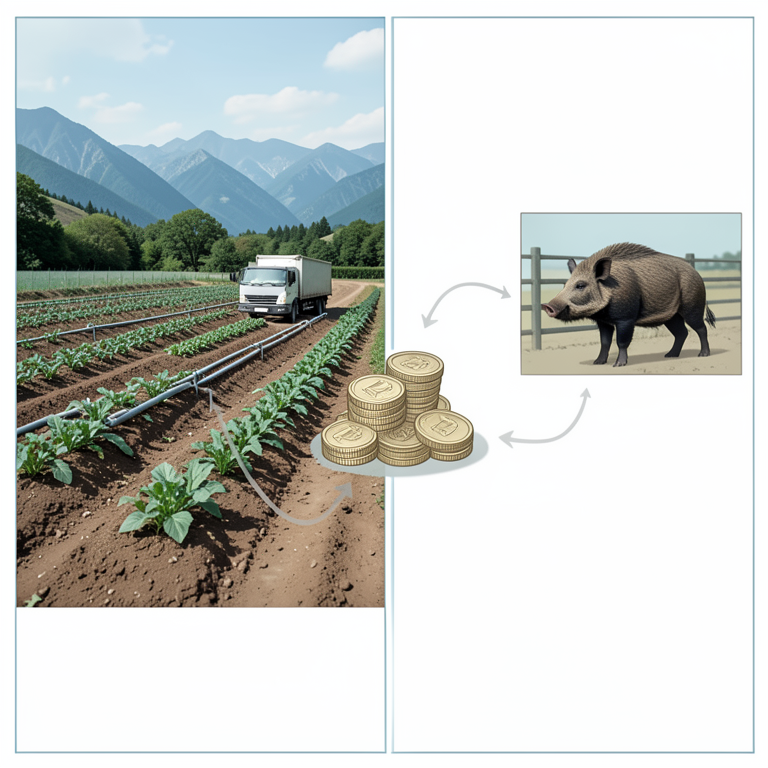
Dependency vs. Constraints
AI-generated conceptual illustration (Vegetable gardens in the mountainous terrain of Almora, Uttarakhand). It explains the idea and does not show study data.
View source evidence ↗Figures & tables
From the original paper Table 1
 Table 2
 Table 3
Introduction
As agriculture is the backbone of many economies round the globe. The hilly state Uttarakhand is also an agri-prone economy primarily or predominantly agrarian (Rana et.al. 2019) [1] where agriculture plays a vital role in the economy as it is only done in 15 percent of the entire geographical land (Prabhakar, 2019) [2] . More than half percent of population is engaged in subsistence agriculture with dependability as the source of revenue in state (Sharma & Kandpal, 2018) [3] . With the specific features and problems in traditional agriculture practices, vegetable farming has gained increasing importance in terms of income and nutritional sustenance for the households in the study region. It provides the muchneeded opportunity for diversification in agriculture especially in view of unusual topography of the state ( (Rana et.al. 2019) [1] . This is attracting farmers due to highly remunerative, regular source of income and employment provider in state (Jethi et.al. 2019) [4] . This shift or transformation is driven by several factors i.e., growing demand of fresh vegetables in nearby urban region, improved access to the markets etc. and it has been identified as financially rewarding practice in the hills of Uttarakhand (Rawal & Ansari, 2019) [5] . The cultivation of vegetable may be one of the major interventions which can enhance the income and standard of living of small farmers (Bishnoi et.al. 2021) [6] . But this transition is also not an easy task it is also full of challenges in which the farmers face several myriads. The livelihood of vegetable farmers in the study area is a complex interplay of several factors i.e., market prices, transportation costs, access to credit, and availability of essential inputs which includes fertilizer, seeds, and irrigation resources. These farmers with marginal agricultural fields often rely on traditional farming techniques and deprived from modern techniques and information which results finally to yield, profitability, and vulnerability to market fluctuations in negative manner. Some other factors as lack of organized market structure and value chains results as exploitation by the intermediaries, which finally results the diminishing returns to the farmers. The findings of this study are intended to contribute a comprehensive understanding of the economic status of vegetable farmers in study region. This will be helpful for policymakers, development practitioners, and for further research in future which is committed to Improving the livelihoods of rural communities in the hills of the Indian mid Himalayan region and at the same time to promoting the sustainable agricultural practices that are economically viable and environmentally sound. Patel et.al. (2013) [7] in their study for finding the constraints of vegetable growers in North Gujrat they conclude their findings that higher cost of plant production protection and pesticides were the major problems the vegetable growers face majorly. On the marketing ide they face higher fluctuations in the prices, absence of transportation facilities. The problems of small and marginal farmers are more such as low prices for their production, lack of marketing information, and no cooperative marketing is also a major problem they find for these vegetable growers. Fartyal & Rathore (2013) [8] conducted their study of vegetable growers in hill regions of Uttarakhand state which is based on gender and find that women perform most of the labor-intensive vegetable cultivation work but they were deprived from marketing the produce. Their time spent in vegetable cultivation is more than the male persons in the family. So the study reveals their work is strenuous and time consuming, but they had limited access to the resources due to various reasons and patriarchy is one of them. They finally conclude that these types of gender gaps are obstacle in the development of women and they suggest for capacity building workshops. Wasudha et.al. (2018) [9] they found that the problem among the small-scale farmers is fluctuations in price and poor infrastructure, drainage in times of drought and heavy rain are the responsible factors for this. They suggest that labour saving agricultural techniques should be introduced which will work as an option in order to increase the production in sustainable manner. Rawal & Ansari (2019) [5] finds in their study that there is high expression by the respondents regarding the extension system which do not meet their expectations. As the hill farming is generally practiced in small and fragmented landholdings in terraced fields and due to low population density, the farmers are dispersed and unreachable in the typical terrain of study region. They suggest for specific extension system to meet the needs of the farming community in the hills of Uttarakhand. Shah & Ansari (2020) [10] in their study find that there were several marketing constraints among the vegetable growers but the major constraints were problem of intermediaries, transportation, storing facility, lack of remunerative price, lack of market information and input information, lack of knowledge regarding grading and standardization of vegetable, problems regarding availability of farm labour and there is also a problem of lack of packaging material for the grown vegetables. Nath et.al. (2020) [11] in their study concluded that the to address the constraints and steps taken up by development agencies were not adequate so that they can be eradicated. They found the gender biasness as the most basic issue behind this even there were steps to fill the gap of gender, they found still that it is present in some cases. They also found that there is none availability of proper infrastructural facilities for them. So, they suggest that the Government should take necessary steps which the farm women face, it will result by boosting the production and productivity in vegetable farming. Rana & Rahaman (2021) [12] studied the problems of vegetable growers and they find that the vegetable growers face different level problems in the field of production and marketing of vegetables they grew. According to them the sociodemographic characteristics of the respondents have significant contribution with the problem confrontation of the respondents while they produce or market the vegetables. They suggest that inputs for vegetable production should be made available to the growers by regular monitoring of market price and provide them to subsidy. Mukaila et.al. (2022) [13] , in their study namely "Effects of vegetable production on income and livelihood of rural households in Nigeria" concluded that the production of vegetable is immensely contributed to the economic status, livelihood and well-being of the households. They suggest for the provision of accessible and affordable credit facilities, through government, NGOs and banks to the farmers which is important to encourage the vegetable growers, will curb most of the constraints and help them in increasing their income. Singh et.al. (2022) [14] in their study named "Constraints and suggestions regarding vegetable cultivation in Varanasi district of Uttar Pradesh" concluded that the most serious constraints in their study were, absence of quality seeds, fertilizers, and pesticides. High cost, availability at proper time, fluctuation in price and market, insufficient or lack of cold storages are necessary components in agriculture but their nonavailability at proper time become a constraint for the vegetable growers. The respondent vegetable growers suggests that they should be provided information about recent trends, malpractices should be stopped, proper marketing facility with reasonable rate and proper cold storage facilities also be provided to them which will help them to increase their vegetable production and help in increasing the income for them. Murmu & Dash (2022) [15] made their study of vegetable growers in Odisha and they find that the efficiency of male farmers is more than female in study area. The results of their study reveal that vegetable marketing should be increase so that it can benefit farmers and consumers both. This will also increase the income of farmers and there will be create opportunities for the employment of local people and finally it will improve their livelihoods.
Review of literature
Review of literature
Objectives of the Study
The objectives for the present study are as follows 1. To study the socio-economic, demographic structure of respondents. 2. To access the economic dependence of households on cultivation of vegetable. 3. To identify and analyse the challenges faced by respondents while they grow vegetables.
Materials and Methods
Materials and Methods
Study area
The study was conducted in Almora district of Kumaon division in Uttarakhand state which is situated in Mid-Himalayan range of Indian Himalayas. With the typical terrain the agriculture practice is done in small, scattered and terraced fields with a low productivity and high input of labour.
Sampling framework
The study is based on judgement sampling for the selection of study region and 50 respondents were selected randomly from Hawalbagh development block who were especially involved in vegetable growing farm activity in their fields for their livelihood.
Data collection
The data for this purpose was collected with the help of a well-structured interview schedule and personal & group interview was also conducted with the respondents to collect the data for this purpose.
Data Processing and Analysis
Before carrying the final analysis, incorrect type data was avoided to minimize the errors in this study. Statistical software (Online and Offline) was used to manage the data and descriptive and inferential statistics were used to analyse the data and make conclusions.
Limitations of the study
The study is only limited to the respondents of Hawalbagh development block in district Almora of Uttarakhand state.
Results and Discussion
Results and Discussion
Socio-economic profile of respondents
Table 1.0 reveals the socio-economic profile of the respondents this provides valuable insights into their livelihood conditions and dependence on vegetable farming. The average net income from different vegetable seasons in a year by selling vegetable was ₹55,000.00 (Monthly average of ₹4,583.33, if evenly spread in twelve months), which indicates that vegetable cultivation provides a modest but significant contribution to household earnings. While this income supports their basic needs, it also suggests financial vulnerability, as the earnings may not be sufficient to meet all household expenditures, particularly in cases of larger families or unexpected economic shocks. The respondents had an average farming experience of 28 years, highlighting their long-standing engagement with agricultural practices, especially vegetable farming. The average age of respondents is 50 years, pointing towards a predominantly middle-aged farming community. The average household size was 05 persons, reflecting typical family structures in rural areas. A notable finding is the average farm size of only 0.16 hectares, which highlights the prevalence of small and fragmented landholdings among the respondents. Such small farms restrict the scope of large-scale production, mechanization, and crop diversification, thereby directly influencing productivity and income levels even after having the farming experience of 28 years on average among respondents. The small farm size also underlines the importance of vegetable cultivation, as it allows higher returns per unit area compared to traditional cereal crops.
| Variables | Respondents |
|---|---|
| Average Net Income from Vegetable Selling (Rs.)* | 55,000.00 |
| Average Farming Experience (Years) | 28 |
| Average Age (Years) | 50 |
| Average Size of Household | 5 persons |
| Average Size of Farm (Hec) | 0.16 |
Table text extracted from the original PDF; superscript letters are shown inline. The original table image is below.
View original table image
Status of dependency on vegetable farming income among respondents
The data on respondents' dependency on vegetable farming income clearly reveals from Table 1.1 that a significant majority rely heavily on this source of livelihood. Out of the total respondents, 43 respondents (86.0%) reported a high level of dependency on vegetable farming income. This indicates that vegetable cultivation plays a central role in sustaining their household economy and is the primary source of earnings for most of them. Such a high percentage highlights the crucial place of vegetable farming in the livelihood portfolio of rural households, reflecting both economic reliance and limited income diversification. On the other hand, only 05 respondents (10.0%) were moderately dependent on vegetable farming. This suggests that while vegetable farming contributes substantially to their earnings, these respondents might also have access to other supplementary sources of income such as wage labor, small businesses, or other agricultural and non-agricultural activities. Their partial dependency could be an indication of efforts toward risk minimization by not relying solely on vegetable farming. A very small proportion, 02 respondents (4.0%), reported low dependency on vegetable farming income. This category represents those who treat vegetable farming as a secondary or supplementary activity. For such respondents, the major share of livelihood may come from alternative sources like service sector jobs, remittances, or other forms of farming. Their limited reliance also reflects either lesser engagement in vegetable cultivation or a relatively stronger economic base from non-farm activities. H0: There is no relation between the income dependency on vegetable growing of respondents and those problems they face. Ha: There is a significant relation between the income dependency on vegetable growing of respondents and the problems they face. The reason for rejection of hypothesis is that the test results demonstrate that dependency on vegetable income is strongly related to many of the major problems faced by respondents. High dependency increases vulnerability to production and market-related challenges. Except the problems like obtaining seeds and wild animal attacks, means these problems are independent of income dependency and affect farmers more uniformly.
Conclusion
The study highlights the socio-economic profile, income dependency, and challenges faced by vegetable farmers. The analysis reveals that vegetable cultivation forms the backbone of livelihood for the majority of respondents, with 86.0% showing high dependency on vegetable farming income. Despite their long farming experience (28 years on average), the respondents earn a modest net income of ₹55,000.00 per year (Monthly average of ₹4,583.33, if evenly spread in twelve months) from different vegetable seasons, which reflects both the importance and vulnerability of vegetable farming as a livelihood activity. The demographic profile, with an average age of 50 years and an average farm size of only 0.16 hectares, indicates that vegetable farming is predominantly practiced by middle-aged farmers with small, fragmented landholdings. The hypothesis testing further confirms that several key problems-namely irrigation, preparation of fields, transportation, and sale of produce-are significantly related to the income dependency of farmers. This suggests that farmers who rely heavily on vegetable farming are more vulnerable to production and marketing-related constraints.
On the other hand, issues such as seed availability and wild animal attacks affect farmers uniformly, irrespective of their level of dependency. Thus, the findings underline that while vegetable farming is a vital source of livelihood, it is fraught with multiple challenges that limit its sustainability and profitability. Addressing these issues is essential for strengthening household economies and ensuring the long-term viability of vegetable cultivation.
In conclusion, while vegetable farming plays a central role in sustaining rural households, it requires comprehensive support in terms of irrigation, mechanization, transportation, and marketing to make it a sustainable and profitable livelihood option. Policy interventions that focus on both improving farming practices and reducing market risks will be crucial in enhancing the socio-economic well-being of vegetable farmers.
Figures and tables from the paper
| — | Respondents (%age) |
|---|---|
| High Level Dependency | 43 (86.0%) |
| Moderate Level Dependency | 05 (10.0%) |
| Low Level Dependency | 02 (4.0%) |
Table text extracted from the original PDF; superscript letters are shown inline. The original table image is below.
View original table image
| Problem | Chi-sq.Value | p-value | (Significant at p<0.01) |
|---|---|---|---|
| Problem of Obtaining Seed | 2.6144 | 0.1059 | Not Significant |
| Problem of Irrigation | 24.96 | 0.0000 | Significant |
| Problems in Preparation of Fields | 23.88 | 0.0000 | Significant |
| Problem of Transportation of Produce | 11.84 | 0.0000 | Significant |
| Problem in Sale of Produce | 19.42 | 0.0000 | Significant |
| Problem of wild animal Attacks | 2.90 | 0.0881 | Not Significant |
Table text extracted from the original PDF; superscript letters are shown inline. The original table image is below.
View original table image
References
15 in the original paper- Rana K, Kameswari VLV, Chaudhary S, Kumar D. Livelihood opportunities through agriculture and allied field in the mid-hills of Uttarakhand. J Pharmacogn Phytochem. 2019;SP5:81-86.
- Prabhakar A. Impact of change in traditional farming method and cropping pattern on sustainable development: With reference to rural areas of Pauri district. IJCRT. 2019;7(1):1-10.
- Sharma A, Kandpal NK. Use of information communication technologies by vegetable growers of Uttarakhand. Global Media Journal Indian Edition. 2018;1-10.
- Jethi R, Roy ML, Mukherjee A, Chandra N, Joshi P. Knowledge level of vegetable growing farmers in hills of Uttarakhand: A comparative study. Technofame. 2019;8(2):1-8.
- Rawal J, Ansari MA. Extension needs of vegetable growers: A study in Kumaon region of Uttarakhand. Asian J Agric Ext Econ Sociol. 2019;36(4):1-10.
- Bishnoi R, Bihari B, Kadam DM, Kumar S. Vegetable cultivation by small and marginal farmers in rainfed and degraded lands under Farmer First Programme in Doon Valley. Indian Farming. 2021;71(1):11-14.
- Patel RR, Thakkar KA, Bindage AB, Patel VM. Constraints of vegetable growers in North Gujarat. Gujarat J Ext Educ. 2013;24:68-73.
- Fartyal S, Rathore S. Vegetable cultivation in Uttarakhand hills: Viewing through a gender lens. Trop Agric Res. 2013;24(3):238-248.
- Wasudha MS, Ori L, Vanwing T. An overview of small-scale farmers in vegetable production in three districts in Suriname. Int J Agric Technol. 2018;14(1):15-29.
- Shah P, Ansari MA. A study of marketing and production constraints faced by vegetable growers. Asian J Agric Ext Econ Sociol. 2020;38(11):257-263.
- Nath SK, Muna S, Swastika S, Soren L. Constraints encountered in vegetable cultivation by farmwomen of Odisha: An empirical study. J Krishi Vigyan. 2020;8(2):35-39.
- Rana MM, Rahaman H. Problem confrontation of vegetable growers in production and marketing of vegetables: Evidence from northern region of Bangladesh. J Agric Food Environ. 2021;2(4):1-10.
- Mukaila R, Falola A, Akanbi SUO, Obetta AE, Egwue LO, Onah TL. Effects of vegetable production on income and livelihood of rural households in Nigeria. Mustafa Kemal Univ Tarim Bilim Derg. 2022;27(2):213-223.
- Singh A, Singh D, Yadav RN, Singh DK, Prakash S, Singh A, et al. Constraints and suggestions regarding vegetable cultivation in Varanasi district of Uttar Pradesh. Pharma Innov J. 2022;11(8):847-850.
- Murmu HK, Dash S. Issues and challenges in supply chain management for vegetable marketing: A case study of Bargarh district in Odisha. Int J Food Nutr Sci. 2022;11(13):4629-4641.