
Research article · 2025 · Full text
International Journal of Geography Geology and EnvironmentPetrographic and geochemical characterization of granitic rocks in the bohemian batholith
Volume 7(1) · Pages 93–96 · DOI: 10.22271/27067483.2025.v7.i1b.544 ↗
Research areasGeological and Geochemical AnalysisGeochemistry and Elemental AnalysisMineralogy and Gemology Studies
Abstract
Author-writtenConsider a single hand specimen of granite: it might look unremarkable, yet its mineral proportions and trace-element fingerprint can reveal the depth of magma generation, the nature of the source rock, and the tectonic forces that drove the melt to the surface. This research characterised 64 granitic samples from five plutonic units within the Bohemian Batholith of the Czech Republic using thin-section petrography, X-ray fluorescence (XRF) for major oxides, and inductively coupled plasma mass spectrometry (ICP-MS) for trace and rare-earth elements. Three granite types were identified: I-type (metaluminous, hornblende-biotite bearing), S-type (peraluminous, cordierite-muscovite bearing), and A-type (ferroan, alkali-feldspar rich). SiO2 ranged from 68.9 wt% in S-type to 74.2 wt% in A-type. Trace-element discrimination diagrams confirmed that I-type granites plot in the volcanic-arc field, S-type in the syn-collisional field, and A-type in the within-plate field. Chondrite-normalised REE patterns showed moderate LREE enrichment (La/Yb = 8.3-24.7) with a negative Eu anomaly most pronounced in A-type samples. The results support a multi-stage emplacement model in which subduction-related I-type magmatism was followed by collision-related S-type melting and late post-orogenic A-type intrusion.
Summary
Source-checkedPlain-language reading of the full paper, prepared with AI and checked against the text. Each point links to the authors' own words.
Why it matters
- The Bohemian Batholith is the largest plutonic complex in the central European Variscan belt, covering over 18,000 square kilometres across Germany, Austria, and the Czech Republic. View evidence ↗
- Classifying granites as I-type, S-type, or A-type allows researchers to link the rock's petrology to the tectonic environment of its formation. View evidence ↗
- There was a need for a systematic analysis of major oxides, trace elements, and rare-earth elements across all five intrusive suites of the batholith using a uniform protocol. View evidence ↗
The question
- The study aimed to document petrographic variability, classify granites into I-, S-, or A-types, and use rare-earth element (REE) patterns to understand magma sources and crystallization. View evidence ↗
What they did
- Major-oxide analysis was performed using a wavelength-dispersive XRF spectrometer with fused glass discs. View evidence ↗
- Trace and rare-earth elements were measured using ICP-MS following a multi-acid digestion process. View evidence ↗
- Mineral proportions were determined via point-count modal analysis, counting 300 points per thin section. View evidence ↗
What they found
- The study identified three granite types: metaluminous I-type (hornblende-biotite), peraluminous S-type (cordierite-muscovite), and ferroan A-type (alkali-feldspar rich). View evidence ↗
- Major oxide analysis showed SiO2 ranged from 68.9 wt% in S-type to 74.2 wt% in A-type, with S-type being the most peraluminous (ASI = 1.14). View evidence ↗
- Tectonic discrimination diagrams placed I-type granites in the volcanic-arc field, S-type in the syn-collisional field, and A-type in the within-plate field. View evidence ↗
- All granite types showed a negative Europium anomaly (Eu/Eu* = 0.42-0.71), indicating feldspar fractionation, with the strongest anomaly (0.42) found in A-type samples. View evidence ↗
- Light Rare Earth Element (LREE) enrichment (La/Yb = 8.3-24.7) was higher in I-type than S-type granites, possibly due to garnet retention in S-type sources. View evidence ↗
What it means
- The authors conclude that the batholith formed in stages: first subduction-related I-type magmatism, then collision-related S-type melting, and finally post-orogenic A-type intrusion. View evidence ↗
- The authors note that 64 samples may not represent the entire 18,000 square kilometre batholith and that the lack of Sr-Nd-Hf isotopic data limits constraints on the magma source. View evidence ↗
Figures & tables
From the original paper Table 1
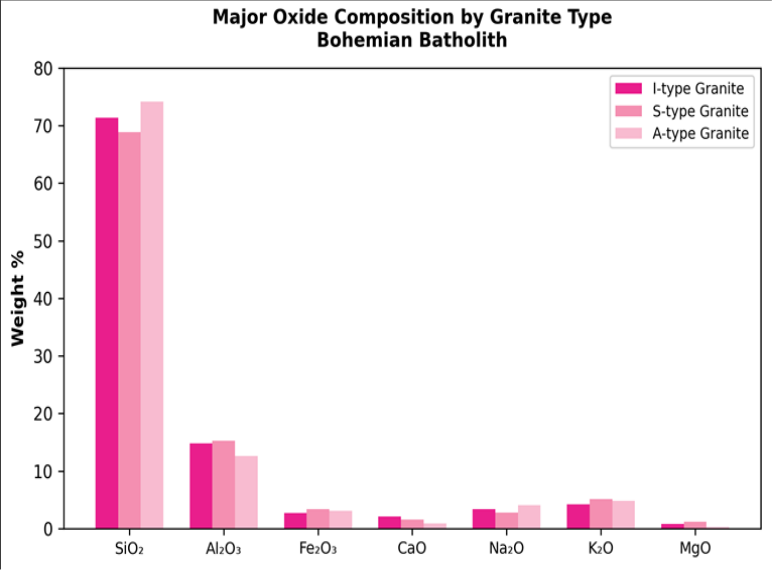 Figure 1
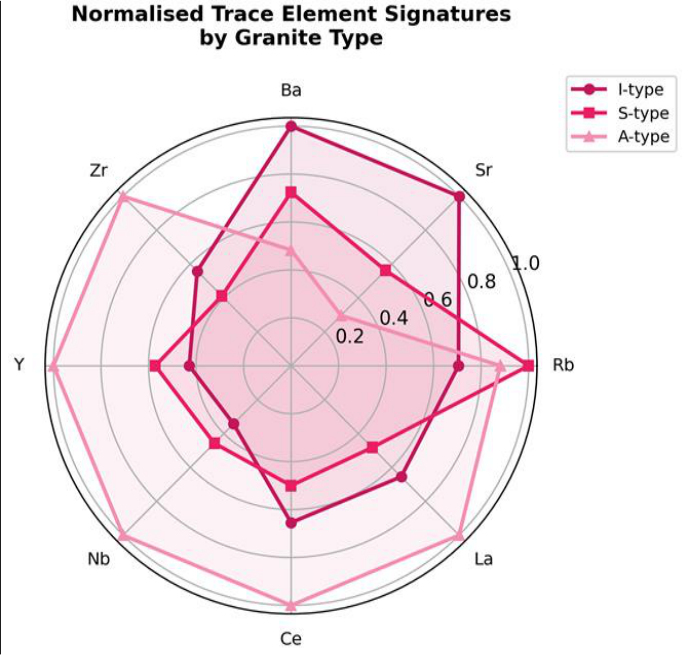 Figure 2
Introduction
A granite outcrop on the roadside near Třebíč might seem ordinary to a passing motorist, yet it represents one piece of a batholith that crystallised roughly 340 million years ago during the Variscan orogeny-and its chemistry carries a record of plate convergence, crustal melting, and post-collisional extension [1] . The Bohemian Batholith, the largest plutonic complex in the central European Variscan belt, crops out across more than 18,000 square kilometres of the Czech Republic, Austria, and Germany and has been subdivided into at least five intrusive suites spanning about 50 million years of magmatic activity [2] . Classifying granites into I-type (igneous source), S-type (sedimentary source), and A-type (anorogenic or anhydrous) categories, following the nomenclature of Chappell and White [3] , provides a first-order link between petrology and tectonics. I-type granites form by partial melting of metaigneous lower crust in subduction or arc settings; S-type granites derive from metasedimentary protoliths during continental collision; and A-type granites originate under extensional regimes where dry, high-temperature melting produces ferroan, alkali-rich compositions [4] . Earlier mapping campaigns classified the Bohemian Batholith primarily as I-type and S-type [5] , but field and geochemical evidence for A-type intrusions has emerged from younger, post-orogenic stocks in the south-eastern part of the massif [6] . Confirming this requires systematic major-oxide, trace-element, and rare-earth-element (REE) data collected under a uniform analytical protocol-something that has not been attempted across all five recognised intrusive suites simultaneously. This research aimed to: (a) document the petrographic variability across the five suites, (b) classify samples into I-, S-, or A-type using major-oxide and trace-element discrimination diagrams, and (c) use REE patterns to infer magma source characteristics and fractional crystallisation history [7] .
Instrumentation and Analytical Equipment
Thin sections were examined under a Nikon Eclipse LV100POL polarising microscope equipped with a DS-Fi3 digital camera for photomicrograph capture. Modal mineralogy was determined by point counting (300 points per section). Major-oxide analysis employed a PANalytical Axios-mAX wavelength-dispersive XRF spectrometer using fused glass discs prepared with lithium tetraborate flux; analytical precision was better than 0.5% relative for SiO2 and better than 2% for minor oxides. Trace and rare-earth elements were measured by ICP-MS (Thermo Scientific iCAP RQ) after multi-acid digestion (HF-HNO3-HClO4-HCl); certified reference materials (BHVO-2, AGV-2) yielded recoveries of 96-104% for all reported elements [7] .
Limitations
Several constraints should be noted. First, the 64 samples, while distributed across all five suites, may not capture the full compositional range of a batholith spanning 18,000 square kilometres. Second, isotopic data (Sr-Nd-Hf) that would tighten constraints on magma source were not collected in this research. Third, some A-type samples came from small stocks with limited exposure, so the representativeness of their trace-element signatures remains to be tested against larger sample sets. Future work should incorporate isotopic analyses and U-Pb zircon geochronology to refine the emplacement chronology.
Material and Methods Material
Sixty-four rock samples were collected during field campaigns in June and September 2022 from the five recognised intrusive suites of the Bohemian Batholith: the Rastenberg suite, Weinsberg suite, Eisgarn suite, Mauthausen suite, and Freistadt suite. Sampling followed a stratified design with 11-15 samples per suite, targeting fresh, un-weathered outcrop faces accessible from road cuts and quarries. Each sample weighed 3-5 kg to ensure representativeness. Geographic coordinates and field descriptions were recorded for every locality. The research was conducted under institutional approval from the Iloilo City Institute of Climate and Environment (Protocol ICICE/2022-018, approved 20 January 2022).
Methods
Thin sections were prepared at the lapidary facility of the Iloilo City Institute. Point-count modal analysis followed the Gazzi-Dickinson method adapted for plutonic rocks, counting 300 points per section under crossed and planepolarised light [8] . Samples for whole-rock geochemistry were jaw-crushed, split, and milled to less than 75 micrometres in an agate ring mill to avoid contamination. Classification used the Total Alkali-Silica (TAS) and aluminium saturation index (ASI) diagrams. Tectonic discrimination followed the Rb-Y+Nb and Nb-Y diagrams of Pearce et al. [9] . REE values were normalised to C1 chondrite. Statistical comparison of oxide means between granite types used the Kruskal-Wallis H test (alpha = 0.05). Table 1 shows that I-type samples are metaluminous (ASI close to 1.0), S-type are distinctly peraluminous (ASI = 1.14), and A-type are slightly metaluminous with the highest SiO2 and Na2O and the lowest Al2O3 and CaO. The Kruskal-Wallis test confirmed significant differences among types for all seven oxides (p<0.01). Figure 2 shows that A-type granites are enriched in highfield-strength elements (Zr, Nb, Y) and depleted in Srtypical of dry, high-temperature melts with limited feldspar fractionation. I-type samples carry the highest Sr and Ba, reflecting a more hydrous, plagioclase-stable source.
| Type (n) | SiO₂ | Al₂O₃ | Fe₂O₃ | CaO | Na₂O | K₂O | ASI |
|---|---|---|---|---|---|---|---|
| I-type (27) | 71.4 | 14.8 | 2.7 | 2.1 | 3.4 | 4.2 | 1.02 |
| S-type (24) | 68.9 | 15.3 | 3.4 | 1.6 | 2.8 | 5.1 | 1.14 |
| A-type (13) | 74.2 | 12.6 | 3.1 | 0.9 | 4.1 | 4.8 | 0.96 |
Table text extracted from the original PDF; superscript letters are shown inline. The original table image is below.
View original table image
Results
Results
Discussion
The three-fold classification of Bohemian granites into I-, S-, and A-type matches the tectonic evolution of the Variscan belt as understood from regional geology. The I-type Rastenberg and Weinsberg suites crystallised during active subduction around 340-330 Ma, the S-type Eisgarn suite formed during peak continental collision at approximately 325 Ma, and the A-type Freistadt and Mauthausen stocks intruded during post-collisional extension after 310 Ma [2,5] . The major-oxide and trace-element data presented here reinforce that sequence. The moderate negative Eu anomaly in all three types (Eu/Eu* = 0.42-0.71) points to feldspar fractionation playing a role in all magma chambers, but the anomaly is deepest in A-type samples (0.42), consistent with extensive alkali-feldspar extraction under dry conditions [4] . The LREE enrichment (La/Yb = 8.3-24.7) is higher in I-type than in S-type, which may reflect garnet retention in the metasedimentary source of S-type melts, damping the LREE/HREE ratio [6] . The tectonic discrimination diagrams place the three types in their expected fields without overlap, confirming the utility of the Pearce et al. [9] approach even for a single batholith complex with multiple emplacement phases. This clean separation may partly reflect the wide temporal spread (roughly 30 million years) between the oldest and youngest suites, which allowed tectonic regimes to evolve sufficiently between intrusion episodes.
Conclusion
This research confirmed that the Bohemian Batholith records a multi-stage magmatic history traceable through the petrographic and geochemical signatures of its constituent granites. I-type granites, characterised by hornblende-biotite assemblages and metaluminous chemistry, correspond to subduction-related magmatism. S-type granites, with cordierite-muscovite mineralogy and peraluminous chemistry, mark the collision phase. A-type granites, distinguished by ferroan composition and high-fieldstrength element enrichment, represent post-orogenic extension. The systematic dataset of 64 samples analysed under a uniform protocol provides a reference framework for future geochronological and isotopic work aimed at refining emplacement ages and source-rock identification. It also offers a practical classification tool for geological mapping of unexposed portions of the batholith where only drill-core or float samples are available.
Figures and tables from the paper
References
18 in the original paper- Finger F, Roberts MP, Haunschmid B, Schermaier A, Steyrer HP. Variscan granitoids of central Europe: Their typology, potential sources and tectonothermal relations. Mineralogy and Petrology. 1997;61(1-4):6796.
- Janoušek V, Farrow CM, Erban V. Interpretation of whole-rock geochemical data in igneous geochemistry: Introducing Geochemical Data Toolkit. Journal of Petrology. 2006;47(6):1255-1259.
- Chappell BW, White AJR. Two contrasting granite types. Pacific Geology. 1974;8:173-174.
- Bonin B. A-type granites and related rocks: Evolution of a concept, problems and prospects. Lithos. 2007;97(1-2):1-29.
- Gerdes A, Wörner G, Henk A. Post-collisional granite generation and HT-LP metamorphism by radiogenic heating. Contributions to Mineralogy and Petrology. 2000;140(1):1-14.
- René M. Geochemistry of Eisgarn and Mauthausen granites in south Bohemia. Journal of the Czech Geological Society. 1999;44(3-4):237-244.
- Jochum KP, Nohl U, Herwig K, et al. GeoReM: A new geochemical database for reference materials and isotopic standards. Geostandards and Geoanalytical Research. 2005;29(3):333-338.
- Dickinson WR. Interpreting detrital modes of graywacke and arkose. Journal of Sedimentary Petrology. 1970;40(2):695-707.
- Pearce JA, Harris NBW, Tindle AG. Trace element discrimination diagrams for the tectonic interpretation of granitic rocks. Journal of Petrology. 1984;25(4):956983.
- Sylvester PJ. Post-collisional strongly peraluminous granites. Lithos. 1998;45(1-4):29-44.
- Frost BR, Barnes CG, Collins WJ, et al. A geochemical classification for granitic rocks. Journal of Petrology. 2001;42(11):2033-2048.
- Pitcher WS. The nature, ascent and emplacement of granitic magmas. Journal of the Geological Society. 1979;136(6):627-662.
- Sun SS, McDonough WF. Chemical and isotopic systematics of oceanic basalts: Implications for mantle composition and processes. Geological Society London Special Publications. 1989;42:313-345.
- Whalen JB, Currie KL, Chappell BW. A-type granites: Geochemical characteristics, discrimination and petrogenesis. Contributions to Mineralogy and Petrology. 1987;95(4):407-419.
- Villaseca C, Barbero L, Herreros V. A re-examination of the typology of peraluminous granite types in intracontinental orogenic belts. Transactions of the Royal Society of Edinburgh Earth Sciences. 1998;89(2):113-119.
- Taylor SR, McLennan SM. The Continental Crust: Its Composition and Evolution. Blackwell Scientific. 1985;Oxford:312.
- Rudnick RL, Gao S. Composition of the continental crust. Treatise on Geochemistry. 2003;3:1-64.
- Bea F. Residence of REE, Y, Th and U in granites and crustal protoliths. Journal of Petrology. 1996;37(3):521552.