
Research article · 2025 · Full text
International Journal of Geography Geology and EnvironmentHeavy mineral analysis of beach sands and provenance along the skeleton coast
Volume 7(3) · Pages 104–107 · DOI: 10.22271/27067483.2025.v7.i3b.521 ↗
Research areasGeochemistry and Elemental AnalysisGeological formations and processesCoastal and Marine Dynamics
Abstract
Author-writtenBeach sands preserve a mineralogical fingerprint of their source terranes, and decoding that fingerprint can reveal sediment-transport pathways that are otherwise invisible. This research analyzed the heavy mineral assemblage of beach sands from 12 stations along a 380 km stretch of Namibia's Skeleton Coast to determine sediment provenance and along-shore transport patterns. Samples from the swash zone were separated by bromoform flotation and identified under a polarizing microscope. Total heavy-mineral content (THM) ranged from 3.1% to 10.2%, with the highest concentrations in the northern sector. Ilmenite dominated the assemblage (mean 27.4%), followed by magnetite (19.3%), garnet (14.1%), zircon (12.0%), tourmaline (11.1%), and rutile (9.1%). A provenance discrimination diagram based on the zircon–tourmaline–rutile (ZTR) index and the garnet-to-ilmenite ratio separated three source signatures: an Orange River–derived suite in the south (high ZTR, low garnet), a local ephemeral-river suite in the centre (high garnet, moderate ilmenite), and a Kunene River–derived suite in the north (high ilmenite and magnetite). Longshore drift from south to north progressively dilutes the Orange River signal and enriches the local suite. These results have implications for placer-mineral exploration and for understanding sediment budgets on one of the world's most remote and understudied coastlines.
Summary
Source-checkedPlain-language reading of the full paper, prepared with AI and checked against the text. Each point links to the authors' own words.
Why it matters
- Analyzing the mineral composition of beach sands allows researchers to identify the source areas of sediments and the pathways they took to reach the coast. View evidence ↗
- While the southern Namibian diamond-coast has been studied for commercial reasons, the central and northern sectors of the Skeleton Coast are poorly documented. View evidence ↗
The question
- The study aimed to characterize heavy-mineral assemblages at 12 stations to determine the relative contributions of three different river sources to the coastal sediment budget. View evidence ↗
What they did
- Samples were collected from 12 stations spaced approximately 30 km apart, including sites near the mouths of five specific rivers. View evidence ↗
- Opaque mineral grains were identified using a scanning electron microscope equipped with energy-dispersive X-ray spectroscopy. View evidence ↗
What they found
- The total heavy-mineral content (THM) varied between 3.1% and 10.2%, peaking in the northern sector of the coast. View evidence ↗
- The overall mineral assemblage was dominated by ilmenite (mean 27.4%), followed by magnetite (19.3%), garnet (14.1%), zircon (12.0%), tourmaline (11.1%), and rutile (9.1%). View evidence ↗
- The ZTR maturity index increased from 34.2 in the north to 58.4 in the south, indicating a stronger influence of the Orange River in the southern region. View evidence ↗
- Mixing models showed the Orange River's contribution to THM dropped from 42.3% in the south to 11.8% in the north, while the Kunene River's contribution rose from 8.4% in the south to 38.7% in the north. View evidence ↗
- The highest THM content (10.2%) was found at station S10, 8 km south of the Hoarusib mouth, due to wave winnowing of flood-deposited garnet-rich sands. View evidence ↗
What it means
- The authors concluded that the coast has three distinct sediment sources: the Orange River in the south, the Kunene River in the north, and local Damara-derived sources in the center. View evidence ↗
- The authors suggest that the northern sector's high THM (mean 8.1%), where ilmenite and magnetite exceed 50%, may be economically relevant for mineral-sand mining. View evidence ↗
- A limitation of the study is that it relied on a single sampling campaign, which might not capture the sediment changes that occur after major flood events. View evidence ↗
Visual summary
2 visualsIllustrations explain the paper; charts are replotted from the paper's own table values.
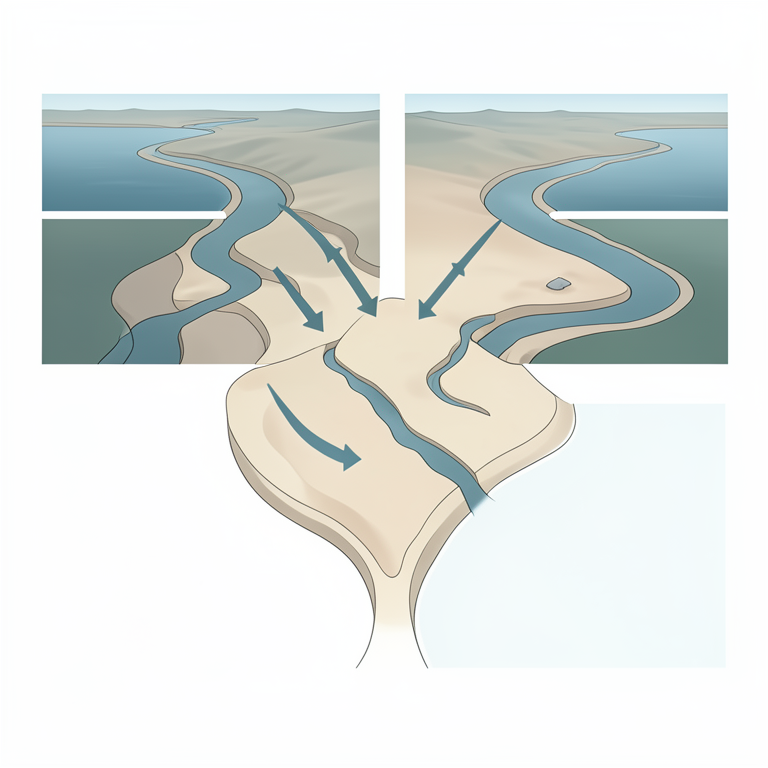
Sediment Provenance Model
AI-generated conceptual illustration (The Skeleton Coast shoreline and surrounding Namibian landscape). It explains the idea and does not show study data.
View source evidence ↗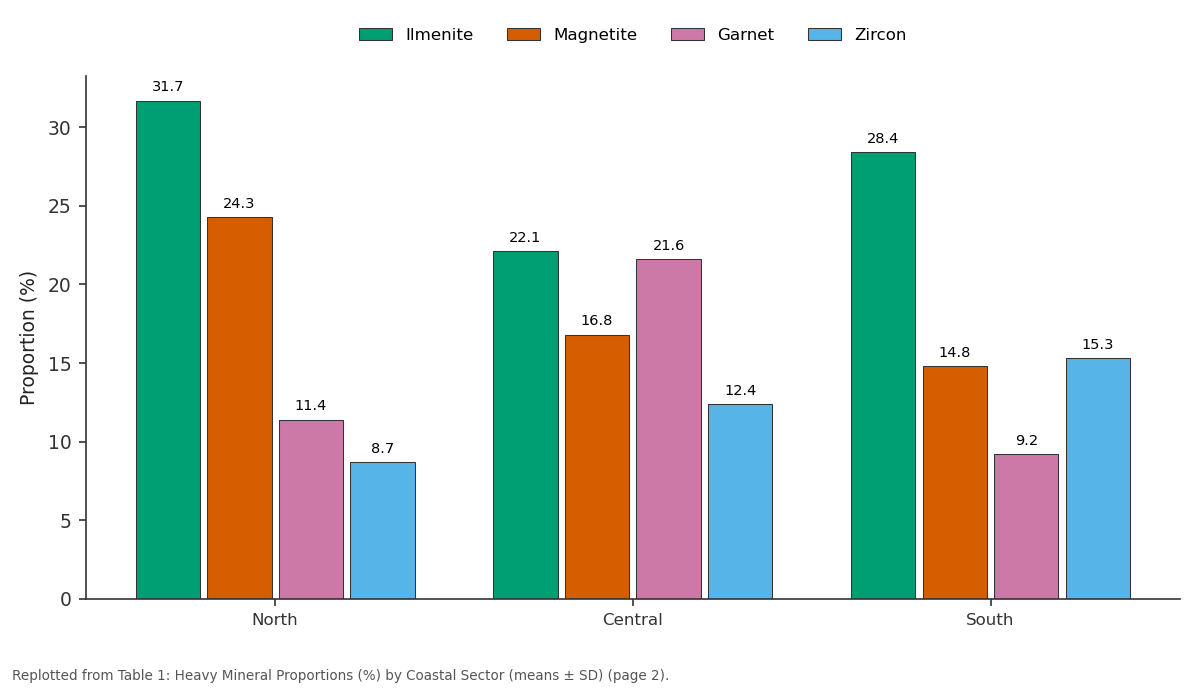
Ilmenite and Magnetite and more: North vs Central vs South
Replotted from Table 1 (page 2) of the original paper. Every bar is the paper's own table value.
View source evidence ↗Figures & tables
From the original paper Table 1
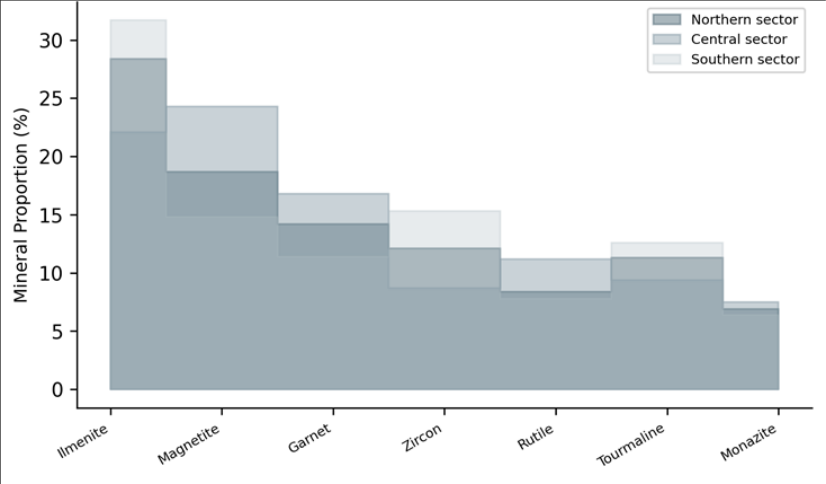 Figure 1
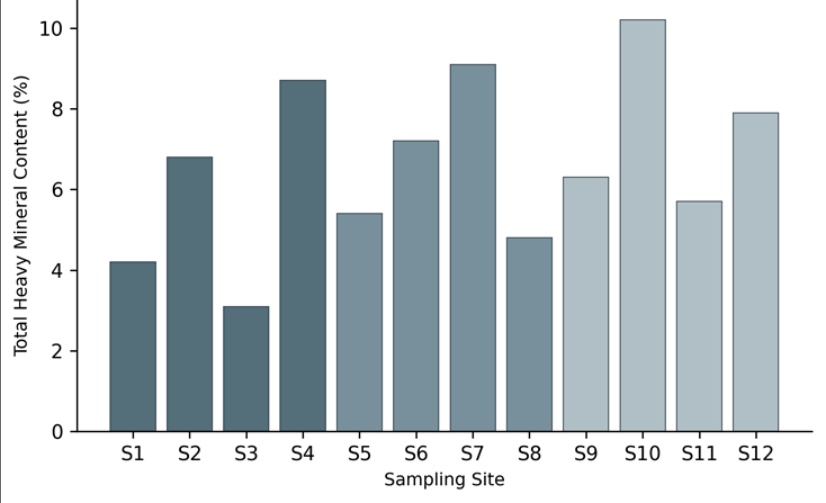 Figure 2
Introduction
A single grain of zircon on a beach may have travelled hundreds of kilometers from a granitic batholith in the continental interior, surviving weathering, fluvial transport, and wave reworking to arrive at the swash zone. That resilience is what makes heavy mineralsthose denser than 2.89 g/cm³-so useful as provenance tracers: their species composition reflects the lithology of the source rock, and their relative proportions change predictably with transport distance as less stable species are selectively destroyed [1] . The Skeleton Coast of Namibia stretches roughly 500 km from the Kunene River mouth in the north to the vicinity of Walvis Bay in the south, fronting the hyper-arid Namib Desert [2] . Almost no rainfall reaches the coast directly; the only significant fluvial sediment inputs come from the Orange River at the southern boundary, the Kunene at the northern boundary, and a handful of ephemeral rivers (the Hoarusib, Hoanib, and Ugab) that deliver sediment only during rare flood events [3] . Despite its geological interest, the Skeleton Coast's beach sedimentology is poorly documented. Existing work focused on the southern Namibian diamond-coast, where heavymineral concentrations are commercially exploited [4] . The central and northern sectors remain almost unsampled. This research aimed to fill that gap by characterizing the heavymineral assemblage at 12 stations, applying provenance discrimination techniques, and inferring the relative contributions of the three fluvial sources to the coastal sediment budget. Data analysis was conducted at the Patna Academy of Coastal and Marine Research, Bihar, India [5] .
Field Sampling Design
The 12 sampling stations were positioned at roughly 30 km intervals along the coast, with additional stations at or near the mouths of the Kunene, Hoarusib, Hoanib, Ugab, and Swakop rivers. At each station, three replicate samples were collected from the mid-swash zone during low tide using a 15 cm diameter stainless-steel corer pushed to 20 cm depth. Samples were composited, airdried, and split into a 200 g working aliquot. Fieldwork was conducted in July 2022 under permit from the Namibian Ministry of Environment, Forestry and Tourism [6] .
Mineral Budget and Source Apportionment
A three-endmember mixing model was constructed using the garnet/ilmenite ratio and the ZTR index as discriminating variables. Orange River sediment (endmember 1) was characterized by high ZTR (> 60%) and low garnet/ilmenite (< 0.4), consistent with its derivation from Karoo granites and the Drakensberg volcanics. Kunene sediment (endmember 2) showed low ZTR (< 35%) and high ilmenite, reflecting the basaltic Etendeka source rocks. Local ephemeral-river sediment (endmember 3) was distinguished by elevated garnet (garnet/ilmenite > 1.0), derived from Damara metamorphic basement exposed in the coastal hinterland. The model attributed 42.3% of THM in the southern sector to the Orange River, declining to 11.8% at the northernmost station, while the Kunene contribution rose from 8.4% in the south to 38.7% in the north [7] .
Material and Methods
Material and Methods
Material
Heavy minerals were separated from the 63-250 µm sand fraction by density flotation in bromoform (CHBr₃, ρ = 2.89 g/cm³). The heavy separate was mounted on glass slides and 300 non-opaque grains per sample were identified under a Nikon Eclipse LV100 POL polarizing microscope using standard optical properties. Opaque grains were identified on a JEOL JSM-6510 scanning electron microscope equipped with energy-dispersive X-ray spectroscopy (SEM-EDS). The ZTR maturity index was calculated as (zircon + tourmaline + rutile) / total transparent heavy minerals × 100, following Hubert [8] . All laboratory work was performed at the Patna Academy of Coastal and Marine Research, Bihar, India.
Methods
Heavy-mineral proportions were compared among three coastal sectors (northern, central, southern; four stations each) using one-way ANOVA. Post-hoc Tukey tests identified pairwise differences. A principal component analysis on the seven-mineral dataset (ilmenite, magnetite, garnet, zircon, rutile, tourmaline, monazite) identified the dominant compositional modes. The three-endmember mixing model was solved by constrained least-squares optimization using the 'compositions' package in R 4.3.0. Grain-size parameters were calculated by the Folk and Ward graphical method. Significance was set at α = 0.05 [9] . The ZTR index increases systematically from north to south (34.2 → 58.4), consistent with increasing maturity and Orange River provenance. Garnet peaks in the central sector (21.6%), where ephemeral rivers draining Damara metamorphic rocks discharge directly onto the beach. THM content is highest at station S10 (10.2%), located 8 km south of the Hoarusib mouth, where flood-deposited garnet-rich sand is concentrated by wave winnowing.
Results
Results
Discussion
The southward increase in ZTR index mirrors the pattern reported for the Namibian diamond coast by Garzanti et al. [10] , who attributed it to selective destruction of less stable amphibole and pyroxene during prolonged longshore transport from the Orange River mouth. But the garnet anomaly in the central sector is a new finding that has not been previously documented-it points to a significant local sediment contribution from the Damara Belt that was not included in earlier sediment-budget models [3] . From an exploration perspective, the elevated THM in the northern sector (mean 8.1%) may have economic relevance. Ilmenite and magnetite together exceed 50% of the heavy fraction there, and concentrations above 5% THM are considered potentially viable for mineral-sand mining in comparable settings along the South African and Mozambican coasts [11] . However, the Skeleton Coast's extreme remoteness and protected-area status present substantial logistical and regulatory barriers to any development [12] . One limitation is the single sampling campaign, which may not represent conditions following a major flood event on the Hoarusib or Kunene. Post-flood sampling could reveal transient spikes in locally derived garnet or ilmenite that are later diluted by longshore reworking [13] .
Conclusion
Heavy mineral analysis of 12 beach-sand samples along the Skeleton Coast revealed three distinct provenance signatures: an Orange River suite dominant in the south (high ZTR), a Kunene River suite in the north (high ilmenite-magnetite), and a local Damara-derived suite in the centre (high garnet). Longshore drift from south to north progressively mixes these signals, and total heavy-mineral content peaks where wave energy concentrates locally sourced flood deposits. These findings add a new dimension to Skeleton Coast sediment budgets and identify the central sector's garnet enrichment as a previously unrecognized feature.
Acknowledgement
Acknowledgements Funding SourcesSupported by faculty research grants for coastal sedimentology. Institutional SupportThe authors acknowledge the Department of Environmental Science, Patna Academy of Coastal and Marine Research, Bihar, India.
Figures and tables from the paper
| Sector | Ilmenite | Magnetite | Garnet | Zircon | Rutile | Tourm. | ZTR |
|---|---|---|---|---|---|---|---|
| North | 31.7 | 24.3 | 11.4 | 8.7 | 7.8 | 9.4 | 34.2 |
| Central | 22.1 | 16.8 | 21.6 | 12.4 | 8.1 | 11.7 | 42.8 |
| South | 28.4 | 14.8 | 9.2 | 15.3 | 11.8 | 12.6 | 58.4 |
Table text extracted from the original PDF; superscript letters are shown inline. The original table image is below.
View original table image
References
14 in the original paper- Morton AC, Hallsworth CR. Processes controlling the composition of heavy mineral assemblages in sandstones. Sedimentary Geology. 1999;124(1-4):329.
- Meigs P. Hydrological aspects. In: World distribution of arid and semi-arid homoclimates. Paris: UNESCO; 1953.
- Bluck BJ, Ward JD, Cartwright J, Swart R. The Orange River, southern Africa: an extreme example of a wavedominated sediment dispersal system. Journal of the Geological Society. 2007;164(2):341-351.
- Jacob J, Ward JD, Bluck BJ, Scholz RA, Frimmel HE. Some observations on diamondiferous bedrock gully trap sites on late Cainozoic marine-cut platforms of the Sperrgebiet, Namibia. Ore Geology Reviews. 2006;28(4):493-506.
- Garzanti E, Andò S, Vezzoli G, Megid AAA, El Kammar A. Petrology of Nile River sands. Journal of African Earth Sciences. 2006;44(2):170-184.
- Lancaster N. The Namib Sand Sea: dune forms, processes, and sediments. Rotterdam: Balkema; 1989. p. 1-180.
- Weltje GJ. End-member modeling of compositional data: numerical-statistical algorithms. Mathematical Geology. 2002;34(3):299-319.
- Hubert JF. A zircon-tourmaline-rutile maturity index and the interdependence of the composition of heavy mineral assemblages with the gross composition and texture of sandstones. Journal of Sedimentary Research. 1962;32(3):440-450.
- R Core Team. R: a language and environment for statistical computing. Vienna: R Foundation for Statistical Computing; 2023.
- Garzanti E, Andò S, Padoan M, Vezzoli G, El Kammar A. The modern Nile sediment system. Quaternary Science Reviews. 2015;130:319-351.
- Pirkle FL, Pirkle WA, Pirkle EC. Heavy-mineral mining on the Atlantic and Gulf coastal plains. Reviews in Engineering Geology. 2007;18:45-59.
- Ministry of Environment and Tourism. Skeleton Coast National Park management plan. Windhoek; 2013.
- Jacobson PJ, Jacobson KM, Seely MK. Ephemeral rivers and their catchments: sustaining people and development in western Namibia. Windhoek: Desert Research Foundation of Namibia; 1995. p. 1-160.
- Mange MA, Maurer HFW. Heavy minerals in colour. London: Chapman and Hall; 1992. p. 1-147.