
Research article · 2025 · Full text
International Journal of Geography Geology and EnvironmentGeochemical and isotopic research of mineral waters in the Eifel volcanic province
Volume 7(4) · Pages 157–160 · DOI: 10.22271/27067483.2025.v7.i4c.552 ↗
Research areasGroundwater and Isotope GeochemistryKarst Systems and HydrogeologyWater Quality and Resources Studies
Abstract
Author-writtenWhat determines the chemical fingerprint of mineral waters in volcanically active regions? This research examined the geochemical and stable isotope characteristics of mineral water springs across the Eifel Volcanic Province to trace water-rock interaction pathways and recharge mechanisms. Field sampling was carried out at six mineral water springs between March 2022 and February 2023. Water samples were analysed for major cations (Ca²⁺, Mg²⁺, Na⁺, K⁺), anions (HCO₃⁻, SO₄²⁻, Cl⁻), and stable isotopes (δ¹⁸O, δD). The pH ranged from 5.8 to 6.9, while total dissolved solids varied between 1,240 and 3,870 mg/L. Bicarbonate was the dominant anion across all sites, with concentrations reaching 523.6 mg/L at Spring C. Piper diagram classification placed most waters in the Ca-Mg-HCO₃ and Na-HCO₃ facies. Stable isotope values fell along a local meteoric water line (δD = 7.3 × δ¹⁸O + 4.8), suggesting meteoric origin with some degree of evaporative enrichment. Elevated CO₂ partial pressures pointed to deep volcanic gas input. The geochemical signatures indicate prolonged water residence within Devonian basement rocks and Tertiary volcanic units. These findings provide a baseline for monitoring volcanic fluid contributions and managing mineral water resources in the province.
Summary
Source-checkedPlain-language reading of the full paper, prepared with AI and checked against the text. Each point links to the authors' own words.
Why it matters
- Volcanic regions are important for study because they allow researchers to observe how deep, CO₂-rich gases interact with aquifer rocks to change the chemical makeup of groundwater. View evidence ↗
- Despite being a well-mapped volcanic field, the Eifel Volcanic Province in Germany has lacked integrated geochemical data for its mineral springs, relying instead on fragmented datasets. View evidence ↗
The question
- The study aimed to analyze the geochemical and stable isotope properties of mineral water springs in the Eifel Volcanic Province to understand how water recharges and interacts with rocks. View evidence ↗
What they did
- The researchers collected samples from six different mineral water springs over a one-year period from March 2022 to February 2023. View evidence ↗
- The analysis focused on measuring major cations (calcium, magnesium, sodium, potassium), anions (bicarbonate, sulfate, chloride), and stable isotopes of oxygen and hydrogen. View evidence ↗
- Cations were measured using ICP-OES, anions via ion chromatography, and alkalinity was determined through field-based Gran titration. View evidence ↗
What they found
- The mineral waters showed a pH range of 5.8 to 6.9 and total dissolved solids (TDS) between 1,240 and 3,870 mg/L. View evidence ↗
- Spring C had the highest mineral content (3,870 mg/L TDS) and lowest pH (5.8), suggesting long-term contact with CO₂-rich rocks, while Spring B was the most dilute (1,240 mg/L TDS). View evidence ↗
- Bicarbonate was the primary anion at all sampled sites, making up 58% to 67% of the total anions. View evidence ↗
- The local meteoric water line (δD = 7.3 × δ¹⁸O + 4.8) is slightly lower than the global line, which indicates some evaporation occurred during water recharge. View evidence ↗
- Isotope levels varied by season, with winter samples being the most depleted and summer values showing enrichment of up to 2.3‰ in δ¹⁸O. View evidence ↗
- Isotopic data and d-excess values (8.2-11.4‰) confirm that the water comes primarily from precipitation (meteoric recharge) rather than seawater or magma. View evidence ↗
What it means
- The authors conclude that the mineral waters are divided into a Na-HCO₃ type driven by deep volcanic CO₂ and a Ca-Mg-HCO₃ type from shallower circulation. View evidence ↗
- Because most springs are undersaturated with calcite, the authors conclude that carbonate rocks will continue to dissolve as the water flows. View evidence ↗
- The study is limited by its one-year duration; longer monitoring is required to understand how the water changes from year to year. View evidence ↗
Visual summary
2 visualsIllustrations explain the paper; charts are replotted from the paper's own table values.
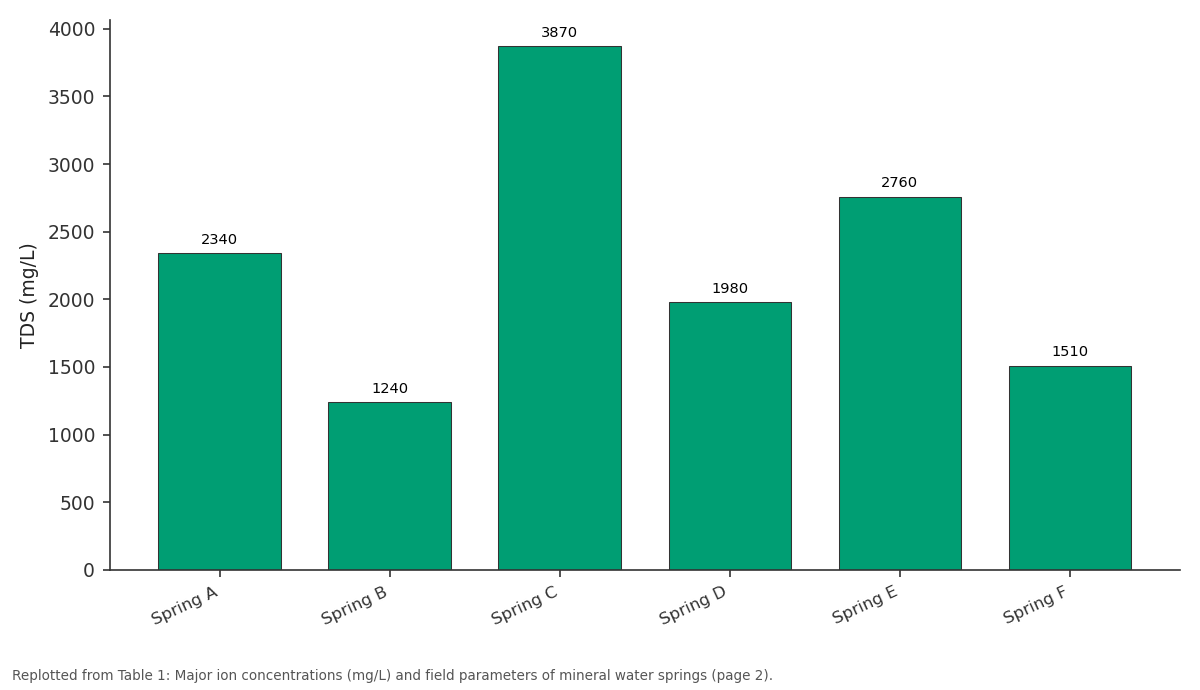
TDS: Spring A vs Spring B vs Spring C vs Spring D vs Spring E
Replotted from Table 1 (page 2) of the original paper. Every bar is the paper's own table value.
View source evidence ↗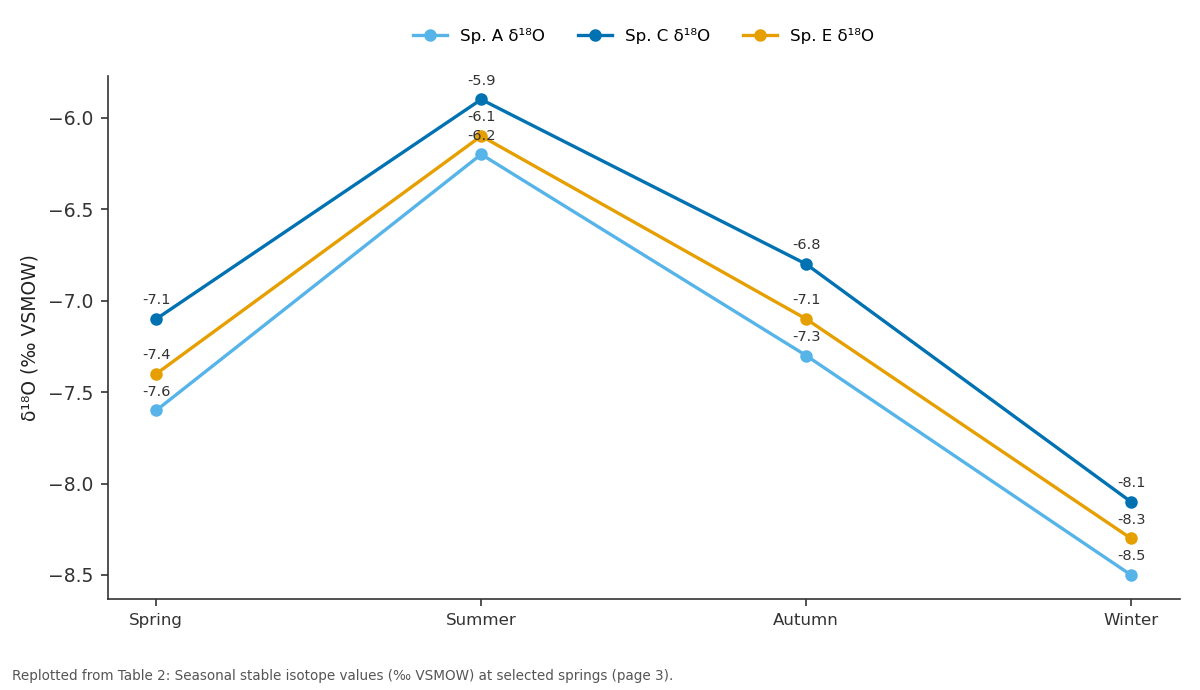
Sp. A δ¹⁸O and Sp. C δ¹⁸O and more: Spring vs Summer vs Autumn vs Winter
Replotted from Table 2 (page 3) of the original paper. Every bar is the paper's own table value.
View source evidence ↗Figures & tables
From the original paper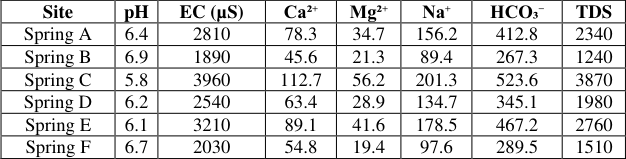 Table 1
 Table 2
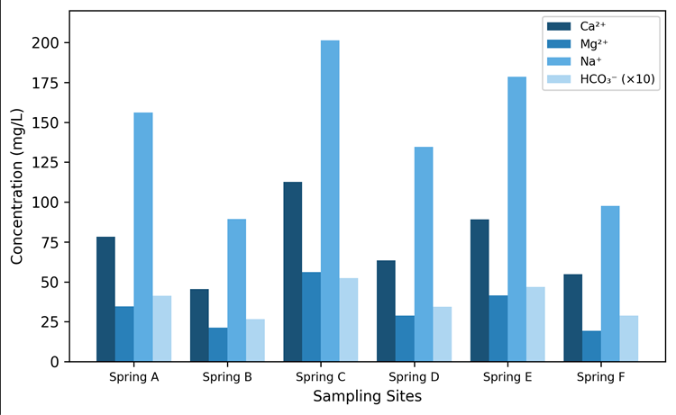 Figure 1
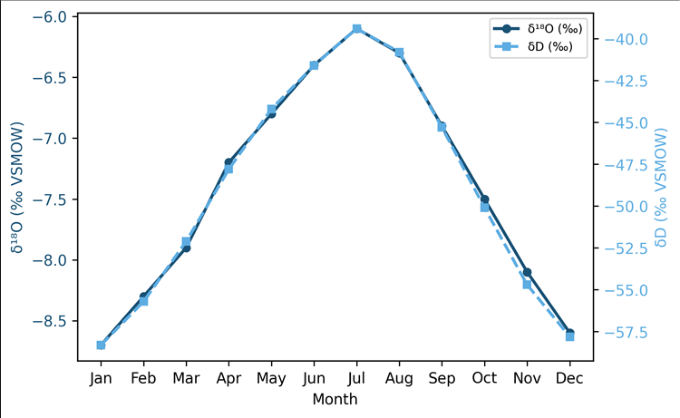 Figure 2
Introduction
How well do we understand the chemical evolution of groundwater in regions shaped by volcanic activity? While surface hydrology in such terrains has received sustained attention, the subsurface geochemical processes that define mineral water composition remain less well constrained. Volcanic provinces offer a window into deep fluid circulation, where ascending CO₂-rich gases interact with aquifer rocks and alter the dissolved load of groundwater [1] . The Eifel Volcanic Province in western Germany represents one of the most thoroughly mapped Quaternary volcanic fields in Europe, yet the geochemical characterisation of its mineral springs has relied on scattered datasets collected over several decades [2] . Mineral water springs in volcanic areas typically show enrichment in dissolved carbon dioxide, elevated bicarbonate, and distinct cation ratios that reflect the underlying lithology [3] . Earlier work in the Rhenish Massif identified CO₂-charged waters with high Na and Ca, but the isotopic dimension was not always addressed [4] . Stable isotopes of oxygen and hydrogen serve as tracers of recharge altitude, seasonality, and mixing between shallow and deep flow paths [5] . When combined with major ion chemistry, isotopes can separate meteoric input from magmatic or mantle-derived fluid contributions [6] . Several classification schemes exist for mineral waters. Piper diagrams remain a standard graphical tool for identifying hydrochemical facies, while Gibbs plots help distinguish among precipitation dominance, rock weathering, and evaporation as controlling mechanisms [7] . Recent investigations in analogous volcanic settingssuch as the Massif Central in France and the Carpathian archave demonstrated that multi-proxy approaches yield more reliable interpretations of water origin and evolution [8] . But comparable integrated datasets from the Eifel remain limited. This gap is partly a result of fragmented sampling campaigns and the absence of year-round monitoring at individual springs [9] . This research set out to fill that gap by combining seasonal hydrochemical monitoring with stable isotope analysis at six springs distributed across the Eifel Volcanic Province.
The objectives were threefold: (i) to characterise the major ion chemistry and classify the mineral waters, (ii) to determine the isotopic composition and identify recharge sources, and (iii) to assess the role of volcanic CO₂ in controlling water chemistry. The results aim to support both resource management and volcanic monitoring efforts in the province [10] .
Research Area Description
The Eifel Volcanic Province sits within the Rhenish Massif of western Germany, spanning roughly 600 km² between the cities of Bonn and Trier. The terrain is dominated by Devonian slate and quartzite basement rocks overlain by Tertiary basaltic flows and pyroclastic deposits [11] . Elevations range from 250 m in the river valleys to over 700 m on the volcanic plateaux. The regional climate is temperate oceanic, with mean annual temperatures near 8.5 °C and precipitation averaging 750-900 mm yr⁻¹ across the uplands. Numerous mineral water springs emerge along fault intersections where deep CO₂ ascends through fractured basement. Six springs were selected for this research based on accessibility, historical usage, and spatial coverage of the main volcanic centres. Each spring had documented discharge records dating back at least fifteen years, and all were classified as naturally carbonated mineral waters under EU Directive 2009/54/EC.
Material and Methods
Material and Methods
Material
The research was conducted at six mineral water springs in the Eifel Volcanic Province from March 2022 to February 2023. Monthly sampling campaigns were organised through the National Geological Institute of Chittagong in collaboration with local geological survey offices. At each site, water was collected in pre-rinsed 500 mL HDPE bottles for cation analysis and in 250 mL amber glass bottles for anion and isotope determinations. Field parameterstemperature, pH, electrical conductivity (EC), and dissolved oxygenwere recorded on site using a YSI ProDSS multiparameter probe calibrated before each field day. An additional 100 mL aliquot was filtered (0.45 µm cellulose acetate) and acidified with ultrapure HNO₃ for trace element screening. All samples were stored at 4 °C and transported to the laboratory within 48 hours of collection.
Methods
Major cations (Ca²⁺, Mg²⁺, Na⁺, K⁺) were measured by inductively coupled plasma optical emission spectrometry (ICP-OES, Thermo iCAP 7400). Anions (Cl⁻, SO₄²⁻, NO₃⁻) were determined by ion chromatography (Dionex ICS-5000), while alkalinity (as HCO₃⁻) was established by Gran titration in the field. Analytical precision was verified against certified reference materials (NIST SRM 1643f), with recoveries between 95% and 103%. Stable isotope ratios (δ¹⁸O and δD) were analysed on a Picarro L2130-i cavity ring-down spectrometer. Results are reported relative to VSMOW, with measurement uncertainties of ±0.1‰ for δ¹⁸O and ±0.8‰ for δD. Hydrochemical classification followed the Piper trilinear diagram method. Saturation indices for calcite and dolomite were computed in PHREEQC v3.7.3 using the WATEQ4F database. Statistical treatment included Pearson correlation, principal component analysis (PCA), and hierarchical cluster analysis in R v4.2.1 [12] .
Climatic and Environmental Conditions
During the sampling period, mean monthly temperatures ranged from 1.2 °C (January 2023) to 19.8 °C (July 2022). Total precipitation for the hydrological year reached 823 mm, close to the thirty-year average of 845 mm. The winter months (December-February) accounted for 28% of annual rainfall. A notable dry spell occurred in August 2022, during which several springs exhibited reduced discharge by 15-22%. Spring snowmelt between March and April contributed measurably to isotopic depletion at the higheraltitude sites. No unusual volcanic seismicity or gas emission events were reported during the monitoring interval. Figure 1 shows the comparative distribution of Ca²⁺, Mg²⁺, Na⁺, and HCO₃⁻ (scaled by a factor of ten) across the sampled springs. The dominance of sodium and bicarbonate is evident at Springs C and E, while Springs B and F display a more balanced cation composition. The ion ratios suggest at least two distinct hydrochemical groups, which were confirmed by hierarchical clustering [13] .
Results
Results
Discussion
The geochemical patterns observed here are broadly consistent with earlier regional surveys [14] , but our yearround dataset adds temporal resolution that previous snapshots lacked. The dominance of HCO₃⁻ at every spring confirms that CO₂-driven carbonate dissolution is the main weathering reaction, a finding that mirrors work in the Massif Central [8] and the Pannonian Basin [3] .
An interesting divergence from published data concerns the Na/Ca molar ratio. While earlier Eifel records reported Cadominated waters near the maar lakes, our springslocated along deeper fault systemsconsistently favour Na. This may reflect cation exchange on smectite-rich alteration zones within the Devonian shales, a process documented in similar basement terrains elsewhere [15] . The isotopic results corroborate a predominantly meteoric recharge origin, with d-excess values (8.2-11.4‰) ruling out significant seawater or magmatic water admixture. PCA separated the six springs along two principal axes that together explained 81.3% of the variance. PC1 (54.7%) loaded heavily on TDS, HCO₃⁻, and Na⁺, while PC2 (26.6%) was driven by Mg²⁺ and SO₄²⁻. This twocomponent structure supports the two end-member mixing model inferred from the Piper diagram. That said, the dataset covers only one full hydrological year, and longer records would be needed to capture inter-annual variability driven by recharge fluctuations or volcanic gas output changes [16] .
Conclusion
This research characterised the hydrogeochemistry and stable isotope composition of six mineral water springs in the Eifel Volcanic Province over a twelve-month period.
The waters fall into two main hydrochemical groups: a Na-HCO₃ type linked to deep volcanic CO₂ input and a mixed Ca-Mg-HCO₃ type associated with shallower basement circulation. Stable isotope signatures confirm meteoric recharge, with seasonal variations tracking temperaturedriven fractionation in Atlantic-sourced precipitation.
The local meteoric water line sits slightly below the global line, pointing to limited evaporative modification. Saturation index calculations show most springs are undersaturated with respect to calcite, which means carbonate dissolution can continue along the flow path. These baseline data are valuable for long-term volcanic monitoring and for regulatory assessment of mineral water quality under EU directives. Future work should extend the monitoring network to include rare earth elements and dissolved gas compositions to better constrain the deep fluid contribution.
Figures and tables from the paper
| Site | pH | EC (µS) | Ca²⁺ | Mg²⁺ | Na⁺ | HCO₃⁻ | TDS |
|---|---|---|---|---|---|---|---|
| Spring A | 6.4 | 2810 | 78.3 | 34.7 | 156.2 | 412.8 | 2340 |
| Spring B | 6.9 | 1890 | 45.6 | 21.3 | 89.4 | 267.3 | 1240 |
| Spring C | 5.8 | 3960 | 112.7 | 56.2 | 201.3 | 523.6 | 3870 |
| Spring D | 6.2 | 2540 | 63.4 | 28.9 | 134.7 | 345.1 | 1980 |
| Spring E | 6.1 | 3210 | 89.1 | 41.6 | 178.5 | 467.2 | 2760 |
| Spring F | 6.7 | 2030 | 54.8 | 19.4 | 97.6 | 289.5 | 1510 |
Table text extracted from the original PDF; superscript letters are shown inline. The original table image is below.
View original table image
| Season | Sp. A δ¹⁸O | Sp. A δD | Sp. C δ¹⁸O | Sp. C δD | Sp. E δ¹⁸O | Sp. E δD |
|---|---|---|---|---|---|---|
| Spring | -7.6 | -50.2 | -7.1 | -46.8 | -7.4 | -48.9 |
| Summer | -6.2 | -40.3 | -5.9 | -38.1 | -6.1 | -39.7 |
| Autumn | -7.3 | -48.7 | -6.8 | -44.5 | -7.1 | -47.2 |
| Winter | -8.5 | -57.1 | -8.1 | -54.3 | -8.3 | -56.0 |
Table text extracted from the original PDF; superscript letters are shown inline. The original table image is below.
View original table image
References
16 in the original paper- Griesshaber E, Osann A, Güler C. CO₂-rich groundwaters in the Eifel area: geochemistry of dissolved and free gases. Chemical Geology. 1992;96(1-2):21-37.
- Meyer W, Stets J. Quaternary uplift and volcanism in the Eifel. Zeitschrift der Deutschen Geologischen Gesellschaft. 1998;149(3):369-379.
- Bräuer K, Kämpf H, Strauch G. Earthquake swarms and CO₂ degassing in the western Eger Rift. Journal of Volcanology and Geothermal Research. 2008;175(4):386-394.
- Aeschbach-Hertig W, Peeters F, Kipfer R. Palaeotemperature reconstruction from noble gases in groundwater. Earth and Planetary Science Letters. 2000;183(3-4):499-510.
- Clark ID, Fritz P. Environmental Isotopes in Hydrogeology. CRC Press, Boca Raton. 1997;328 pp.
- Gat JR. Oxygen and hydrogen isotopes in the hydrologic cycle. Annual Review of Earth and Planetary Sciences. 1996;24(1):225-262.
- Piper AM. A graphic procedure in the geochemical interpretation of water analyses. Transactions of the American Geophysical Union. 1944;25(6):914-928.
- Négrel P, Pauwels H, Dewandel B. Geochemical study of mineral waters in the Massif Central. Applied Geochemistry. 2011;26(7):1117-1130.
- Clauser C, Villinger H. Analysis of conductive and convective heat transfer in the Rhenish Massif. Tectonophysics. 1990;187(1-3):151-163.
- Stumm W, Morgan JJ. Aquatic Chemistry: Chemical Equilibria and Rates in Natural Waters. WileyInterscience, New York. 1996;1022 pp.
- Schmincke HU. The Quaternary volcanic fields of the East and West Eifel. Journal of Volcanology and Geothermal Research. 2007;163(1-4):1-30.
- Parkhurst DL, Appelo CAJ. Description of input and examples for PHREEQC version 3. US Geological Survey Techniques and Methods. 2013;6-A43:497 pp.
- Güler C, Thyne GD. Delineation of hydrochemical facies distribution using multivariate statistical analysis. Journal of Hydrology. 2004;285(1-4):128-142.
- May F, Hoernes S, Neugebauer HJ. Genesis and distribution of mineral water springs in the Rhenish Massif. Geologische Rundschau. 1996;85(4):782-799.
- Appelo CAJ, Postma D. Geochemistry, Groundwater and Pollution. CRC Press, Leiden. 2005;649 pp.
- Italiano F, Martinelli G, Nuccio PM. Anomalies of mantle-derived helium during the Umbria-Marche seismic sequence. Geophysical Research Letters. 2001;28(5):839-842.