
Research article · 2025 · Full text
International Journal of Agriculture and NutritionEffect of humic acid and seaweed extract on nutrient uptake and yield of potato
Volume 7(3) · Pages 34–37 · DOI: 10.33545/26646064.2025.v7.i3a.604 ↗
Research areasPlant Growth Enhancement TechniquesAgricultural Science and FertilizationAgriculture, Plant Science, Crop Management
Abstract
Author-writtenWhat happens when biostimulants replace part of the conventional fertilizer programme for potato? This research was carried out at the Chandra Shekhar Azad University of Agriculture research farm in Kanpur, Uttar Pradesh, during the rabi season of 2022-2023 to assess the effect of Humic Acid (HA) and Seaweed Extract (SE) on nutrient uptake and tuber yield of potato (Solanum tuberosum L.) variety Kufri Pukhraj. Six treatments were arranged in a randomised complete block design with three replications: an unfertilised control, HA at 5 and 10 kg/ha, SE at 2 and 4 ml/L, and a combined application of HA 10 kg/ha with SE 4 ml/L. The combined treatment recorded the highest nitrogen uptake (67.2 kg/ha), phosphorus uptake (16.3 kg/ha), and potassium uptake (61.8 kg/ha), representing increases of 58.9%, 87.4%, and 62.2% over the control. Tuber yield reached 28.6 t/ha under the combined treatment compared with 19.3 t/ha in the control. These findings suggest that integrating humic acid with seaweed extract can meaningfully improve nutrient recovery and potato yield in alluvial soils.
Summary
Source-checkedPlain-language reading of the full paper, prepared with AI and checked against the text. Each point links to the authors' own words.
Why it matters
- Potato is a globally significant food crop, with India producing approximately 13% of the world's total output. View evidence ↗
- Because potatoes have shallow root systems, they struggle to access deep-soil nutrients and depend heavily on external fertilizers. View evidence ↗
- In the Indo-Gangetic plain, conventional nitrogen application is high, but the recovery rate of that nitrogen is typically below 50%. View evidence ↗
The question
- The study aimed to determine if combining soil-applied humic acid and foliar seaweed extract increases nutrient uptake and tuber yield more than using them individually, and to find the best application rates for Kanpur's climate. View evidence ↗
What they did
- The experiment used the Kufri Pukhraj potato variety and was conducted during the 2022-2023 rabi season at the Chandra Shekhar Azad University of Agriculture in Kanpur, Uttar Pradesh. View evidence ↗
- The study employed a randomized complete block design with three replications across six different treatments on plots measuring 4.0 m by 3.0 m. View evidence ↗
- Nutrient uptake was measured at harvest by oven-drying and digesting plant samples, using micro-Kjeldahl for nitrogen, the vanadomolybdophosphoric method for phosphorus, and flame photometry for potassium. View evidence ↗
What they found
- The combined treatment of humic acid and seaweed extract (T6) resulted in the highest nitrogen uptake at 67.2 kg/ha, which was 58.9% higher than the control. View evidence ↗
- The combined treatment (T6) achieved a phosphorus uptake of 16.3 kg/ha, representing an 87.4% increase over the control. View evidence ↗
- Potassium uptake was highest in the combined treatment (T6) at 61.8 kg/ha, a 62.2% increase compared to the control. View evidence ↗
- Tuber yield increased by 48.2% in the combined treatment, reaching 28.6 t/ha compared to 19.3 t/ha in the control. View evidence ↗
- At 60 days after planting (DAP), the combined treatment (T6) produced the longest vines at 48.1 cm, while the control had the shortest at 34.7 cm. View evidence ↗
- Yield differences between treatments were minimal until 45 DAP but increased significantly from 60 DAP, which aligns with the tuber bulking phase. View evidence ↗
What it means
- The authors conclude that applying 10 kg/ha of soil humic acid and 4 ml/L of foliar seaweed extract significantly improves tuber yield and macronutrient uptake in alluvial sandy loam soils. View evidence ↗
- The authors state that because the data comes from a single season and location, multi-year and multi-site validation is required before making firm recommendations. View evidence ↗
- The authors suggest that future research should investigate split dosing of humic acid and test the effects across various potato varieties. View evidence ↗
Visual summary
1 visualsIllustrations explain the paper; they do not show study data.
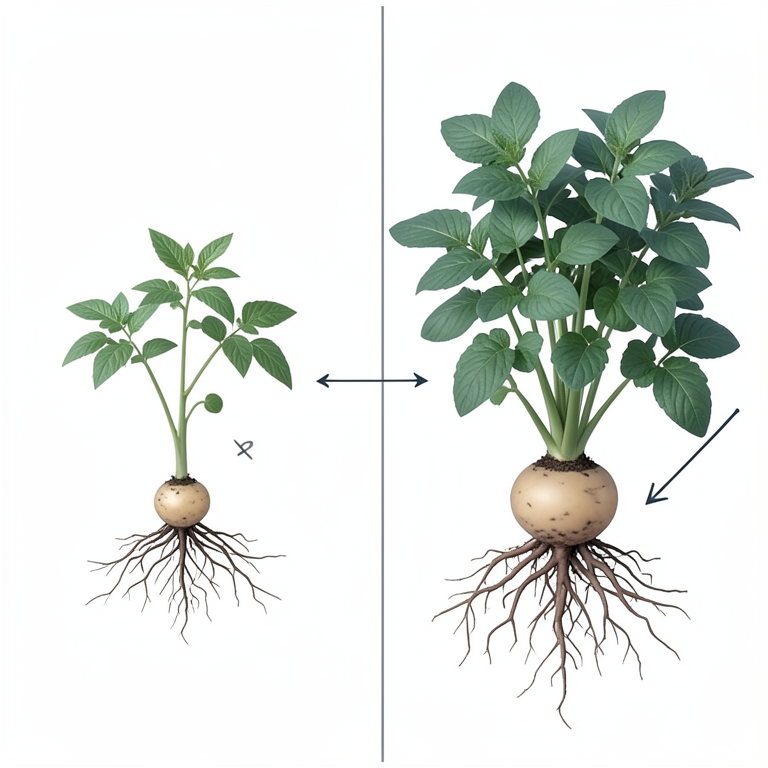
Synergistic Biostimulant Action
AI-generated conceptual illustration (potato plants in alluvial sandy loam soil). It explains the idea and does not show study data.
View source evidence ↗Figures & tables
From the original paper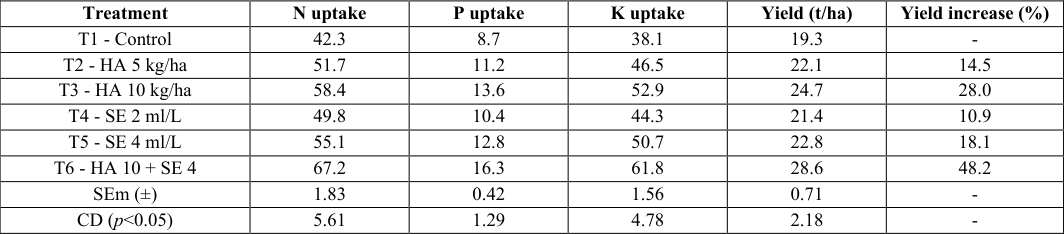 Table 1
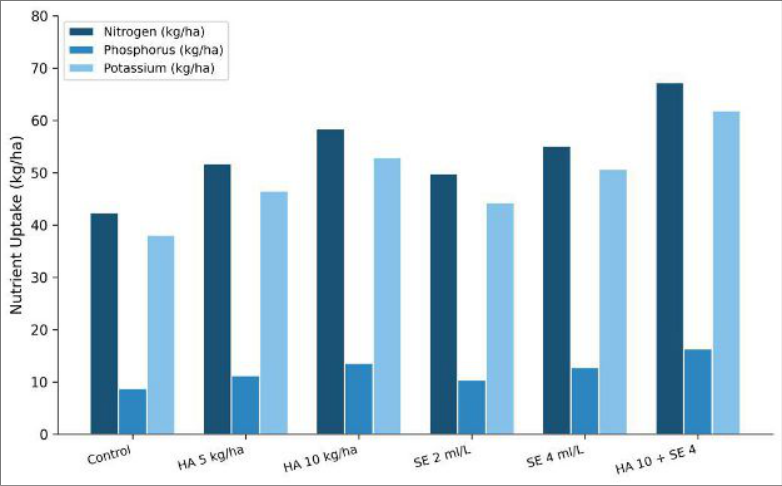 Figure 1
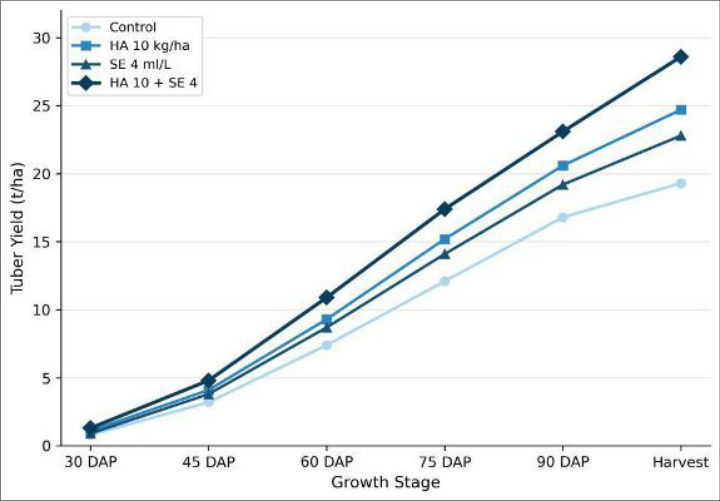 Figure 2
Introduction
Can the growing dependence on synthetic fertilizers in potato production be reduced without sacrificing yield? Potato ranks as the fourth most important food crop worldwide, with India contributing roughly 13% of global output [1] . The crop has a shallow root system that limits its ability to access nutrients from deeper layers, making it heavily reliant on external inputs [2] . Conventional practice in the Indo-Gangetic plain involves applying 150-200 kg N per hectare, yet recovery of applied nitrogen rarely exceeds 50% [3] . Biostimulants have attracted interest as a complementary strategy. Humic acid stimulates root proliferation, chelates micronutrients, and increases cation exchange capacity in the rhizosphere [4] . Field trials on vegetable crops have reported 10-25% yield gains with humic acid at 5-15 kg/ha [5] . Seaweed extracts, primarily from Ascophyllum nodosum, contain cytokinins and betaines that promote cell division and delay leaf senescence [6] . Foliar application at 2-5 ml/L has been linked to improved photosynthetic efficiency in tomato and pepper [7] . Despite individual benefits, information on combined use in potato under sub-tropical alluvial conditions remains limited [8] . This research tested whether soil-applied humic acid combined with foliar seaweed extract could raise nutrient uptake and tuber yield beyond what either product achieves alone, and sought to identify appropriate rates for the two biostimulants under Kanpur's agro-climatic conditions [9,10] .
Material and Methods
Material and Methods
Material
Certified seed tubers of potato variety Kufri Pukhraj (25-35 g) were sourced from the Central Potato Research Institute sub-station, Modipuram. Humic acid (Potassium Humate, 80% HA content) was procured from Humintech GmbH, and the commercial seaweed extract (Ascophyllum nodosum base, 0.2% cytokinin equivalent) from Acadian Seaplants Ltd. Both products were tested for heavy metal content and found within permissible limits [11] . Basal fertilizers comprised urea (46% N), single super phosphate (16% P 2 O 5 ), and muriate of potash (60% K 2 O). Laboratory reagents for nutrient analysis were purchased from Merck ), ground, and digested using the di-acid mixture. Nitrogen was estimated by micro-Kjeldahl [12] , phosphorus by vanadomolybdophosphoric method, and potassium by flame photometry. Data were analysed by one-way ANOVA in R (v4.3.1) with Duncan's test at p<0.05 [13] .
Results
Table The bar chart (Figure 1) confirms that T 6 outperformed every other treatment for all three macronutrients. The gap was widest for phosphorus, likely reflecting the chelating role of humic acid in improving P solubility alongside root expansion from seaweed extract. The line graph (Figure 2) shows yield differences were small until 45 DAP but diverged sharply from 60 DAP, coinciding with the active tuber bulking phase.
Discussion
The 48.2% tuber yield advantage from the combined HA + SE treatment aligns with earlier reports by Shafeek et al. [5] who recorded a 38% yield increase in potato with humic acid alone in Egyptian soils. The extra gain in our work likely stems from the complementary modes of action: humic acid modifying rhizosphere chemistry and seaweed extract boosting canopy function. Canellas and Olivares [4] proposed that humic substances activate plasma-membrane H+-ATPases, stimulating root elongation. The large P-uptake response (87.4% over control in T 6 ) is noteworthy because phosphorus availability in calcareous alluvial soils is often constrained by fixation with calcium. Humic acid can form soluble complexes with calcium, releasing bound phosphorus [14] . When this operates alongside improved root surface area from seaweed cytokinins, the net effect on P acquisition appears more than additive, as Battacharyya et al. [15] also noted for tomato. It's worth noting that our results represent a single-season dataset from one location. Multi-year, multi-site validation is needed before firm recommendations can be issued [16] . And the apparent N recovery in T 6 (16.3%) still remains below the global benchmark of 33% for cereals, indicating scope for further optimization through split humic acid application or adjusted spray timing.
Conclusion
This research confirmed that soil-applied humic acid at 10 kg/ha combined with foliar seaweed extract at 4 ml/L meaningfully boosted macronutrient uptake and tuber yield of potato in alluvial sandy loam. The combined treatment raised nitrogen, phosphorus, and potassium uptake by 58.9%, 87.4%, and 62.2% over the control. Tuber yield increased by 48.2%, reaching 28.6 t/ha. The data point toward a complementary relationship: humic acid improves nutrient availability in the root zone while seaweed extract supports biomass accumulation and photosynthetic efficiency. Farmers in the Indo-Gangetic plain may benefit from adding these biostimulants to existing fertilizer programmes, though economic feasibility requires separate assessment. Future research should examine split humic acid dosing and test the response across different potato varieties.
Figures and tables from the paper
| Treatment | N uptake | P uptake | K uptake | Yield (t/ha) | Yield increase (%) |
|---|---|---|---|---|---|
| T1 - Control | 42.3 | 8.7 | 38.1 | 19.3 | - |
| T2 - HA 5 kg/ha | 51.7 | 11.2 | 46.5 | 22.1 | 14.5 |
| T3 - HA 10 kg/ha | 58.4 | 13.6 | 52.9 | 24.7 | 28.0 |
| T4 - SE 2 ml/L | 49.8 | 10.4 | 44.3 | 21.4 | 10.9 |
| T5 - SE 4 ml/L | 55.1 | 12.8 | 50.7 | 22.8 | 18.1 |
| T6 - HA 10 + SE 4 | 67.2 | 16.3 | 61.8 | 28.6 | 48.2 |
| SEm (±) | 1.83 | 0.42 | 1.56 | 0.71 | - |
| CD (p<0.05) | 5.61 | 1.29 | 4.78 | 2.18 | - |
Table text extracted from the original PDF; superscript letters are shown inline. The original table image is below.
View original table image
References
16 in the original paper- Devaux A, Goffart JP, Kromann P. Potato as a food and nutrition security crop. Potato Research. 2014;57(1):97106.
- Rosen CJ, Bierman PM. Potato yield and tuber set as affected by phosphorus fertilization. American Journal of Potato Research. 2008;85(2):110-120.
- Ladha JK, Pathak H, Krupnik TJ, Six J, van Kessel C. Efficiency of fertilizer nitrogen in cereal production. Advances in Agronomy. 2005;87:85-156.
- Canellas LP, Olivares FL. Physiological responses to humic substances as plant growth promoter. Chemical and Biological Technologies in Agriculture. 2014;1(1):3.
- Shafeek MR, Helmy YI, Omar NM, Rizk FA. Effect of foliar application of some biostimulants on growth and productivity of potato. Middle East Journal of Agriculture Research. 2016;5(3):316-323.
- Khan W, Rayirath UP, Subramanian S, Jithesh MN, Rayorath P. Seaweed extracts as biostimulants of plant growth and development. Journal of Plant Growth Regulation. 2009;28(4):386-399.
- Ali N, Farrell A, Ramsubhag A, Maharaj J. Seaweedbased biostimulant effects on photosynthesis and yield of tomato. Scientia Horticulturae. 2016;213:1-7.
- Selim EM, Mosa AA. Fertigation of humic substances improves yield and quality of broccoli. Journal of Plant Nutrition. 2012;35(4):519-537.
- Soppelsa S, Kelderer M, Casera C, Bassi M, Robatscher P. Use of biostimulants for organic apple production. Agronomy. 2018;8(5):64.
- Rose MT, Patti AF, Little KR, Brown AL, Jackson WR. A meta-analysis and review of plant-growth response to humic substances. Advances in Agronomy. 2014;124:37-89.
- Government of India. The Fertilizer (Control) Order, 1985 (Amended 2021). Ministry of Agriculture and Farmers Welfare. New Delhi.
- Bremner JM. Nitrogen-total. In: Sparks DL, editor. Methods of Soil Analysis Part 3. Madison: SSSA; 1996. p. 1085-1121.
- Duncan DB. Multiple range and multiple F tests. Biometrics. 1955;11(1):1-42.
- Guppy CN, Menzies NW, Moody PW, Blamey FPC. Competitive sorption reactions between phosphorus and organic matter. Soil Research. 2005;43(2):189-202.
- Battacharyya D, Babgohari MZ, Rathor P, Prithiviraj B. Seaweed extracts as biostimulants in horticulture. Scientia Horticulturae. 2015;196:39-48.
- Yakhin OI, Lubyanov AA, Yakhin IA, Brown PH. Biostimulants in plant science. Frontiers in Plant Science. 2017;7:2049.