
Research article · 2025 · Full text
International Journal of Agriculture and NutritionAgronomic evaluation of biofortified wheat varieties for zinc and iron content
Volume 7(3) · Pages 160–163 · DOI: 10.33545/26646064.2025.v7.i3c.624 ↗
Research areasPlant Micronutrient Interactions and EffectsCrop Yield and Soil FertilityWheat and Barley Genetics and Pathology
Abstract
Author-writtenAn anecdote from a rural health worker in Gujarat sums up the hidden hunger problem: children eating two full meals of wheat chapati every day were still showing zinc deficiency symptoms. This research evaluated five wheat varieties, one conventional check (BHU-31) and four biofortified releases (WB-02, HPBW-01, Zinc Shakti, PBW-757), for grain zinc and iron content, agronomic performance, and yield stability at the Swarnim Gujarat Agricultural University, Gandhinagar, during rabi 2022-2023. A RCBD with four replications was used. Zinc Shakti recorded the highest grain Zn (46.8 mg/kg), 65% above the conventional check (28.4 mg/kg), while PBW-757 led for iron (43.7 vs 32.1 mg/kg). Grain yield of biofortified varieties ranged from 3.78 to 4.12 t/ha, comparable to the conventional check (3.94 t/ha), confirming no yield penalty. The waterfall analysis showed that the yield advantage of HPBW-01 (4.12 t/ha) over BHU-31 was driven primarily by more tillers and grains per spike. These results support the deployment of biofortified wheat in Gujarat's wheat belt as a cost-free strategy against micronutrient malnutrition.
Summary
Source-checkedPlain-language reading of the full paper, prepared with AI and checked against the text. Each point links to the authors' own words.
Why it matters
- Zinc and iron deficiencies are widespread global health issues, with a particularly high impact in South Asia. View evidence ↗
- Wheat is a major global calorie source but typically contains zinc and iron levels below the recommended targets for dietary impact. View evidence ↗
- Biofortification is a highly cost-effective method for reducing micronutrient malnutrition, costing less than $0.50 per person annually. View evidence ↗
The question
- The study aimed to evaluate four biofortified wheat varieties compared to a conventional variety regarding their micronutrient content and agronomic performance in irrigated Gujarat. View evidence ↗
What they did
- The researchers tested five wheat varieties: the conventional check BHU-31 and four biofortified varieties (WB-02, HPBW-01, Zinc Shakti, and PBW-757). View evidence ↗
- The trial was conducted at Swarnim Gujarat Agricultural University during the 2022-2023 rabi season using a Randomized Complete Block Design (RCBD) with four replications. View evidence ↗
- The crops received a basal fertilizer of 120:60:40 kg N:P2O5:K2O/ha and four scheduled irrigations. View evidence ↗
- Iron was measured using Atomic Absorption Spectroscopy (AAS), and the phytate:Zn molar ratio was calculated using the Wade reagent method to assess zinc bioavailability. View evidence ↗
What they found
- Zinc Shakti had the highest zinc content at 46.8 mg/kg, which is 65% higher than the conventional check (28.4 mg/kg) and exceeds the HarvestPlus target. View evidence ↗
- PBW-757 recorded the highest iron content at 43.7 mg/kg, compared to 32.1 mg/kg for the conventional check. View evidence ↗
- Zinc Shakti exhibited the lowest phytate:Zn ratio (17.4), suggesting it provides the best bioavailability of zinc. View evidence ↗
- The yield advantage of HPBW-01 over BHU-31 was primarily driven by an increase in tillers and grains per spike, despite a slight decrease in thousand-grain weight (TGW). View evidence ↗
What it means
- The authors recommend Zinc Shakti for the irrigated wheat belt of Gujarat for its zinc content and bioavailability, and PBW-757 for areas where iron deficiency is the primary concern. View evidence ↗
- The study was limited to a single location and season; the authors suggest multi-year and multi-location testing to confirm the stability of micronutrient gains across different soils. View evidence ↗
Visual summary
3 visualsIllustrations explain the paper; charts are replotted from the paper's own table values.
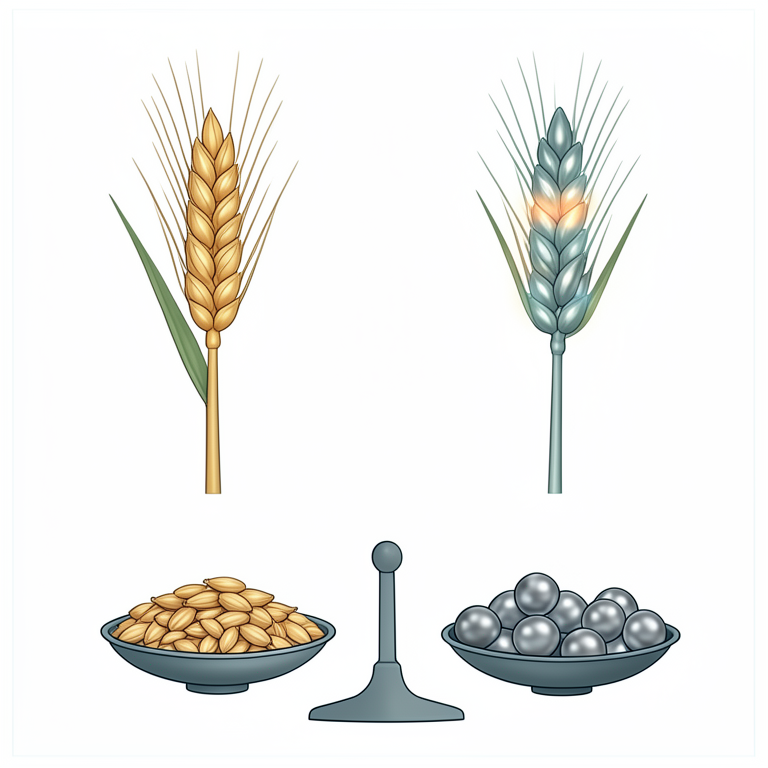
Biofortification Trade-off Analysis
AI-generated conceptual illustration (wheat plants and grains). It explains the idea and does not show study data.
View source evidence ↗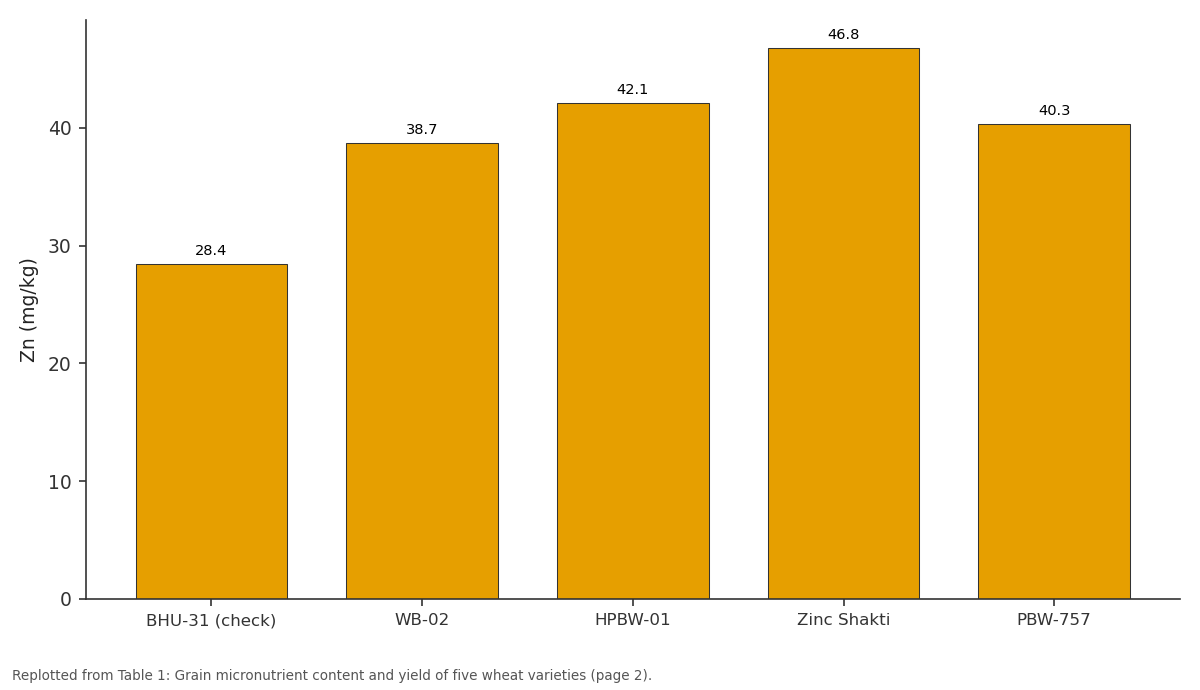
Zn (mg/kg): BHU-31 (check) vs WB-02 vs HPBW-01 vs Zinc Shakti vs PBW-757
Replotted from Table 1 (page 2) of the original paper. Every bar is the paper's own table value.
View source evidence ↗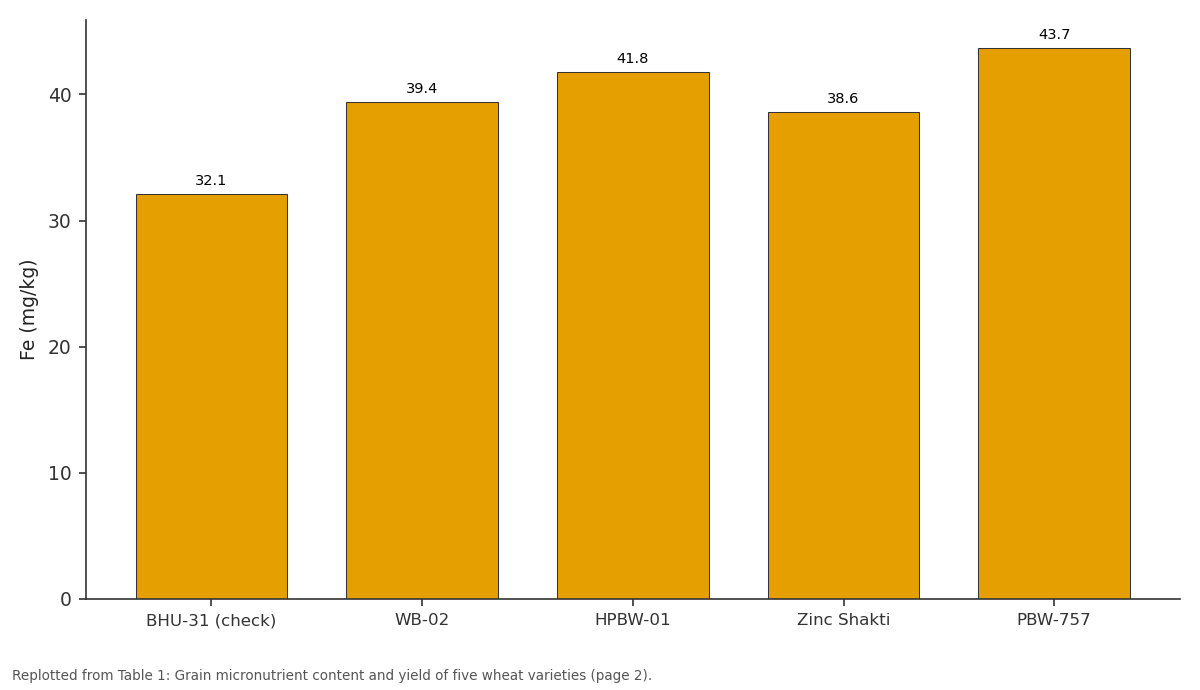
Fe (mg/kg): BHU-31 (check) vs WB-02 vs HPBW-01 vs Zinc Shakti vs PBW-757
Replotted from Table 1 (page 2) of the original paper. Every bar is the paper's own table value.
View source evidence ↗Figures & tables
From the original paper Table 1
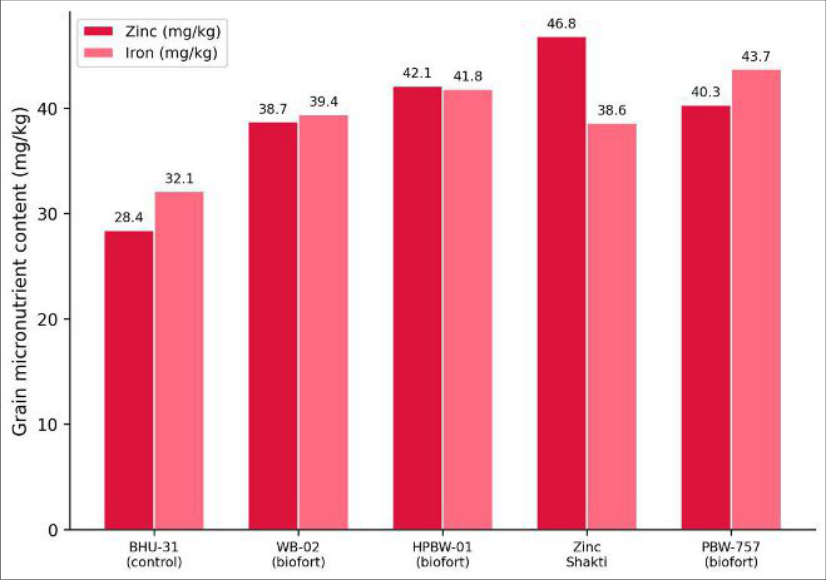 Figure 1
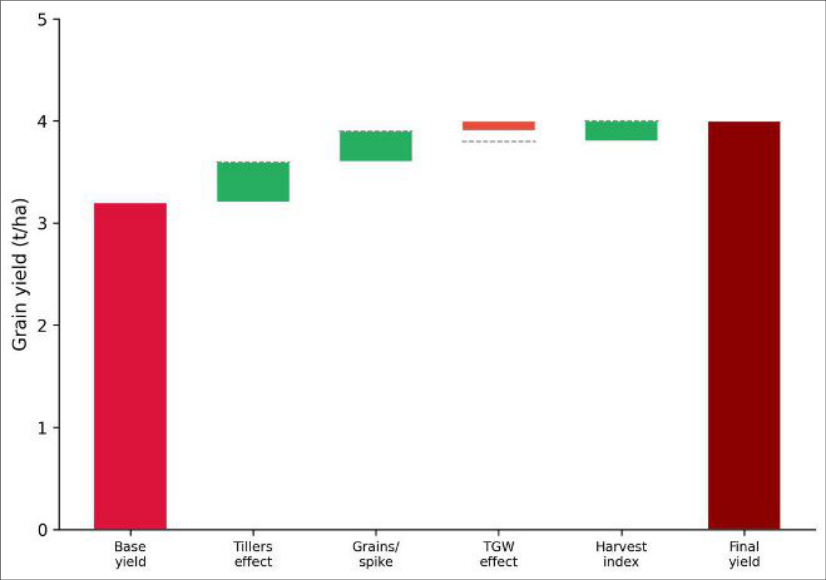 Figure 2
Introduction
The anecdote above reflects a broader reality: zinc deficiency affects an estimated 25% of the global population, and iron deficiency anaemia touches over 1.2 billion people, with South Asia bearing a disproportionate burden [1] . Wheat, which supplies 20% of global calorie intake, is inherently low in zinc (20-30 mg/kg) and iron (30-35 mg/kg in wholemeal), well below the target levels of 40-50 mg/kg recommended by HarvestPlus for meaningful dietary impact [2] . Biofortification, the breeding of staple crops for higher micronutrient density, is considered one of the most cost-effective approaches to combating hidden hunger, at less than $0.50 per beneficiary per year [3] . India released its first biofortified wheat variety (WB-02) in 2017, and several more have followed, including Zinc Shakti, HPBW-01, and PBW-757, each targeting different agro-ecological zones [4] . But agronomic data from Gujarat, where wheat occupies over 1.1 million hectares of irrigated land, are limited. Farmers need assurance that biofortified varieties don't sacrifice yield [5] . This research was conducted at the Swarnim Gujarat Agricultural University, Gandhinagar (23.21 deg N, 72.68 deg E; altitude 81 m), to compare four biofortified wheat varieties against a conventional check for grain micronutrient content, yield, and yield component architecture under Gujarat's irrigated conditions [6,7] .
Material and Methods
Material and Methods
Material
Seeds of BHU-31 (conventional, 28 mg/kg Zn), WB-02, HPBW-01, Zinc Shakti, and PBW-757 were obtained from ICAR-Indian Institute of Wheat and Barley Research, Karnal. The trial was sown on 20 November 2022 on a sandy loam soil (pH 7.6, DTPA-Zn 0.72 mg/kg, DTPA-Fe 4.1 mg/kg) in a RCBD with four replications, plot size 5 m x 2.5 m, row spacing 22.5 cm. Basal fertilizer: 120:60:40 kg N:P 2 O 5 :K 2 O/ha with N split (half basal, quarter each at CRI and heading). Four irrigations were applied at CRI, tillering, heading, and grain filling.
Methods
Yield components (tillers/m2, spike length, grains/spike, thousand-grain weight) were recorded at harvest on five randomly tagged plants per plot. Grain yield was measured per plot at 12% moisture. Grain samples were digested in tri-acid mixture (HNO 3 :H 2 SO 4 :HClO 4 , 10:1:4) and Zn and Fe determined by AAS (Shimadzu AA-7000) [8] . Phytic acid was estimated by the Wade reagent method to calculate the phytate:Zn molar ratio, which predicts zinc bioavailability [9] . Data were analysed by ANOVA in SAS 9.4 with DMRT at p<0.05 [10] . The bar chart (Figure 1) shows Zinc Shakti dominating the zinc axis while PBW-757 leads for iron. The waterfall chart (Figure 2) decomposes HPBW-01's yield into components: its advantage over BHU-31 came primarily from more tillers (+0.4 t/ha equivalent) and more grains per spike (+0.3), partially offset by a slightly lower TGW (-0.1).
Results
Results
Discussion
The 65% zinc enrichment in Zinc Shakti over the conventional check confirms that genetic biofortification can achieve meaningful micronutrient gains without agronomic management changes. At the daily wheat consumption of 350 g per capita in Gujarat, switching from BHU-31 to Zinc Shakti would add roughly 6.4 mg Zn to the diet, covering about 50% of the adult RDA shortfall [2,3] . The low phytate: Zn ratio (17.4) further enhances this benefit, since phytate chelates zinc and reduces its absorption in the gut [9] . The absence of a yield penalty is consistent with multilocation data from ICAR's biofortification network, which has shown that modern biofortified lines carry yield genes comparable to the best conventional releases [4] . This is a marked improvement over early biofortified materials, which often traded 5-10% yield for higher micronutrient content [11] . One limitation: our trial was single-location and single-season. The G x E interaction for grain Zn is known to be large, and soil Zn status strongly influences absolute concentrations [12,13] .
Conclusion
All four biofortified wheat varieties exceeded the conventional check for grain zinc and iron without sacrificing yield. Zinc Shakti is recommended for Gujarat's irrigated wheat belt based on its 65% zinc advantage and lowest phytate: Zn ratio. PBW-757 is the preferred choice where iron deficiency is the greater concern. Biofortified wheat offers a zero-cost, seed-based approach to improving micronutrient intake that requires no behaviour change from farmers or consumers. Multi-year, multi-location testing should follow to confirm stability of the micronutrient advantage across Gujarat's diverse soils.
Figures and tables from the paper
| Variety | Zn (mg/kg) | Fe (mg/kg) | Phytate: Zn | Yield (t/ha) | TGW (g) | Tillers/m² |
|---|---|---|---|---|---|---|
| BHU-31 (check) | 28.4 | 32.1 | 28.6 | 3.94 | 41.2 | 312 |
| WB-02 | 38.7 | 39.4 | 21.3 | 3.78 | 39.8 | 328 |
| HPBW-01 | 42.1 | 41.8 | 19.7 | 4.12 | 40.6 | 342 |
| Zinc Shakti | 46.8 | 38.6 | 17.4 | 3.86 | 38.4 | 318 |
| PBW-757 | 40.3 | 43.7 | 20.8 | 3.91 | 40.1 | 324 |
| CD (p<0.05) | 3.4 | 3.8 | 2.1 | NS | 1.8 | 18 |
Table text extracted from the original PDF; superscript letters are shown inline. The original table image is below.
View original table image
References
14 in the original paper- Wessells KR, Brown KH. Estimating the global prevalence of zinc deficiency. PLoS One. 2012;7(11):e50568.
- Cakmak I, Kutman UB. Agronomic biofortification of cereals with zinc. Frontiers in Plant Science. 2018;9:937.
- Bouis HE, Saltzman A. Improving nutrition through biofortification. Global Food Security. 2017;12:49-57.
- Singh RP, Velu G, Joshi AK. Zinc-biofortified wheat varieties for India. Indian Farming. 2019;69(3):12-15.
- Velu G, Ortiz-Monasterio I, Cakmak I, Hao Y, Singh RP. Biofortification strategies to increase grain zinc and iron in wheat. Annals of Botany. 2014;114(7):14671473.
- ICAR-IIWBR. Progress Report All India Coordinated Wheat Improvement Project 2022-23. Karnal: IIWBR; 2023.
- Lindsay WL, Norvell WA. Development of a DTPA soil test for zinc, iron, manganese and copper. Soil Science Society of America Journal. 1978;42(3):421428.
- Haug W, Lantzsch HJ. Sensitive method for the rapid determination of phytate in cereals and cereal products. Journal of the Science of Food and Agriculture. 1983;34(12):1423-1426.
- SAS Institute. SAS/STAT User's Guide. Version 9.4. Cary: SAS Institute; 2017.
- Pfeiffer WH, McClafferty B. HarvestPlus: breeding crops for better nutrition. Crop Science. 2007;47(S3):S88-S105.
- Zou CQ, Zhang YQ, Rashid A, Ram H, Savasli E. Biofortification of wheat with zinc through zinc fertilization in seven countries. Plant and Soil. 2012;361(1):119-130.
- Gomez-Becerra HF, Yazici A, Ozturk L, Budak H, Peleg Z. Genetic variation and environmental stability of grain mineral nutrient concentrations in Triticum dicoccoides. Euphytica. 2010;171(1):145-152.
- Trijatmiko KR, Duenas C, Tsakirpaloglou N, Torrizo L, Arines FM. Biofortified indica rice attains iron and zinc nutrition dietary targets. Scientific Reports. 2016;6:19792.
- Prasad R, Shivay YS, Kumar D. Agronomic biofortification of cereal grains with iron and zinc. Advances in Agronomy. 2014;125:55-91.