
Research article · 2025 · Full text
International Journal of Agriculture and NutritionRole of proline accumulation in salinity tolerance of rice seedlings under NaCl stress
Volume 7(3) · Pages 103–106 · DOI: 10.33545/26646064.2025.v7.i3b.616 ↗
Research areasPlant Stress Responses and ToleranceRice Cultivation and Yield ImprovementGABA and Rice Research
Abstract
Author-writtenThe trend toward expanding rice cultivation into salt-affected lowlands of East Africa has made salinity tolerance a priority breeding target. This research compared proline accumulation, growth responses, and ion homeostasis in a salt-tolerant rice genotype (Pokkali) and a salt-sensitive genotype (IR29) under seven NaCl concentrations (0, 25, 50, 75, 100, 125, 150 mM) in a hydroponic system at the Oromia Institute of Agricultural Sciences, Jimma, Ethiopia, during 2023. A completely randomised design with factorial arrangement and three replications was used. Proline content in Pokkali rose from 1.2 to 12.8 micromol/g FW across the salinity gradient, roughly double the accumulation in IR29 (1.1 to 6.4 micromol/g FW). Shoot length declined by 62% in IR29 at 150 mM but only by 38% in Pokkali. The tolerant genotype maintained a lower Na+/K+ ratio (1.8 vs 4.7 in IR29 at 150 mM). A strong negative correlation (r = -0.91) between proline content and Na+/K+ ratio in Pokkali supports the hypothesis that proline contributes to osmotic adjustment and ion exclusion. These results confirm proline accumulation as a reliable biochemical marker for screening salt tolerance in rice.
Summary
Source-checkedPlain-language reading of the full paper, prepared with AI and checked against the text. Each point links to the authors' own words.
Why it matters
- Expanding rice cultivation into salt-affected lowlands in East Africa has made the development of salinity-tolerant varieties a priority for breeding. View evidence ↗
- Soil salinity is increasing in Ethiopia's Rift Valley due to expanding irrigation, with approximately 11 million hectares now considered salt-affected. View evidence ↗
- Proline is a five-carbon amino acid that accumulates during osmotic stress and is commonly used as a marker for salt tolerance in plants. View evidence ↗
The question
- The study aimed to quantify how different NaCl concentrations affect proline accumulation, growth, and ion balance in two contrasting rice genotypes. View evidence ↗
What they did
- The researchers compared a salt-tolerant genotype (Pokkali) and a salt-sensitive genotype (IR29) across seven NaCl concentrations ranging from 0 to 150 mM in a hydroponic system. View evidence ↗
- The experiment used a completely randomized factorial design with 42 experimental units, consisting of two genotypes, seven salinity levels, and three replications. View evidence ↗
- Measurements taken 21 days after reaching target salinity included shoot/root length, weight, proline content via acid-ninhydrin, Na+/K+ levels via flame photometry, and the Membrane Stability Index (MSI). View evidence ↗
What they found
- Across the salinity gradient, proline in Pokkali increased from 1.2 to 12.8 µmol/g FW, which was approximately double the accumulation seen in IR29 (1.1 to 6.4 µmol/g FW). View evidence ↗
- At 150 mM NaCl, Pokkali maintained a significantly lower Na+/K+ ratio (1.83) compared to IR29 (4.72), demonstrating superior ion exclusion. View evidence ↗
- At 150 mM NaCl, Pokkali retained a Membrane Stability Index (MSI) of 58.6%, while IR29's MSI was estimated at 41%. View evidence ↗
- In Pokkali, a strong negative correlation (r = -0.91) was found between proline content and the Na+/K+ ratio, suggesting proline aids in ion exclusion and osmotic adjustment. View evidence ↗
What it means
- The authors conclude that proline is a reliable early-stage biochemical marker for screening salt tolerance in rice due to its strong association with the Na+/K+ ratio in tolerant genotypes. View evidence ↗
- The authors recommend that breeding programs in East Africa use seedling-stage proline assays to speed up the selection of salt-tolerant rice. View evidence ↗
- A limitation of the study is the use of a hydroponic system with uniform salinity, which may not reflect the spatially variable salt concentrations found in field soils. View evidence ↗
- The authors state that future work should validate these hydroponic findings using naturally saline soils in the Ethiopian Rift Valley. View evidence ↗
Visual summary
3 visualsIllustrations explain the paper; charts are replotted from the paper's own table values.
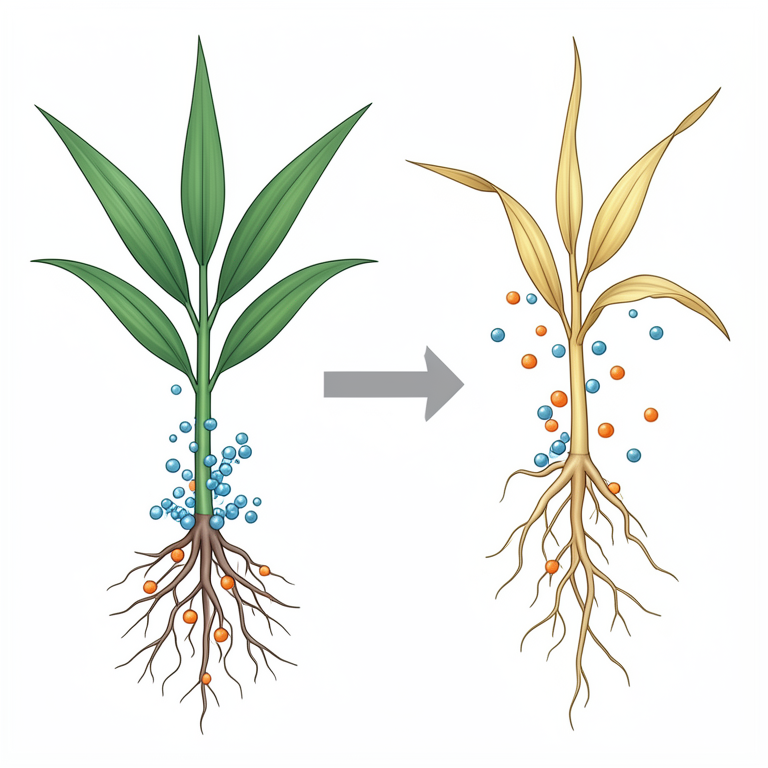
Proline and Ion Balance Relationship
AI-generated conceptual illustration (rice seedlings). It explains the idea and does not show study data.
View source evidence ↗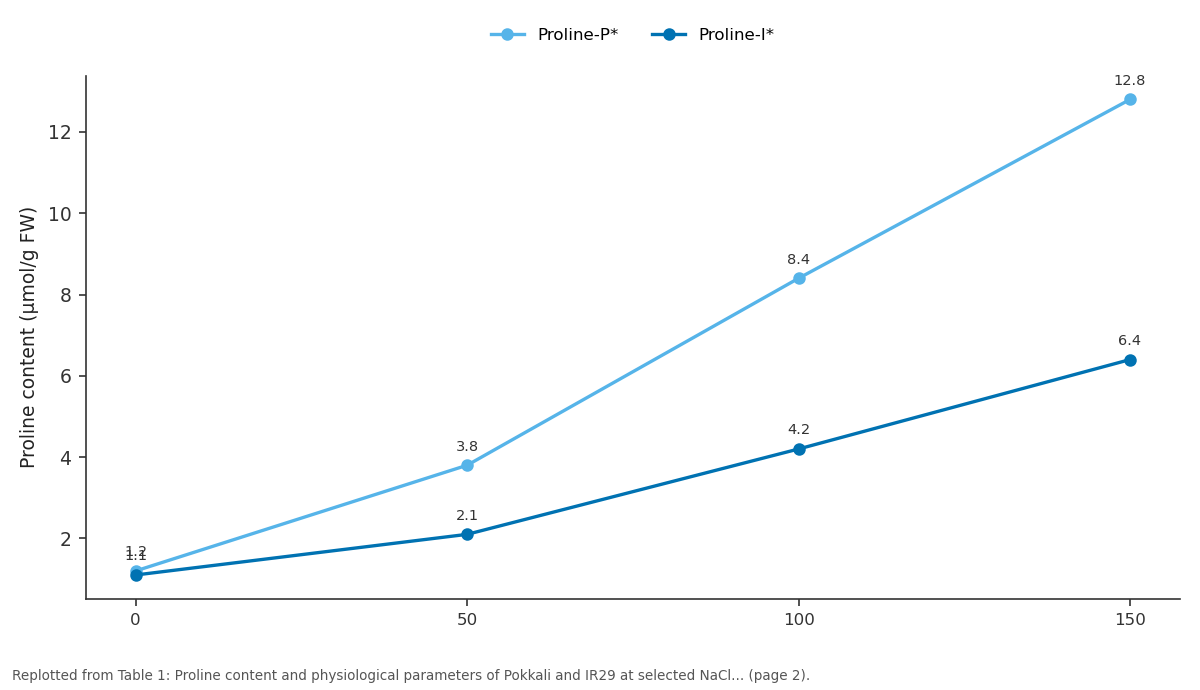
Proline-P* and Proline-I*: 0 vs 50 vs 100 vs 150
Replotted from Table 1 (page 2) of the original paper. Every bar is the paper's own table value.
View source evidence ↗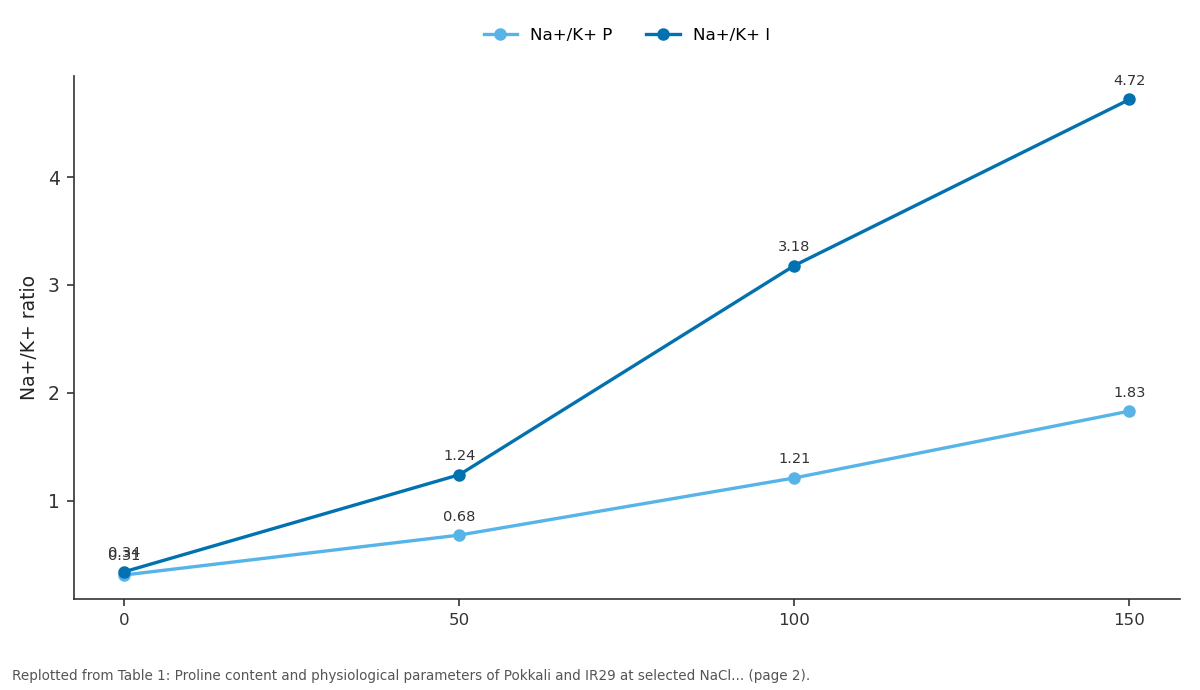
Na+/K+ P and Na+/K+ I: 0 vs 50 vs 100 vs 150
Replotted from Table 1 (page 2) of the original paper. Every bar is the paper's own table value.
View source evidence ↗Figures & tables
From the original paper Table 1
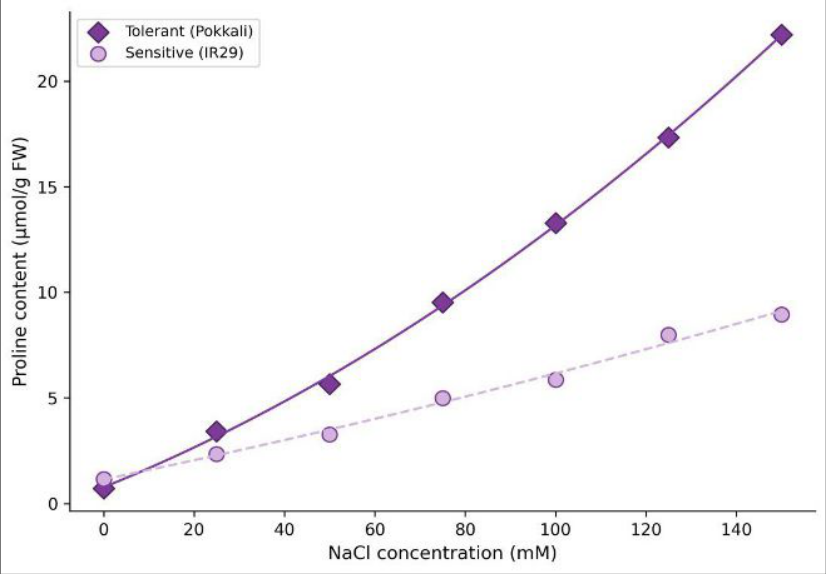 Figure 1
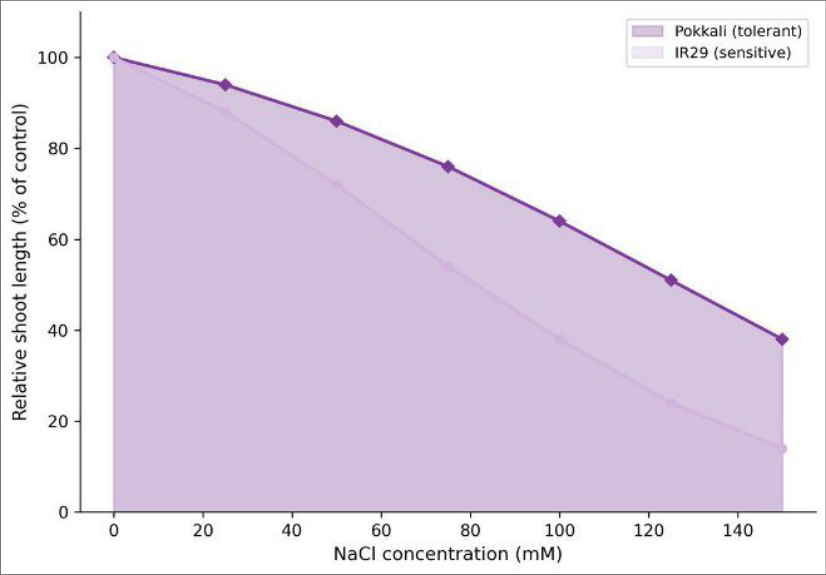 Figure 2
Introduction
The trend is unmistakable: as irrigation schemes expand across Ethiopia's Rift Valley, soil salinity is rising in step, with roughly 11 million hectares now classified as salt-affected [1] . Rice, introduced as a strategic food security crop in the 2000s, is increasingly sown in these marginal lowlands, where seedlings face NaCl concentrations of 4-12 dS/m within weeks of transplanting [2] . Proline, a five-carbon amino acid, accumulates in plant tissues under osmotic stress and is widely considered a marker of salt tolerance. Its proposed functions include osmotic adjustment, reactive oxygen species scavenging, stabilisation of protein structure, and maintenance of cellular redox balance [3] . Salt-tolerant rice varieties such as Pokkali accumulate proline two to three times faster than sensitive genotypes like IR29 [4] . Whether this accumulation is a cause or consequence of tolerance remains debated, but the correlation is strong enough to serve as a screening tool [5] . This research was conducted at the Oromia Institute of Agricultural Sciences, Jimma (7.67 deg N, 36.83 deg E; altitude 1,780 m), to quantify dose-response relationships between NaCl concentration, proline accumulation, growth parameters, and ion balance in two contrasting rice genotypes under controlled hydroponic conditions [6,7] .
Material and Methods
Material and Methods
Material
Seeds of Pokkali (salt-tolerant, Indian landrace) and IR29 (salt-sensitive, IRRI breeding line) were obtained from the Africa Rice Center, Cotonou. Seeds were surface-sterilised (0.1% HgCl 2 , 2 min), germinated in Petri dishes for 5 days, and transferred to 5-L plastic containers with modified Yoshida nutrient solution (pH 5.5) [8] . NaCl (Merck, analytical grade) was added in daily increments of 25 mM to avoid osmotic shock, reaching the target concentrations within six days. The experiment was housed in a naturally lit glasshouse (28/22 deg C day/night, 75% RH) at the institute campus.
Methods
A completely randomised factorial design (2 genotypes x 7 NaCl levels x 3 reps) gave 42 experimental units. Measurements were taken 21 days after reaching target salinity. Shoot and root length, fresh weight, and dry weight were recorded. Proline was estimated by the acid-ninhydrin method of Bates et al. [9] . Leaf Na + and K + were measured by flame photometry after HNO 3 digestion. Membrane Stability Index (MSI) was assessed by the electrolyte leakage method [10] . Relative Water Content (RWC) was measured gravimetrically. Data were analysed by two-way ANOVA in GenStat 21 with LSD at p<0.05 [11] . The scatter plot (Figure 1) shows Pokkali's proline curve rising steeply, especially above 75 mM, while IR29's response is flatter. The area chart (Figure 2) illustrates the growing gap in growth maintenance between genotypes, with Pokkali retaining a much larger proportion of its control shoot length throughout the salinity range.
Results
Results
Discussion
The two-fold difference in proline accumulation between Pokkali and IR29 supports the view that active proline synthesis, driven by up-regulation of P5CS (pyrroline-5carboxylate synthetase), is a key component of the tolerance mechanism rather than a passive stress response [3] . The strong negative correlation (r = -0.91) between proline and Na + /K + ratio in Pokkali suggests that proline helps maintain osmotic balance, reducing the thermodynamic drive for sodium influx [4] . IR29's rapid membrane deterioration (MSI falling to roughly 41% at 150 mM) points to oxidative damage that proline, at the lower concentrations found in the sensitive genotype, cannot prevent [12] . Pokkali's better MSI indicates preserved membrane integrity, likely aided by proline's role as a scavenger of hydroxyl radicals. One limitation is that this work used a hydroponic system, which imposes uniform and constant salinity; field soils present spatially variable salt concentrations that may alter the genotype ranking [13,14] .
Conclusion
Pokkali accumulated roughly twice the proline of IR29 under equivalent NaCl stress and maintained better ion homeostasis, membrane stability, and shoot growth. The tight association between proline content and the Na + /K + ratio in the tolerant genotype confirms proline as a reliable early-stage biochemical marker for screening salt tolerance in rice. Breeding programmes targeting salt-affected lowlands of East Africa can use proline assays at the seedling stage to accelerate selection. Future work should validate these hydroponic results under field conditions with naturally saline soils in the Ethiopian Rift Valley [15] .
Figures and tables from the paper
| NaCl (mM) | Proline-P* | Proline-I* | Na+/K+ P | Na+/K+ I | MSI-P (%) | Shoot loss-I (%) |
|---|---|---|---|---|---|---|
| 0 | 1.2 | 1.1 | 0.31 | 0.34 | 91.3 | 0 |
| 50 | 3.8 | 2.1 | 0.68 | 1.24 | 84.7 | 28 |
| 100 | 8.4 | 4.2 | 1.21 | 3.18 | 72.4 | 62 |
| 150 | 12.8 | 6.4 | 1.83 | 4.72 | 58.6 | 86 |
| LSD | 0.9 | 0.7 | 0.14 | 0.28 | 4.3 | - |
Table text extracted from the original PDF; superscript letters are shown inline. The original table image is below.
View original table image
References
14 in the original paper- Taddese G. Land degradation: a challenge to Ethiopia. Environmental Management. 2001;27(6):815-824.
- Rice Development Strategy 2020-2030. Addis Ababa: Ministry of Agriculture and Natural Resources; 2020.
- Verbruggen N, Hermans C. Proline accumulation in plants: a review. Amino Acids. 2008;35(4):753-759.
- Ghosh B, Ali MN, Saikat G. Response of rice under salinity stress: a review update. Rice Research Open Access. 2016;4(2):167.
- Ashraf M, Foolad MR. Roles of glycine betaine and proline in improving plant abiotic stress resistance. Environmental and Experimental Botany. 2007;59(2):206-216.
- Flowers TJ, Colmer TD. Plant salt tolerance: adaptations in halophytes. Annals of Botany. 2015;115(3):327-331.
- Yoshida S, Forno DA, Cock JH, Gomez KA. Laboratory Manual for Physiological Studies of Rice. Manila: IRRI; 1976.
- Bates LS, Waldren RP, Teare ID. Rapid determination of free proline for water-stress studies. Plant and Soil. 1973;39(1):205-207.
- Sairam RK, Rao KV, Srivastava GC. Differential response of wheat genotypes to long-term salinity stress in relation to oxidative stress. Plant Science. 2002;163(5):1037-1046.
- Payne RW. GenStat Release 21. Hemel Hempstead: VSN International; 2021.
- Hasegawa PM, Bressan RA, Zhu JK, Bohnert HJ. Plant cellular and molecular responses to high salinity. International Journal of Agriculture and Nutrition https://www.agriculturejournal.net Annual Review of Plant Physiology and Plant Molecular Biology. 2000;51:463-499.
- Gregorio GB, Senadhira D, Mendoza RD, Manigbas NL, Roxas JP. Progress in breeding for salinity tolerance and associated abiotic stresses in rice. Field Crops Research. 2002;76(2-3):91-101.
- Ismail AM, Horie T. Genomics, physiology, and molecular breeding approaches for improving salt tolerance. Annual Review of Plant Biology. 2017;68:405-434.
- Walia H, Wilson C, Condamine P, Liu X, Ismail AM. Comparative transcriptional profiling of two contrasting rice genotypes under salinity stress. Plant Physiology. 2005;139(2):822-835.