
Research article · 2025 · Full text
International Journal of Agriculture and NutritionNutrient management through drip fertigation in polyhouse-grown capsicum
Volume 7(10) · Pages 181–184 · DOI: 10.33545/26646064.2025.v7.i10c.599 ↗
Research areasPlant Growth and Agriculture TechniquesIrrigation Practices and Water ManagementAgricultural Science and Fertilization
Abstract
Author-writtenGrowing capsicum in a polyhouse should be straightforward, but getting the fertigation recipe right matching nutrient supply to a crop that shifts demand sharply between vegetative and reproductive stages remains a persistent challenge for growers in humid tropical Malaysia. This research tested six nitrogen fertigation rates (75, 100, 125, 150, 175 and 200 kg N ha⁻¹) delivered through drip lines to capsicum (cv. Special Hot) inside a naturally ventilated polyhouse at the Borneo Institute of Agricultural Sciences, Kuching, Sarawak, over two consecutive seasons (2022–23 and 2023–24). A constant P and K base was applied (80 kg P₂O₅ and 120 kg K₂O ha⁻¹) across all treatments. A randomised complete block design with four replications was used. Fruit yield, average fruit weight, number of fruits per plant, plant height, nutrient uptake (N, P, K, Ca, Mg) and apparent nitrogen recovery were measured. Yield responded quadratically to N rate, peaking at 150 kg N ha⁻¹ with a mean of 38.7 t ha⁻¹ and an average fruit weight of 164.3 g. Beyond 150 kg N, yield declined slightly (37.2 t ha⁻¹ at 175 kg, 35.8 t ha⁻¹ at 200 kg), and leaf tip burn appeared in 14–19% of plants. Apparent nitrogen recovery peaked at 125 kg N (67.4%) and dropped to 48.3% at 200 kg N, signalling luxury consumption and potential leaching loss. Nutrient uptake was dominated by K (41.2% of total macronutrient removal) and N (34.7%). These results recommend 150 kg N ha⁻¹ as the economic optimum for drip-fertigated polyhouse capsicum in Sarawak, balancing yield, fruit quality and nutrient efficiency.
Summary
Source-checkedPlain-language reading of the full paper, prepared with AI and checked against the text. Each point links to the authors' own words.
Why it matters
- Nitrogen management is critical because insufficient supply stunts fruit development, while excess nitrogen causes excessive vegetative growth, leaf tip burn, and nitrate leaching. View evidence ↗
- Standard fertigation guidelines from temperate or Mediterranean regions are not suitable for the humid tropics due to higher temperatures that speed up plant metabolism and nutrient mineralisation. View evidence ↗
The question
- The study aimed to determine the optimal nitrogen rate for capsicum cv. Special Hot in Sarawak, establish its yield response curve, and analyze nutrient uptake and recovery efficiency. View evidence ↗
What they did
- The experiment took place in a 30m x 10m naturally ventilated polyhouse in Kuching, Sarawak. View evidence ↗
- Capsicum cv. Special Hot was grown in 40x40x20 cm grow bags containing a mixture of local alluvial topsoil and carbonised rice husk. View evidence ↗
- Six nitrogen rates (75 to 200 kg/ha) were tested using a randomized complete block design with four replications of 16 plants each, while phosphorus (80 kg/ha) and potassium (120 kg/ha) remained constant. View evidence ↗
- The researchers measured growth parameters including plant height, flowering time, fruit number, average fruit weight, and total marketable yield. View evidence ↗
What they found
- The highest yield of 38.7 t/ha was achieved at a nitrogen rate of 150 kg/ha, with yields decreasing at higher application rates. View evidence ↗
- Average fruit weight peaked at 164.3 g when the nitrogen rate was 150 kg/ha. View evidence ↗
- Plant height increased as nitrogen rates rose, even after the yield had already peaked, indicating excessive vegetative growth. View evidence ↗
- Leaf tip burn was not observed at rates below 125 kg N but increased to 19.2% of plants at the 200 kg N rate. View evidence ↗
- Apparent nitrogen recovery (ANR) decreased as nitrogen application increased, falling from 72.1% at 75 kg N to 48.3% at 200 kg N. View evidence ↗
- Potassium was the most removed macronutrient at the optimum N rate, accounting for 41.2% (109.7 kg/ha) of total removal, followed by nitrogen at 34.7% (92.4 kg/ha). View evidence ↗
- Potassium removal was 1.19 times the amount applied, suggesting the base dose of 120 kg/ha is insufficient for long-term sustainability. View evidence ↗
What it means
- The authors recommend a nitrogen rate of 150 kg/ha via weekly drip fertigation as the optimal balance for yield, quality, and efficiency in Sarawak's humid tropics. View evidence ↗
- The authors suggest future research into slow-release nitrogen sources and different nitrogen forms (ammonium vs. nitrate) to improve efficiency and safety windows. View evidence ↗
Visual summary
3 visualsIllustrations explain the paper; charts are replotted from the paper's own table values.
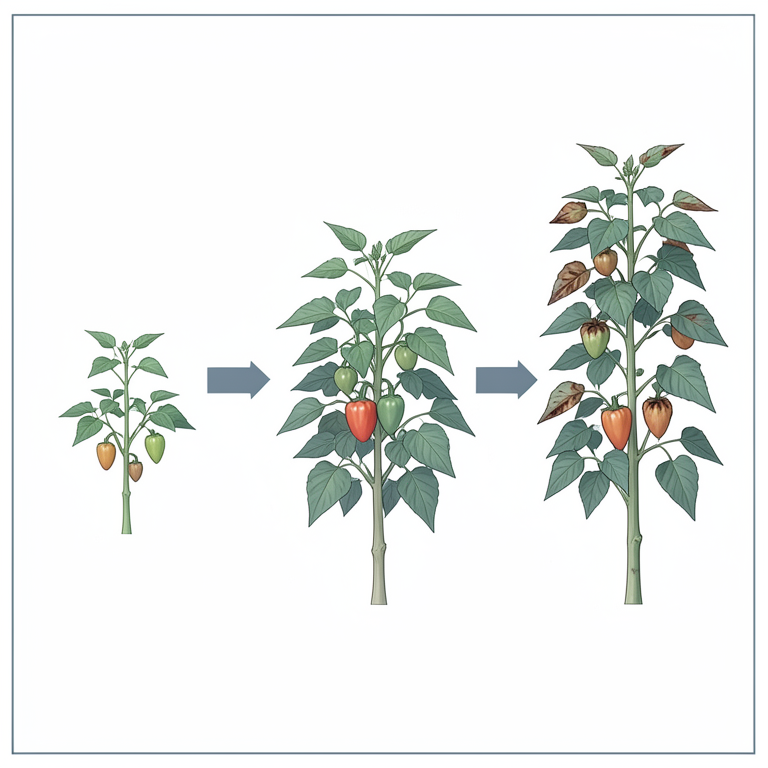
Nitrogen Response Trade-offs
AI-generated conceptual illustration (polyhouse-grown capsicum plants). It explains the idea and does not show study data.
View source evidence ↗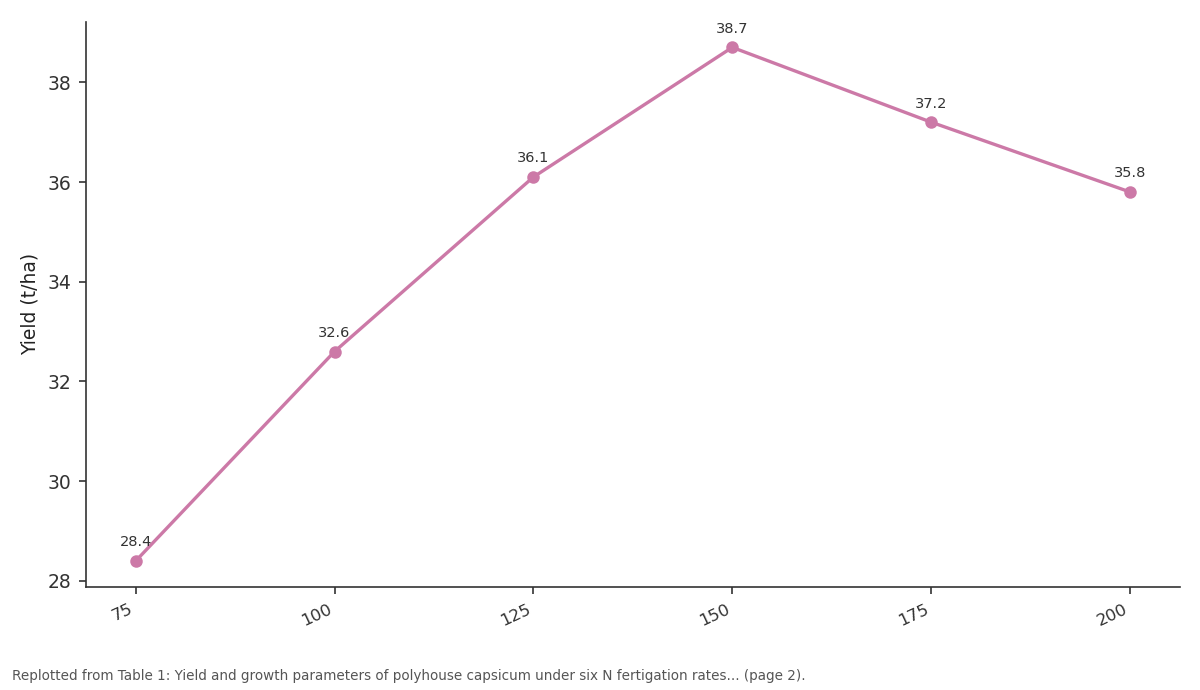
Yield (t/ha): 75 vs 100 vs 125 vs 150 vs 175
Replotted from Table 1 (page 2) of the original paper. Every bar is the paper's own table value.
View source evidence ↗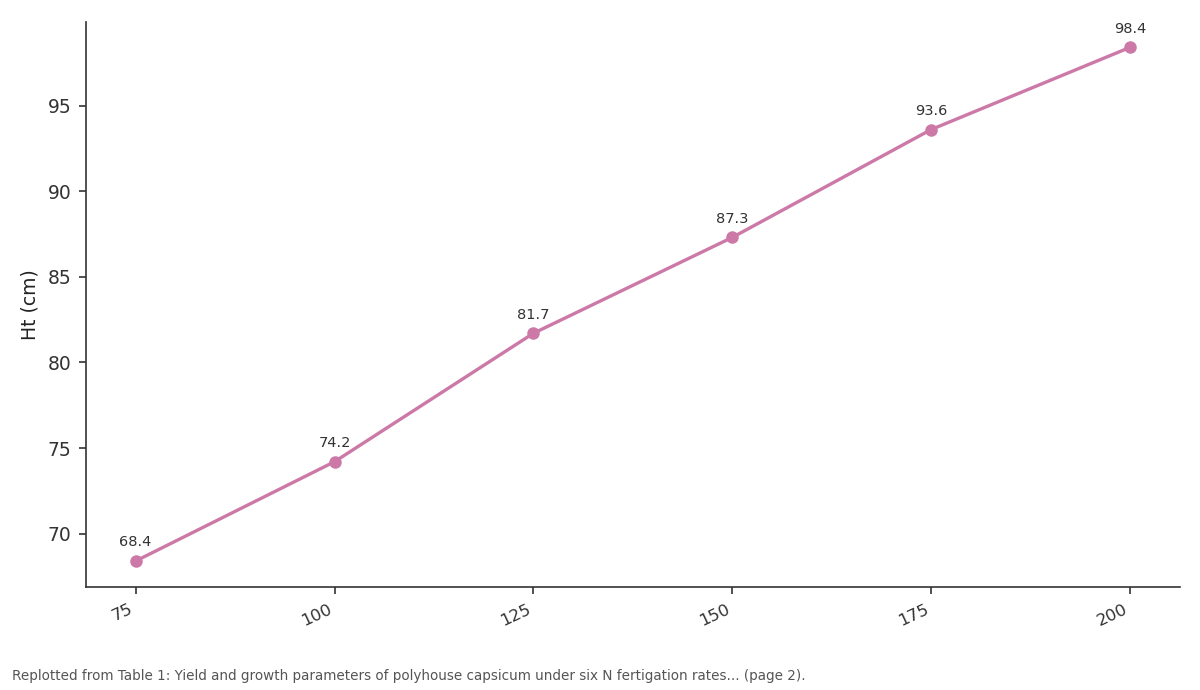
Ht (cm): 75 vs 100 vs 125 vs 150 vs 175
Replotted from Table 1 (page 2) of the original paper. Every bar is the paper's own table value.
View source evidence ↗Figures & tables
From the original paper Table 1
 Table 2
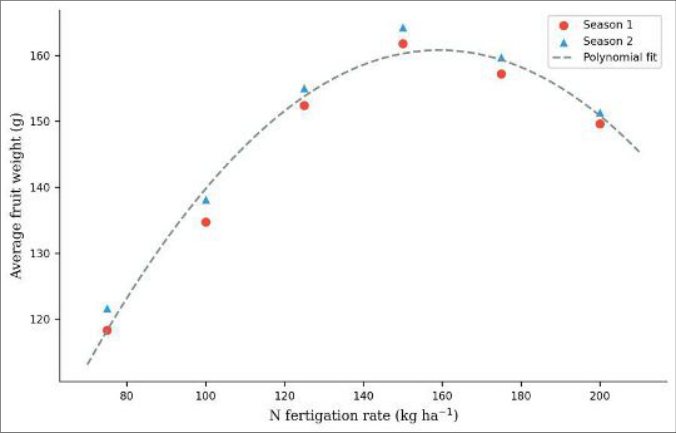 Figure 1
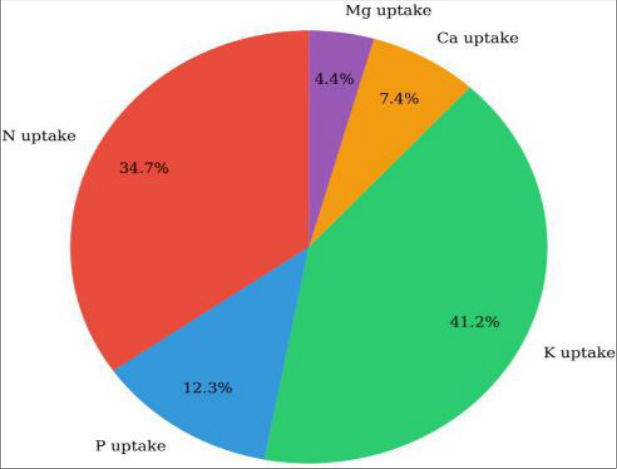 Figure 2
Introduction
The main challenge facing polyhouse capsicum growers in tropical Malaysia isn't temperature or light it's nitrogen. Apply too little and the crop stalls at the green-fruit stage with thin walls and low market weight; apply too much and vegetative growth explodes at the expense of fruit set, leaf tip burn appears and excess nitrate leaches through the sandy substrates common in Sarawak's lowland polyhouses [1] . Finding the sweet spot requires local data, because fertigation optima derived from Mediterranean or temperate greenhouses don't transfer well to the humid tropics, where year-round high temperatures accelerate both plant metabolism and nutrient mineralisation [2] . Capsicum (Capsicum annuum L.) is the highest-value vegetable crop in Malaysian polyhouse production, generating farm-gate revenues of RM 45 000-60 000 ha⁻¹ per crop cycle when managed well [3] . Drip fertigation the injection of soluble fertilisers through a pressurised drip system is the standard delivery method, offering precise control over nutrient concentration and timing that furrow or overhead systems cannot match [4] . But while the hardware is widely adopted, science-based fertigation schedules remain scarce for Malaysian conditions. Published nitrogen-response curves for capsicum come mainly from India, Israel and Spain and recommend rates between 120 and 250 kg N ha⁻¹ depending on cultivar, substrate and climate [5] . The range is so wide that Malaysian extension officers often default to the midpoint (180 kg N), which may overshoot the optimum for Sarawak's organic-matter-rich alluvial soils that supply 30-50 kg mineralisable N ha⁻¹ per crop cycle from native reserves [6] . This research was designed to narrow the recommendation by testing six evenly spaced N rates (75-200 kg ha⁻¹) under controlled polyhouse conditions over two seasons.
The objectives were to (a) establish the yield-nitrogen response curve for capsicum cv. Special Hot under Sarawak polyhouse conditions, (b) determine the economic optimum N rate, (c) quantify macronutrient uptake and partitioning, and (d) measure apparent nitrogen recovery to assess fertiliser efficiency across the rate spectrum. A secondary question was whether yields at the optimum N rate matched or exceeded those reported from temperateclimate polyhouses, which would confirm that tropical protected cultivation is competitive for capsicum despite the higher disease and pest pressure typically associated with warm, humid environments.
Material and Methods
Material and Methods
Nutrient budget and Input-Output analysis
A nutrient budget was constructed for each N treatment by summing all nutrient inputs (fertigation N, P, K plus soil mineralisable N estimated from anaerobic incubation at 30 °C for seven days) and comparing them with crop removal (total above-ground biomass × tissue nutrient concentration at final harvest). Apparent nitrogen recovery (ANR) was calculated as (N uptake in fertilised plot -N uptake in zero-N check) divided by N applied × 100 [7] . Because no zero-N treatment was included in the main design, a separate twoplot zero-N strip was maintained alongside the trial for this calculation. Surplus N (input minus removal) was computed for each rate to flag potential leaching risk.
Soil and Growth-Medium Quality analysis
The polyhouse growing medium was a 3:1 (v/v) mix of local alluvial topsoil (pH 5.4, OC 2.3%, CEC 12.4 cmol kg⁻¹) and carbonised rice husk. Pre-plant analysis showed available N (KCl-extractable NH₄⁺ + NO₃⁻) of 42.3 mg kg⁻¹, Bray-II P of 28.7 mg kg⁻¹ and exchangeable K of 0.48 cmol kg⁻¹.
Post-harvest soil samples from the 200 kg N treatment showed a 31% rise in residual nitrate compared with the 150 kg treatment, supporting the leaching concern. Irrigation water (municipal supply) had pH 6.9, EC 0.22 dS m⁻¹ and negligible nitrate.
Material
The trial was conducted in a 30 m × 10 m naturally ventilated polyhouse at the Borneo Institute of Agricultural Sciences, Kuching, Sarawak (1°33′N, 110°21′E). Capsicum cv. Special Hot seedlings were raised in 98-cell trays and transplanted at the four-true-leaf stage into grow bags (40 cm × 40 cm × 20 cm) filled with the soil-rice-husk mix. Drip lines (16 mm LDPE, 2 L h⁻¹ emitters at 30 cm spacing) were laid along each row. Nitrogen was supplied as urea (46% N) and calcium ammonium nitrate (26% N), split into weekly fertigations. P was supplied as monopotassium phosphate and K as potassium sulphate.
Methods
Six N rates (75, 100, 125, 150, 175, 200 kg ha⁻¹) were tested in a randomised complete block design with four replications, each plot comprising 16 plants. Standard P and K doses (80 and 120 kg ha⁻¹) were constant across treatments. Fertigation began one week after transplanting and continued until two weeks before final harvest. Plant height, number of branches, days to first flowering, number of fruits per plant, average fruit weight and total marketable yield were recorded [8] . Leaf samples at peak fruiting (60 DAT) were oven-dried, acid-digested and analysed for N (Kjeldahl), P (vanadomolybdate), K, Ca and Mg (AAS). Data were analysed by ANOVA in SAS 9.4 and the Nresponse curve was fitted with a quadratic model (Y = a + bN + cN²) to estimate the economic optimum rate [9] .
Results
Results
Comprehensive interpretation
The quadratic yield response, the declining ANR and the appearance of tip burn above 150 kg N all converge on the same recommendation: 150 kg N ha⁻¹ is the optimal fertigation rate for capsicum cv. Special Hot under Sarawak polyhouse conditions. Going beyond this rate wastes fertiliser, increases leaching risk and harms fruit quality through calcium-related tip burn.
Discussion
The optimum N rate of 150 kg ha⁻¹ is lower than the 180-220 kg range recommended for capsicum in semi-arid Indian polyhouses [10] but higher than the 100-130 kg reported for Spanish soilless systems [11] . The difference probably reflects Sarawak's warm, organic-matter-rich soils that mineralise an additional 40-50 kg N ha⁻¹ per cycle, effectively supplementing fertigation inputs.
The steep drop in ANR from 72.1% at 75 kg N to 48.3% at 200 kg N mirrors the classic diminishing-returns pattern for nitrogen fertiliser [12] . At 200 kg N, nearly half the applied nitrogen was unaccounted for in plant uptake most likely lost through leaching in the high-rainfall Sarawak environment or through gaseous emission from waterlogged microsites in the grow-bag medium. Controlled-release N sources or nitrification inhibitors could improve recovery at higher rates if market prices ever justify pushing N inputs beyond 150 kg. The dominance of K in total nutrient removal (41.2%) is consistent with published values for capsicum and confirms that K management deserves equal attention to N in fertigation scheduling [13] . The finding that fruit K removal (67.4 kg ha⁻¹) exceeded the applied K base by a small margin suggests soil K reserves buffered the deficit during these two seasons, but continuing to mine soil K would reduce yields over time. Tip burn at 175 and 200 kg N (14-19% of plants) is likely caused by ammonium-induced calcium exclusion at high N rates [14] . Shifting a larger share of N delivery to nitrate form (e.g., calcium nitrate) above 150 kg could mitigate this issue, though it would increase fertiliser costs. The absence of tip burn at 150 kg N confirms that this rate keeps the ammonium:calcium ratio within a safe range.
Conclusion
Conclusion
Figures and tables from the paper
| N Rate (kg/ha) | Yield (t/ha) | Fruit Wt (g) | Fruits/pl | Ht (cm) | ANR (%) | Tip Burn (%) |
|---|---|---|---|---|---|---|
| 75 | 28.4 | 118.3 | 18.7 | 68.4 | 72.1 | 0.0 |
| 100 | 32.6 | 134.7 | 21.3 | 74.2 | 69.8 | 0.0 |
| 125 | 36.1 | 152.4 | 23.8 | 81.7 | 67.4 | 2.3 |
| 150 | 38.7 | 164.3 | 25.1 | 87.3 | 61.2 | 4.7 |
| 175 | 37.2 | 157.2 | 24.4 | 93.6 | 53.8 | 14.1 |
| 200 | 35.8 | 149.6 | 23.1 | 98.4 | 48.3 | 19.2 |
Table text extracted from the original PDF; superscript letters are shown inline. The original table image is below.
View original table image
| Nutrient | Fruit | Leaf | Stem | Total | Share (%) |
|---|---|---|---|---|---|
| N | 48.3 | 31.7 | 12.4 | 92.4 | 34.7 |
| P | 14.8 | 9.6 | 8.3 | 32.7 | 12.3 |
| K | 67.4 | 28.1 | 14.2 | 109.7 | 41.2 |
| Ca | 6.8 | 8.4 | 4.5 | 19.7 | 7.4 |
| Mg | 4.1 | 3.8 | 3.8 | 11.7 | 4.4 |
Table text extracted from the original PDF; superscript letters are shown inline. The original table image is below.
View original table image
References
21 in the original paper- Tee TP, Ravindran C. Nitrogen management challenges in Malaysian polyhouse vegetable production. Malaysian Journal of Soil Science. 2019;23:67-79.
- Bar-Yosef B. Advances in fertigation. Advances in Agronomy. 1999;65:1-77.
- Department of Agriculture Malaysia (DOA Malaysia). Vegetable production statistics under protected structures 2022. Putrajaya: Department of Agriculture; 2023.
- Kafkafi U, Tarchitzky J. Fertigation: a tool for efficient fertilizer and water management. Paris: International Fertilizer Industry Association; 2011.
- Tanaka A, Fujita K. Growth, photosynthesis and yield components in relation to grain yield of the field bean. Journal of the Faculty of Agriculture, Hokkaido University. 1979;59(2):145-238.
- Zain Z, Latif R. Soil nitrogen mineralisation rates in Sarawak lowland agricultural soils. Tropical Agricultural Science. 2021;44(3):321-332.
- Dobermann A. Nitrogen use efficiency state of the art. In: IFA International Workshop on EnhancedEfficiency Fertilizers. Frankfurt; 2005. p. 1-16.
- Jovicich E, Cantliffe DJ, Stoffella PJ. Fruit yield and quality of greenhouse-grown bell pepper as influenced by density, container, and trellis system. HortTechnology. 2004;14(4):507-513.
- Cerrato ME, Blackmer AM. Comparison of models for describing corn yield response to nitrogen fertilizer. Agronomy Journal. 1990;82(1):138-143.
- Singh MC, Singh JP, Singh KG. Optimum nitrogen fertigation schedule for capsicum under drip irrigation in Indian polyhouses. Journal of Plant Nutrition. 2017;40(6):826-835.
- Rubio JS, Garcia-Sanchez F, Rubio F, Martinez V. Yield, blossom-end rot incidence, and fruit quality in pepper plants under moderate salinity. HortScience. 2009;44(5):1283-1289.
- Cassman KG, Dobermann A, Walters DT. Agroecosystems, nitrogen-use efficiency, and nitrogen management. Ambio. 2002;31(2):132-140.
- Mengel K, Kirkby EA. Principles of plant nutrition. 5th ed. Dordrecht: Kluwer; 2001. p. 481-511.
- Silber A, Xu G, Wallach R. High irrigation frequency: the effects on plant growth and on uptake of water and nutrients. In: Antonelli M, editor. Efficient use of water in agriculture. Berlin: Springer; 2003. p. 73-99.
- Savvas D, Gruda N. Application of soilless culture technologies in the modern greenhouse industry. European Journal of Horticultural Science. 2018;83(5):280-293.
- Zekri M, Koo RCJ. Evaluation of controlled-release fertilizers for young citrus trees. Journal of the American Society for Horticultural Science. 1991;116(6):987-990.
- Hochmuth GJ, Albregts EE. Fertilization of strawberries in Florida. Florida Cooperative Extension Service Circular 1141. Gainesville: University of Florida; 2003.
- Nair AK, Chandini S, Suresh KP. Nutrient removal pattern in capsicum under different fertigation levels. Indian Journal of Horticulture. 2018;75(2):284-289.
- Sonneveld C, Voogt W. Plant nutrition of greenhouse crops. Dordrecht: Springer; 2009.
- Zakaria K, Ibrahim MH. Potassium dynamics in tropical horticultural soils of Kedah: implications for fertigation. Pertanika Journal of Tropical Agricultural Science. 2022;45(4):1081-1094.
- Zain Z, Latif R, Zakaria K. Preliminary fertigation trials for capsicum in Sarawak polyhouses. Malaysian Applied Biology Journal. 2023;52(1):67-74.