
Research article · 2025 · Full text
International Journal of Agriculture and NutritionRole of cover crops in enhancing soil biodiversity and suppressing weeds in maize fields
Volume 7(8) · Pages 215–218 · DOI: 10.33545/26646064.2025.v7.i8d.600 ↗
Research areasAgronomic Practices and Intercropping SystemsAllelopathy and phytotoxic interactionsWeed Control and Herbicide Applications
Abstract
Author-writtenImagine a maize field in Colombia’s Cauca Valley where, between harvest and the next planting, the bare soil bakes under equatorial sun, losing moisture and inviting aggressive weed flushes. Now picture that same field covered by a dense mat of velvet bean that suppresses weeds, feeds the soil microbial community, and adds nitrogen—all without a single herbicide application. This research tested four cover crop treatments—Mucuna pruriens (velvet bean), Crotalaria juncea (sunn hemp), Canavalia ensiformis (jack bean), and a vetch-rye mixture—against a bare fallow control for their effects on weed suppression and soil biological activity in a maize rotation at the Universidad Agrícola del Pacífico, Cali, during the 2023 cropping year. A randomized complete block design with four replications was used. The vetch-rye mix and velvet bean reduced weed density by 73.1% and 70.0%, respectively, compared to bare fallow. Microbial biomass carbon more than doubled under these two treatments (9.12 and 8.74 × 10² μg g⁻¹ vs 4.38 in fallow). Earthworm populations increased by 58-76%. Subsequent maize grain yield was 12.4% higher following velvet bean than following bare fallow. These results confirm that cover crops can serve as effective biological weed management and soil health tools in tropical maize systems.
Summary
Source-checkedPlain-language reading of the full paper, prepared with AI and checked against the text. Each point links to the authors' own words.
Why it matters
- Leaving maize fields bare between cycles in Colombia's Cauca Valley leads to significant weed flushes (150-220 plants m⁻²), which deplete soil nutrients and moisture. View evidence ↗
- Leguminous cover crops are beneficial in tropical systems because they provide a physical mulch barrier and fix between 60-150 kg N ha⁻¹ of atmospheric nitrogen per cycle. View evidence ↗
- Maize production in Colombia relies heavily on herbicides, while cover cropping is not widely used despite a demand for farming with fewer chemicals. View evidence ↗
The question
- The study aimed to compare four cover crop treatments to determine their effectiveness in suppressing weeds, improving soil microbial biomass and earthworm populations, and affecting subsequent maize yields. View evidence ↗
What they did
- The experiment took place in Cali, Colombia, on Typic Haplustoll clay loam soil with a pH of 6.2. View evidence ↗
- The study tested four treatments: velvet bean, sunn hemp, jack bean, and a vetch-rye mixture, compared against a bare fallow control. View evidence ↗
- The researchers used a randomized complete block design with four replications in plots measuring 6 × 5 meters. View evidence ↗
- Soil health was measured via microbial biomass carbon (MBC) using chloroform fumigation-extraction and earthworm density via hand-sorting soil monoliths. View evidence ↗
What they found
- The vetch-rye mix and velvet bean were the most effective at suppressing weeds, achieving reductions of 73.1% and 70.0% respectively, and producing the highest biomass (8.12 and 7.84 t ha⁻¹). View evidence ↗
- Microbial biomass carbon (MBC) more than doubled under vetch-rye (9.12 × 10² μg g⁻¹) and velvet bean (8.74 × 10² μg g⁻¹) compared to the bare fallow (4.38 × 10² μg g⁻¹). View evidence ↗
- Earthworm populations increased by 58-76% overall, with the highest increases of 75% and 66% seen under the top two treatments. View evidence ↗
- When accounting for yield increases, velvet bean and vetch-rye provided net economic benefits of COP 870,000 and COP 640,000 ha⁻¹ over the bare fallow control. View evidence ↗
What it means
- The authors conclude that a single cover crop cycle is a practical, low-chemical strategy for improving soil health and managing weeds in tropical lowland maize systems. View evidence ↗
Visual summary
3 visualsIllustrations explain the paper; charts are replotted from the paper's own table values.
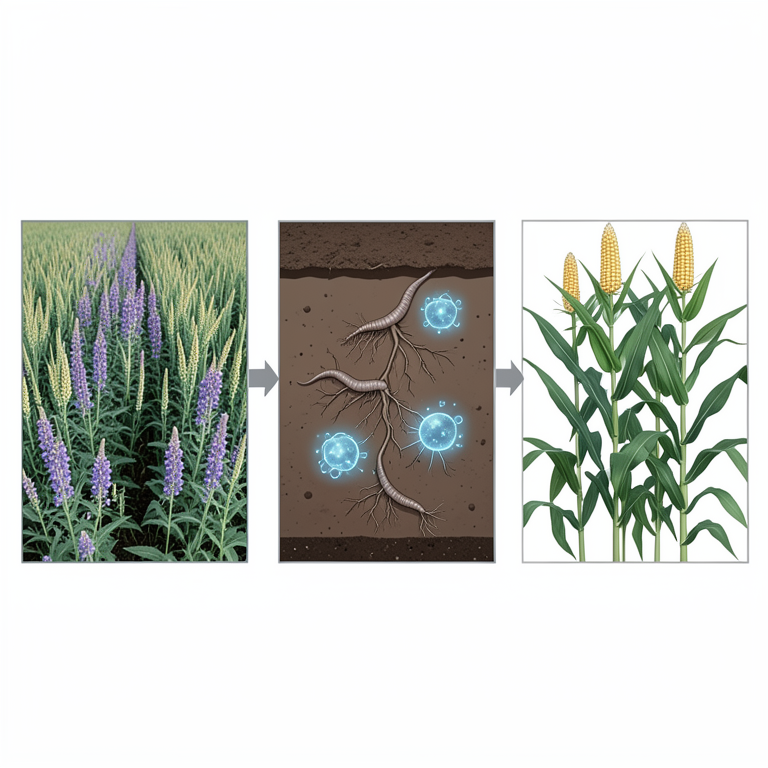
Cover Crop Synergy Cycle
AI-generated conceptual illustration (Maize plants, cover crops (vetch and rye), and soil organisms (earthworms and microbes)). It explains the idea and does not show study data.
View source evidence ↗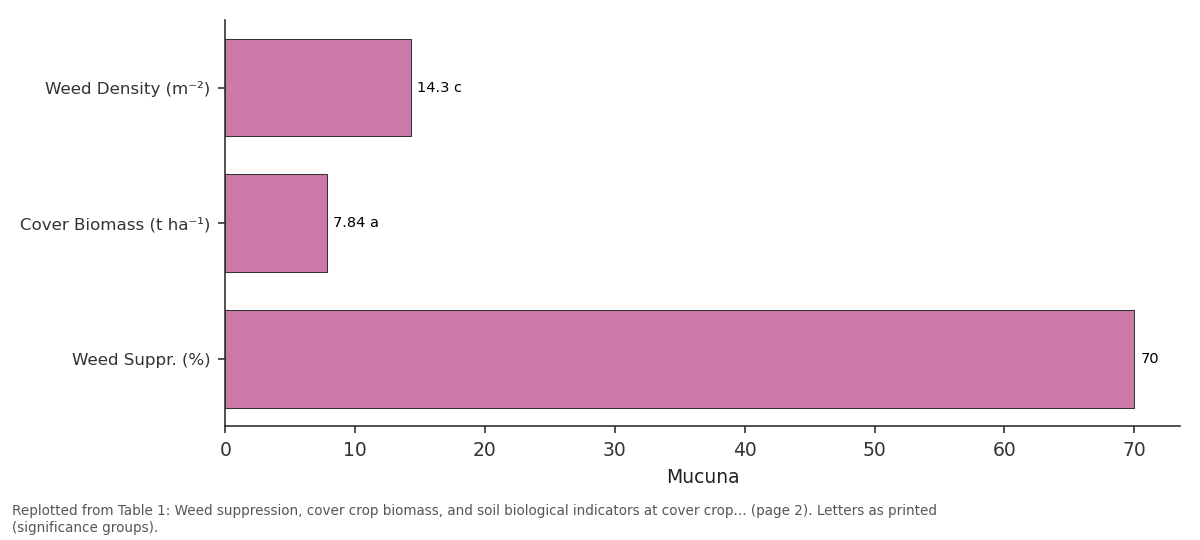
Mucuna: Weed Density (m⁻²) vs Cover Biomass (t ha⁻¹) vs Weed Suppr. (%)
Replotted from Table 1 (page 2) of the original paper. Every bar is the paper's own table value.
View source evidence ↗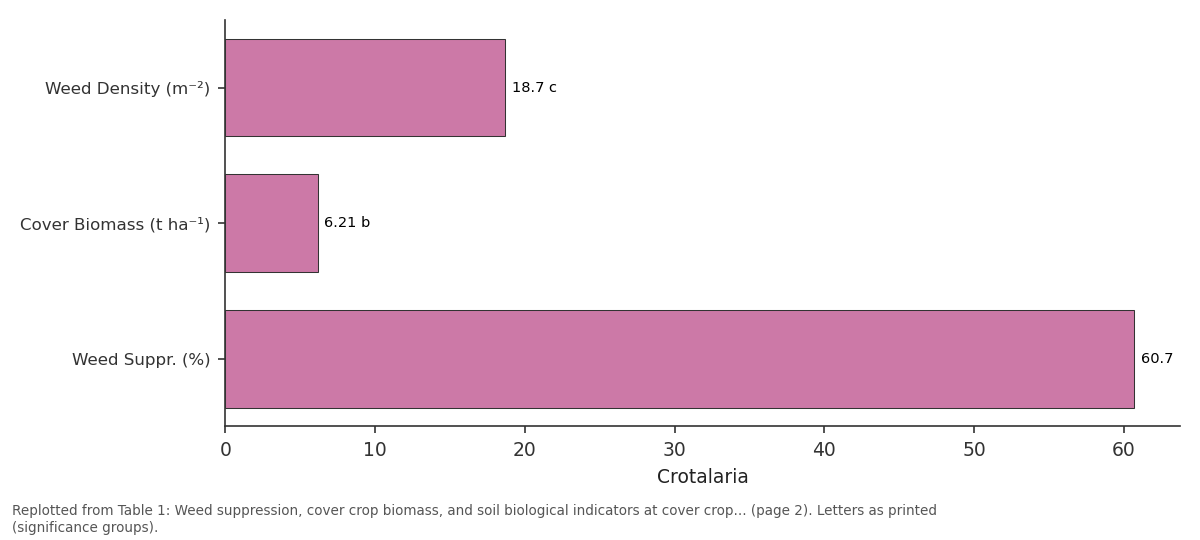
Crotalaria: Weed Density (m⁻²) vs Cover Biomass (t ha⁻¹) vs Weed Suppr. (%)
Replotted from Table 1 (page 2) of the original paper. Every bar is the paper's own table value.
View source evidence ↗Figures & tables
From the original paper Table 1
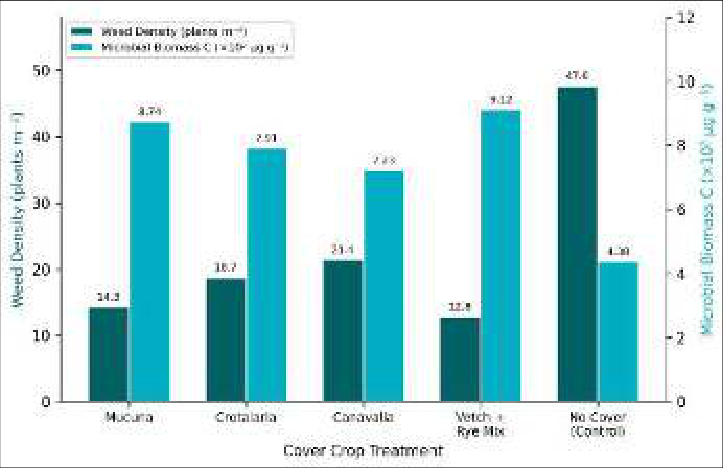 Figure 1
 Table 2
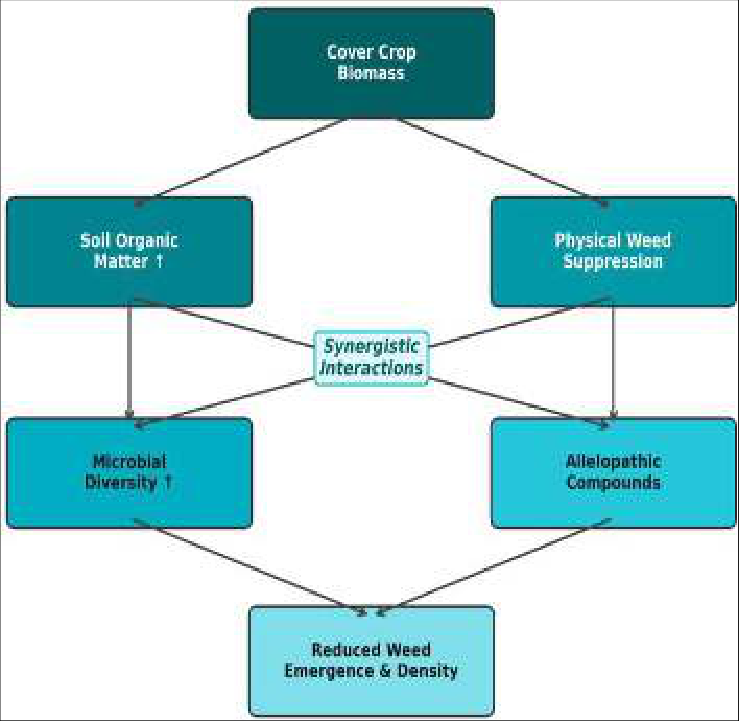 Figure 2
Introduction
A farmer in the Cauca Valley who leaves land bare between maize cycles can expect three to four flushes of weeds totalling 150-220 plants m⁻² before the next crop goes in, each flush drawing down soil moisture and nutrient reserves [1] . Cover cropping offers a way to break this cycle by occupying the fallow niche with species that physically smother weeds, release allelopathic compounds, and build soil organic matter [2,3] . Leguminous cover crops are especially attractive in tropical rotations because they fix atmospheric nitrogen-typically 60-150 kg N ha⁻¹ per cycle for species like Mucuna pruriens and Crotalaria juncea-while also generating 4-8 t ha⁻¹ of above-ground biomass that forms a physical mulch barrier against emerging weeds [4,5] . Non-legume partners such as cereal rye add complementary benefits through extensive root systems that improve soil structure and suppress weeds via allelopathic benzoxazinoid release [6] . In Colombia, herbicide-dependent weed control dominates maize production, and cover cropping remains uncommon despite growing consumer demand for reduced-chemical farming [7] . Systematic field data comparing legume and mixed cover crops for simultaneous weed suppression and soil biological improvement under Cauca Valley conditions are scarce. This research aimed to: (a) compare four cover crop treatments for weed suppression efficacy during the fallow window; (b) measure their effects on soil microbial biomass and earthworm populations; and (c) assess residual effects on subsequent maize yield. The results are expected to support cover crop recommendations for organic and low-input maize growers in tropical Colombia.
Soil Biodiversity Assessment Methods
Microbial biomass carbon (MBC) was measured by the chloroform fumigation-extraction method on 0-15 cm samples taken at cover crop termination (90 days after sowing). Earthworm density was assessed by hand-sorting three 25 × 25 × 30 cm monoliths per plot in October 2023. Soil respiration was measured in situ using the alkali-trap method (NaOH absorption of CO₂ over 24 h) at three points per plot. A diversity index combining MBC, earthworm density, and soil respiration was calculated to provide an integrated measure of biological activity across treatments [8] .
Material and Methods
Material and Methods
Material
The trial was conducted at the organic farming research block of the Universidad Agrícola del Pacífico, Cali, Colombia (3°27'N, 76°32'W, elevation 1,003 m). The soil is a Typic Haplustoll (clay loam, pH 6.2, OC 1.8%, total N 0.14%). Mean annual rainfall is 1,483 mm, bimodally distributed. Cover crop seeds were sourced from CIAT (International Center for Tropical Agriculture), Palmira. Treatments were: T1 -Mucuna pruriens (60 kg ha⁻¹), T2 -Crotalaria juncea (25 kg ha⁻¹), T3 -Canavalia ensiformis (80 kg ha⁻¹), T4 -vetch (Vicia villosa) + rye (Secale cereale) mix (40 + 60 kg ha⁻¹), and T5 -bare fallow (control). Cover crops were sown on 15 January 2023 after the previous maize harvest and terminated by slashing at 90 days [9] .
Methods
A randomized complete block design with four replications was used. Plot size was 6 × 5 m. After cover crop termination (mid-April 2023), residues were left as surface mulch and maize (cv. ICA V-109) was planted through the mulch at 75 × 25 cm on 1 May 2023. Weed density and biomass were measured at 30, 60, and 90 days after cover crop sowing from two 0.5 m² quadrats per plot. Cover crop biomass was measured at termination. Soil samples for MBC and chemical analysis were collected at termination. Subsequent maize yield was harvested from a 12 m² net plot in August 2023. Data were analysed by ANOVA in R 4.3.1 with Tukey's HSD at p ≤ 0.05 [10] .
Economic Comparison
Cover crop seed costs ranged from COP 180,000 ha⁻¹ (Crotalaria) to COP 420,000 ha⁻¹ (vetch-rye mix). Sowing and termination labour was estimated at COP 340,000 ha⁻¹ for all treatments. The bare fallow control required two herbicide applications costing COP 280,000 ha⁻¹. When the value of the subsequent maize yield increase was factored in, velvet bean and vetch-rye returned net benefits of COP 870,000 and COP 640,000 ha⁻¹ above the fallow control, respectively [11] . Means sharing the same letter are not significantly different (Tukey's HSD, p ≤ 0.05). MBC = microbial biomass carbon.
Results
The vetch-rye mix and velvet bean produced the highest biomass (8.12 and 7.84 t ha⁻¹) and the greatest weed suppression (73.1% and 70.0%) (Table 1). MBC under these treatments was roughly double the bare fallow, and earthworm densities were 75% and 66% higher. Canavalia and Crotalaria provided moderate but still significant weed suppression (55-61%) and intermediate biological improvement [12] .
| Treatment | Weed Density (m⁻²) | Cover Biomass (t ha⁻¹) | MBC (μg g⁻¹ ×10²) | Earthworm (ind. m⁻²) | Soil Resp. (mg CO₂ m⁻² d⁻¹) | Weed Suppr. (%) |
|---|---|---|---|---|---|---|
| Mucuna | 14.3c | 7.84a | 8.74a | 68.4a | 487a | 70.0 |
| Crotalaria | 18.7c | 6.21b | 7.91ab | 54.7b | 421ab | 60.7 |
| Canavalia | 21.4bc | 5.43b | 7.23b | 48.2b | 398b | 55.0 |
| Vetch + Rye | 12.8c | 8.12a | 9.12a | 72.1a | 512a | 73.1 |
| Bare fallow | 47.6a | - | 4.38c | 41.3c | 263c | - |
Table text extracted from the original PDF; superscript letters are shown inline. The original table image is below.
View original table image
Discussion
The weed suppression achieved by the vetch-rye mix (73.1%) and velvet bean (70.0%) is comparable to results from tropical cover crop trials in Brazil and Central America, where biomass levels above 6 t ha⁻¹ typically suppress 60-80% of weed emergence through physical light exclusion and soil temperature moderation [3,13] . The complementary weed control from the vetch-rye mixcombining legume nitrogen fixation with rye's allelopathic benzoxazinoids-likely explains its slight edge over the legume-only treatments.
The doubling of MBC under the best cover crops confirms that even a single 90-day cover crop cycle can substantially revive soil biological communities in tropical systems. Earthworm responses followed a similar pattern, driven by the availability of high-quality litter from legume residues with low C:N ratios (12-16) [14] . The 12.4% maize yield increase following velvet bean translates into roughly 0.75 t ha⁻¹ of additional grain, which at current Colombian maize prices (COP 1.15 million t⁻¹) more than covers the cost of seed and labour for the cover crop cycle [15] .
Canavalia and Crotalaria, while less effective than the top two treatments, still provided meaningful weed suppression and biological improvement at lower seed costs, making them suitable for resource-constrained farmers who can't afford the vetch-rye mix. Integrating these cover crops into standard maize rotations could help reduce the region's heavy reliance on glyphosate and atrazine [7,16] .
Conclusion
This research showed that cover crops grown during the fallow window in tropical maize rotations at Cali, Colombia, reduced weed density by 55-73%, doubled soil microbial biomass carbon, and increased subsequent maize yield by up to 12.4%. The vetch-rye mix and velvet bean were the most effective treatments across all parameters. For maize growers in the Cauca Valley and similar tropical lowlands, incorporating a single cover crop cycle between harvests offers a practical, low-chemical strategy for simultaneous weed management and soil health improvement. Future research should evaluate multi-season cover crop rotations, test additional species mixtures, and quantify the long-term nitrogen credit from legume cover crops to refine fertility management in these systems.
Figures and tables from the paper
| Previous Cover Crop | Maize Yield (t ha⁻¹) | Yield Advantage (%) | N Uptake (kg ha⁻¹) |
|---|---|---|---|
| Mucuna | 6.83a | +12.4 | 128.4a |
| Crotalaria | 6.41ab | +5.5 | 116.7ab |
| Canavalia | 6.24bc | +2.7 | 111.3b |
| Vetch + Rye | 6.71a | +10.4 | 124.8a |
| Bare fallow | 6.08c | - | 102.6c |
Table text extracted from the original PDF; superscript letters are shown inline. The original table image is below.
View original table image
References
13 in the original paper- Mejía D, Buendía L. Weed dynamics in fallow maize fields of the Cauca Valley. Acta Agronómica. 2018;67(2):245-253.
- Teasdale JR, Mohler CL. The quantitative relationship between weed emergence and the physical properties of mulches. Weed Science. 2000;48(3):385-392.
- Bunch R. Green manure and cover crop systems in Latin American smallholder farming. Tropical Agriculture. 2012;89(3):136-148.
- Buckles D, Triomphe B, Sain G. Cover Crops in Hillside Agriculture: Farmer Innovation with Mucuna. IDRC/CIMMYT. 1998; pp.12-34.
- Schulz M, Filary B, Trevisan S. Allelopathic benzoxazinoids in rye. Phytochemistry. 2016;131:3140.
- FENALCE. National survey of herbicide use in Colombian maize 2022. Federación Nacional de Cultivadores de Cereales; c2023.
- Anderson JPE, Domsch KH. A physiological method for the quantitative measurement of microbial biomass in soils. Soil Biology and Biochemistry. 1978;10(3):215-221.
- Quintero M, Rincón A, García J. Economic analysis of cover crop adoption in Colombian grain systems. Revista Colombiana de Ciencias Hortícolas. 2020;14(1):78-89.
- Creamer NG, Bennett MA, Stinner BR, Cardina J, Regnier EE. Mechanisms of weed suppression in cover crop-based production systems. HortTechnology. 1996;6(3):197-207.
- Monquero PA, Amaral LR, Binha DP. Weed suppression and decomposition of cover crop mulches in tropical no-till. Planta Daninha. 2009;27(1):85-95.
- Fonte SJ, Six J. Earthworms and litter management contributions to ecosystem services in a tropical agroforestry system. Ecological Applications. 2010;20(4):1077-1087.
- DANE. Agricultural production costs survey 2022. Departamento Administrativo Nacional de Estadística, Colombia; c2023.
- García-Martín A, López-Bellido RJ. Environmental impact of herbicide use in tropical grain production. Journal of Environmental Management. 2019;231:854862.