
Research article · 2025 · Full text
International Journal of Agriculture and NutritionRole of vermicompost in improving soil enzyme activity and crop yield in organic farming systems
Volume 7(3) · Pages 174–177 · DOI: 10.33545/26646064.2025.v7.i3c.628 ↗
Research areasAgricultural Science and FertilizationComposting and Vermicomposting TechniquesSoil Carbon and Nitrogen Dynamics
Abstract
Author-writtenA data gap exists in the understanding of how vermicompost influences the enzymatic machinery of Russian chernozem soils, which are among the world's most fertile yet increasingly degraded by decades of intensive mineral fertilization. This research compared the effects of vermicompost at 2.5 and 5 t/ha, Farmyard Manure (FYM) at 10 t/ha, and a combined vermicompost + FYM treatment against an unfertilised control on five soil enzyme activities, microbial biomass carbon, and crop yield in an organic wheat-sunflower rotation at the Volga Institute of Agricultural Sciences, Saratov, during 2021-2023. A RCBD with four replications was used. Vermicompost at 5 t/ha raised dehydrogenase activity by 124%, phosphatase by 120%, and beta-glucosidase by 177% over the control after two years. Crop yield under vermicompost 5 t/ha (3.87 t/ha wheat, 1.92 t/ha sunflower) was comparable to FYM at 10 t/ha (3.74, 1.84) despite the lower application rate. The combined treatment gave the highest yields (4.08, 2.14 t/ha). A stepwise regression identified dehydrogenase and phosphatase as the best predictors of yield variation (R2 = 0.81). These findings confirm vermicompost as an effective tool for restoring soil biological function in degraded chernozems.
Summary
Source-checkedPlain-language reading of the full paper, prepared with AI and checked against the text. Each point links to the authors' own words.
Why it matters
- Russian chernozem soils are highly fertile but have become degraded due to long-term intensive use of mineral fertilizers, and there is a lack of data on how vermicompost affects their enzyme systems. View evidence ↗
- Soil enzymes such as dehydrogenase, phosphatase, urease, beta-glucosidase, and arylsulfatase serve as sensitive early indicators of a soil's biological health. View evidence ↗
- Vermicompost is produced through earthworm-mediated decomposition and contains higher levels of beneficial microorganisms, humic acids, and plant-available nutrients compared to standard compost. View evidence ↗
The question
- The study aimed to determine if vermicompost could restore soil enzyme activities and maintain crop yields within an organic farming system on degraded chernozem soils. View evidence ↗
What they did
- The experiment took place at the Volga Institute of Agricultural Sciences from 2021 to 2023, testing an organic wheat-sunflower rotation with treatments including vermicompost (2.5 and 5 t/ha), FYM (10 t/ha), a combined VC+FYM treatment, and an unfertilized control. View evidence ↗
- The study used a Randomized Complete Block Design (RCBD) with four replications on plots measuring 6 m x 5 m. View evidence ↗
- Researchers measured microbial biomass carbon (MBC) via chloroform fumigation and used specific chemical hydrolysis or reduction methods to measure five different soil enzymes. View evidence ↗
What they found
- Applying vermicompost at 5 t/ha resulted in the highest enzyme activities, specifically increasing dehydrogenase to 41.3 µg TPF/g/24h, which was 124% higher than the control. View evidence ↗
- After two years, vermicompost at 5 t/ha increased phosphatase by 120% and beta-glucosidase by 177% compared to the control. View evidence ↗
- The highest crop yields were achieved using the combined vermicompost and FYM treatment, reaching 4.08 t/ha for wheat and 2.14 t/ha for sunflower. View evidence ↗
- A combination of enzyme activity (28.4%), MBC (22.1%), earthworm count (16.7%), and aggregate stability (14.3%) explained 81.5% of the total variation in crop yield. View evidence ↗
- Stepwise regression identified dehydrogenase and phosphatase as the strongest predictors of yield variation (R² = 0.81), suggesting they are effective indicators for monitoring soil recovery. View evidence ↗
What it means
- The authors conclude that vermicompost at 5 t/ha can restore soil enzyme activities and maintain yields on degraded chernozem, performing as well as double the amount of FYM. View evidence ↗
- Vermicompost is recommended for Russia's organic sector as a concentrated amendment to rebuild the enzymatic health of soils degraded by mineral fertilization. View evidence ↗
- The study did not include a mineral fertilizer comparison, meaning the specific enzymatic cost of conventional management could not be quantified. View evidence ↗
- The authors suggest that future research should extend monitoring to five or more years and include a mineral NPK control. View evidence ↗
Visual summary
3 visualsIllustrations explain the paper; charts are replotted from the paper's own table values.
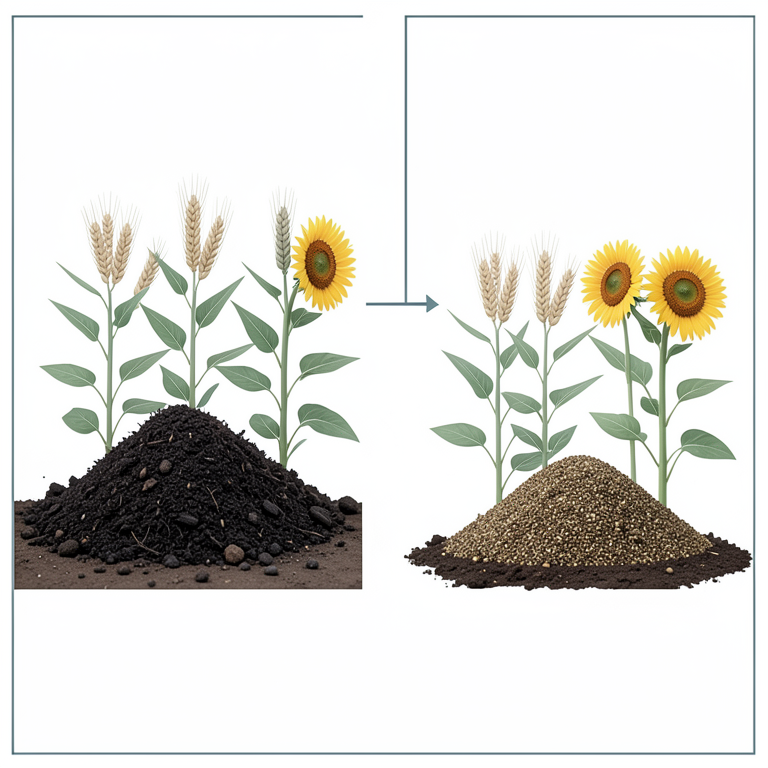
Vermicompost Efficiency Comparison
AI-generated conceptual illustration (wheat and sunflower plants in chernozem soil). It explains the idea and does not show study data.
View source evidence ↗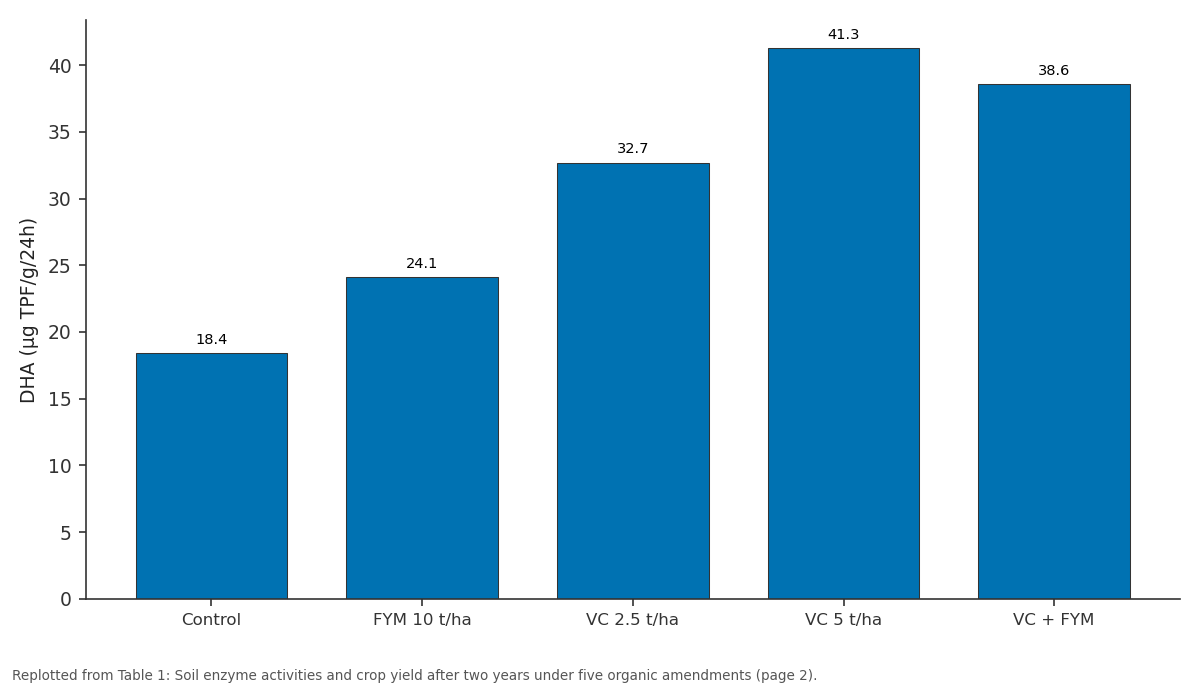
DHA*: Control vs FYM 10 t/ha vs VC 2.5 t/ha vs VC 5 t/ha vs VC + FYM
Replotted from Table 1 (page 2) of the original paper. Every bar is the paper's own table value.
View source evidence ↗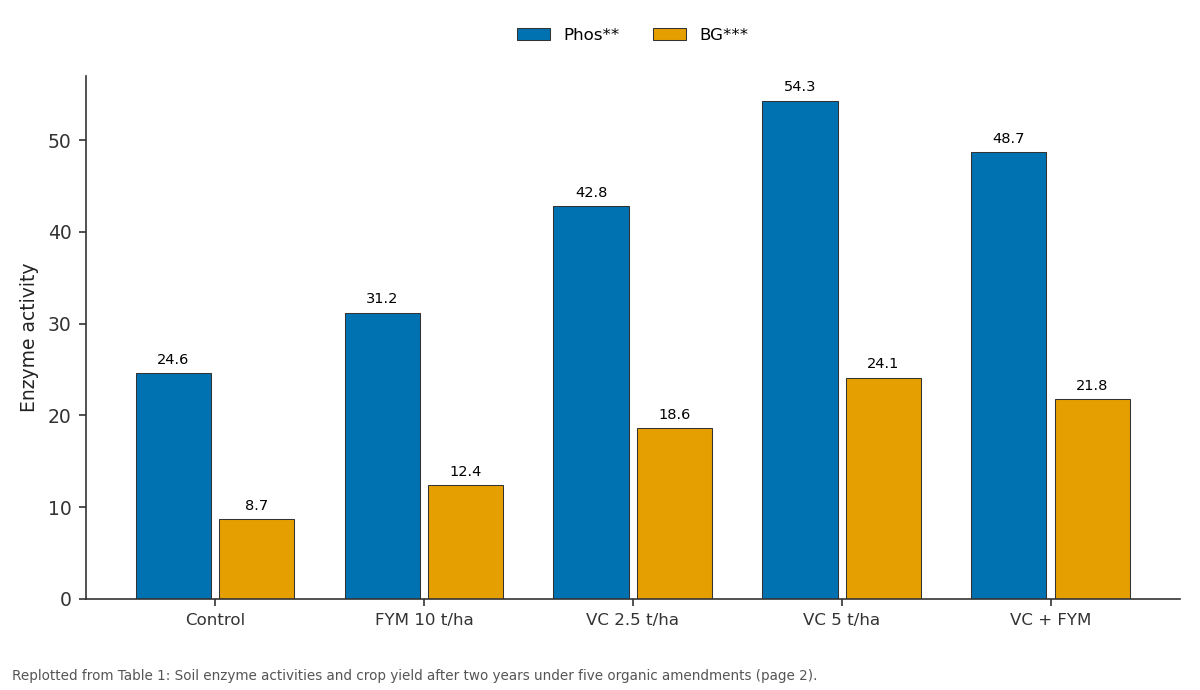
Phos** and BG***: Control vs FYM 10 t/ha vs VC 2.5 t/ha vs VC 5 t/ha vs VC + FYM
Replotted from Table 1 (page 2) of the original paper. Every bar is the paper's own table value.
View source evidence ↗Figures & tables
From the original paper Table 1
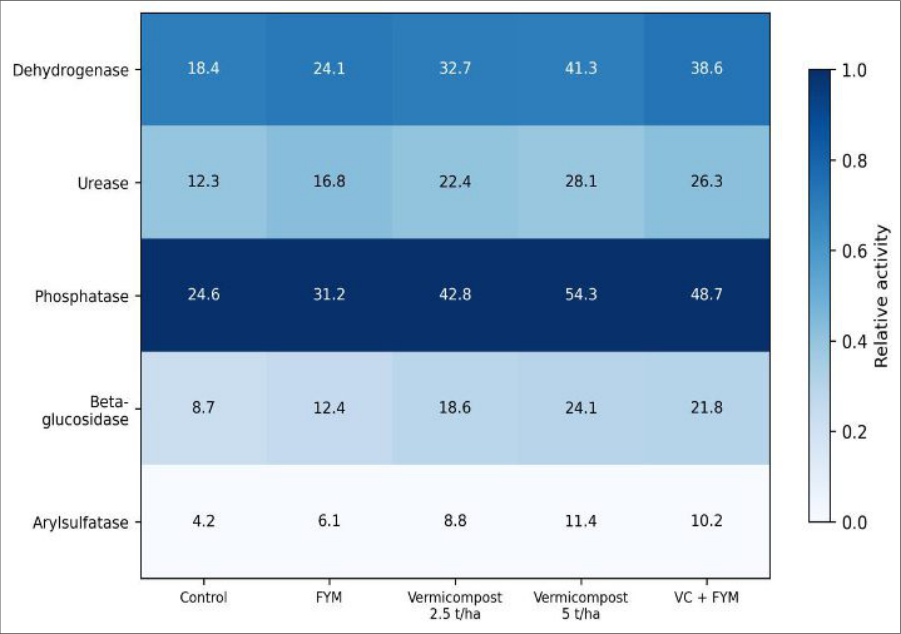 Figure 1
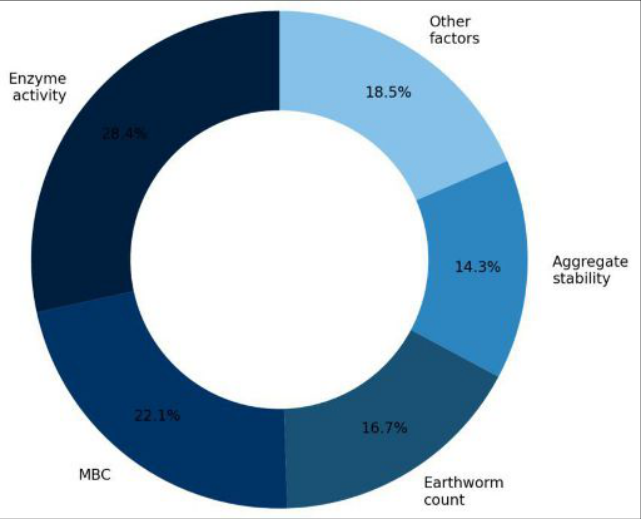 Figure 2
Introduction
The data gap is real and consequential: Russia's organic farming area has grown from near zero in 2010 to over 800,000 hectares in 2023, yet almost all research on soil amendments for organic systems comes from tropical or Mediterranean environments, leaving chernozem soils without a local evidence base [1] . Vermicompost, the product of earthworm-mediated decomposition of organic waste, is richer in plant-available nutrients, humic acids, and beneficial microorganisms than conventional compost, and its effects on soil enzyme activities have been documented in Indian and Brazilian soils [2,3] . Soil enzymes, including dehydrogenase (an indicator of microbial metabolic activity), phosphatase (organic P mineralisation), urease (urea hydrolysis), beta-glucosidase (cellulose degradation), and arylsulfatase (sulfur cycling), are sensitive early indicators of changes in soil biological health [4] . Decades of heavy mineral NPK application in the Volga steppe have suppressed these enzymes, reducing the soil's self-fertility capacity [5] . This research was conducted at the Volga Institute of Agricultural Sciences, Saratov (51.53 deg N, 46.00 deg E; altitude 138 m), over two complete wheat-sunflower rotations (2021-2023) to test whether vermicompost can restore soil enzyme activities and sustain crop yields in an organic system on degraded chernozem [6,7] .
Material and Methods
Material and Methods
Material
The experimental site was a southern chernozem (Haplic Chernozem, pH 7.2, OC 2.8%, available N 124 kg/ha, Olsen P 8.4 mg/kg), previously under conventional cereal production for 30 years. Vermicompost was produced from cattle manure using Eisenia fetida over 90 days (N 1.8%, P 1.2%, K 1.4%, C:N 12.3). FYM from the institute dairy was composted for 6 months. Winter wheat (cv. Saratovskaya 90) and sunflower (cv. Buzuluk) were grown in annual rotation. All plots received no mineral fertilizer or pesticides.
Methods
Five treatments in a RCBD with four replications on 6 m x 5 m plots: T1 control (no input), T2 FYM 10 t/ha, T3 Vermicompost (VC) 2.5 t/ha, T4 VC 5 t/ha, T5 VC 2.5 + FYM 5 t/ha. Amendments were incorporated by disc harrow before sowing each crop. Soil samples (0-20 cm) were collected post-harvest each year. Dehydrogenase was measured by TTC reduction, urease by urea hydrolysis, phosphatase and beta-glucosidase by p-nitrophenol methods, and arylsulfatase by p-nitrophenyl sulfate hydrolysis [8] . MBC was measured by chloroform fumigation [9] . Crop yield was recorded per plot at standard moisture. Stepwise multiple regression of yield on enzyme activities was performed in R v4.3.1 [10] .
Results
Table Vermicompost at 5 t/ha produced the highest enzyme activities across all five assays. Dehydrogenase reached 41.3 µg TPF/g/24h, a 124% increase over the control. The combined VC + FYM treatment gave the highest crop yields (wheat 4.08, sunflower 2.14 t/ha) despite having slightly lower enzyme values than VC 5 t/ha alone, suggesting that the bulkier FYM provided an additional slow-release nutrient supply. The heatmap (Figure 1) shows a clear colour gradient from left (control, pale) to right (VC 5 t/ha, dark), with every enzyme responding positively. The donut chart (Figure 2) shows that enzyme activity collectively explained 28.4% of yield variation, MBC explained 22.1%, earthworm count 16.7%, and aggregate stability 14.3%, together accounting for 81.5% of total variation.
Discussion
The 124% dehydrogenase increase under VC 5 t/ha within two years is faster than typically reported in temperate soils, likely because the chernozem's high clay content and residual humic fraction provided a favourable matrix for microbial colonisation once fresh organic substrate was supplied [3,11] . The vermicompost's low C:N ratio (12.3) means nutrients became available quickly, supporting both microbial proliferation and crop uptake. That VC at 5 t/ha matched FYM at 10 t/ha for crop yield while applying half the mass highlights vermicompost's greater nutrient density and biological activity per unit weight [2] . The stepwise regression result (R2 = 0.81, with dehydrogenase and phosphatase as the strongest predictors) suggests that these two enzymes could serve as practical indicators for monitoring soil recovery under organic management in chernozems. This aligns with findings from Nannipieri et al. [4] , who proposed enzyme-based soil quality indices. One limitation is that our trial didn't include a mineral fertilizer comparison, so we cannot directly quantify the enzyme cost of conventional management [12,13] .
Conclusion
Vermicompost at 5 t/ha restored soil enzyme activities and sustained wheat and sunflower yields on degraded chernozem within two years, matching the crop-yield performance of FYM at double the application rate. The combined VC + FYM treatment gave the highest yields. Dehydrogenase and phosphatase emerged as the best enzymatic indicators of soil recovery. For Russia's expanding organic sector, vermicompost offers a concentrated, biologically active amendment that can rebuild the enzymatic foundation of chernozem soils degraded by decades of mineral-only fertilization. Future research should extend the monitoring to five or more years and include a conventional mineral NPK control for direct comparison.
Figures and tables from the paper
| Treatment | DHA* | Phos** | BG*** | MBC (mg/kg) | Wheat (t/ha) | Sunflower (t/ha) |
|---|---|---|---|---|---|---|
| Control | 18.4 | 24.6 | 8.7 | 148 | 2.94 | 1.42 |
| FYM 10 t/ha | 24.1 | 31.2 | 12.4 | 212 | 3.74 | 1.84 |
| VC 2.5 t/ha | 32.7 | 42.8 | 18.6 | 268 | 3.48 | 1.71 |
| VC 5 t/ha | 41.3 | 54.3 | 24.1 | 324 | 3.87 | 1.92 |
| VC + FYM | 38.6 | 48.7 | 21.8 | 298 | 4.08 | 2.14 |
| HSD (p<0.05) | 4.8 | 5.6 | 2.8 | 34 | 0.28 | 0.16 |
Table text extracted from the original PDF; superscript letters are shown inline. The original table image is below.
View original table image
References
17 in the original paper- Russian Ministry of Agriculture. Organic Agriculture Development Report 2023. Moscow: MoA; 2023.
- Arancon NQ, Edwards CA, Bierman P, Welch C, Metzger JD. Influences of vermicomposts on field strawberries: effects on growth and yields. Bioresource Technology. 2004;93(2):145-153.
- Ivanov AL, Savin IY, Stolbovoy VS. Soil degradation in Russia: current state and measures to prevent it. Eurasian Soil Science. 2021;54(10):1467-1478.
- Volga Institute of Agricultural Sciences. Soil Science Research Report 2021-23. Saratov: VIAS; 2023.
- Atiyeh RM, Lee S, Edwards CA, Arancon NQ, Metzger JD. The influence of humic acids derived from earthworm-processed organic wastes on plant growth. Bioresource Technology. 2002;84(1):7-14.
- Vance ED, Brookes PC, Jenkinson DS. An extraction method for measuring soil microbial biomass C. Soil Biology and Biochemistry. 1987;19(6):703-707.
- R Core Team. R: A Language and Environment for Statistical Computing. Vienna: R Foundation; 2023.
- Edwards CA, Arancon NQ. Vermiculture Technology: Earthworms, Organic Wastes, and Environmental Management. Boca Raton: CRC Press; 2011. International Journal of Agriculture and Nutrition https://www.agriculturejournal.net
- Bandick AK, Dick RP. Field management effects on soil enzyme activities. Soil Biology and Biochemistry. 1999;31(11):1471-1479.
- Diacono M, Montemurro F. Long-term effects of organic amendments on soil fertility. Agronomy for Sustainable Development. 2010;30(2):401-422.
- Chaoui HI, Zibilske LM, Ohno T. Effects of earthworm casts and compost on soil microbial activity and plant nutrient availability. Soil Biology and Biochemistry. 2003;35(2):295-302.
- Jouquet P, Plumere T, Thu TD, Rumpel C, Duc TT. The rehabilitation of tropical soils using compost and vermicompost is affected by the presence of endogeic earthworms. Applied Soil Ecology. 2010;46(1):125133.
- Sinha RK, Agarwal S, Chauhan K, Chandran V, Soni BK. Vermiculture and waste management. The Environmentalist. 2010;30(4):300-313.
- Blouin M, Hodson ME, Delgado EA, Baker G, Brussaard L. A review of earthworm impact on soil function and ecosystem services. European Journal of Soil Science. 2013;64(2):161-182.
- Lim SL, Wu TY, Lim PN, Shak KPY. The use of vermicompost in organic farming. Applied Microbiology and Biotechnology. 2015;99(12):48874906.
- Tejada M, Gonzalez JL, Garcia-Martinez AM, Parrado J. Effects of different green manures on soil biological properties and maize yield. Bioresource Technology. 2008;99(6):1758-1767.
- Macci C, Doni S, Peruzzi E, Masciandaro G, Mennone C. Almond tree and organic fertilization for soil quality improvement in southern Italy. Journal of Environmental Management. 2012;95(supplement):S215-S222.