
Research article · 2026 · Full text
International Journal of Agriculture and NutritionComparative Assessment of Prominent Crop Residue Machines in Panipat District of Haryana
Volume 8(4) · Pages 60–64 · DOI: 10.33545/26646064.2026.v8.i4a.591 ↗
Research areasSoil Management and Crop YieldAgricultural Engineering and MechanizationAgricultural Economics and Practices
Abstract
Author-writtenThis study evaluated the performance of three prominent crop residue management (CRM) machines-Conventional Rotavator, Zero Tillage, and Super Seeder-in District Panipat. Data collected from 10 farmers per machine were analyzed for grain yield, straw yield, cost of cultivation, gross and net returns, and benefit-cost (B:C) ratio. Zero tillage demonstrated superior agronomic and economic performance, with the highest average grain yield (54.3 q/ha), straw yield (41.5 q/ha), and lowest cost of cultivation (Rs. 34,603/ha). It also achieved the highest gross returns (Rs. 136,064/ha), net returns (Rs. 101,461/ha), and B:C ratio (3.93), indicating better profitability and sustainability of this treatment. The super seeder showed competitive yields and returns but incurred slightly higher costs, resulting in a moderate B:C ratio (3.70). The conventional rotavator lagged behind in terms of productivity and economic returns. Variability in zero tillage outcomes suggests adaptability to diverse conditions and the potential for optimization. These findings advocate the promotion of zero tillage technology to enhance crop productivity, economic returns, and sustainable residue management in the region.
Summary
Source-checkedPlain-language reading of the full paper, prepared with AI and checked against the text. Each point links to the authors' own words.
Why it matters
- Crop residue management (CRM) is essential for sustainable agriculture because it affects soil health, environmental quality, and crop productivity. View evidence ↗
- Traditional CRM methods, such as using rotavators, can be problematic as they increase costs, degrade soil structure, and contribute to environmental issues like residue burning. View evidence ↗
- Zero tillage is a promising alternative that preserves soil structure and reduces fuel and labor costs by eliminating plowing. View evidence ↗
The question
- The study aimed to compare the performance of three crop residue management machines, Conventional Rotavator, Zero Tillage, and Super Seeder, in the Panipat District. View evidence ↗
What they did
- The research was conducted across various villages and blocks in the Panipat District, including Samalkha, Israna, Matlauda, Panipat, and Bapoli. View evidence ↗
What they found
- Zero tillage produced the highest average grain yield at 54.3 q/ha, compared to 53.3 q/ha for the super seeder and 50.3 q/ha for the conventional rotavator. View evidence ↗
- Zero tillage also achieved the highest average straw yield (41.5 q/ha), followed by the super seeder (41.2 q/ha) and the conventional method (38.9 q/ha). View evidence ↗
- Zero tillage had the lowest average cost of cultivation at Rs. 34,603/ha, while the super seeder and conventional rotavator cost Rs. 36,252/ha and Rs. 36,336/ha, respectively. View evidence ↗
- Zero tillage yielded the highest average gross returns (Rs. 136,064/ha), followed by the super seeder (Rs. 133,896/ha) and the conventional rotavator (Rs. 126,285/ha). View evidence ↗
- Net returns were highest for zero tillage (Rs. 101,461/ha), compared to the super seeder (Rs. 97,644/ha) and the conventional method (Rs. 89,949/ha). View evidence ↗
- Zero tillage showed the best economic efficiency with a benefit-cost ratio of 3.93, which was higher than the super seeder (3.70) and the conventional rotavator (3.48). View evidence ↗
- Zero tillage showed the most variability in grain yield (51.5 to 57.3 q/ha) and net returns (Rs. 96,405 to Rs. 109,100/ha), suggesting it is adaptable to different field conditions. View evidence ↗
What it means
- The authors conclude that zero tillage is the most economically viable and agronomically efficient CRM practice among the three machines tested in Panipat. View evidence ↗
- The authors recommend promoting zero tillage technology to increase farm income, crop productivity, and environmental sustainability. View evidence ↗
- The authors state that future work should address the variability in zero tillage results through site-specific recommendations and farmer training. View evidence ↗
Figures & tables
From the original paper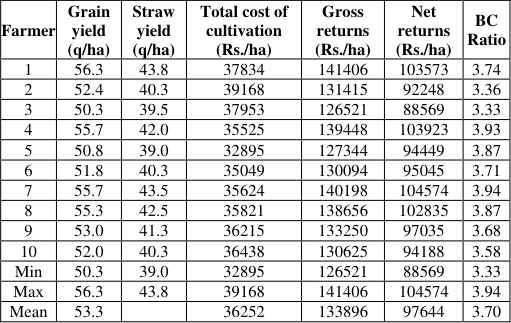 Table 3
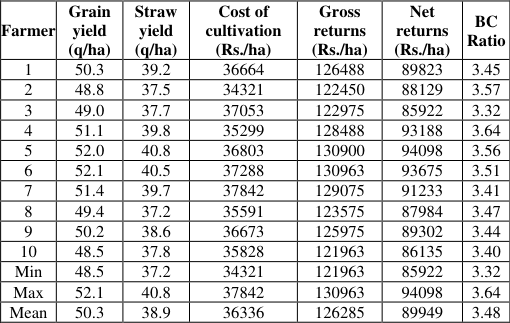 Table 1
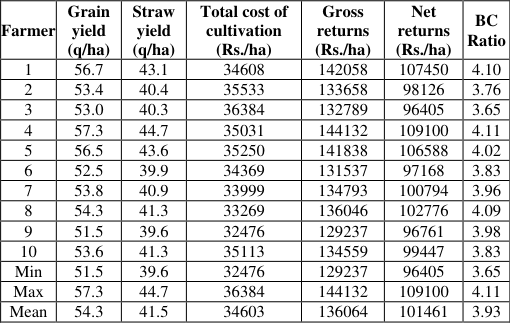 Table 2
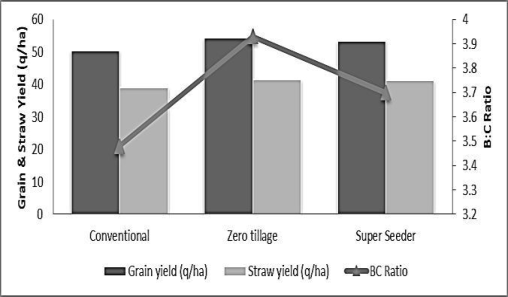 Figure 1
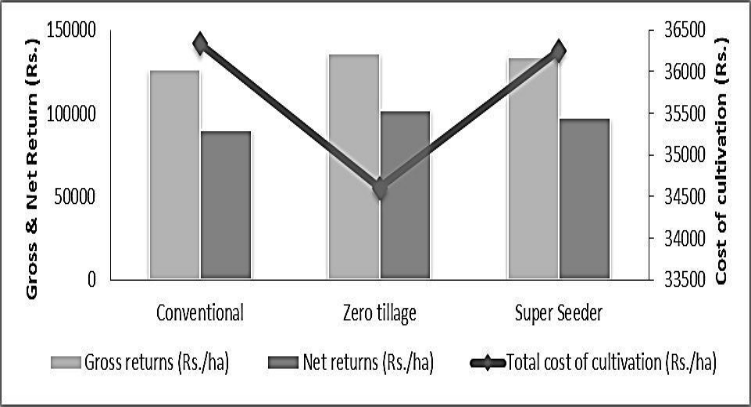 Figure 2
Introduction
Crop residue management (CRM) plays a pivotal role in sustainable agricultural systems by directly influencing soil health, crop productivity and environmental quality (Singh et al., 2019) [15] . Effective management of crop residues is essential for maintaining soil organic matter, improving moisture retention, and reducing the dependency on intensive tillage operations, all of which contribute to enhanced soil fertility and long-term sustainability of farms (Behera et al., 2022) [3] . The integration of mechanized CRM technologies has become increasingly important in addressing the challenges posed by traditional residue management practices, offering practical and scalable solutions to optimize agronomic and economic outcomes (Aleminew, 2024; Sandepogu et al., 2025) [1,14] The Panipat district, characterized by its intensive cropping systems and significant agricultural activity, faces persistent challenges related to crop residue management. Conventional practices, particularly the use of rotavators, often involve multiple tillage passes that disrupt soil structure, increase operational costs, and contribute to environmental issues, such as residue burning and soil degradation (Mandal et al., 2013) [12] . These challenges necessitate the exploration and promotion of alternative CRM technologies that minimize soil disturbance while maintaining or improving productivity and profitability of the system. In this context, zero tillage and super seeder technologies have emerged as promising alternatives to conventional rotation. Zero tillage minimizes soil disruption by eliminating the need for plowing, thereby preserving the soil structure, enhancing moisture conservation, and reducing labor and fuel costs (Blagoev, 2024; Brandt, 1992; Kumari et al., 2023) [4,5,10] . The super seeder integrates residue management with seeding operations, allowing efficient sowing in fields with retained crop residues, which can reduce turnaround time and operational inputs. This study aimed to conduct a detailed comparative assessment of the performance of three prominent CRM machines-Conventional Rotavator, Zero Tillage, and Super Seeder-in District Panipat. The evaluation focuses on critical parameters, including grain and straw
Materials & Methods
The present study was undertaken in District Panipat, a region known for its intensive wheat-based cropping systems and significant agricultural activities. The primary objective was to evaluate and comparatively analyze the performance of three widely adopted crop residue management (CRM) machines-Conventional Rotavator, Zero Tillage, and Super Seeder-focusing on their agronomic and economic impacts during the wheat cropping season.
Study Area and Farmer Selection
The study encompassed multiple villages and blocks within District Panipat to ensure representation of diverse agroecological zones and farming practices. Specifically, the villages included Hathwala, Mehrana, Luhari, Sithana, Nohra, Palri, Jalalpur-1, Karad, and others across the blocks of Samalkha, Israna, Matlauda, Panipat, and Bapoli. Thirty farmers were purposively selected based on their consistent use of one of the three CRM technologies. Ten farmers for each CRM machine were included, ensuring a balanced sample for comparative analysis. The selection criteria emphasized farmers with at least one full cropping season experience using the respective CRM method to capture realistic operational conditions.
Data Collection Procedures
Comprehensive data were collected from each participating farmer covering agronomic and economic parameters: Grain Yield (q/ha): Measured as the total harvested grain quantity per hectare, recorded at maturity. Straw Yield (q/ha): Quantified as the biomass of straw per hectare, reflecting residue retention. Cost of Cultivation (Rs./ha): Detailed recording of all expenses incurred during crop establishment and management, including: Pre-sowing and sowing operations (ploughing, discing/harrowing, fuel, human labor, seed procurement, sowing charges), plant protection cost, Weed management costs (chemical herbicides, mechanical weeding, manual labor), irrigation management and other operational costs directly related to cultivation activities.
Gross Returns (Rs./ha): Total monetary returns from crop production per hectare based on market prices at harvest. Net Returns (Rs./ha): Calculated as the difference between gross returns and total cost of cultivation. Benefit-Cost (B:C) Ratio: Economic efficiency indicator computed as the ratio of gross returns to cost of cultivation.
Data on specific input quantities, such as liters of fuel used, kilograms of seed sown, number of tillage passes, and labor days, were meticulously recorded to ensure accuracy in cost estimation.
Data Analysis
Descriptive statistical analyses were performed to compute mean, minimum, and maximum values for each parameter across the three CRM methods. Comparative assessments were conducted to evaluate the agronomic performance (grain and straw yields) and economic viability (costs, returns, B:C ratio) of the machines. The comprehensive methodology ensured robust evaluation of both productivity and economic aspects of CRM technologies under real-world farming conditions in District Panipat, providing actionable insights for stakeholders.
Results
The study evaluated the performance of three prominent crop residue management (CRM) machines-Conventional Rotavator, Zero Tillage, and Super Seeder-based on data collected from 10 farmers for each machine in District Panipat. The assessment focused on key parameters including grain yield, straw yield, cost of cultivation, gross and net returns, and the benefit-cost (B:C) ratio, providing a comprehensive understanding of the agronomic and economic efficiency of each machine. The data pertaining to the yield and economics under conventional method, zero tillage and super seeder are given in table 1, 2 and 3, respectively. Whereas, the comparative data of same are visualized in figure 1 & 2. Among the three CRM methods, zero tillage demonstrated superior performance in terms of productivity. The average grain yield recorded under zero tillage was 54.3 q/ha, which was notably higher than that achieved by the conventional rotavator (50.3 q/ha) and the super seeder (53.3 q/ha) (Figure 2). Similarly, straw yield under zero tillage averaged 41.5 q/ha, outperforming the conventional method (38.9 q/ha) and slightly exceeding the super seeder (41.2 q/ha) (Figure 2). This indicates that zero tillage not only enhances grain production but also contributes to greater biomass retention, which is beneficial for soil health and residue management.
| Farmer | Grain yield (q/ha) | Straw yield (q/ha) | Cost of cultivation (Rs./ha) | Gross returns (Rs./ha) | Net returns (Rs./ha) | BC Ratio |
|---|---|---|---|---|---|---|
| 1 | 50.3 | 39.2 | 36664 | 126488 | 89823 | 3.45 |
| 2 | 48.8 | 37.5 | 34321 | 122450 | 88129 | 3.57 |
| 3 | 49.0 | 37.7 | 37053 | 122975 | 85922 | 3.32 |
| 4 | 51.1 | 39.8 | 35299 | 128488 | 93188 | 3.64 |
| 5 | 52.0 | 40.8 | 36803 | 130900 | 94098 | 3.56 |
| 6 | 52.1 | 40.5 | 37288 | 130963 | 93675 | 3.51 |
| 7 | 51.4 | 39.7 | 37842 | 129075 | 91233 | 3.41 |
| 8 | 49.4 | 37.2 | 35591 | 123575 | 87984 | 3.47 |
| 9 | 50.2 | 38.6 | 36673 | 125975 | 89302 | 3.44 |
| 10 | 48.5 | 37.8 | 35828 | 121963 | 86135 | 3.40 |
| Min | 48.5 | 37.2 | 34321 | 121963 | 85922 | 3.32 |
| Max | 52.1 | 40.8 | 37842 | 130963 | 94098 | 3.64 |
| Mean | 50.3 | 38.9 | 36336 | 126285 | 89949 | 3.48 |
Table text extracted from the original PDF; superscript letters are shown inline. The original table image is below.
View original table image
Economically, zero tillage proved to be the most costeffective option with the lowest average cost of cultivation at Rs. 34,603/ha (figure 2). This cost efficiency was achieved despite the advanced technology involved, likely due to reduced labor and fuel requirements associated with minimal soil disturbance. In comparison, the conventional rotavator and super seeder incurred higher mean costs of Rs. 36,336/ha and Rs. 36,252/ha, respectively (figure 2). These differences in cultivation costs significantly influenced the overall economic returns. The gross returns under zero tillage were the highest, averaging Rs. 136,064/ha, followed by the super seeder at Rs. 133,896/ha and the conventional rotavator at Rs. 126,285/ha (figure 2). Correspondingly, net returns favored zero tillage with an average of Rs. 101,461/ha, surpassing the super seeder (Rs. 97,644/ha) and conventional method (Rs. 89,949/ha) (figure 2). The benefit-cost ratio further emphasized the profitability of zero tillage, registering the highest mean value of 3.93, which reflects better economic efficiency and return on investment compared to the super seeder (3.70) and conventional rotavator (3.48) (figure 1).
Variability in performance among farmers was also observed. The data presented in table 2 indicated that zero tillage exhibited the widest range in grain yield (51.5 to 57.3 q/ha) and net returns (Rs. 96,405 to Rs. 109,100/ha), indicating its adaptability to diverse field conditions and management practices. This variability suggests potential for further optimization and customization of zero tillage practices to maximize benefits. In contrast, the super seeder and conventional rotavator showed narrower ranges in yields and returns, possibly reflecting more consistent but less flexible performance.
| Farmer | Grain yield (q/ha) | Straw yield (q/ha) | Total cost of cultivation (Rs./ha) | Gross returns (Rs./ha) | Net returns (Rs./ha) | BC Ratio |
|---|---|---|---|---|---|---|
| 1 | 56.7 | 43.1 | 34608 | 142058 | 107450 | 4.10 |
| 2 | 53.4 | 40.4 | 35533 | 133658 | 98126 | 3.76 |
| 3 | 53.0 | 40.3 | 36384 | 132789 | 96405 | 3.65 |
| 4 | 57.3 | 44.7 | 35031 | 144132 | 109100 | 4.11 |
| 5 | 56.5 | 43.6 | 35250 | 141838 | 106588 | 4.02 |
| 6 | 52.5 | 39.9 | 34369 | 131537 | 97168 | 3.83 |
| 7 | 53.8 | 40.9 | 33999 | 134793 | 100794 | 3.96 |
| 8 | 54.3 | 41.3 | 33269 | 136046 | 102776 | 4.09 |
| 9 | 51.5 | 39.6 | 32476 | 129237 | 96761 | 3.98 |
| 10 | 53.6 | 41.3 | 35113 | 134559 | 99447 | 3.83 |
| Min | 51.5 | 39.6 | 32476 | 129237 | 96405 | 3.65 |
| Max | 57.3 | 44.7 | 36384 | 144132 | 109100 | 4.11 |
| Mean | 54.3 | 41.5 | 34603 | 136064 | 101461 | 3.93 |
Table text extracted from the original PDF; superscript letters are shown inline. The original table image is below.
View original table image
International Journal of Agriculture and Nutrition https://www.agriculturejournal.net
The super seeder, while not outperforming zero tillage, showed promising results with grain and straw yields closely matching zero tillage and better than conventional methods. However, its cost of cultivation was slightly higher than zero tillage, which impacted its net returns and B:C ratio. Despite this, the super seeder remains a viable alternative for farmers seeking improved residue management with reasonable economic returns. Overall, the findings underscore zero tillage as the most efficient and economically viable CRM practice among the three evaluated machines in District Panipat. It offers higher productivity and profitability while reducing cultivation costs, making it a sustainable option for farmers aiming to enhance crop residue management and overall farm economics. The super seeder also presents a beneficial option, particularly for farmers who may prefer its operational characteristics despite the marginally higher costs.
These results advocate for increased adoption of zero tillage technology in the region to improve crop yields, economic returns, and sustainable residue management practices, thereby supporting both agricultural productivity and environmental conservation goals.
Discussion
The findings of this study highlight the important agronomic and economic implications of crop residue management (CRM) practices in Panipat district. Zero tillage emerged as the most effective CRM method, delivering the highest grain and straw yields among the three evaluated machines. The superior yields under zero tillage can be attributed to minimal soil disturbance, which preserves soil structure, enhances moisture retention, and promotes better root development. These factors collectively contribute to improved nutrient uptake and crop growth, thereby increasing grain and biomass production. A higher straw yield also suggests enhanced residue retention, which is critical for maintaining soil organic matter and improving long-term soil fertility and sustainability (Guo et al., 2018; Smagacz & Martyniuk, 2023) [7,17] . Economically, zero tillage has demonstrated clear advantages by incurring the lowest cost of cultivation. This reduction in cost is primarily due to savings in labor, fuel, and machinery operations, as zero tillage eliminates the multiple tillage passes required in conventional methods.
The economic efficiency of zero tillage is further reflected in its highest gross and net returns, as well as its superior benefit-cost (B:C) ratio. These results underscore the potential of zero tillage to increase farm profitability while promoting sustainable agronomic practices (M. Singh et al., 2019) [15] . The super seeder, while not surpassing zero tillage, showed competitive agronomic performance, with grain and straw yields closely matching zero tillage. However, its slightly higher cost of cultivation, likely due to operational complexity or maintenance requirements, reduced its net returns and B:C ratio relative to zero tillage. Despite this, the super seeder's ability to combine seeding and residue management in a single operation may offer practical advantages for farmers aiming to optimize field operations and reduce the turnaround time.
In contrast, the conventional rotavator method, although widely used, lagged behind in both yield and economic returns. The greater soil disturbance associated with this method may lead to increased moisture loss and soil degradation, which negatively impact crop growth and biomass accumulation (Angon et al., 2023; Kay, 1990; Wankhade et al., 2025) [2,8,19] . Additionally, higher operational costs reduce their economic attractiveness. The narrower variability in performance among farmers using the conventional method indicates more predictable but less adaptable outcomes, which may limit its effectiveness under diverse field conditions. The observed variability in zero tillage performance across farmers indicates that site-specific factors, such as soil type, residue management practices, and farmer expertise, influence outcomes. This suggests opportunities for further refinement of zero tillage practices through targeted extension services and customized management recommendations to maximize the benefits across varying agroecological conditions.
Conclusions
This study conclusively identifies zero tillage as the most agronomically efficient and economically viable crop residue management practice among the three prominent machines evaluated in District Panipat. Zero tillage consistently delivered higher grain and straw yields while reducing cultivation costs, resulting in enhanced profitability and sustainability. The super seeder also presents a valuable alternative, offering comparable productivity with the added benefit of integrated seeding and residue management, albeit at slightly higher costs. The conventional rotavator, while familiar to many farmers, demonstrated lower efficiency and profitability, highlighting the need for transitioning towards more sustainable CRM technologies. Promoting the adoption of zero tillage technology can significantly improve crop productivity, farm income, and environmental sustainability in the region. Future initiatives should focus on addressing the variability in zero tillage outcomes through farmer training, adaptive management strategies, and site-specific recommendations. Such efforts will help optimize the benefits of zero tillage, contributing to resilient and sustainable agricultural systems in District Panipat.
Figures and tables from the paper
| Farmer | Grain yield (q/ha) | Straw yield (q/ha) | Total cost of cultivation (Rs./ha) | Gross returns (Rs./ha) | Net returns (Rs./ha) | BC Ratio |
|---|---|---|---|---|---|---|
| 1 | 56.3 | 43.8 | 37834 | 141406 | 103573 | 3.74 |
| 2 | 52.4 | 40.3 | 39168 | 131415 | 92248 | 3.36 |
| 3 | 50.3 | 39.5 | 37953 | 126521 | 88569 | 3.33 |
| 4 | 55.7 | 42.0 | 35525 | 139448 | 103923 | 3.93 |
| 5 | 50.8 | 39.0 | 32895 | 127344 | 94449 | 3.87 |
| 6 | 51.8 | 40.3 | 35049 | 130094 | 95045 | 3.71 |
| 7 | 55.7 | 43.5 | 35624 | 140198 | 104574 | 3.94 |
| 8 | 55.3 | 42.5 | 35821 | 138656 | 102835 | 3.87 |
| 9 | 53.0 | 41.3 | 36215 | 133250 | 97035 | 3.68 |
| 10 | 52.0 | 40.3 | 36438 | 130625 | 94188 | 3.58 |
| Min | 50.3 | 39.0 | 32895 | 126521 | 88569 | 3.33 |
| Max | 56.3 | 43.8 | 39168 | 141406 | 104574 | 3.94 |
| Mean | 53.3 | 36252 | 133896 | 97644 | 3.70 |
Table text extracted from the original PDF; superscript letters are shown inline. The original table image is below.
View original table image
References
19 in the original paper- Aleminew A. Enhancing Soil Fertility and Crop Productivity through Crop Residue Management: A Review. Agricultural Reviews, Of. 2024. Available from: https://doi.org/10.18805/ag.rf-294
- Angon PB, Anjum N, Akter MM, Kc S, Suma RP, Jannat S. An Overview of the Impact of Tillage and Cropping Systems on Soil Health in Agricultural Practices. Advances in Agriculture. 2023;1-14. Available from: https://doi.org/10.1155/2023/8861216
- Behera MS, Sharma L, Samanta P. Resource Conservation through Crop Residue Management for Sustainable Agriculture. In: CRC. 2022. p. 135-42. Available from: https://doi.org/10.1201/9781003364665-11
- Blagoev A. Potential of No-Till Technology for Environmental Protection. IDARA. 2023;2. Available from: https://doi.org/10.37075/idara.2023.25
- Brandt SA. Zero vs. Conventional Tillage and Their Effects on Crop Yield and Soil Moisture. Canadian Journal of Plant Science. 1992;72(3):679-88. Available from: https://doi.org/10.4141/cjps92-084
- Chernogaev VG, Svirina VA. Comparative analysis of the efficiency of application of different methods of tillage in the system of resource-saving agriculture technologies. Agrarian Science. 2021;11-12:105-7. Available from: https://doi.org/10.32634/0869-81552020-343-11-105-107
- Guo Z, Liu H, Hua K, Wang D, He C. Long-term Straw Incorporation Benefits the Elevation of Soil Phosphorus Availability and Use Efficiency in the Agroecosystem. Spanish Journal of Agricultural Research. 2018;16(3):e1101. Available from: https://doi.org/10.5424/sjar/2018163-12857
- Kay BD. Rates of Change of Soil Structure Under Different Cropping Systems. In: Springer New York; 1990. p. 1-52. Available from: https://doi.org/10.1007/978-1-4612-3316-9_1
- Kumar S, Rani V, Kumar A, Pannu R, Mor A. Effect of Conventional Tillage and Zero Tillage on Different Soil and Yield Parameters. Journal of Agriculture Research and Technology. 2022;Special(01):105-13. Available from: https://doi.org/10.56228/jart.2022.sp117
- Kumari A, P A, Tiwari P, Sachan P, Malla AK, Tripathy A, et al. Zero Tillage Lead to Enhanced Productivity and Soil Health. International Journal of Environment and Climate Change. 2023;13(10):370715. Available from: https://doi.org/10.9734/ijecc/2023/v13i103042
- Li L, Guan J, Chen S, Zhang X. Intermittent Deep Tillage on Improving Soil Physical Properties and Crop Performance in an Intensive Cropping System. Agronomy. 2022;12(3):688. Available from: https://doi.org/10.3390/agronomy12030688
- Mandal S, Bhattacharyya B, Mukherjee S. Design Optimization of Rotary Tiller Blades: A Critical Review. Scientific Journal of Pure and Applied Sciences. 2013;2(6):260-9. Available from: https://doi.org/10.14196/sjpas.v2i6.837
- Reicosky DC, Saxton KE. The Benefits of No-Tillage. In: Food Agriculture Organization Of United Nations Cabi; 2006. p. 11-20. Available from: https://doi.org/10.1079/9781845931162.0011
- Sandepogu P, Patange MJ, Srivastava A, Khodang C, Kaur S, Vishwakarma SK, et al. Crop Residue Management: Balancing Agricultural Sustainability and Environmental Impact. International Journal of Research in Agronomy. 2025;8(3):383-5. Available from: https://doi.org/10.33545/2618060x.2025.v8.i3e.2688
- Singh M, Jaswal A, Singh A. Crop Residue Management for Sustenance of Natural Resources and Agriculture Productivity. Agricultural Reviews. 2019;40(03). Available from: https://doi.org/10.18805/ag.r-1814
- Singh OP, Singh R, Lakra K, Singh PK. Improving Environmental and Economic Benefits through ZeroTillage in Mirzapur District of Uttar Pradesh, India. International Journal of Current Research in Biosciences and Plant Biology. 2016;3(9):89-96. Available from: https://doi.org/10.20546/ijcrbp.2016.309.013
- Smagacz J, Martyniuk S. Soil Properties and Crop Yields as Influenced by the Frequency of Straw Incorporation in Rape-Wheat-Triticale Rotation. Journal of Water and Land Development. 2023;1-6. Available from: https://doi.org/10.24425/jwld.2023.143737
- Uri ND. An Evaluation of the Economic Benefits and Costs of Conservation Tillage. Environmental Geology. 2000;39(3-4):238-48. Available from: https://doi.org/10.1007/s002540050004
- Wankhade RD, Kumar A, Babu A, Bhaat D, Prakash M, Nisha N, et al. Effect of Tillage Practices on Soil Parameters. International Journal of Agriculture and Food Science. 2025;7(2):256-61. Available from: https://doi.org/10.33545/2664844x.2025.v7.i2d.304