
Research article · 2026 · Full text
International Journal of Biology SciencesFloristic diversity and ethnomedicinal importance of tree species in noto village, Mayurbhanj, Odisha, India
Volume 8(4) · Pages 154–159 · DOI: 10.33545/26649926.2026.v8.i4b.812 ↗
Research areasEthnobotanical and Medicinal Plants StudiesForest Ecology and ConservationBotany and Plant Ecology Studies
Abstract
Author-writtenThis study evaluates the floristic diversity and ethnomedicinal importance of tree species in Noto village, Mayurbhanj, Odisha. Situated within a tropical deciduous forest ecosystem, the area provides vital botanical resources for the Santhal and Kolha tribal communities. The survey documented 56 tree species belonging to 48 genera and 26 families, reflecting high taxonomic richness. Fabaceae is the dominant family (8 species), followed by Moraceae and Anacardiaceae (5 species each). Several families, including Myrtaceae and Combretaceae, contributed three species, while others like Lamiaceae and Apocynaceae were represented by two. Thirteen families, such as Dipterocarpaceae and Meliaceae, were represented by a single species each. Quantitative analysis through the Shannon-Wiener Index (2.15-3.26) confirms a complex biological structure in the tree layer. Local inhabitants demonstrate a sophisticated reliance on these resources, primarily utilizing bark (46.7%) and leaves for therapeutic purposes. Significant medicinal species identified include Shorea robusta, Terminalia arjuna, and Madhuca indica, used to treat conditions such as hypertension, malaria, and gastrointestinal disorders. Despite this rich biodiversity, the erosion of traditional ecological knowledge among the younger generation poses a threat to indigenous healthcare. This research emphasizes the necessity of formal documentation and sustainable conservation strategies to safeguard the region's bicultural heritage.
Summary
Source-checkedPlain-language reading of the full paper, prepared with AI and checked against the text. Each point links to the authors' own words.
Why it matters
- Tree species are the most structurally significant parts of ecosystems and are essential for environmental sustainability. View evidence ↗
- Industrialization, urban growth, and deforestation are causing habitat fragmentation, which threatens both ecological balance and traditional medicinal knowledge. View evidence ↗
- The tropical deciduous forest ecosystem in Noto village provides essential botanical resources for the local Santhal and Kolha tribal communities. View evidence ↗
The question
- The study aims to evaluate the floristic composition and ecological parameters of Noto village in Mayurbhanj, Odisha. View evidence ↗
- The research seeks to highlight the need for conservation strategies by identifying species richness and the medicinal importance of local flora. View evidence ↗
What they did
- To assess tree abundance and density, the researchers used 10 to 13 quadrats, typically measuring 20m x 20m or 31.62m x 31.62m (0.1 ha). View evidence ↗
- Ethnomedicinal data was collected from purposively selected informants, including traditional healers (Vaidyas), forest watchers, and village elders aged 35-73. View evidence ↗
What they found
- The survey documented 56 tree species belonging to 48 genera and 26 families in Noto village. View evidence ↗
- Fabaceae was the most dominant family, representing 14.28% of the recorded species with 8 species. View evidence ↗
- Moraceae and Anacardiaceae were the next most common families, each contributing 5 species (8.92%). View evidence ↗
- The Shannon-Wiener Diversity Index ranged from 2.15 to 3.26, indicating a high level of diversity for regional tropical deciduous forest patches. View evidence ↗
- Bark is the most commonly used plant part for medicinal remedies, accounting for 46.7% of recorded uses. View evidence ↗
- Informants showed high consensus on using Shorea robusta for diarrhoea and Terminalia arjuna for cardiac issues. View evidence ↗
What it means
- The authors recommend effective conservation measures such as afforestation, community participation, protection of habitats, and sustainable resource use. View evidence ↗
- Traditional ecological knowledge is primarily held by the older generation (aged 40-60), creating a risk that this knowledge will be lost as younger generations adopt modern lifestyles. View evidence ↗
Visual summary
1 visualsIllustrations explain the paper; they do not show study data.
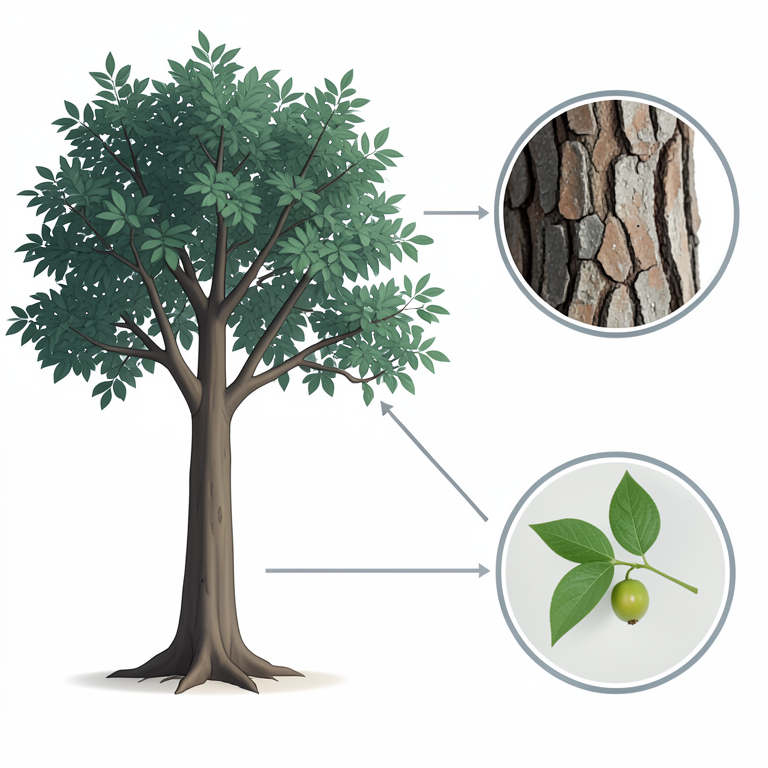
Medicinal Plant Part Usage
AI-generated conceptual illustration (Indian medicinal tree species). It explains the idea and does not show study data.
View source evidence ↗Figures & tables
From the original paper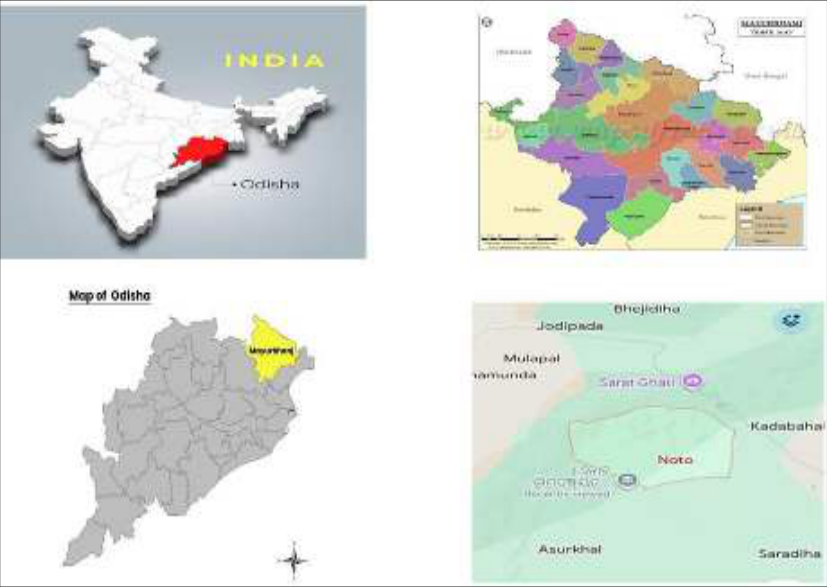 Figure 1
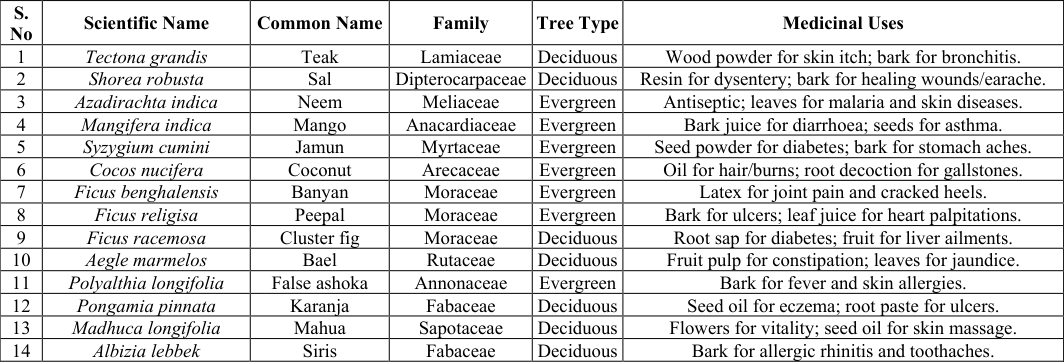 Table 1
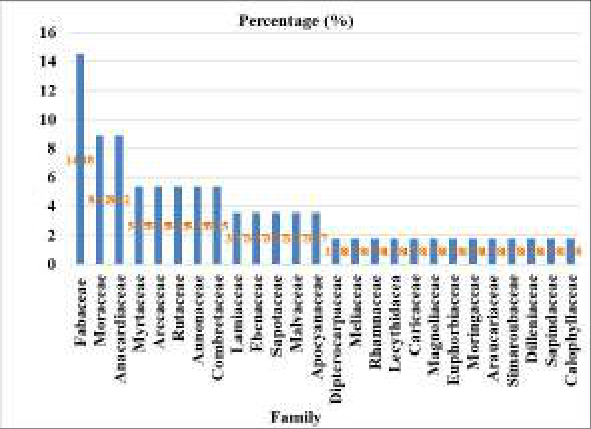 Figure 2
Introduction
The growing emphasis on floristic studies in developing nations highlights the urgent need to assess and preserve plant wealth (Naik et al., 2020) [7] . Biodiversity encompasses the intricate variety of life forms, ranging from genetic and species variation to the complex ecosystems they inhabit (Rawat and Agrawal, 2015) [10] . As defined by Whittaker (1972) [15] , the synergy between genetic, species, and ecosystem diversity is fundamental to maintaining ecological equilibrium. Within these systems, tree species stand out as the most structurally significant components, serving as the pillars of environmental sustainability. Floristic diversity is a primary determinant of ecosystem resilience. Research by David Tilman (2001) [14] suggests that higher species richness leads to greater stability against environmental stressors. Trees, in particular, provide essential ecological services that support life: • Ecological Stability: Diverse tree communities act as a buffer against climate change, droughts, and pest outbreaks, ensuring that if one species fails, others maintain the system's integrity. [1] is essential for understanding species distribution and abundance, providing the baseline data required for sustainable resource management. However, the current era of rapid industrialization, urban expansion, and deforestation has led to severe habitat fragmentation. The resulting decline in tree diversity threatens not only ecological balance but also the survival of indigenous medicinal knowledge. In this context, documenting the botanical heritage of specific regions has become a global priority.
The present study focuses on Noto village in Mayurbhanj, Odisha, aiming to evaluate its floristic composition and ecological parameters. By identifying species richness and assessing the medicinal importance of the local flora, this research seeks to highlight the necessity of conservation strategies. Protecting the tree diversity of Noto is not merely a botanical pursuit but a vital step toward ensuring the longterm ecological and economic security of the local tribal communities.
To deepen the focus on the socio-economic impact and the Santhal and Kolha tribes, we can integrate a specific section into your study that explains how these trees function as a "Natural Capital" for the village.
Aim & Objectives
The primary aim of this study is to evaluate the floristic diversity of tree species in Noto village, Mayurbhanj, and to document the traditional ethnomedicinal knowledge associated with these species among the local tribal communities (Santhal and Kolha).
To achieve this aim, the following specific objectives have been identified:
• Taxonomic Inventory: To identify and document the complete diversity of tree species in the Noto village ecosystem, categorizing them by family, genus, and species.
• Ecological Assessment: To analyze the community structure using quantitative indices, specifically the Shannon-Wiener Diversity Index (H'), to determine species richness and evenness. • Ethnobotanical Documentation: To record the indigenous medicinal uses of tree species, including the specific parts used (e.g., bark, leaves), preparation methods, and the ailments treated by the local inhabitants.
• Quantitative
Ethnomedicine: To determine the dominance of plant families (e.g., Fabaceae) and calculate the frequency of use for different tree parts to identify the most culturally and medicinally significant species.
• Conservation Analysis: To assess the current status of traditional knowledge transfer between generations and highlight the need for sustainable management and conservation of medicinal tree wealth in the region.
Literature Review
The foundational importance of biodiversity lies in its ability to maintain ecological equilibrium. Whittaker (1972) [15] established that biodiversity is a multi-layered concept involving genetic, species, and ecosystem variations. This variety is critical for resilience; as Tilman (2001) observed, ecosystems with higher species richness exhibit greater stability and are better equipped to recover from environmental disturbances compared to monocultures. In the state of Odisha is recognized as a significant reservoir of botanical wealth due to its varied topography and tropical climate. Haines (1921-1925) [2] provided the pioneering documentation of the region's flora, which remains a primary reference for taxonomic studies in the state. More recent assessments by Naik et al. (2020) [7] emphasize that floristic studies are increasingly vital for developing nations to quantify their natural capital and monitor habitat degradation.
The Mayurbhanj district, home to the Similipal Biosphere Reserve, is a hotspot for ethnomedicinal research. Kumar (2021) [3] highlights that the district hosts a high density of medicinal trees, with the Fabaceae family frequently emerging as the most dominant in terms of species used for traditional healing. Research by Babulal et al. (2022) [1] notes that for tribal communities like the Santhal and Kolha, forest resources are not merely biological entities but are central to their primary healthcare systems. In the context of medicinal trees, the choice of plant part is significant. Studies in the Eastern Ghats and surrounding plateaus indicate that bark is the most frequently harvested part for traditional remedies. Rawat and Agrawal (2015) [10] suggest this is due to the high concentration of secondary metabolites in the bark, which remain available throughout the year, unlike seasonal flowers or fruits. However, they also warn that unsustainable bark stripping can lead to high mortality rates among mature tree populations. Recent literature identifies a critical "knowledge gap" in indigenous practices. Panda et al. (2011) [8] observed that while the elder members of Odisha's tribal communities possess vast botanical knowledge, this information is not being effectively transferred to the younger generation. This erosion of traditional ecological knowledge (TEK), coupled with habitat loss due to urbanization, necessitates the urgent documentation and scientific validation of these practices to ensure future conservation (Sahu et al., 2013) [11] .
Materials & Methods
The Materials and Methods section outlines the systematic approach used to evaluate tree diversity and document traditional knowledge in Noto village, Mayurbhanj. The methodology combines standard ecological sampling with recognized ethnobotanical survey techniques.
Study Area and Environmental Conditions
Noto village is situated in the Mayurbhanj district of Odisha, within the Northern Plateau region (Fig. -1). The area is dominated by tropical deciduous forests (moist and dry subtypes), characterized by red lateritic soils and a seasonal climate with distinct summer, monsoon, and winter phases.
Ethnomedicinal Data Collection
To document traditional healthcare practices, the study engaged with the Santhal and Kolha tribal communities.
• Informant Selection: Knowledgeable informants, including Vaidyas (traditional healers), village elders (aged 35-73), and forest watchers, were selected through purposive and snowball sampling. • Interview Methods: Data were gathered using semistructured questionnaires, group discussions, and guided field walks. Information included local names, parts used (e.g., bark, leaves), preparation modes (decoctions, pastes, juices), and dosage.
• Ethical Compliance: Prior Informed Consent (PIC) was obtained verbally or in writing from all participants before the start of interviews.
Quantitative Ecological Analysis: To measure community structure and diversity, the following statistical indices were applied:
Shannon-Wiener Diversity Index (H'): Measures both species richness and evenness.
Simpson's Diversity Index (D): Used to assess species dominance and habitat diversity.
Margalef's Richness Index (SR): A simple measure of the total number of species relative to the total number of individuals.
Pielou's Evenness Index (J): Calculates how evenly the individuals are distributed among species. Important Value Index (IVI): Derived from relative frequency, density, and dominance to determine the ecological success of a species.
Results & Discussion
The study on tree species diversity in Noto village, Mayurbhanj, reveals a varied representation of families contributing to the local floristic richness. The documentation highlights the prominence of certain families in the area's tree composition.
Floristic Composition and Diversity Indices
The floristic analysis of Noto village documented a rich assemblage of 56 tree species distributed across 48 genera and 26 families. The calculated Shannon-Wiener Diversity Index (H') for the study area ranged between 2.15 and 3.26, which is considered high for tropical deciduous forest patches in the region. This value indicates a complex biological structure with a relatively balanced distribution of individuals among species, rather than dominance by a single taxon. The Fabaceae family was found to be the most dominant, contributing 8 species. This aligns with broader regional surveys in Mayurbhanj where the Medicinal Trees of Mayurbhanj frequently identify Fabaceae as the primary medicinal and structural family. Moraceae and Anacardiaceae each contributed 5 species, further underlining the high taxonomic diversity of the area.
Ethnomedicinal Utilization Patterns
The Santhal and Kolha tribes of Noto village demonstrate a deep-seated reliance on local tree diversity for primary healthcare.
• Plant Parts Used: The survey revealed that bark is the most frequently utilised part (46.7% of all recorded remedies), followed by leaves and fruits. The high usage of bark is characteristic of tribal medicine in Odisha, as it is often available year-round and concentrated with bioactive compounds. • Therapeutic Applications: The trees are primarily used to treat gastrointestinal disorders, hypertension, malaria, and skin infections. Key species like Shorea robusta (Sal) and Terminalia arjuna (Arjuna) were noted for their high consensus among informants as treatments for diarrhoea and cardiac issues, respectively.
Discussion of Conservation Status
The high Shannon-Wiener Index values (reaching 3.26) reflect the relatively undisturbed nature of the village's forest fringes. However, the study observed that traditional ecological knowledge (TEK) is disproportionately held by the older generation (aged 40-60). Similar to findings reported in Ethnomedicinal studies in Mayurbhanj, there is a significant risk of this knowledge being lost as younger members of the community shift toward modern lifestyles. Furthermore, while the Fabaceae and Combretaceae families provide high medicinal value, the over-exploitation of bark for local trade could threaten the long-term viability of these species. Establishing community-led Sustainable Management practices is essential to preserve both the floristic richness and the indigenous healthcare heritage of Noto village. The table-1 represents a systematic inventory of 56 tree species identified in Noto village, organized to highlight their botanical classification, ecological nature, and functional utility.
Conclusion
The study on floristic diversity of tree species in Noto village of Mayurbhanj reveals that the area possesses a rich and varied tree flora, reflecting favorable environmental conditions such as suitable climate, soil, and topography. A wide range of species belonging to different families indicates a healthy and balanced ecosystem. The presence of economically, medicinally, and ecologically important tree species highlights the dependence of local communities on forest resources for their livelihood and daily needs. However, certain challenges such as deforestation, overexploitation, grazing, and human interference pose threats to this diversity. The study emphasizes the need for effective conservation measures, including afforestation, sustainable resource use, protection of natural habitats, and community participation. Awareness programs and proper management strategies can help in preserving this valuable floristic wealth. In conclusion, the floristic diversity of Noto village is an important natural asset, and its conservation is essential for maintaining ecological balance, supporting biodiversity, and ensuring sustainable development for future generations.
Figures and tables from the paper
| S. No | Scientific Name | Common Name | Family | Tree Type | Medicinal Uses |
|---|---|---|---|---|---|
| 1 | Tectona grandis | Teak | Lamiaceae | Deciduous | Wood powder for skin itch; bark for bronchitis. |
| 2 | Shorea robusta | Sal | Dipterocarpaceae | Deciduous | Resin for dysentery; bark for healing wounds/earache. |
| 3 | Azadirachta indica | Neem | Meliaceae | Evergreen | Antiseptic; leaves for malaria and skin diseases. |
| 4 | Mangifera indica | Mango | Anacardiaceae | Evergreen | Bark juice for diarrhoea; seeds for asthma. |
| 5 | Syzygium cumini | Jamun | Myrtaceae | Evergreen | Seed powder for diabetes; bark for stomach aches. |
| 6 | Cocos nucifera | Coconut | Arecaceae | Evergreen | Oil for hair/burns; root decoction for gallstones. |
| 7 | Ficus benghalensis | Banyan | Moraceae | Evergreen | Latex for joint pain and cracked heels. |
| 8 | Ficus religisa | Peepal | Moraceae | Evergreen | Bark for ulcers; leaf juice for heart palpitations. |
| 9 | Ficus racemosa | Cluster fig | Moraceae | Deciduous | Root sap for diabetes; fruit for liver ailments. |
| 10 | Aegle marmelos | Bael | Rutaceae | Deciduous | Fruit pulp for constipation; leaves for jaundice. |
| 11 | Polyalthia longifolia | False ashoka | Annonaceae | Evergreen | Bark for fever and skin allergies. |
| 12 | Pongamia pinnata | Karanja | Fabaceae | Deciduous | Seed oil for eczema; root paste for ulcers. |
| 13 | Madhuca longifolia | Mahua | Sapotaceae | Deciduous | Flowers for vitality; seed oil for skin massage. |
| 14 | Albizia lebbek | Siris | Fabaceae | Deciduous | Bark for allergic rhinitis and toothaches. |
Table text extracted from the original PDF; superscript letters are shown inline. The original table image is below.
View original table image
References
14 in the original paper- Babulal M, et al. Title of floristic documentation paper. J Bot. 2022;10(2):45-60.
- Kumar S. Medicinal trees of Mayurbhanj, India. In: Medico-biowealth of India. Vol 3. 2021.
- Magurran AE. Ecological diversity and its measurement. New Jersey: Princeton University Press; 1988.
- Margalef R. Information theory in ecology. Gen Syst. 1958;3:36-71.
- Martin GJ. Ethnobotany: a methods manual. London: Chapman & Hall; 1995.
- Naik S, et al. Plant wealth assessment in developing nations. Ecol Today. 2020;15:112-125.
- Mayurbhanj district, Orissa, India. J Pharmacogn Phytother. 2011;3(7):101-113.
- Pielou EC. The measurement of diversity in different types of biological collections. J Theor Biol. 1966;13:131-144.
- Rawat BS, Agrawal P. Biodiversity and ecosystems. New Delhi: Science Press; 2015.
- Sahu SC, Pattnaik SK, Sahoo SL, Lenka SS, Dhal NK. Ethnobotanical study of medicinal plants in the coastal districts of Odisha. Curr Bot. 2013;2(7):17-20.
- Shannon CE, Weaver W. The mathematical theory of communication. Urbana: University of Illinois Press; 1949.
- Simpson EH. Measurement of diversity. Nature. 1949;163:688-688.
- Tilman D. Functional consequences of biodiversity: experimental progress and theoretical extensions. Ecology. 2001;82(6):1759-1771.
- Whittaker RH. Evolution and measurement of species diversity. Taxon. 1972;21(2-3):213-251.