
Research article · 2025 · Full text
International Journal of Agriculture and NutritionInvestigations on seed dormancy breaking mechanisms in wild medicinal plant species
Volume 7(8) · Pages 227–230 · DOI: 10.33545/26646064.2025.v7.i8d.603 ↗
Research areasSeed Germination and PhysiologySeedling growth and survival studiesFlowering Plant Growth and Cultivation
Abstract
Author-writtenA paradox runs through wild medicinal plant conservation: the very seed dormancy mechanisms that ensure species survival in unpredictable habitats become the main barrier when these plants need to be cultivated or propagated for research and restoration. This research tested five dormancy-breaking treatments—cold stratification (4°C, 30 days), gibberellic acid (GA₃, 500 ppm), acid scarification (conc. H₂SO₄, 10 min), smoke water (10% v/v), and potassium nitrate (KNO₃, 0.2%)—on six wild medicinal species collected from montane habitats in central Japan: Withania somnifera, Rauvolfia serpentina, Picrorhiza kurroa, Nardostachys jatamansi, Podophyllum hexandrum, and Gloriosa superba. Trials were conducted at the Kanto Institute of Agricultural Sciences, Tsukuba, from April to December 2023 using a factorial completely randomized design. The most effective treatment varied sharply among species: GA₃ gave the highest germination in R. serpentina (84.3%) and G. superba (67.1%); cold stratification was best for P. kurroa (81.7%) and N. jatamansi (74.3%); acid scarification was uniquely effective for P. hexandrum (88.7%); and smoke water performed best on W. somnifera (54.7%). These species-specific responses reflect fundamentally different dormancy classes—physical, physiological, and morphophysiological—that require matched treatments. The results provide a practical germination protocol for each species and advance understanding of dormancy ecology in Himalayan medicinal flora.
Summary
Source-checkedPlain-language reading of the full paper, prepared with AI and checked against the text. Each point links to the authors' own words.
Why it matters
- Seed dormancy is an evolutionary survival strategy for wild plants, but it creates a significant barrier for conservation, research, and restoration efforts. View evidence ↗
- The difficulty of propagating medicinally valuable plants creates a bottleneck for both their commercial cultivation and conservation. View evidence ↗
- Seed dormancy is categorized into five main classes (physical, physiological, morphological, morphophysiological, and combinational), each requiring specific cues to trigger germination. View evidence ↗
The question
- The study aimed to screen five dormancy-breaking treatments across six wild medicinal species to identify the most effective method for each and relate these responses to their dormancy classes. View evidence ↗
What they did
- The researchers tested five treatments (cold stratification, GA₃, acid scarification, smoke water, and KNO₃) on six wild medicinal species from central Japan. View evidence ↗
- The experiment used a factorial completely randomized design with six species, six treatments (including a control), and four replications of 25 seeds each. View evidence ↗
- Germination was defined as radicle emergence of 2 mm or more, scored every 3 days for 45 days, and used to calculate mean germination time and seedling vigour index. View evidence ↗
- Dormancy classes were assigned based on water uptake (PY), imbibition without germination (PD), or embryo development (MPD). View evidence ↗
What they found
- Acid scarification was highly effective for P. hexandrum, increasing germination from 3.2% in the control to 88.7%. View evidence ↗
- Gibberellic acid (GA₃) provided the highest germination rates for R. serpentina (84.3%) and G. superba (67.1%). View evidence ↗
- Cold stratification was the most effective treatment for P. kurroa (81.7%) and N. jatamansi (74.3%). View evidence ↗
- Smoke water was the most effective treatment for W. somnifera, achieving a germination rate of 54.7%. View evidence ↗
- W. somnifera was the most difficult species to germinate, suggesting it may have multiple layers of dormancy. View evidence ↗
- P. hexandrum showed the greatest improvement in seedling vigour index (SVI), with a 45.1-fold increase from the control (18) to the best treatment (812). View evidence ↗
What it means
- The authors conclude that there is no universal method for breaking seed dormancy; success requires matching the specific treatment to the plant's dormancy class. View evidence ↗
- The authors suggest that future work should investigate combination treatments for complex dormancy and track seedling survival until transplanting. View evidence ↗
Visual summary
2 visualsIllustrations explain the paper; charts are replotted from the paper's own table values.
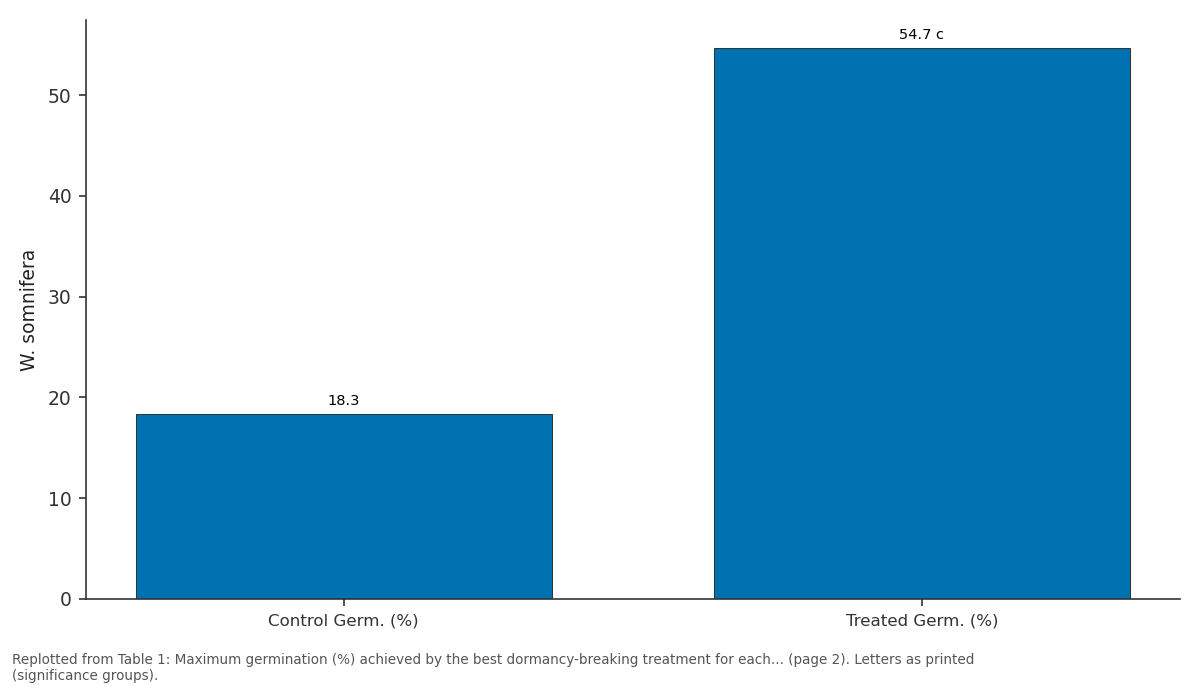
W. somnifera: Control Germ. (%) vs Treated Germ. (%)
Replotted from Table 1 (page 2) of the original paper. Every bar is the paper's own table value.
View source evidence ↗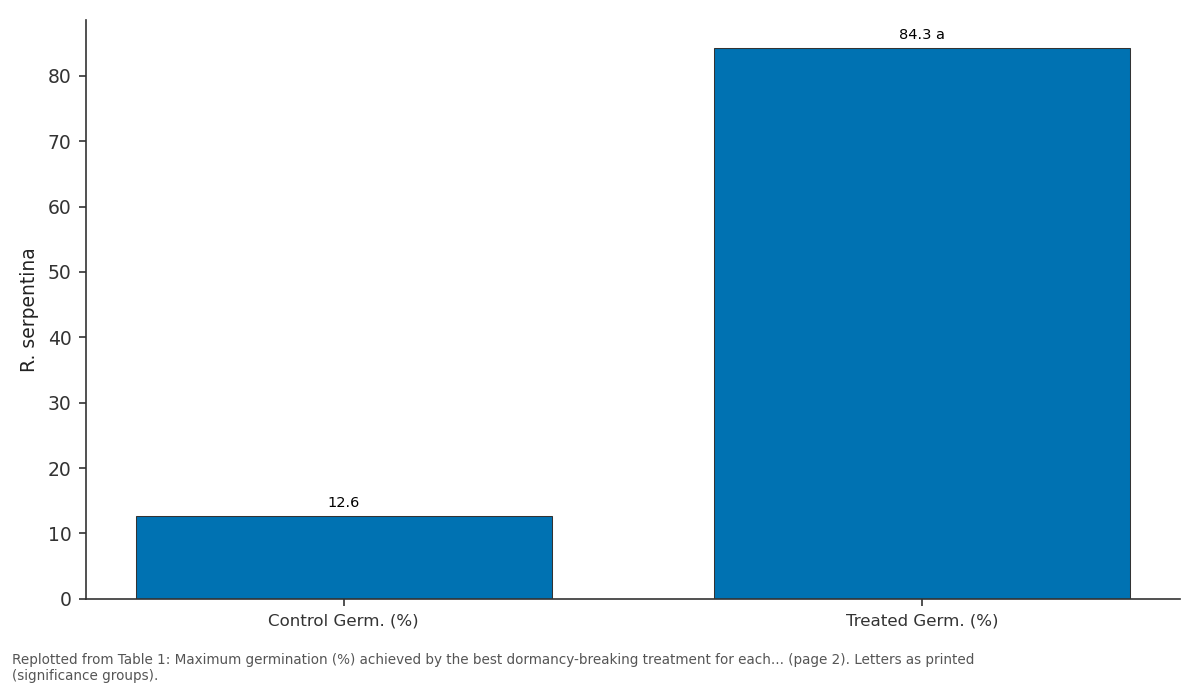
R. serpentina: Control Germ. (%) vs Treated Germ. (%)
Replotted from Table 1 (page 2) of the original paper. Every bar is the paper's own table value.
View source evidence ↗Figures & tables
From the original paper Table 1
 Table 2
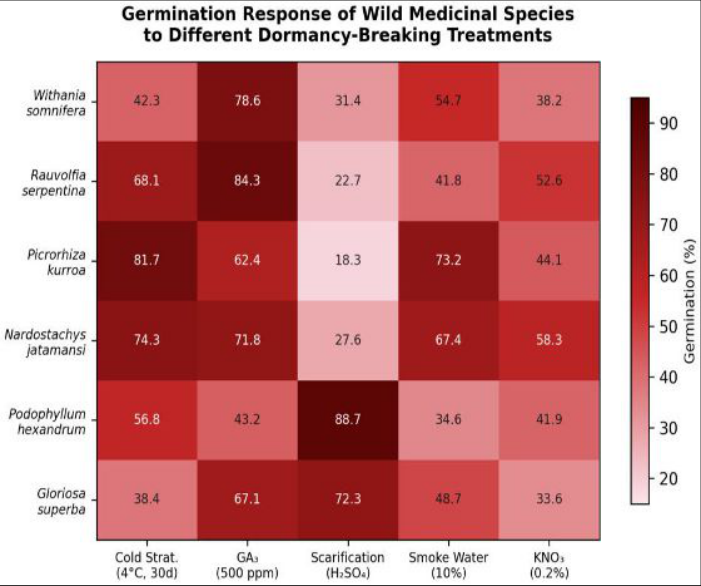 Figure 1
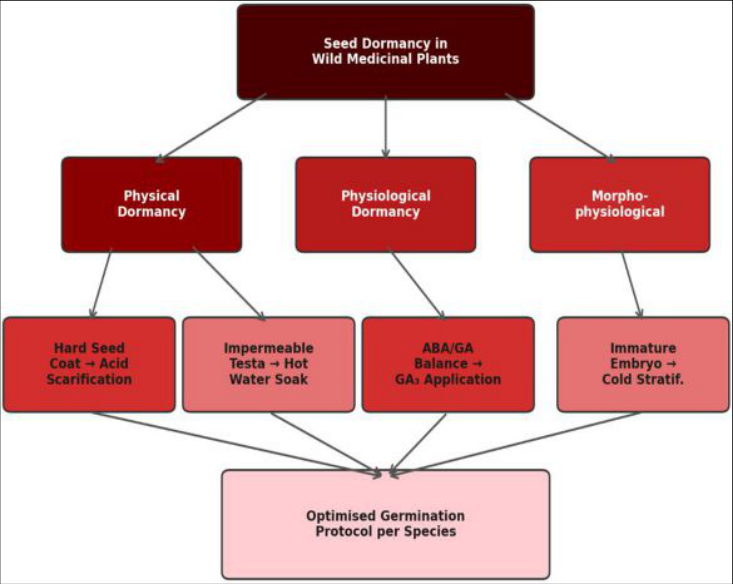 Figure 2
Introduction
It seems paradoxical that some of the most medicinally valuable plant species are also the hardest to germinate under controlled conditions. Podophyllum hexandrum, source of the anti-cancer compound podophyllotoxin, has been reported with natural germination rates as low as 3-5% without pre-treatment [1] . Nardostachys jatamansi, critically endangered and prized in traditional medicine, rarely exceeds 10% field emergence from untreated seed [2] . This mismatch between pharmacological value and propagation difficulty is a core bottleneck for both conservation and commercial cultivation of wild medicinal plants [3] . Seed dormancy in wild species is an evolutionary strategy that distributes germination over time and space to hedge against environmental uncertainty [4] . The five main dormancy classes-physical (PY), physiological (PD), morphological (MD), morphophysiological (MPD), and combinational (PY+PD)-each require different breaking cues ranging from mechanical disruption of the seed coat to hormonal shifts triggered by temperature or chemical signals [5] . GA₃ application is the most widely used chemical dormancy breaker, effective for species with physiological dormancy where the embryo's growth potential needs boosting [6] . Cold stratification mimics winter chilling, satisfying the vernalisation requirement of many temperate MPD species [7] . Acid scarification breaks physical dormancy in hard-coated leguminous and some solanaceous seeds. Smoke water, a more recent addition to the dormancy-breaking toolkit, contains karrikinolide (KAR₁) that triggers germination in fireadapted and some non-fire-adapted species through KAI2 receptor signalling [8] . This research was designed to: (a) screen five dormancy-breaking treatments across six wild medicinal species from central Japan's montane zone; (b) identify the most effective treatment for each species; and (c) relate treatment responses to dormancy class to build a predictive framework for protocol selection.
The findings should help seed banks, botanical gardens, and medicinal plant growers develop reliable germination protocols for these difficult-to-propagate species.
Seed Collection and Viability Assessment
Seeds were collected between August and October 2022 from wild populations in the Chichibu-Tama-Kai and Nikkō mountain regions of central Honshu at altitudes of 800-2,400 m. Collection was made under permits issued by the Kanto Regional Forest Office (Permit No. KR-2022-043). Seeds were cleaned, air-dried at 20°C and 40% RH for two weeks, and stored at 5°C in sealed aluminium-foil pouches until use. Initial viability was confirmed by tetrazolium (TZ) staining (1% TTC, 24 h at 30°C) on 50 seeds per species: viability ranged from 78.4% (G. superba) to 94.6% (P. kurroa). Seed moisture content at storage was 6.8-8.3% (oven method, 103°C, 17 h). Imbibition tests (24 h water uptake) distinguished species with impermeable seed coats (P. hexandrum: 8.4% uptake) from those with permeable coats (R. serpentina: 67.3%) [9] .
Material and Methods
Material and Methods
Material
All germination trials were conducted in the seed testing laboratory of the Kanto Institute of Agricultural Sciences, Tsukuba, Ibaraki, Japan (36°03'N, 140°07'E). Germination chambers (Sanyo MLR-352H) were set to species-specific temperature regimes based on published optimal ranges: 25/15°C (12/12 h) for tropical-origin species (W. somnifera, R. serpentina, G. superba) and 20/10°C for montane species (P. kurroa, N. jatamansi, P. hexandrum). GA₃ (Sigma-Aldrich, ≥90% purity) was dissolved in a small volume of ethanol before dilution to 500 ppm in distilled water. Concentrated H₂SO₄ (95-97%, Wako Pure Chemical) was used for scarification. Smoke water was prepared by bubbling smoke from burning native leaf litter through distilled water for 60 minutes, then diluting to 10% v/v [10] .
Methods
A factorial CRD with six species × six treatments (five dormancy-breaking + untreated control) × four replications of 25 seeds each was used. Pre-treatments were: (1) cold stratification-seeds on moist filter paper at 4°C in darkness for 30 days; (2) GA₃-seeds soaked in 500 ppm solution for 24 h at 25°C; (3) acid scarification-seeds immersed in concentrated H₂SO₄ for 10 min, rinsed thoroughly; (4) smoke water-seeds soaked in 10% smoke water for 24 h;
(5) KNO₃-seeds placed on filter paper moistened with 0.2% KNO₃ solution. After pre-treatment, seeds were placed in 9 cm Petri dishes on double-layered moistened Whatman No. 1 filter paper and incubated in growth chambers. Germination (radicle emergence ≥ 2 mm) was scored every 3 days for 45 days. Mean germination time (MGT), germination index (GI), and seedling vigour index (SVI) were calculated. Data were analysed by two-way ANOVA in R 4.3.1 with Tukey's HSD at p ≤ 0.05 [11] .
Dormancy Class Assignment
Each species was assigned a tentative dormancy class based on imbibition test results, embryo morphology (dissection under stereomicroscope), and treatment response patterns, following the Baskin and Baskin classification system [5] .
Species with impermeable coats and low imbibition (≤ 15%
water uptake) were classified as PY; those with fully imbibed but non-germinating seeds were classified as PD; species with underdeveloped embryos (≤ 50% of seed cavity) were classified as MPD. This classification guided the interpretation of treatment specificity in the discussion [12] . Every species showed a dramatic germination improvement under its best-matched treatment compared to the untreated control (Table 1). The most striking response was in P. hexandrum, where acid scarification raised germination from 3.2% to 88.7%-a 27-fold increase. R. serpentina and P. kurroa both exceeded 80% under their optimal treatments. W. somnifera was the most recalcitrant, reaching only 54.7% even with the best treatment (smoke water), suggesting additional dormancy layers that weren't fully addressed [13] .
| Species | Control Germ. (%) | Best Treatment | Treated Germ. (%) | MGT (days) | Dormancy Class |
|---|---|---|---|---|---|
| W. somnifera | 18.3 | Smoke water | 54.7c | 21.4 | PD |
| R. serpentina | 12.6 | GA₃ | 84.3a | 14.7 | PD |
| P. kurroa | 7.4 | Cold strat. | 81.7a | 18.6 | MPD |
| N. jatamansi | 4.8 | Cold strat. | 74.3b | 22.1 | MPD |
| P. hexandrum | 3.2 | Acid scarif. | 88.7a | 16.3 | PY + PD |
| G. superba | 11.7 | GA₃ | 67.1b | 19.8 | PD |
Table text extracted from the original PDF; superscript letters are shown inline. The original table image is below.
View original table image
Results
Results
Discussion
The species-specific treatment responses closely mirror their assigned dormancy classes and align with the Baskin and Baskin framework [5] . Podophyllum hexandrum's dramatic response to acid scarification confirms a primarily physical dormancy imposed by its extremely hard, lignified endocarp (imbibition test: only 8.4% water uptake untreated). Once the seed coat barrier was breached by H₂SO₄, germination reached 88.7%-among the highest ever reported for this critically endangered species [1,14] . The two montane species (P. kurroa and N. jatamansi) both responded to cold stratification, consistent with morphophysiological dormancy where underdeveloped embryos require a chilling signal to complete growth before germination can proceed [7] . GA₃ was effective as a secondbest option for P. kurroa (62.4%), likely because exogenous gibberellin partially substitutes for the cold-induced endogenous GA synthesis [15] . The water response of W. somnifera is an interesting finding, since this species is not from a fire-prone habitat.
Recent work has shown that karrikinolide acts through the KAI2 signalling pathway, which may have broader ecological roles beyond fire response, including detection of microbial metabolites in soil [8,16] .
Figures and tables from the paper
| Species | Best Treat. SVI | 2nd Best Treatment | 2nd SVI | Control SVI | Improvement (×) |
|---|---|---|---|---|---|
| W. somnifera | 387 | KNO₃ | 312 | 94 | 4.1 |
| R. serpentina | 724 | Smoke water | 518 | 86 | 8.4 |
| P. kurroa | 691 | GA₃ | 483 | 42 | 16.5 |
| N. jatamansi | 542 | Smoke water | 378 | 28 | 19.4 |
| P. hexandrum | 812 | Cold strat. | 341 | 18 | 45.1 |
| G. superba | 478 | Cold strat. | 367 | 72 | 6.6 |
Table text extracted from the original PDF; superscript letters are shown inline. The original table image is below.
View original table image
References
18 in the original paper- Nadeem M, Palni LMS, Purohit AN, Pandey H, Nandi SK. Propagation and conservation of Podophyllum hexandrum Royle: an important medicinal herb. Biological Conservation. 2000;92(1):121-129.
- Purohit VK, Palni LMS, Nandi SK. Seed germination of Nardostachys jatamansi: effect of cold stratification and gibberellic acid. Seed Science and Technology. 2015;43(1):91-101.
- Bewley JD, Bradford KJ, Hilhorst HWM, Nonogaki H. Seeds: Physiology of Development, Germination and Dormancy. 3 rd ed. Springer. 2013; pp.247-297.
- Baskin JM, Baskin CC. A classification system for seed dormancy. Seed Science Research. 2004;14(1):1-16.
- Finch-Savage WE, Leubner-Metzger G. Seed dormancy and the control of germination. New Phytologist. 2006;171(3):501-523.
- Geneve RL. Impact of temperature on seed dormancy. HortScience. 2003;38(3):336-341.
- Flematti GR, Ghisalberti EL, Dixon KW, Trengove RD. A compound from smoke that promotes seed germination. Science. 2004;305(5686):977.
- ISTA. International Rules for Seed Testing 2023. International Seed Testing Association. 2023.
- De Lange JH, Boucher C. Autecological studies on Audouinia capitata (Bruniaceae). I. Plant-derived smoke as a seed germination cue. South African Journal of Botany. 1990;56(6):700-703.
- R Core Team. R: A language and environment for statistical computing, v4.3.1. R Foundation. 2023.
- Nikolaeva MG. Factors controlling the seed dormancy pattern. In: Khan AA (ed.). The Physiology and Biochemistry of Seed Dormancy and Germination. North-Holland. 1977;pp.51-74.
- Razdan MK, Koul AK. Seed germination and dormancy in Withania somnifera. Phytomorphology. 2003;53(2):147-156.
- Chaurasia OP, Ballabh B, Tayade A, Kumar R, Singh SB. Podophyllum L.: an endangered medicinal plant. Journal of Medicinal Plants Research. 2012;6(13):25452556.
- Yamaguchi S, Kamiya Y. Gibberellin biosynthesis: its regulation by endogenous and environmental signals. Plant and Cell Physiology. 2000;41(3):251-257.
- Nelson DC, Riseborough JA, Flematti GR, Stevens J, Ghisalberti EL, Dixon KW, Smith SM. Karrikins discovered in smoke trigger Arabidopsis seed germination by a mechanism requiring gibberellic acid synthesis and light. Plant Physiology. 2009;149(2):863873.
- Copete E, Herranz JM, Ferrandis P, Baskin CC, Baskin JM. Physiology, morphology and phenology of seed dormancy break and germination in the endemic Iberian species Narcissus hispanicus. Annals of Botany. 2011;107(6):1003-1012.
- Vandelook F, Bolle N, Van Assche JA. Seed dormancy and germination of the European Chaerophyllum temulum (Apiaceae), a dimorphic annual. Annals of Botany. 2007;100(7):1527-1532.
- Merritt DJ, Dixon KW. Restoration seed banks-a matter of scale. Science. 2011;332(6028):424-425.