
Research article · 2025 · Full text
International Journal of Agriculture and NutritionEvaluation of seed priming techniques for improving germination under salinity stress in okra
Volume 7(3) · Pages 38–41 · DOI: 10.33545/26646064.2025.v7.i3a.605 ↗
Research areasSeed Germination and PhysiologyPlant Stress Responses and TolerancePlant Growth Enhancement Techniques
Abstract
Author-writtenNearly 20% of irrigated farmland across South Asia is affected by soil salinity, and okra (Abelmoschus esculentus L. Moench) is among the vegetables most sensitive to salt stress during germination. This research evaluated six seed priming protocols for improving germination and seedling vigour of okra cultivar Arka Anamika under four salinity levels (0, 4, 8, and 12 dS/m NaCl). The experiment was conducted at the seed-testing laboratory of Bundelkhand University of Agricultural Sciences, Jhansi, during 2023, following a completely randomised factorial design with four replications. Treatments included hydropriming, osmopriming with PEG 6000 at -0.5 MPa, halopriming with KCl (1%) and KNO3 (2%), hormonal priming with GA3 (50 ppm), and an unprimed control. KNO3 priming at 2% consistently gave the best performance across all salinity levels. At 12 dS/m, germination under KNO3 priming reached 48.3% compared with 22.7% in the control. Vigour index I was 2.3 times higher in KNO3-primed seeds at 8 dS/m. GA3 priming ranked second, while PEG osmopriming showed the weakest improvement. A simple overnight soak in 2% KNO3 offers an affordable approach to overcoming salt-induced germination failure in okra.
Summary
Source-checkedPlain-language reading of the full paper, prepared with AI and checked against the text. Each point links to the authors' own words.
Why it matters
- Soil salinity affects nearly 20% of irrigated farmland in South Asia, and okra is one of the most sensitive vegetables to this stress during its germination phase. View evidence ↗
What they did
- The researchers tested six priming protocols on okra cultivar Arka Anamika under four NaCl salinity levels: 0, 4, 8, and 12 dS/m. View evidence ↗
- Priming treatments included distilled water (12h), PEG 6000 at -0.5 MPa (16h), 1% KCl (12h), 2% KNO3 (12h), and 50 ppm GA3 (8h). View evidence ↗
- Germination was tested using the between-paper method with 25 seeds per replicate, utilizing four replications for a total of 96 rolls. View evidence ↗
What they found
- At 12 dS/m salinity, the Vigour Index I for KNO3-primed seeds was 627, which is approximately 2.8 times higher than the control value of 227. View evidence ↗
- Among the treatments, GA3 priming was the second most effective, followed by KCl and hydropriming. View evidence ↗
- PEG osmopriming showed the weakest improvement, which the authors suggest may be due to PEG clogging the pores of okra's mucilaginous seed coat. View evidence ↗
- At salinity levels between 8 and 12 dS/m, only KNO3 and GA3 priming were able to keep germination rates above 40%. View evidence ↗
What it means
- The authors conclude that halopriming with 2% KNO3 for 12 hours is the most effective method for improving okra germination and vigour under salinity stress. View evidence ↗
- The authors note that even the best priming treatment only reached 48% germination at 12 dS/m, which might be insufficient for commercial crop stands. View evidence ↗
- The authors state that future research is needed to validate these laboratory results under actual field conditions in the Indo-Gangetic plain. View evidence ↗
Visual summary
2 visualsIllustrations explain the paper; charts are replotted from the paper's own table values.
Seed Priming Comparison Framework
AI-generated conceptual illustration (okra seeds). It explains the idea and does not show study data.
View source evidence ↗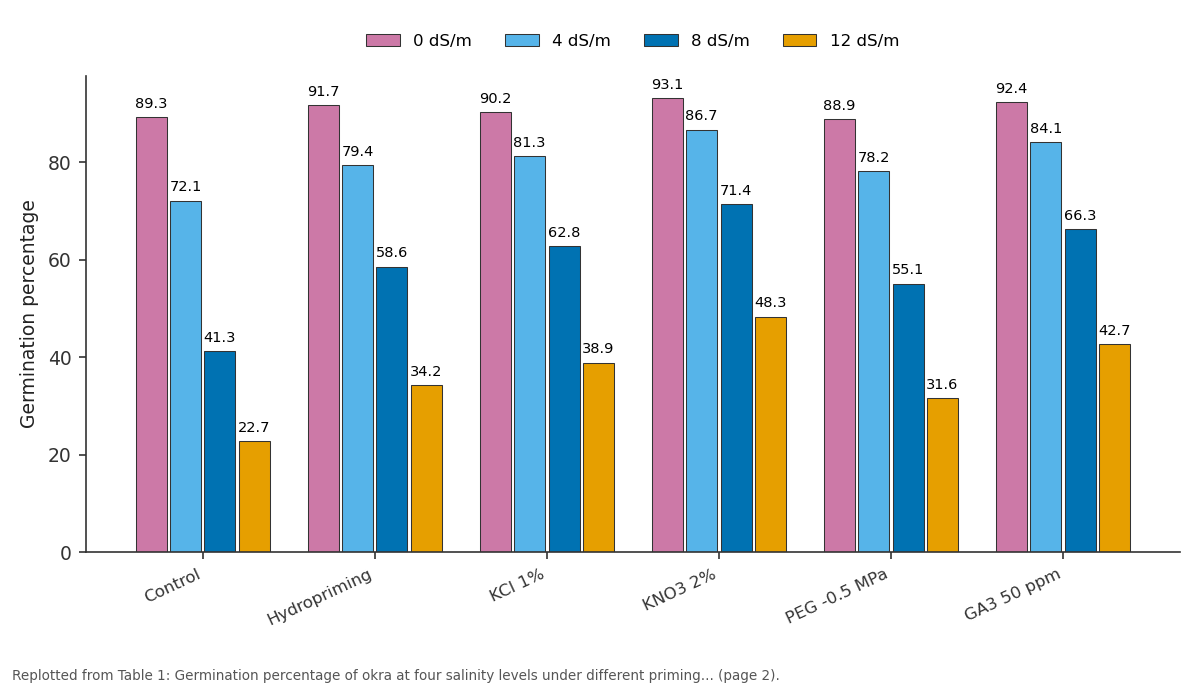
0 dS/m and 4 dS/m and more: Control vs Hydropriming vs KCl 1% vs KNO3 2% vs PEG -0.5 MPa
Replotted from Table 1 (page 2) of the original paper. Every bar is the paper's own table value.
View source evidence ↗Figures & tables
From the original paper Table 1
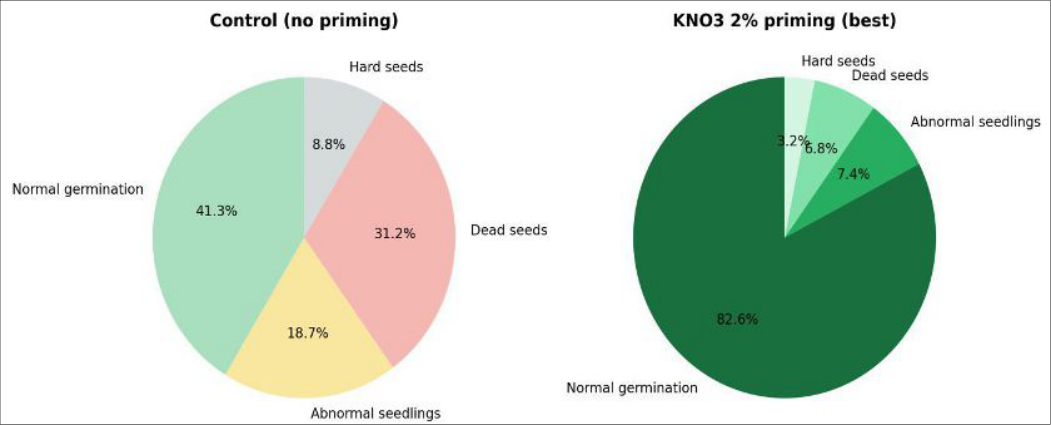 Figure 1
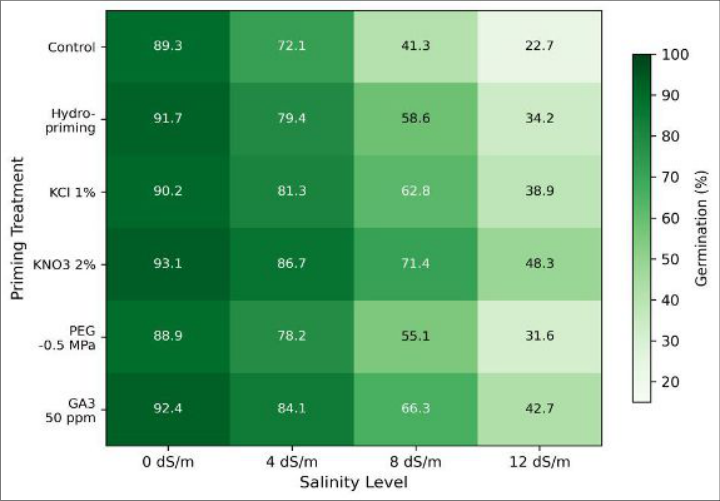 Figure 2
Introduction
According to the Indian Council of Agricultural Research, roughly 6.73 million hectares of land in India are salt-affected, and the figure may rise to 16.2 million hectares by 2050 [1] . Soil salinity disrupts water uptake, creates ion toxicity, and triggers oxidative damage, all of which reduce germination [2] . Okra is particularly vulnerable to salt injury at germination because of its mucilaginous seed coat that absorbs excess sodium [3] . Seed priming, the controlled hydration of seeds followed by re-drying before sowing, has been explored as a low-cost countermeasure. The technique activates pre-germinative metabolic events without allowing radical emergence [4] . Several priming agents have been tested: hydropriming with water shows moderate success in wheat [5] ; osmopriming with PEG regulates imbibition rate [6] ; halopriming with KCl or KNO 3 provides both osmotic conditioning and a nutrient source [7] ; and hormonal priming with GA3 directly promotes embryo growth [8] . Comparative data for okra under graded salinity remain scarce. A few reports exist for okra under drought [9] , but controlled comparisons under salinity are limited. The interaction between priming method and salinity level is especially important: a treatment effective at 4 dS/m may fail at 12 dS/m [10] . This research compared six seed priming protocols across four salinity levels to identify the agent offering the widest protection window for okra growers in salt-affected areas [11,12] .
Material and Methods
Material and Methods
Material
Seeds of okra cultivar Arka Anamika were obtained from the Indian Institute of Vegetable Research, Varanasi (initial germination 92%, moisture 8.4%). Priming chemicals included PEG 6000 (Sigma-Aldrich), KCl and KNO 3 (Merck, analytical grade), and GA3 (Loba Chemie, 90% purity). Saline solutions were prepared using NaCl (Merck). All germination
Methods
Seeds were surface-sterilised with 0.1% mercuric chloride (2 min), rinsed, and primed: hydropriming in distilled water (12 h); osmopriming in PEG 6000 at -0.5 MPa (16 h); halopriming in 1% KCl (12 h) and 2% KNO 3 (12 h); and hormonal priming in 50 ppm GA3 (8 h). Seed-to-solution ratio was 1:5 (w/v). After priming, seeds were air-dried to original moisture [13] . Germination tests used the betweenpaper method with 25 seeds per replicate across four NaCl levels (0, 4, 8, 12 dS/m) and four replications (96 rolls total). Counts were taken on days 7 and 14 following ISTA rules [14] . Vigour index I = germination % x seedling length; vigour index II = germination % x seedling dry weight [15] . Data were analysed as a factorial CRD using OPSTAT software; means separated by LSD at p<0.05.
Results
Table Germination declined progressively with salinity, but the magnitude varied sharply among priming methods. At 0 dS/m, differences were small. At 8 and 12 dS/m, KNO 3primed seeds maintained germination at 71.4% and 48.3%, while unprimed seeds dropped to 41.3% and 22.7%. The priming x salinity interaction was significant (p<0.01). Vigour index I under KNO 3 at 12 dS/m was 627, roughly 2.8 times the control value of 227. The pie charts (Figure 1) contrast seed fate at 12 dS/m: without priming, dead seeds and abnormal seedlings accounted for nearly half the lot, whereas KNO 3 shifted the balance toward normal germination. The heatmap (Figure 2) confirms KNO 3 2% as the greenest row across all columns, while PEG osmopriming appears almost indistinguishable from hydropriming at higher salinities.
Discussion
The strong performance of KNO 3 priming agrees with Nawaz et al. [7] in wheat and Basra et al. [16] in hot pepper. Potassium nitrate likely confers a dual benefit: potassium ions counteract sodium entry through competitive inhibition at membrane transport sites, while nitrate ions serve as a nitrogen source for early enzymatic activity [17] . The reasonable performance of KCl supports the view that the potassium ion is the main driver of protection. GA3 priming ranked second. Gibberellic acid stimulates alpha-amylase and other hydrolytic enzymes that supply the embryo with sugars and amino acids [8] . But GA3 costs several times more than KNO 3 , limiting its appeal for smallholder growers. The weak PEG response was unexpected; Farooq et al. [6] cautioned that PEG can clog seed coat pores in mucilaginous species, and okra's abundant mucilage production may explain this finding. One practical implication: the priming advantage was greatest at 8 dS/m and declined at 12 dS/m. Even the best treatment only lifted germination to 48% at 12 dS/m, which may be too low for commercial stands. Seed priming should therefore be part of a broader salinity management package that includes soil amendments and salt-tolerant varieties [18,19] .
Conclusion
This research demonstrated that seed priming can substantially improve okra germination under salinity stress. Among six treatments, halopriming with 2% KNO 3 for 12 hours was the most effective, raising germination at 12 dS/m from 22.7% to 48.3% and lifting vigour index I by 2.8-fold. GA3 priming ranked second, followed by KCl and hydropriming. PEG osmopriming was weakest, possibly because of mucilage-PEG interactions. The priming x salinity interaction was significant: at low salinity most methods worked similarly, but at 8-12 dS/m only KNO 3 and GA3 kept germination above 40%. KNO 3 is inexpensive, widely available, and requires no specialised equipment, making it suitable for smallholder adoption. Future work should validate these results under field conditions across salt-affected regions of the Indo-Gangetic plain.
Acknowledgement
Acknowledgements Funding sourcesThe research was funded by the Department of Plant Breeding and Seed Technology, Bundelkhand University of Agricultural Sciences, Jhansi. Institutional supportThe authors thank the Director of Research, Bundelkhand University of Agricultural Sciences, and the Department of Seed Research, Krishi Vigyan Agricultural University, Ludhiana, for collaboration.
Figures and tables from the paper
| Treatment | 0 dS/m | 4 dS/m | 8 dS/m | 12 dS/m | Mean | % change* |
|---|---|---|---|---|---|---|
| Control | 89.3 | 72.1 | 41.3 | 22.7 | 56.4 | - |
| Hydropriming | 91.7 | 79.4 | 58.6 | 34.2 | 66.0 | 17.0 |
| KCl 1% | 90.2 | 81.3 | 62.8 | 38.9 | 68.3 | 21.1 |
| KNO3 2% | 93.1 | 86.7 | 71.4 | 48.3 | 74.9 | 32.8 |
| PEG -0.5 MPa | 88.9 | 78.2 | 55.1 | 31.6 | 63.5 | 12.6 |
| GA3 50 ppm | 92.4 | 84.1 | 66.3 | 42.7 | 71.4 | 26.6 |
| CD (p<0.05) | 3.1 | 3.8 | 4.6 | 5.2 | - | - |
Table text extracted from the original PDF; superscript letters are shown inline. The original table image is below.
View original table image
References
18 in the original paper- Mandal AK, Sharma RC, Singh G, Dagar JC. Computerized database on salt affected soils in India. Indian Journal of Soil Conservation. 2010;38(1):46-55.
- Munns R, Tester M. Mechanisms of salinity tolerance. Annual Review of Plant Biology. 2008;59:651-681.
- Gupta S, Chattopadhyay T, Datta S, Gupta D. Okra response to salinity at germination stage. Vegetable Science. 2017;44(2):112-116.
- Paparella S, Araujo SS, Rossi G, Wijayasinghe M, Carbonera D. Seed priming: state of the art and new perspectives. Plant Cell Reports. 2015;34(8):12811293.
- Harris D, Rashid A, Miraj G, Arif M, Shah H. On-farm seed priming with zinc sulphate in wheat. Experimental Agriculture. 2007;43(3):315-321.
- Farooq M, Basra SMA, Wahid A, Ahmad N, Saleem BA. Improving drought tolerance in rice by International Journal of Agriculture and Nutrition https://www.agriculturejournal.net osmopriming. Seed Science and Technology. 2009;37(2):306-315.
- Nawaz J, Hussain M, Jabbar A, Nadeem GA, Sajid M. Seed priming a technique. International Journal of Agriculture and Crop Sciences. 2013;6(20):1373-1381.
- Yamaguchi S. Gibberellin metabolism and its regulation. Annual Review of Plant Biology. 2008;59:225-251.
- Amjad M, Ziaf K, Iqbal Q, Ahmad I, Riaz MA. Effect of seed priming on okra germination under thermal stress. Scientia Horticulturae. 2007;114(3):175-181.
- Jisha KC, Vijayakumari K, Puthur JT. Seed priming for abiotic stress tolerance. Acta Physiologiae Plantarum. 2013;35(5):1381-1396.
- Lutts S, Benincasa P, Wojtyla L, Kubala S, Pace R. Seed priming: new comprehensive approaches. Journal of Experimental Botany. 2016;67(3):567-581.
- Singh A, Dahiru R, Musa M, Haliru BS. Effect of osmopriming duration on germination and seedling vigour. Seed Technology. 2014;36(2):109-118.
- ISTA. International Rules for Seed Testing 2022. Bassersdorf: International Seed Testing Association; 2022.
- Abdul-Baki AA, Anderson JD. Vigour determination in soybean seed. Crop Science. 1973;13(6):630-633.
- Basra SMA, Farooq M, Tabassam R, Ahmad N. Physiological and biochemical aspects of seed vigor enhancement in fine rice. Seed Science Research. 2005;15(1):1-9.
- Iqbal M, Ashraf M. Seed preconditioning modulates growth, ionic relations and photosynthetic capacity in wheat under salt stress. Plant Growth Regulation. 2007;51(3):195-206.
- Qadir M, Quillerou E, Nangia V, Murtaza G, Singh M. Economics of salt-induced land degradation. Natural Resources Forum. 2014;38(4):282-295.
- Bewley JD, Bradford KJ, Hilhorst HWM, Nonogaki H. Seeds: Physiology of Development, Germination and Dormancy. 3rd ed. New York: Springer; 2013.