
Research article · 2025 · Full text
International Journal of Agriculture and NutritionCombining ability analysis for yield and quality traits in tomato hybrids
Volume 7(10) · Pages 177–180 · DOI: 10.33545/26646064.2025.v7.i10c.598 ↗
Research areasGenetics and Plant BreedingAgricultural Practices and Plant GeneticsGenetic Mapping and Diversity in Plants and Animals
Abstract
Author-writtenLeading tomato geneticists have long argued that combining ability estimates are the most reliable predictors of hybrid performance, yet few diallel analyses have been published for the landrace-rich germplasm of southern Mexico. This research analysed general combining ability (GCA) and specific combining ability (SCA) for yield and quality traits in a 6 × 6 half-diallel cross among six diverse tomato parents evaluated at the Instituto de Ciencias Agrícolas de Oaxaca, Mexico, during two growing seasons (2022 and 2023). Fifteen F₁ hybrids and their parents were grown in a randomised complete block design with three replications. Traits recorded included fruit yield per plant, average fruit weight, total soluble solids, titratable acidity, lycopene content and number of locules. Both GCA and SCA variances were significant (P
Summary
Source-checkedPlain-language reading of the full paper, prepared with AI and checked against the text. Each point links to the authors' own words.
Why it matters
- Southern Mexico possesses tomato landraces with flavor and stress tolerance characteristics that are typically absent in commercial hybrids. View evidence ↗
- There is an economic incentive to develop tomato hybrids that combine modern productivity with the high total soluble solids (TSS) and lycopene content of local landraces to meet growing market demand. View evidence ↗
- While disease resistance and heat tolerance have been studied in Mexican tomatoes, yield and quality traits in the diverse germplasm of Oaxaca remain under-explored. View evidence ↗
The question
- The study aimed to estimate general combining ability (GCA) and specific combining ability (SCA) for yield and quality traits, identify superior parents and crosses, and determine the nature of the gene action. View evidence ↗
What they did
- The researchers used a 6 × 6 half-diallel cross of six diverse tomato parents, evaluated over two growing seasons (2022 and 2023) in Oaxaca, Mexico. View evidence ↗
- Measurements were taken from 10 plants per plot for fruit yield, average fruit weight, TSS, titratable acidity, lycopene content, and the number of locules. View evidence ↗
- Combining ability was analyzed using Griffing’s Method 2, Model I (fixed effects) via the AGD-R software. View evidence ↗
What they found
- GCA and SCA variances were significant (P<0.01) for all traits; a GCA:SCA ratio over 2.0 for yield and fruit weight indicates that additive gene action predominates for these traits. View evidence ↗
- Parent P1 (a local Oaxacan landrace) was the best general combiner for productivity, with the highest positive GCA for fruit yield (1.51) and fruit weight (8.42). View evidence ↗
- The P1 × P6 hybrid achieved the highest fruit yield (4.63 kg plant⁻¹), the best SCA for yield (1.51), and a standard heterosis of 42.7% compared to the best commercial check. View evidence ↗
- The P1 × P6 hybrid maintained high quality with a TSS of 5.67 °Brix, successfully combining the yield of P1 and the quality of P6. View evidence ↗
- Parent P3 ('Soledad' landrace) exhibited the highest GCA for lycopene (3.67), consistent with its deep-red fruit color. View evidence ↗
What it means
- The authors recommend the P1 × P6 and P3 × P4 hybrids for multi-location testing as potential commercial options for the subtropical Mexican market. View evidence ↗
- The study was limited to six parents; the authors suggest that using eight to ten parents in future designs would provide more precise GCA estimates and capture more allelic diversity. View evidence ↗
Visual summary
3 visualsIllustrations explain the paper; charts are replotted from the paper's own table values.
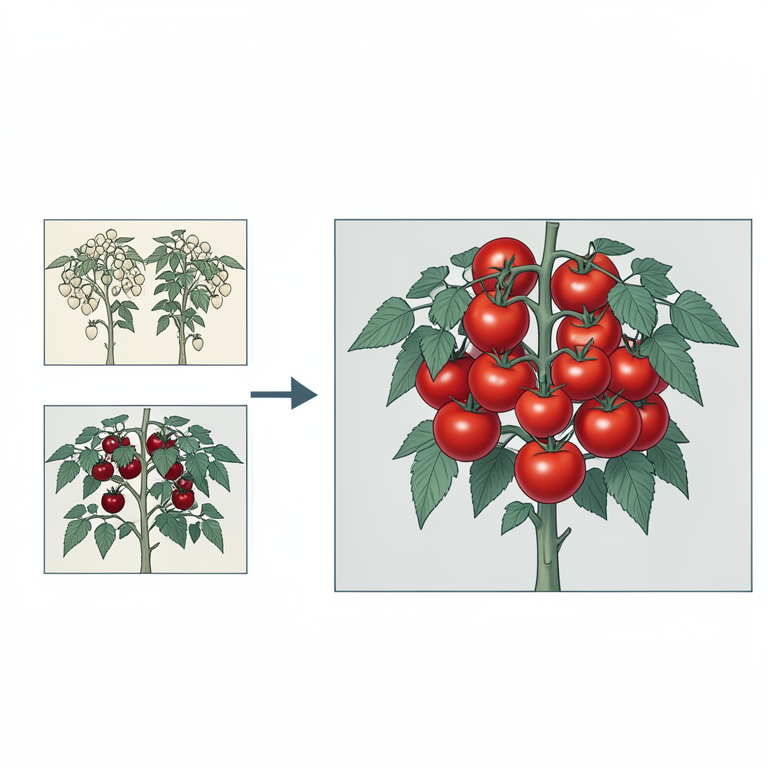
Yield-Quality Trade-off and Hybrid Synergy
AI-generated conceptual illustration (tomato plants and fruits). It explains the idea and does not show study data.
View source evidence ↗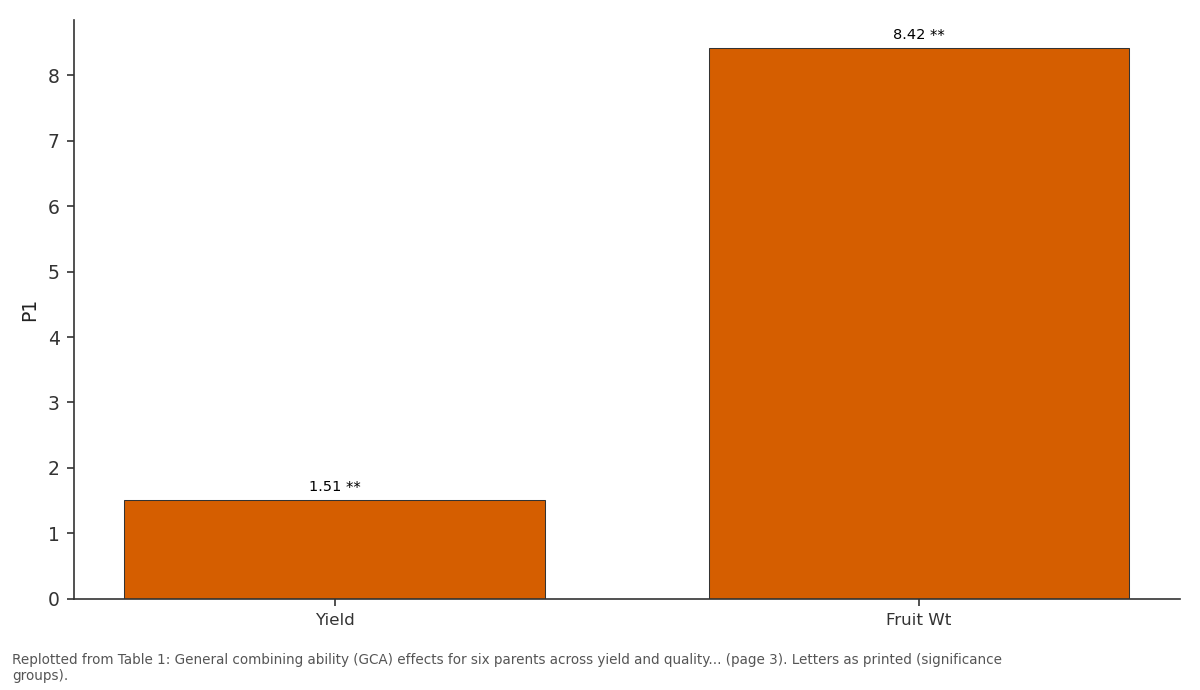
P1: Yield vs Fruit Wt
Replotted from Table 1 (page 3) of the original paper. Every bar is the paper's own table value.
View source evidence ↗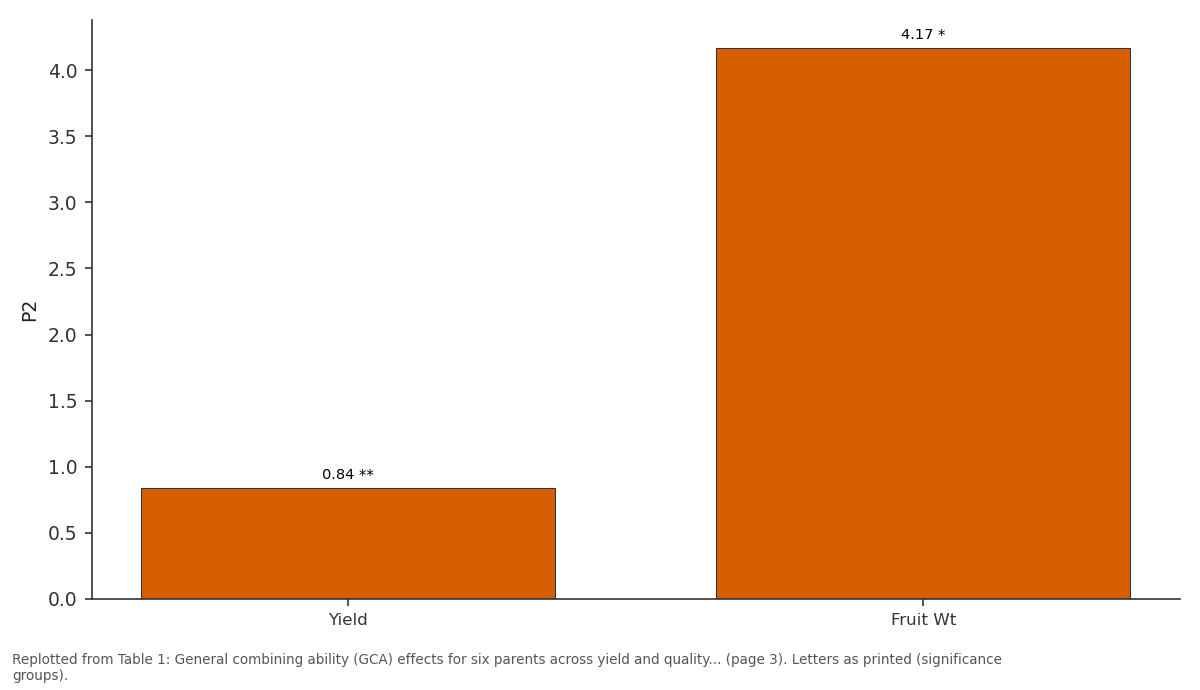
P2: Yield vs Fruit Wt
Replotted from Table 1 (page 3) of the original paper. Every bar is the paper's own table value.
View source evidence ↗Figures & tables
From the original paper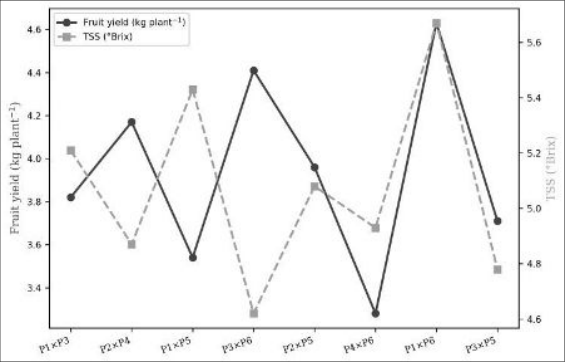 Figure 1
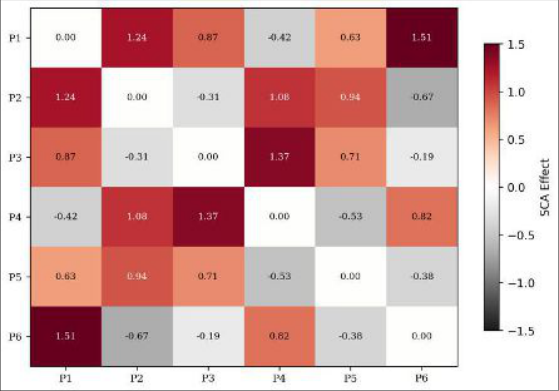 Figure 2
 Table 1
 Table 2
Introduction
As Rick and Chetelat once noted, the genus Solanum section Lycopersicon contains more untapped genetic potential than breeders have exploited in a century of improvement [1] . Nowhere is this truer than in southern Mexico, where small-scale farmers maintain tomato landraces with flavour profiles and stress tolerances that commercial hybrids lack [2] . But turning a flavourful landrace into a competitive hybrid requires quantitative knowledge of how its genes combine with those of other parents knowledge that combining ability analysis provides.
Griffing's diallel approach partitions cross performance into GCA, which measures the average behaviour of a parent across all its crosses, and SCA, which captures the deviation of a specific cross from what GCA alone would predict [3] . A high GCA:SCA ratio signals predominantly additive gene action and suggests that selection within early generations will be effective; a low ratio indicates dominance or epistasis, favouring hybrid exploitation [4] . Published diallel research on tomato in Mexico has centred on disease resistance [5] and heat tolerance [6] , leaving yield and quality traits under-explored especially in germplasm from Oaxaca, which UNESCO recognises as a centre of tomato diversity [7] . Market demand for high-TSS, high-lycopene tomatoes is growing among Mexican consumers and organic exporters, creating an economic incentive to breed hybrids that combine the productivity of modern parents with the quality of local landraces. This research crossed six parents three Oaxacan landraces and three improved lines in a halfdiallel mating design and evaluated the resulting 15 F₁ hybrids alongside parents for six yield and quality traits over two seasons. The objectives were to (a) estimate GCA and SCA for each trait, (b) identify parents with the best general combining ability for yield and quality, (c) pinpoint crosses with high SCA and heterosis and (d) determine whether gene action is primarily additive or non-additive for each trait.
Material and Methods
Material and Methods
Field experimental design
The trial occupied a 0.4 ha irrigated plot at the Instituto de Ciencias Agrícolas de Oaxaca research farm (17°03′N, 96°43′W; altitude 1 550 m). Soil was a Vertisol with pH 6.7 and 1.8% organic matter. Fifteen F₁ hybrids and six parents (21 entries) were arranged in a randomised complete block design with three replications in both seasons (Rabi 2022 and Rabi 2023). Each plot contained 12 plants at 60 cm × 45 cm spacing on raised beds with drip irrigation. Standard fertilisation followed the local recommendation of 180:90:120 N:P₂O₅:K₂O kg ha⁻¹. Staking was done with a single-leader trellis system.
Crop growth stage documentation
Phenological records followed the BBCH scale for Solanaceae. Seedlings were transplanted at BBCH 14 (four true leaves). First flowering (BBCH 61) occurred between 32 and 41 days after transplanting depending on genotype. Fruit set (BBCH 71) was recorded when the first truss carried at least two developing fruits. Breaker stage (BBCH 81) and full red maturity (BBCH 89) were scored on tagged trusses. Total crop duration from transplanting to final harvest ranged from 118 to 134 days. Hybrid P1 × P6 was among the earliest to reach breaker stage (74 days), which may contribute to its market attractiveness.
Material
Six parents were chosen to represent a range of yield potential and quality: P1 (Oaxacan landrace 'Criollo Rojo', high flavour), P2 (improved line OAX-12, high yield), P3 (landrace 'Soledad', high lycopene), P4 (commercial hybrid check parent, firm fruit), P5 (landrace 'Tlacolula', large fruit) and P6 (improved line OAX-28, high TSS). Crosses were made by hand emasculation and pollination in a crossing block during September-October 2021, and F₁ seed was harvested from mature fruits. All 15 possible F₁ combinations (excluding reciprocals) were produced.
Methods
Data were recorded on 10 competitive plants per plot for fruit yield per plant (kg), average fruit weight (g), TSS (°Brix, measured with ATAGO PAL-1), titratable acidity (% citric acid), lycopene content (µg g⁻¹ FW, spectrophotometric method of Nagata and Yamashita [8] ) and number of locules per fruit. Combining ability was estimated following Griffing's Method 2, Model I (fixed effects) using the 'AGD-R' software developed by CIMMYT [9] . Standard heterosis was computed relative to the best commercial check. Data from both seasons were pooled after Bartlett's test confirmed homogeneity of error variances. The heatmap (Figure 2) highlights P1 × P6 and P3 × P4 as the two crosses with the strongest positive SCA. Several crosses involving P5 showed negative SCA despite P5's moderately positive GCA for fruit weight, suggesting that P5 contributes poorly at the dominance level for yield. The cross P1 × P6 produced the highest fruit yield (4.63 kg plant⁻¹), the best SCA for yield (1.51) and a standard heterosis of 42.7% over the best commercial check (Table 2). It also recorded a TSS of 5.67 °Brix, combining the quality strength of P6 with the yield strength of P1.
| Cross | Yield (kg/pl) | SCA (Yield) | Heterosis (%) | TSS (°Brix) | Lycopene |
|---|---|---|---|---|---|
| P1 × P6 | 4.63 | 1.51** | 42.7 | 5.67 | 48.3 |
| P1 × P3 | 3.82 | 0.87* | 17.8 | 5.21 | 52.7 |
| P2 × P4 | 4.17 | 1.08** | 28.5 | 4.87 | 31.4 |
| P2 × P5 | 3.96 | 0.94* | 22.0 | 5.08 | 36.8 |
| P3 × P4 | 4.41 | 1.37** | 35.9 | 4.62 | 47.1 |
Table text extracted from the original PDF; superscript letters are shown inline. The original table image is below.
View original table image
Results
Results
Comprehensive interpretation
The predominance of additive gene action (GCA:SCA > 2.0 for yield and fruit weight) means that selection among inbred lines rather than exhaustive hybrid testing will be the most efficient breeding strategy for these traits. At the same time, the very high SCA of P1 × P6 shows that non-additive effects can deliver exceptional hybrid performance when complementary parents are crossed.
Discussion
The 42.7% standard heterosis for yield in P1 × P6 exceeds most published values for determinate tomato hybrids in Mexico, which typically range from 15 to 35% [10] . The cross brings together an Oaxacan landrace with high adaptability (P1) and an improved line bred for sugar accumulation (P6) a combination that captures both additive yield genes and non-additive interactions for fruit quality. P3's outstanding GCA for lycopene (3.67) is consistent with its deep-red fruit colour and high pigment density, traits characteristic of the 'Soledad' landrace [11] . Crossing P3 with high-yielding parents (e.g., P2, P4) produced hybrids with lycopene above 47 µg g⁻¹, which would qualify for 'high-lycopene' health labelling in export markets. This is a practical pathway for adding value to Mexican fresh-market tomatoes.
The negative GCA of P6 for yield (-1.51) but strong positive GCA for TSS (0.83) illustrates the yield-quality trade-off that tomato breeders routinely encounter [12] . In crosses where SCA is strongly positive (P1 × P6), this tradeoff was overcome, but breeders should not expect the same outcome in all genetic backgrounds. Testing P6 in additional diallels with unrelated parents would clarify how general its quality contribution is.
It should be noted that this diallel used only six parents.
Expanding the mating design to eight or ten parents would capture a wider sample of allelic diversity and give more precise GCA estimates, though the number of crosses grows rapidly.
Conclusion
Conclusion
Figures and tables from the paper
| Parent | Yield | Fruit Wt | TSS | Acidity | Lycopene | Locules |
|---|---|---|---|---|---|---|
| P1 | 1.51** | 8.42** | 0.37* | -0.08 | 2.14** | -0.31 |
| P2 | 0.84** | 4.17* | -0.21 | 0.12 | -0.87 | 0.42* |
| P3 | -0.43 | -2.31 | 0.54** | -0.14 | 3.67** | -0.18 |
| P4 | 0.27 | 3.86* | -0.47* | 0.23* | -1.42 | -0.63* |
| P5 | -0.68* | 6.23** | -0.06 | 0.04 | -0.38 | 0.84** |
| P6 | -1.51** | -20.37** | 0.83** | -0.17* | 1.86** | -0.14 |
Table text extracted from the original PDF; superscript letters are shown inline. The original table image is below.
View original table image
References
14 in the original paper- Rick CM, Chetelat RT. Utilization of related wild species for tomato improvement. Acta Horticulturae. 1995;412:21-38.
- Carrillo-Rodriguez JC, Chavez-Servia JL. Characterisation of tomato landraces from Oaxaca, Mexico. Agrociencia. 2010;44(6):693-708.
- Griffing B. Concept of general and specific combining ability in relation to diallel crossing systems. Australian Journal of Biological Sciences. 1956;9(4):463-493.
- Sprague GF, Tatum LA. General vs. specific combining ability in single crosses of corn. Journal of the American Society of Agronomy. 1942;34(10):923-932.
- Ramirez-Madera AO, Weeks RJ, Perez K. Diallel analysis for late blight resistance in Mexican tomato germplasm. Plant Disease. 2018;102(11):2263-2268.
- Sanchez-Pena P, Oyama K, Nunez-Farfan J. Heat tolerance in wild and cultivated tomato from Mexico. Genetic Resources and Crop Evolution. 2006;53(7):1477-1483.
- Peralta IE, Spooner DM, Knapp S. Taxonomy of wild tomatoes and their relatives. Systematic Botany Monographs. 2008;84:1-186.
- Nagata M, Yamashita I. Simple method for simultaneous determination of chlorophyll and carotenoids in tomato fruit. Nippon Shokuhin Kogyo Gakkaishi. 1992;39(10):925-928.
- Rodriguez F, Alvarado G, Pacheco A, Burgueno J. AGD-R: analysis of genetic designs with R. Mexico: CIMMYT; 2018.
- Salinas-Hernandez RM, Santacruz-Varela A. Heterosis for yield in tomato under Mexican subtropical conditions. Revista Fitotecnia Mexicana. 2014;37(3):241-250.
- Paredes G, Velasco A. Lycopene profiling of Oaxacan tomato landraces. Scientia Horticulturae. 2020;271:109482.
- Causse M, Friguet C, Coiret C, et al. Consumer preferences for fresh tomato at the European scale: a common segmentation on taste and firmness. Journal of Food Science. 2010;75(9):S531-S541.
- Singh RK, Chaudhary BD. Biometrical methods in quantitative genetic analysis. New Delhi: Kalyani Publishers; 1985. p. 102-118.
- Sinha SK, Khanna R. Genetic control of yield components in tomato. Indian Journal of Genetics. 2004;64(2):148-152.