
Research article · 2026 · Full text
International Journal of Biology SciencesAnalysis of mosquito population dynamics and diversity in Nanded city, Maharashtra, India
Volume 8(4) · Pages 184–187 · DOI: 10.33545/26649926.2026.v8.i4c.813 ↗
Research areasMosquito-borne diseases and controlMalaria Research and ControlDengue and Mosquito Control Research
Abstract
Author-writtenMosquito-borne diseases continue to be a major public health concern in tropical regions. This study looked at the distribution and diversity of mosquito populations in five locations of Nanded City, Maharashtra, India, from 2024 to 2025. The number of mosquitoes recorded in 2024 was 2,569, and in 2025, it increased to 2,719, indicating an upward trend. To assess species diversity, we used diversity indexes such Shannon-Wiener (H′) and Simpson's index (D). The Shannon index values (H′ = 1.19 in 2024; H′ = 1.21 in 2025) showed moderate diversity, whereas Simpson's index values (D ≈ 0.67-0.68) indicated high diversity with low dominance. Anand Nagar and Vazirabad had higher abundances, with peak populations occurring during the monsoon season. This study underlines the importance of combining diversity indices with spatial data to develop effective vector-management strategies.
Summary
Source-checkedPlain-language reading of the full paper, prepared with AI and checked against the text. Each point links to the authors' own words.
Why it matters
- Mosquito-borne diseases represent a significant public health challenge in tropical areas. View evidence ↗
- The diversity of mosquito genera is critical because different types of mosquitoes are responsible for transmitting different diseases. View evidence ↗
- Studying both the density and diversity of mosquito populations is necessary to understand potential disease threats and ecological stability. View evidence ↗
The question
- The study aimed to analyze the diversity and distribution of mosquito populations across five locations in Nanded City, India, between 2024 and 2025. View evidence ↗
What they did
- Sampling was conducted in five specific areas of Nanded: Anand Nagar, Shri Nagar, Taroda, Vazirabad, and Degloor Naka. View evidence ↗
- Mosquito population data were collected monthly from January to December for the years 2024 and 2025. View evidence ↗
- Adult mosquitoes were captured using light traps for nocturnal species, as well as hand nets and aspirators for those resting on surfaces. View evidence ↗
- The researchers used the Shannon-Wiener Index (H') and Simpson's Diversity Index (D) to assess species diversity. View evidence ↗
What they found
- The total mosquito population increased by 5.84%, rising from 2,569 in 2024 to 2,719 in 2025. View evidence ↗
- Spatial analysis revealed that Anand Nagar and Vazirabad had high abundance and diversity, while Shri Nagar showed lower diversity. View evidence ↗
- Mosquito populations peaked during the monsoon season from June to August, following a gradual increase starting in April. View evidence ↗
- Population levels were relatively low during the winter and early summer months of January through March. View evidence ↗
- The moderate diversity observed suggests the presence of multiple vector genera, including Anopheles, Aedes, and Culex, increasing the risk of various vector-borne diseases. View evidence ↗
What it means
- The authors conclude that mosquito populations in Nanded are increasing, characterized by consistent moderate diversity and strong seasonal patterns. View evidence ↗
- The authors recommend combining spatial data with diversity indices to create more effective strategies for vector management. View evidence ↗
Visual summary
3 visualsIllustrations explain the paper; charts are replotted from the paper's own table values.
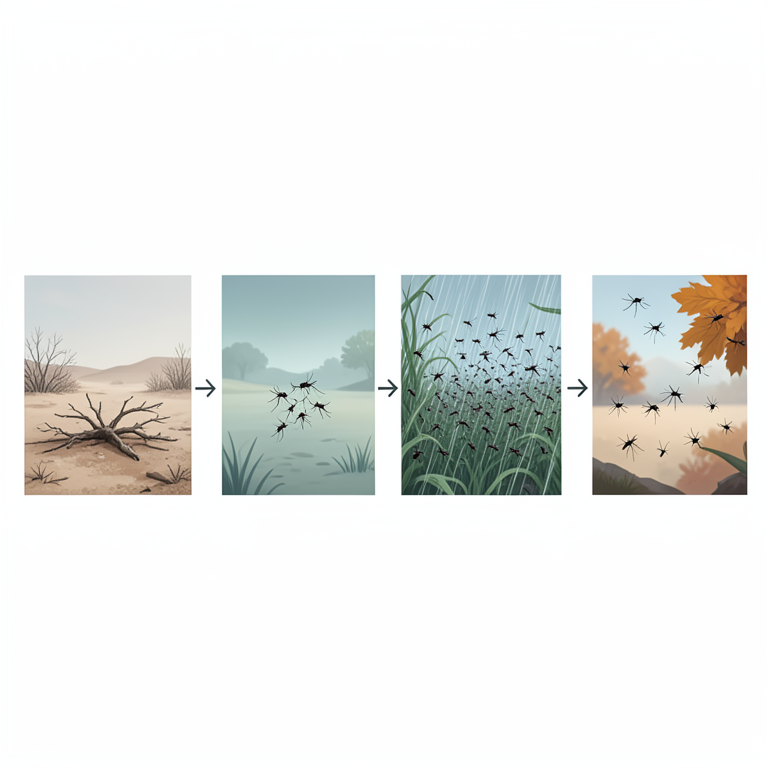
Seasonal Population Cycle
AI-generated conceptual illustration (Aedes and Culex mosquitoes in an urban Indian city setting). It explains the idea and does not show study data.
View source evidence ↗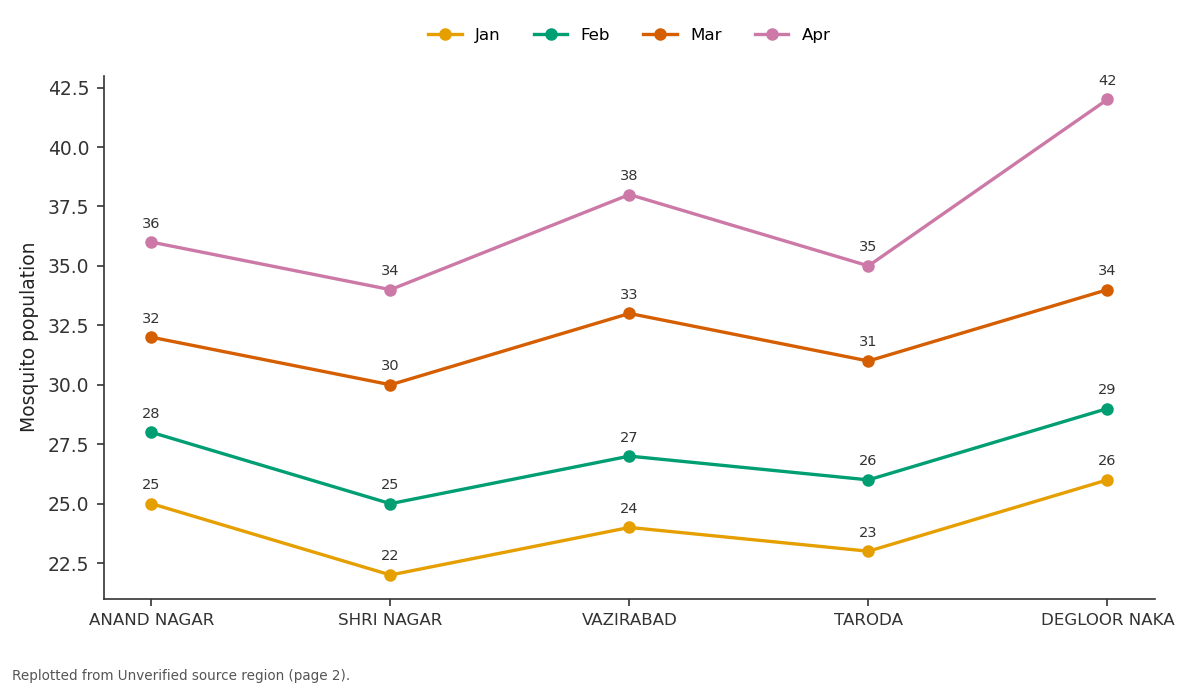
Jan and Feb and more: ANAND NAGAR vs SHRI NAGAR vs VAZIRABAD vs TARODA vs DEGLOOR NAKA
Replotted from a table (page 2) of the original paper. Every bar is the paper's own table value.
View source evidence ↗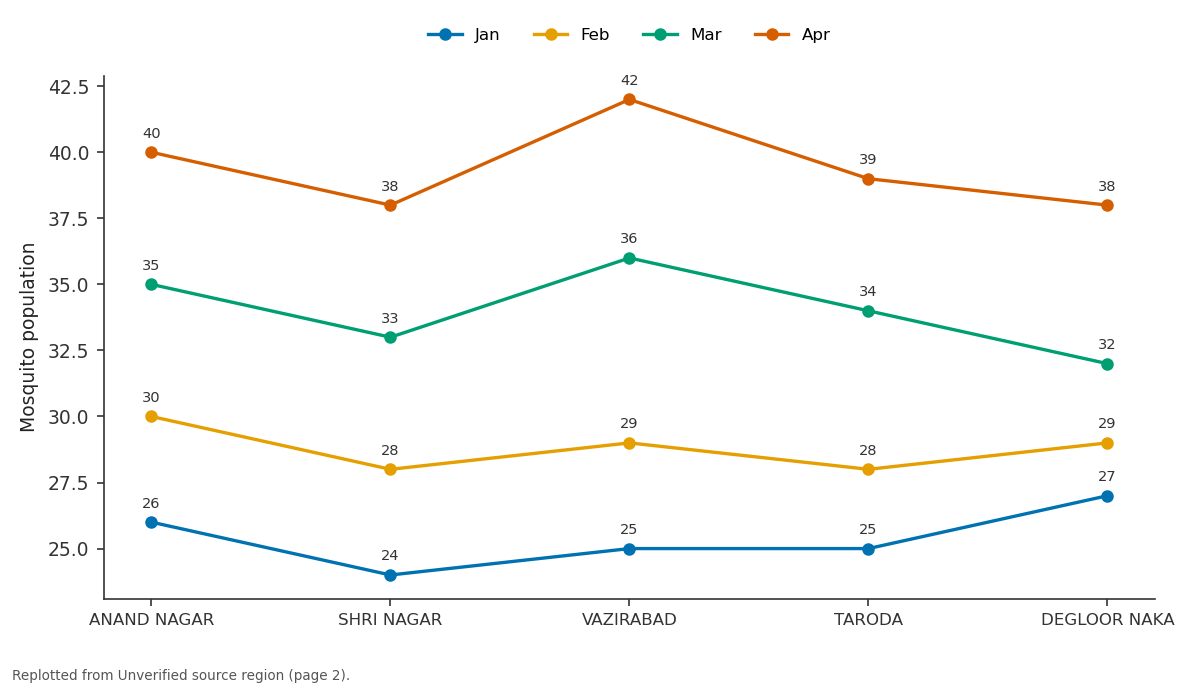
Jan and Feb and more: ANAND NAGAR vs SHRI NAGAR vs VAZIRABAD vs TARODA vs DEGLOOR NAKA
Replotted from a table (page 2) of the original paper. Every bar is the paper's own table value.
View source evidence ↗Introduction
Mosquito populations are important not just for their size but also for their diversity, as different genera play diverse roles in disease transmission (Panda et al., 2024) [1] . Ecological indices, such as the Shannon-Wiener and Simpson's indices, are frequently used to evaluate biodiversity and dominance patterns (Onwuegbuzie, 2024) [2] . Understanding ecological stability and potential disease threats requires a thorough study of both population density and diversity. As a result, this study covered both diversity indices and the location-wise distribution of mosquitos.
Materials and Methods
Materials and Methods
Study Area
This study focused on five separate areas of Nanded: Anand Nagar, Shri nagar, Taroda, Vazirabad, Degloor Naka.
Data Collection
Data on mosquito populations were regularly collected each month from January to December for two consecutive years, 2024 and 2025. To ensure that the observations were consistent and comparable, sampling was carried out at all five designated sites-Anand Nagar, Shri Nagar, Vazirabad, Taroda, and Degloor Naka. A regular sampling schedule was followed throughout the investigation to eliminate temporal bias and assure the trustworthiness of the gathered data. Mosquitoes were captured using a variety of common entomological techniques. Light traps were set up in the evening to attract and catch adult mosquitos, particularly those that are active at night. In addition, hand nets and aspirators were used to catch mosquitos resting on walls, vegetation, and other surfaces in the early morning and evening. These methods ensured a thorough sampling of the mosquito population across various microhabitats within each study site. In addition to collecting adult mosquitos, we did further observations to identify probable nesting sites. Regular inspections were conducted in sites such as stagnant water bodies, drainage channels, residential water storage containers, and roadside puddles to identify potential larval habitats. While the study primarily focused on the quantity of adult mosquitos, these findings provided vital information about breeding conditions and environmental factors. Each month, all collected specimens were thoroughly numbered and documented at each location. A total of 2,569 mosquitoes were recorded in 2024, and 2,719 in 2025, reflecting a gradual rise in the mosquito population over the study period. To ensure data reliability, consistent sampling efforts and standardized procedures were maintained throughout both years. Observations were recorded using uniform formats, and data entries were crosschecked to minimize errors. This systematic and structured approach facilitated effective analysis of the spatial distribution, seasonal trends, and overall population dynamics of mosquitoes in the study area.
Diversity Indices Calculation
Shannon-Wiener Index (H′): H' = -Σ (pi × ln(pi)).
Where: (pi) represents the proportion of each genus. Simpson's Diversity Index (D): D = 1 -Σ (pi2
Seasonal Trends
The analysis of monthly mosquito data revealed a clear and consistent seasonal trend across all research sites. During the winter and early summer months (January-March), the mosquito population remained relatively low, likely due to unfavorable environmental conditions such as decreased humidity and fewer breeding sites. Mosquito populations gradually increased beginning in April and peaked during the monsoon season (June-August). This rise can be due to increased rainfall, which causes stagnant water bodies that provide ideal circumstances for mosquito reproduction and growth. From September to December, mosquito population gradually decreased following the monsoon peak. This decline is most likely due to less rainfall, drying of breeding grounds, and less favorable climatic conditions. Importantly, all five study locations displayed comparable seasonal trends, implying that climatic factors dominate mosquito population dynamics across the region, regardless of local environmental changes.
Discussion
Integrating diversity indices with location-specific data provides richer ecological insights.
Diversity Patterns
Mosquito populations were somewhat diverse, with Shannon index values ranging from 1.19 to 1.21, indicating no severe dominance (Visa Shalini et al., 2022) [4] . Simpson's index (~0.67-0.68) showed low dominance and stable diversity, indicating no single genus dominated the environment (Lei et al., 2025) [5] .
Spatial Variation
Anand Nagar and Vazirabad have high levels of diversity and abundance, but Shri Nagar has lower diversity. Environmental fluctuation, the abundance of breeding sites, and human activities may all contribute to these variances.
Seasonal Influence
The monsoon season increases population size and diversity by providing additional breeding locations and optimal humidity and temperature conditions (Shah Habibullah et al., 2019) [6] .
Ecological and Public Health Implications
Moderate diversity suggests the existence of several vector genera, such as Anopheles (responsible for malaria), Aedes (related with dengue), and Culex (connected to filariasis). This scenario raises the probability of contracting a variety of vector-borne illnesses.
Conclusion
According to the findings, mosquito populations in Nanded are on the rise, with moderate but consistent diversity and a noticeable seasonal influence. The use of diversity indices indicates ecological stability while also indicating potential dangers of transmitting numerous diseases.
References
6 in the original paper- Panda D, Pandit RS, Sahu B, Kamaraju R, Barik TK. Understanding mosquito faunal diversity: an approach to assess the burden of vector-borne diseases in three representative topographies (rural, urban, and periurban) of Ganjam district in Odisha state, India. J Trop Med. 2024;2024(1):9701356.
- Onwuegbuzie AJ. Comparing ecology-based quantitized themes via the Shannon diversity index: introducing the Shannon-based thematic diversity index. Int J Mult Res Approaches. 2024;16(1):47-80.
- Omayio D, Mzungu E. Modification of ShannonWiener diversity index towards quantitative estimation of environmental wellness and biodiversity levels under a non-comparative scenario. J Environ Earth Sci. 2019;9(9).
- Visa Shalini P, Shriram AN, Elango A, Natarajan R, Vijayakumar B, Raju KHK, et al. Mosquito diversity in an experimental township in Tamil Nadu, India. J Med Entomol. 2022;59(5):1615-1624.
- Lei J, Feng J, Ding J, Yang Y. Revisiting the classical biodiversity-ecosystem functioning and stability relationships in microbial microcosms. PNAS Nexus. 2025;4(4):pgaf114.
- Shah Habibullah M, Haji Din B, Tan SH. Impact of climate change on the number of threatened species: international evidence. Rev Polit Public Policy Emerg Econ. 2019;1(2):61-78.