
Research article · 2026 · Full text
International Journal of Agriculture and NutritionImpact of Government Initiatives on Crop Residue Management in Sonipat District (Haryana): Role of Custom Hiring Centres and Krishi Vigyan Kendra
Volume 8(4) · Pages 102–109 · DOI: 10.33545/26646064.2026.v8.i4b.597 ↗
Research areasAgricultural Economics and PracticesAgricultural Innovations and PracticesAgricultural Development and Management
Abstract
Author-writtenThe present study was conducted in Sonipat District, Haryana, to evaluate the effects of different components of the centrally sponsored scheme “Promotion of Agricultural Mechanization for in-situ Management of Crop Residue”. Under this scheme, Krishi Vigyan Kendra (KVK), Sonipat, adopted 11 villages over the period 2018-19 to 2022-23. To manage crop residues through retention/incorporation into the soil, the Department of Agriculture and Farmers Welfare provided financial assistance to individual farmers for the procurement of Crop Residue Management (CRM) machinery and equipment. Under this scheme, a total of 2839 CRM machines, with financial assistance of Rs. 142621834, were provided to individual farmers in the district. The most preferred equipment among farmers was the rotavator (1188), the super seeder (1129), and the zero-tillage seed cum fertilizer drill (332). Farmers preferred to purchase equipment that was easy to operate, repair, maintenance, and suitable for their cropping pattern. In addition, a total of 234 Custom Hiring Centres (CHCs) with financial assistance of Rs.112143181 were established in the District, out of which 17 CHCs with financial assistance of Rs. 11482452 were established in 11 Villages adopted by KVK, Sonipat. In these Villages, frontline demonstrations using different CRM machinery were conducted over 100 ha, 120 ha, 50 ha, and 100 ha in the years 2018-19, 2020-21, 2021-22, and 2022-23, respectively by KVK, Sonipat. Out of the total cultivated area, 63.0% to 82.9% area was covered by CRM technologies in different adopted Villages during the period of study. Through the effective implementation of the CRM project in the District, the number of crop residue burning incidents decreased from 154 in 2018-19 to 33 in 2022-23.
Summary
Source-checkedPlain-language reading of the full paper, prepared with AI and checked against the text. Each point links to the authors' own words.
Why it matters
- Crop residue burning is a global problem that is particularly severe in the North Indian states of Punjab and Haryana. View evidence ↗
- Burning residues threatens human health through air pollution and degrades soil quality by causing the loss of carbon, nitrogen, sulphur, and 20-25% of phosphorus and potash. View evidence ↗
- Labor shortages and the large amount of residue left by combine harvesters make it difficult for farmers to manage crop residues using conventional equipment. View evidence ↗
The question
- The study aimed to evaluate how government initiatives and crop residue management (CRM) technologies impacted the incidence of residue burning and the expansion of cultivated area in the Sonipat District. View evidence ↗
What they did
- The research focused on 11 villages adopted by the Krishi Vigyan Kendra (KVK) in Sonipat from 2018-19 to 2022-23. View evidence ↗
- The government provided 50% financial assistance to individual farmers and 80% to Cooperative Societies, FPOs, and Panchayats for CRM machinery and Custom Hiring Centres (CHCs). View evidence ↗
- KVK Sonipat conducted frontline demonstrations (FLDs) covering 100 ha in 2018-19, 120 ha in 2020-21, 50 ha in 2021-22, and 100 ha in 2022-23. View evidence ↗
What they found
- A total of 2,839 CRM machines were provided to individual farmers in the district with financial assistance totaling Rs. 142,621,834. View evidence ↗
- The most preferred CRM equipment among farmers were the rotavator (1,188 units), the super seeder (1,129 units), and the zero-tillage seed cum fertilizer drill (332 units). View evidence ↗
- During the study, CRM technologies covered between 63.0% and 82.9% of the total cultivated area across the adopted villages. View evidence ↗
- The number of crop residue burning incidents in the district dropped from 154 in 2018-19 to 33 in 2022-23. View evidence ↗
- The introduction of the super seeder in 2020-21 led to it replacing the happy seeder entirely and the zero-tillage machine to a large extent due to higher farmer acceptance. View evidence ↗
What it means
- The authors conclude that the effective implementation of the CRM project successfully reduced crop residue burning incidents in the district. View evidence ↗
Visual summary
2 visualsIllustrations explain the paper; they do not show study data.
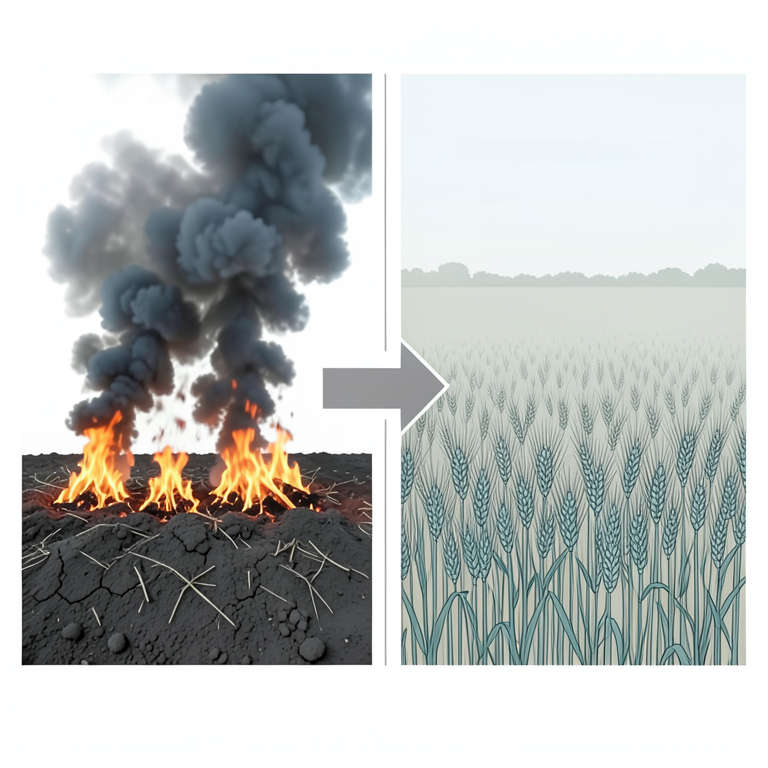
Reduction in Burning Incidents
AI-generated conceptual illustration (wheat fields in Haryana, India). It explains the idea and does not show study data.
View source evidence ↗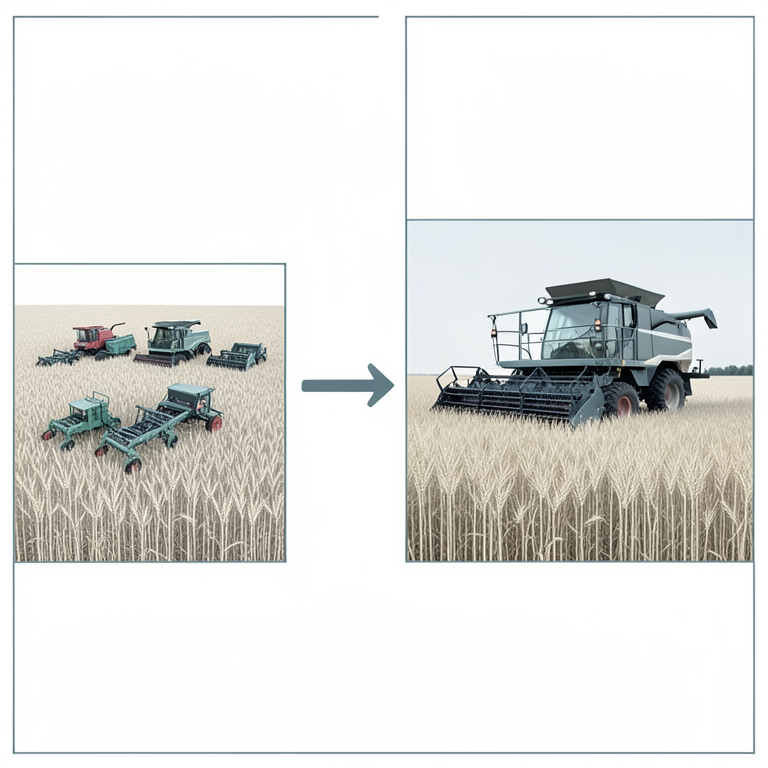
Shift in Machinery Preference
AI-generated conceptual illustration (wheat fields in Haryana with agricultural machinery). It explains the idea and does not show study data.
View source evidence ↗Figures & tables
From the original paper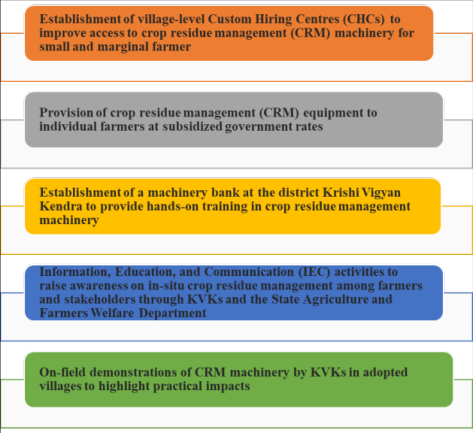 Figure 1
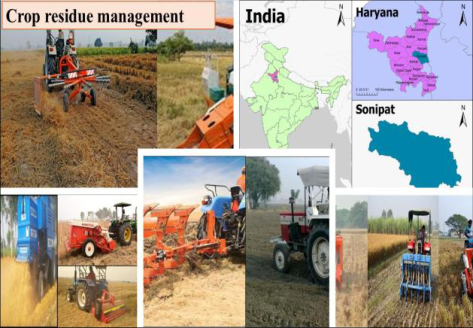 Figure 2
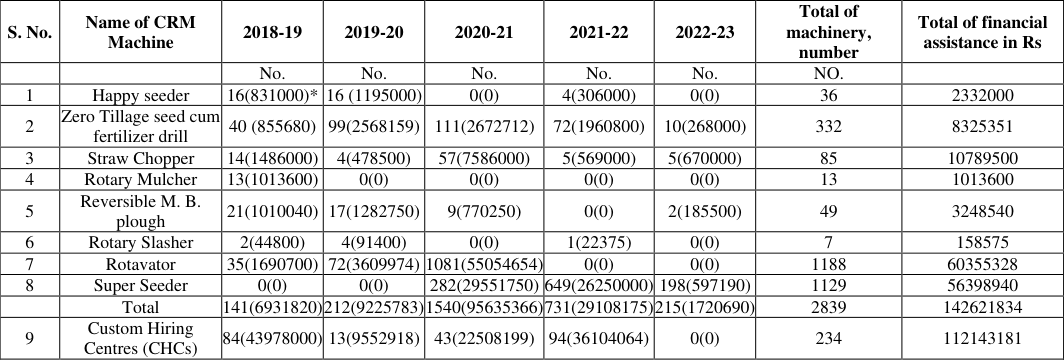 Table 1
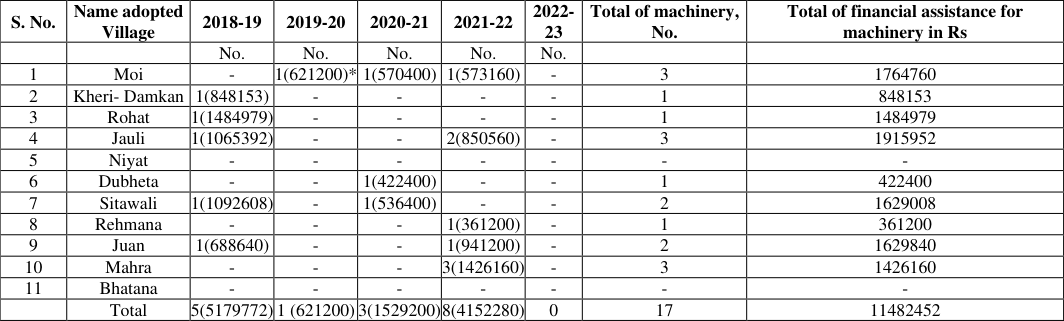 Table 2
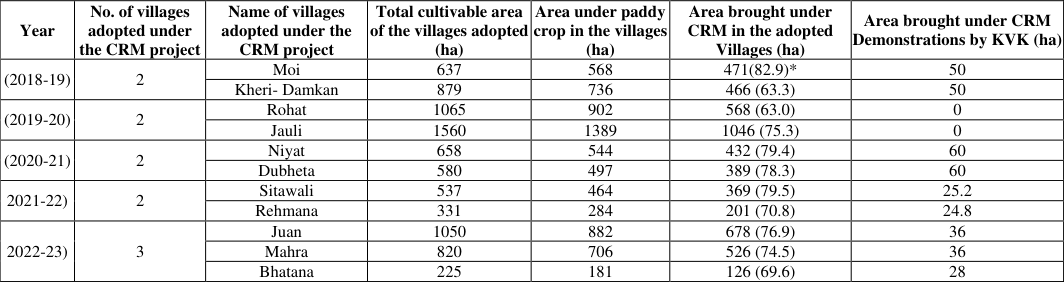 Table 3
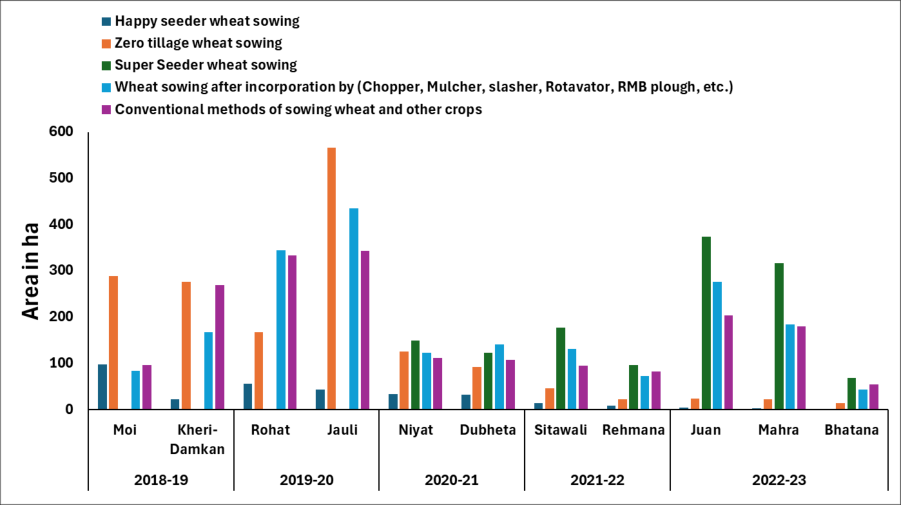 Figure 3
Introduction
India holds the top global position in jute production and ranks second in rice, wheat, cotton, sugarcane and groundnut production (GOI, 2020) [10] . Thus, because of the country's agricultural substantial output, crop residue generation is also significant. The production of main cereal crops rice and wheat in northwest India has significant role in national food security (Singh et al., 2018) [30] . In India, 13.5 Mha of the Indo-Gangetic plains is under ricewheat cropping systems, accounting for more than 85% of the total area (Jat et al., 2024) [14] . Burning of crop residues is a worldwide issue, and India is no exception. The problem is more severe in North Indian states falling within the Indo-Gangetic plains, particularly Punjab and Haryana. Agriculture sector is a significant contributor to total global greenhouse gas (GHG) emissions and directly produces 10 to 12% of global anthropogenic GHG emissions (Bennetzen et al., 2016; Tongwane and Moeletsi, 2018; Crippa et al., 2021) [4,32,8] . However, with in sector, incidences of crop residue burning is a significant contributor to air pollution and a big threat to human health (Li et al., 2016; Santiago-De La Rosa et al., 2018; Lan et al., 2022) [18,26,16] . Substantial amounts of carbon dioxide, nitrous oxide, methane, and other pollutants releases during crop residue burning which produces negative environmental and human health impacts (Abdurrahman et al., 2020) [1] . The burning of crop residues also deteriorates soil quality. During burning entire carbon, major portion of nitrogen, 20-25% of phosphorus (P) & Potash (K), half of the sulphur (S) is lost. Burning also depletes soil micronutrients (Singh et al., 2022) [27] essential for enhancing for crop productivity.
The amounts of CO2, CO, CH4, and N2O released into the atmosphere due to crop residue burning are around 70, 7, 0.66, and 2.1 %, respectively (Ye et al., 2024) [35] . Straw is an essential agricultural by-product (Chaturvedi et al., 2022; Srivastava et al., 2023) [7,31] , which has traditionally been used mainly for livestock fodder, fuel for domestic cooking, and thatching material (Iqbal et al., 2022) [12] . However, the amount of straw produced each year exceeds their uses. Therefore, straw recycling through incorporation or mulching into or on the soil is essential, which also improves soil properties and subsequently plant growth. Returning straw to the soil has been widely studied for its role in boosting productivity and environmental benefits (Wang et al., 2015; Xia et al., 2018; Berhane et al., 2020) [33,34,5] . Straw return plays a significant role in enriching soil organic matter, enhancing nutrient availability, and promoting microbial population & diversity (Guan et al., 2023; Lin et al., 2023) [11,21] . It is closely linked to the global nitrogen and carbon cycles and agricultural productivity (Li et al., 2023) [17] . Returning straw affects several soil physicochemical parameters, including soil pH, dissolved oxygen concentration and temperature (Li et al., 2020) [19] . It also improves soil aggregation and soluble organic carbon (Ma et al., 2020) [23] . Incorporation of straw improves soil moisture, water infiltration, porosity, and aggregate stability (Zhao et al., 2019; Brankatschk and Finkbeiner, 2015 [36,6,34,13,25,20] . One of the most significant issues, Indian farmers face is shortage of agricultural labour (Kadaraiah et al., 2022) [15] . Agricultural mechanization is minimizing input costs and increasing crop productivity by completing farm operations more quickly. However, Mechanization is mainly observed among farmers with large operational holdings. The limited availability of improved farm machinery among marginal and small farmers is affecting agricultural output (Anonymous, 2015a & b) [2,3] . The average Farm Power Availability in India is still low i.e. 1.84 kW/ha. To achieve higher productivity and minimizing input cost, farm power of 4.00 kW/ha by 2030 is considered crucial (Final Report on M&E SMAM, 2018) [9] . A large proportion of the area under rice-wheat cropping system was subjected to mechanical harvesting, that saves labour, time, and money. But the major challenge with combine harvesters, a large amount of residue is left in the fields after harvesting and farmers cannot manage it effectively with conventional farm equipment. Hence, farmers generally adopt a quick, economical, and easier way to burn the residue in their fields to facilitate the timely sowing of the succeeding crops. Management of rice residues can be carried out either through in-situ techniques (retention of rice straw on the soil surface or incorporation of the residue into the soil for decomposition) or ex-situ (use of paddy straw for energy, biochar and mulching, etc.) (Mahal et al., 2019) [24] . However, in-situ paddy straw management is the most economical and sustainable among all available options (Singh et al., 2020) [29] . The major technologies/machinery for in-situ paddy straw management consist of super seeder, happy seeder, paddy straw mulcher, paddy straw chopper, cutter-cum-spreader, zero-till drill, rotavator, reversible mould board plough, etc. One of the methods is to directdrill wheat seed into paddy stubble, with straw retained on the surface as mulch. At the same time, another solution is incorporating paddy straw into the soil, which is essential for seedbed preparation for vegetable crops such as potato and pea (Singh et al., 2022) [28] . To implement these methods successfully at farmers' field, Government of India had sanctioned and initiated a Central Sector Scheme entitled "Promotion of Agricultural Mechanization for insitu Management of Crop Residue in the States of Punjab, Haryana, Uttar Pradesh, and NCT of Delhi" in the year 2018-19. This study presents the overall impacts of the project/scheme in minimizing crop residue burning incidence and expanding cultivated area through different crop residue management technologies in District Sonipat, by providing substantial financial support to individual farmers and custom hiring centres. The study also examined the dissemination of CRM technologies by conducting front-line demonstrations at farmers' fields in adopted Villages of Krishi Vigyan Kendra to showcase the real impact of technologies for further expansion.
Materials and Methods
Sonipat district is part of the Yamuna Plain, with rice-wheat as the major cropping system. The total area of the district is 2130.81 Km2. Wheat and rice are grown on 164000 ha and 114000 ha, respectively (Department of Agriculture and Farmers Welfare, Sonipat, Haryana). It lies from 28 to 48' 30" to 29 o 17' 54" north of latitudes and from 76 to 28' 30" to 77o 13' 40" east of longitudes. The continuously increasing area under paddy crops has created problems of straw management and, due to lack of awareness and some other reasons, several farmers burn the paddy straw in their fields. Hence, the Government of India initiated the Sub-Mission on Agricultural Mechanization (SMAM) in 2014 to promote farm mechanization, with a particular focus on custom hiring centres to mitigate the adverse economies of scale associated with small landholdings and the high cost of individual ownership. SMAM provides financial assistance to rural entrepreneurs, progressive farmers, selfhelp groups (SHGs), Co-operative Societies, Farmer Producer Organizations (FPOs), etc., to establish custom hiring centres (CHCs) to make farm equipment available to farmers, particularly small and marginal farmers, as required. The crop residue management scheme was launched with the objectives of protecting environment from air pollution and preventing loss of nutrients in soil caused by burning of crop residues. Under this scheme, 50% financial assistance was provided to individual farmers and 80% to Cooperative Societies, FPOs, and Panchayats for the purchase of crop residue management machinery and establishment of Custom Hiring Centres (CHCs) respectively. The Scheme promoted the usage of machines such as Super Straw Management Systems, Super Seeder, Happy Seeder, Zero tillage drill, Paddy Straw Chopper, Paddy Straw Mulcher, reversible mould board plough, Rotavator, Rotary slasher, for in-situ management of crop residue and Balers & Rakes for ex-situ uses for collection of straw in the form of bales. For the smooth implementation of the scheme, a districtlevel executive committee (DLEC) was constituted under the chairmanship of the Deputy Commissioner, with members from the Department of Agriculture and Farmers Welfare, the Krishi Vigyan Kendra, the lead bank, and the line departments. DLEC was responsible for carrying forward the objectives of the scheme by involving farmers' groups/progressive farmers. KVK, Sonipat, has conducted demonstrations and organised trainings for farmers, about use, repair and maintenance of latest farm machinery for crop residue management (Figure 1). The present study was conducted to evaluate the effects of the project's components from 2018-19 to 2022-23 in district Sonipat (Figure 2). To promote the management of crop residues by retention/incorporation into the soil, the Department of Agriculture and Farmers Welfare provided financial assistance to individual farmers for the procurement of CRM machinery and equipment. Financial assistance was also offered to co-operative societies of farmers, farmers' producer organizations (FPOs), and Village Panchayats, etc., for the establishment of custom hiring centers (CHCs) to ensure the availability of CRM machinery to small and marginal farmers of the cluster. Krishi Vigyan Kendra of the district was also equipped with the latest CRM machinery with the financial support of the Indian Council of Agricultural Research to conduct demonstrations of different CRM machinery at the KVK farm and the KVK's adopted Villages. Under this project KVK, Sonipat adopted 11 villages namely Moi, Kheri Damkan, Rohat, Jauli, Niyat, Dubheta, Sitawali, Rehamna, Juan, Mahra and Bhatana over different years during the time period of 2018-19 to 2022-23 in the District for promotion of agricultural mechanization for insitu crop management of crop residue (Fig. 2). CRM programs were designed to develop a scalable delivery models for cost-effective solutions to farmers with the following objectives i) continuous dialogues were held to farmers through multiple communication channels to build awareness on air pollution from crop residue burnings and its impacts on human health as well as agricultural productivity ii) Farm level demonstrations and trainings were conducted for capacity building of farmers to use improved crop residue management machines. Master trainers and village volunteers were trained to provide further technical handholding and support to other farmers. During the period of study, various IEC activities, viz., skill development training on in-situ crop residue management, awareness camps in adopted Villages, Farmer-scientist interactions, exposure visits of farmers, field days on different crop residue management (CRM) technologies, etc., have been organized in these adopted villages. The adopted Villages were also educated and awarded through wall writing and the fixing of banners and hoardings at the most common places in the Villages for wide publicity among different stakeholders. Further, in the district's adopted villages, frontline demonstrations on crop residue management technologies were conducted using the latest farm equipment.
Residue retention to increase soil health
Crop residue retention is to keep the residues in the field to improve soil health. The presence and impact of residues on the surface enhances soil moisture content and reduces evaporation from the soil. In addition, retention of residues on soil surface enhances water infiltration rate and leading to better soil physical condition. Presence of crop residues also increases soil organic carbon content, amount of nitrogen and other essential nutrients, which improves the crop yield.
Machineries used for residue retention Zero tillage seed cum fertilizer drill
In zero tillage technology, wheat seeds are directly drilled into soil in presence of paddy stubbles. The technology is highly suitable for basmati rice, which is grown and harvested manually, leaving short anchored stubbles in the field. The operations of zero-till drills require less time and energy than those of conventional tillage implements, thereby lowering total cultivation cost of production and reducing the risk of Phalaris minor germination in the wheat crop fields. Compared to the happy seeder, it is a lightweight machine that can be pulled by less horsepower tractors. The field capacity of a zero till drill was 0.4 -0.5 ha/h.
Happy seeder
The Happy seeder is a machine that sows wheat crop in the standing stubble of the rice crop without ploughing of the field. When the stubbles of a combine-harvested field is further cut and spread with the help of a paddy straw chopping machines, happy seeder can more easily plant wheat seed. Sowing with happy seeder increases wheat yield, reduces fertilizer costs, saves time and money. Before the introduction of this machine, it wasn't easy to sow wheat in rice residue-retained fields. Further, this machine retains crop residues in the field, enhances soil quality and minimizing environmental pollution from stubble burning. This machine requires more than 45-horsepower tractor for its smooth operation and able to sow 0.25-0.35 ha per hour. Functioning of happy Seeder is affected in wet residue conditions.
Super seeder
The Super seeder machine can incorporate standing and loose rice stubbles in combine harvested field. Super seeder machine requires at least 50 h.p. tractor for its smooth running. During the operation, a furrow opener splits apart the soil, and the seed and fertilizer are placed into soil at the recommended depth. The roller fitted into back of machine helps to compress seed and chopped straw. The actual field capacity of the Super Seeder was 0.30-0.40 ha/h.
Incorporation of residues
Paddy straw incorporation significantly influences soil structure, microbial populations and carbon & nitrogen composition, essential for maintaining soil health in cropping systems. Straw incorporation creates an ambient environment that enhances bacterial activity and organic matter decomposition. Straw incorporation is identified as a significant factor affecting soil fertility. Straw incorporation affects several soil physicochemical parameters, including EC, pH, and soil temperature. It improves soil aggregation and soluble organic carbon. Straw incorporation increases soil moisture content, rate of water infiltration and hydraulic conductivity. In addition, straw incorporation reduces the topsoil temperature helpful in reducing terminal heat effect on crop yield. The incorporation of straw also improves crop germination and growth, which results in increasing yield by mineralizing soil nutrients.
Machineries used for the incorporation of residues into the soil Reversible mould board plough (RMB plough)
The RMB plough is used to mix straw into the soil by rotating the top layer of soil. Mixing of crop residues into soil improves soil fertility by accelerating straw decomposition. To run this equipment, high horsepower tractor is required, and diesel consumption is also higher. When the subsoil is sandy or less fertile, RMB Plough is less useful. The RMB Plough performs best when planting potato or other vegetable crops that require a fine seedbed for their cultivation.
Rotavator
A rotavator is a multipurpose machine that removes and mixes crop residues to prepare seedbed for sowing of crops.
It is an improved land preparation method that saves significant energy and time as compared to the conventional method. Due to the versatility of operations such as tillage, mulching, puddling and green manuring, the use of rotavator is increasing. The major limitation of a rotavator is, it is less effective in standing stubbles and heavy crop load conditions.
Machinery used for cutting paddy straw for incorporation and mulching Super straw management system (Super SMS)
An attachment called super SMS is fitted at the back of combine harvester to control the straw stack. It cuts the stubbles of the crop into small pieces and distributes it uniformly in the field. A 110 h.p. engine is necessary for the super SMS attached combine harvester to pull it successfully. For uniform spreading of residues along the full length behind the harvester, the chopped straw was discharged tangentially from the output of the machine with the help of a deflector. After using this system, sowing of wheat crop in the paddy harvested field was more easier. However, fuel consumption increased from 2.5 to 3 l/h during the combined operation.
Straw Chopper
The straw chopper consists of a rotary shaft fitted with a flail-like blade that collects the remaining stubble, cuts it into very small pieces, and distribute uniformly in the field.
It is operated by a 45 h.p. tractor. The actual field capacity of the paddy straw chopper was 0.35-0.45 ha/h.
Shrub master/Slasher
The Slasher or shrub master is used for cutting and spreading crop residues in the field. It consists of a cutting blade, capable to cut anchored stubble and loose straw into small pieces. The cost of the equipment is less and can easily be operated by small h.p. tractor.
Straw Mulcher
Happy seeder is more effectively used in the field after operation of straw mulcher. Standing stubbles are removed, creating a uniform stubble mulch layer. In wet straw condition, the mulcher cannot be used because slipping blades will prevent it from chopping standing and loose straw. The field capacity was 0.30-0.35 ha/h and fuel consumption was 5.5-6.0 l/h. One disadvantage of a mulcher is, it requires additional field operations.
Implementation of the scheme through Government financial assistance
Under the crop residue management scheme, a total of 2839 CRM machines, with financial aid of Rs.142621834 were provided to individual farmers in the District for effective management of crop residues. In District Sonipat, the most preferred equipment was rotavator (1188), super seeder (1129), and zero tillage seed cum fertilizer drill (332). Farmers preferred to purchase equipment that was easy to operate, repair, maintenance and highly suitable for managing crop residues in line with their cropping patterns. Among the least preferred equipment procured by farmers were the rotary slasher (07), rotary mulcher (13), and happy seeder (36), as shown in Table 1. In fact, happy seeder is a highly suitable machine for paddy straw management in combined-harvested paddy field. But, there was less preference for this machine in the district due to the area harvested by a combine harvester is comparatively less and farmers faced some difficulty with its operation and maintenance. In combine-harvested paddy fields, the new machine super seeder was highly preferred. 2). Under the CRM scheme, individual farmers of these Villages had also purchased different machines at subsidized rates. They used them for paddy straw management due to the availability of CRM machinery with individual farmers, the establishment of CHCs, and the organization of intensive IEC activities and demonstrations conducted by different CRM machines in adopted Villages. Almost nil crop residue burning incidence were recorded in the KVK's adopted Villages during the study period.
| S. No. | Name of CRM Machine | 2018-19 | 2019-20 | 2020-21 | 2021-22 | 2022-23 | Total of machinery, number | Total of financial assistance in Rs |
|---|---|---|---|---|---|---|---|---|
| No. | No. | No. | No. | No. | NO. | |||
| 1 | Happy seeder | 16(831000)* | 16 (1195000) | 0(0) | 4(306000) | 0(0) | 36 | 2332000 |
| 2 | Zero Tillage seed cum fertilizer drill | 40 (855680) | 99(2568159) | 111(2672712) | 72(1960800) | 10(268000) | 332 | 8325351 |
| 3 | Straw Chopper | 14(1486000) | 4(478500) | 57(7586000) | 5(569000) | 5(670000) | 85 | 10789500 |
| 4 | Rotary Mulcher | 13(1013600) | 0(0) | 0(0) | 0(0) | 0(0) | 13 | 1013600 |
| 5 | Reversible M. B. plough | 21(1010040) | 17(1282750) | 9(770250) | 0(0) | 2(185500) | 49 | 3248540 |
| 6 | Rotary Slasher | 2(44800) | 4(91400) | 0(0) | 1(22375) | 0(0) | 7 | 158575 |
| 7 | Rotavator | 35(1690700) | 72(3609974) | 1081(55054654) | 0(0) | 0(0) | 1188 | 60355328 |
| 8 | Super Seeder | 0(0) | 0(0) | 282(29551750) | 649(26250000) | 198(597190) | 1129 | 56398940 |
| Total | 141(6931820) | 212(9225783) | 1540(95635366) | 731(29108175) | 215(1720690) | 2839 | 142621834 | |
| 9 | Custom Hiring Centres (CHCs) | 84(43978000) | 13(9552918) | 43(22508199) | 94(36104064) | 0(0) | 234 | 112143181 |
Table text extracted from the original PDF; superscript letters are shown inline. The original table image is below.
View original table image
Front Line Demonstration (FLD) at farmers' fields in adopted Villages
One of the paramount components of this scheme was to organize frontline demonstrations of different CRM technologies in adopted villages. During the year 2018-19, a total of 471 ha was managed out of 568 ha area grown under paddy crop, using various types of CRM machinery in the adopted village of Moi. The highest area i.e. 282 ha was covered with the help of a Zero tillage seed cum fertilizer drill to sow the following wheat crop. The farmer also used a happy seeder machine over 98 ha area to manage stubble in the combined-harvested paddy fields and other fields with long, anchored stubbles. Another adopted village, Kheri Damkan, had a smaller area (23 ha) under a happy seedersown wheat crop, as the water table in this Village is comparatively high. Some farmers faced problems in operating the happy seeder machine, which is heavy in weight and needs special care during their operation. However, a total of 276 ha was covered with the zero-tillage machines, which was also higher than the other CRM practices (Figure 3).
In the year 2019For preparing the seedbed and sowing the crop, no separate implement is required. In 2020-21, 34.5% and 31.6% of the total area was sown using the Super seeder machine out of the total crop residue-managed area in the adopted villages Niyat and Dubheta, respectively. It proveed the popularity, acceptability, and adaptability of this technology. Similarly, in the year 2021-22, 48.2% and 47.7% of the area was sown using super seeder machine, and only 3.8% and 4.5% of the area was sown with the help of a happy seeder, area sown by zero till drill also decreased to 12.4% and 11.4% in the adopted villages, Sitawali and Rehmana, respectively. The acceptability of the happy seeder machine drastically reduced with the introduction of the super seeder machine.
During the year 2022-23, less than 1% area was sown with the help of a happy seeder in the adopted villages of Juan and Mahra, whereas no area was covered in village Bhatana. Only 3.5%, 4.2%, and 11.1% area was sown with the help of a zero till drill, but 55.1%, 60.2% and 53.9% area was sown with the help of super seeder machine and 40.7%, 35.0% and 34.9% area managed using stubble incorporating machinery in adopted Village Juan, Mahra and Bhatana respectively (Figure 3). From the above data, it is clear that the super seeder machine has replaced the happy seeder machine entirely and the zero tillage machine to a large extent. Farmers are either using a super seeder or incorporating paddy stubbles into the soil with the help of other CRM implements.
Conclusion
In conclusion, the study evaluated the effect of different components of the project for promoting crop residue management technologies by providing financial assistance to individual farmers/CHCs for the procurement of CRM machinery and equipment. Krishi Vigyan Kendra, Sonipat, was also equipped with the latest CRM machinery to conduct demonstrations of different CRM machinery at the KVK farm and the adopted Villages during the study period
Acknowledgement
AcknowledgementResearch was supported by the Indian Council of Agricultural Research, Department of Agricultural Research and Education, Government of India, through ICAR-ATARI, Zone-II, Jodhpur. Technical support provided by CCS HAU Hisar and the cooperation of the participating farmers in this study are duly acknowledged.
Figures and tables from the paper
| S. No. | Name adopted Village | 2018-19 | 2019-20 | 2020-21 | 2021-22 | 2022- 23 | Total of machinery, No. | Total of financial assistance for machinery in Rs |
|---|---|---|---|---|---|---|---|---|
| No. | No. | No. | No. | No. | ||||
| 1 | Moi | - | 1(621200)* | 1(570400) | 1(573160) | - | 3 | 1764760 |
| 2 | Kheri- Damkan | 1(848153) | - | - | - | - | 1 | 848153 |
| 3 | Rohat | 1(1484979) | - | - | - | - | 1 | 1484979 |
| 4 | Jauli | 1(1065392) | - | - | 2(850560) | - | 3 | 1915952 |
| 5 | Niyat | - | - | - | - | - | - | - |
| 6 | Dubheta | - | - | 1(422400) | - | - | 1 | 422400 |
| 7 | Sitawali | 1(1092608) | - | 1(536400) | - | - | 2 | 1629008 |
| 8 | Rehmana | - | - | - | 1(361200) | - | 1 | 361200 |
| 9 | Juan | 1(688640) | - | - | 1(941200) | - | 2 | 1629840 |
| 10 | Mahra | - | - | - | 3(1426160) | - | 3 | 1426160 |
| 11 | Bhatana | - | - | - | - | - | - | - |
| Total | 5(5179772) | 1 (621200) | 3(1529200) | 8(4152280) | 0 | 17 | 11482452 |
Table text extracted from the original PDF; superscript letters are shown inline. The original table image is below.
View original table image
References
36 in the original paper- Abdurrahman MI, Chaki S, Saini G, et al. Stubble burning: effects on health & environment, regulations and management practices. Environ Adv. 2020;2:100011. https://doi.org/10.1016/j.envadv.2020.100011.
- Anonymous. State of Indian Agriculture 2015-16. Government of India, Ministry of Agriculture and Farmers Welfare Department of Agriculture, Cooperation and Farmers Welfare, Directorate of Economics and Statistics, New Delhi, India.
- Anonymous. Transforming agriculture through mechanization. Federation of Indian Chambers of Commerce and Industry, New Delhi, India. 2015. p. 1634.
- Bennetzen EH, Smith P, Porter JR, et al. Agricultural production and greenhouse gas emissions from world regions-the major trends over 40 years. Global Environ Change. 2016;37:43-55. https://doi.org/10.1016/j.gloenvcha.2015.12.004.
- Berhane M, et al. Effects of long-term straw return on soil organic carbon storage and sequestration rate in North China upland crops: a meta-analysis. Global Change Biol. 2020;26(4):2686-2701. https://doi.org/10.1111/gcb.15018.
- Brankatschk G, Finkbeiner M. Modeling crop rotation in agricultural LCAs -challenges and potential solutions. Agric Syst. 2015;138:66-76. https://doi.org/10.1016/j.agsy.2015.05.008.
- Chaturvedi S, et al. Chapter 15 -Stalk fibers (rice, wheat, barley, etc.) composites and applications. In: Rangappa SM, editor. Plant Fibers, Their Composites, and Applications. Woodhead Publishing; 2022. p. 347362. https://doi.org/10.1016/B978-0-12-824528-6.00009-6.
- Crippa M, Solazzo E, Guizzardi D, et al. Food systems are responsible for a third of global anthropogenic GHG emissions. Nature Food. 2021;2(3):198-209. https://doi.org/10.1038/s43016-021-00225-9.
- Department of Agriculture, Cooperation & Farmers Welfare. Final Report on Monitoring, Concurrent Evaluation, and Impact Assessment of Sub-Mission on Agricultural Mechanization. Mechanization & Technology Division. 2018. p. 5-2, 23.
- Government of India (GOI). Pocketbook of Agricultural Statistics. Ministry of Agriculture and Farmers' Welfare, Directorate of Economics and Statistics, Government of India. 2020. https://eands.dacnet.nic.in/.
- Guan Y, et al. Effects of continuous straw returning on soil functional microorganism and microbial communities. J Microbiol. 2023;61(1):49-62. https://doi.org/10.1007/s12275-022-00004-6.
- Iqbal MA, et al. Underutilized grasses production: new evolving perspectives. Grasses and Grassland: New Perspectives. 2022;53.
- Jacobs AA, et al. Cover crops and no-tillage reduce crop production costs and soil loss, compensating for lack of short-term soil quality improvement in a maize and soybean production system. Soil Tillage Res. 2022;218:105310. https://doi.org/10.1016/j.still.2021.105310.
- Jat HS, Kakraliya M, Mukhopadhyay R, Kumar S, Choudhary M, Sharma PC. Conservation agriculture catalyzes sustainable reclamation of sodic soils and enhances crop productivity and input-use efficiency: a scientific inquiry. J Environ Manage. 2024;358:120811. https://doi.org/10.1016/j.jenvman.2024.120811.
- Kadaraiah A, Jirli B, Yarazari SP, Nandini HM, Chaubey PN. Perception of farmers towards custom hiring service centres in Tumakuru district of Karnataka. Indian J Ext Educ. 2022;58(2):209-212.
- Lan R, et al. Air quality impacts of crop residue burning in India and mitigation alternatives. Nat Commun. 2022;13(1):6537. https://doi.org/10.1038/s41467-022-34093-z.
- Li D, et al. Biostraw resource recycling systems: agricultural productivity and green development. Resour Conserv Recycl. 2023;190:106844. https://doi.org/10.1016/j.resconrec.2022.106844.
- Li J, Bo Y, Xie S. Estimating emissions from crop residue open burning in China based on statistics and MODIS re products. J Environ Sci. 2016;44:158-170. https://doi.org/10.1016/j.jes.2015.08.024.
- Li Z, et al. Neoformed aluminosilicate and phytogenic silica are competitive sinks in the silicon soil-plant cycle. Geoderma. 2020;368:114308. https://doi.org/10.1016/j.biortech.2018.02.028.
- Liao Y, et al. By increasing infiltration and reducing evaporation, mulching can improve the soil water environment and apple yield of orchards in semiarid areas. Agric Water Manag. 2021;253:106936. https://doi.org/10.1016/j.agwat.2021.106936.
- Lin BJ, et al. Management-induced changes in soil organic carbon and related crop yield dynamics in China's cropland. Global Change Biol. 2023;29(13):3575-3590. https://doi.org/10.1111/gcb.16703.
- Lou Y, et al. Straw coverage alleviates seasonal variability of the topsoil microbial biomass and activity. Catena. 2011;86(2):117-120. https://doi.org/10.1016/j.catena.2011.03.006.
- Ma S, et al. Effects of straw return mode on soil aggregates and associated carbon in the North China Plain. Agronomy. 2020;10. https://doi.org/10.3390/agronomy10010061.
- Mahal JS, Manes GS, Singh A, Kaur S, Singh M. Complementing solutions and strategies for managing rice straw and their impact in the state of Punjab. Agric Res J. 2019;56:588-593.
- Ruisi P, et al. Long-term effects of no tillage treatment on soil N availability, N uptake, and 15N-fertilizer recovery of durum wheat differ in relation to crop sequence. Field Crops Res. 2016;189:51-58. https://doi.org/10.1016/j.fcr.2016.02.009.
- Santiago-De La Rosa N, et al. Emission factors of atmospheric and climatic pollutants from crop residue burning. J Air Waste Manag Assoc. 2018;68(8):849865. https://doi.org/10.1080/10962247.2018.1459326.
- Singh D, Dhiman SK, Kumar V, Babu R, Shree K, Priyadarshani A, Singh A, Shakya L, Autiyal A, Saluja S. Crop residue burning and its relationship between health, agriculture value addition, and regional finance. Atmosphere. 2022;13:2-17. https://www.mdpi.com/journal/atmosphere.
- Singh G, Sachdeva J, Walia GS. Paddy straw management in Punjab: An economic analysis of different techniques. Indian J Ecol. 2022;49:301-307.
- Singh G, Singh P, Sodhi GPS, Tiwari D. Adoption status of rice residue management technologies in south-western Punjab. Indian J Ext Educ. 2020;56:7682.
- Singh NP, Anand B, Khan MA. Micro-level perceptions of climate change and adaptation issues: a prelude to mainstreaming climate adaptation into the developmental landscape in India. Nat Hazards. 2018;92(3):1287-1304. https://doi.org/10.1007/s11069-018-3250-y.
- Srivastava RK, et al. Biorefineries development from agricultural by-products: value addition and circular bioeconomy. Sustainable Chem Pharm. 2023;32:100970. https://doi.org/10.1016/j.scp.2023.100970.
- Tongwane MI, Moeletsi ME. A review of greenhouse gas emissions from the agriculture sector in Africa. Agric Syst. 2018;166:124-134. https://doi.org/10.1016/j.agsy.2018.08.011.
- Wang J, et al. Crop yield and soil organic matter after long-term straw return to soil in China. Nutrient Cycl Agroecosyst. 2015;102(3):371-381. https://doi.org/10.1016/j.scitotenv.2017.12.096.
- Xia L, et al. Trade-offs between soil carbon sequestration and reactive nitrogen losses under straw return in global agroecosystems. Global Change Biol. 2018;24(12):5919-5932. https://doi.org/10.1111/gcb.14466.
- Ye J, Jensen MM, Goonesekera EM, Yu R, Smets BF, Valverde-Pérez B, et al. Denitrifying communities enriched with mixed nitrogen oxides preferentially reduce N2O under conditions of electron competition in wastewater. Chem Eng J. 2024;498:155292. https://doi.org/10.1016/j.cej.2024.155292.
- Zhao X, et al. Effects of full straw incorporation on soil fertility and crop yield in rice-wheat rotation for silty clay loamy cropland. Agronomy. 2019;9. https://doi.org/10.3390/agronomy9030133.