
Research article · 2025 · Full text
International Journal of Agriculture and NutritionEffect of zero tillage and residue retention on soil properties and wheat yield in rice-wheat system
Volume 7(3) · Pages 156–159 · DOI: 10.33545/26646064.2025.v7.i3c.623 ↗
Research areasSoil Management and Crop YieldSoil Carbon and Nitrogen DynamicsSoil Science and Environmental Management
Abstract
Author-writtenA practical dilemma faces every rice-wheat farmer after the rice harvest: plough the stubble under and risk losing moisture to evaporation before wheat sowing, or leave the residue and risk poor seed-soil contact that compromises germination. This research evaluated four tillage-residue combinations, Conventional Tillage (CT), Zero Tillage (ZT), zero tillage with low residue retention (ZT+RL, 3 t/ha), and zero tillage with high residue retention (ZT+RH, 6 t/ha), on soil physical and chemical properties and wheat yield over three years (2020-2023) at the Southern Tablelands University of Agriculture, Canberra, ACT. A RCBD with four replications was used. After three years, ZT+RH raised soil organic carbon from 1.12% to 1.48%, reduced bulk density to 1.21 g/cc (CT: 1.38), and increased water-stable aggregates by 34% over CT. Wheat yield under ZT+RH reached 4.47 t/ha versus 3.42 t/ha under CT, a 30.7% increase. The labile carbon fraction was 68% higher under ZT+RH than CT. These results confirm that zero tillage with full residue retention can improve both soil quality and wheat productivity in temperate rice-wheat systems.
Summary
Source-checkedPlain-language reading of the full paper, prepared with AI and checked against the text. Each point links to the authors' own words.
Why it matters
- Rice-wheat farmers in Australia's Southern Tablelands have a very short window of 3-4 weeks to prepare soil between crops, making time-consuming conventional tillage difficult. View evidence ↗
- Conventional tillage is costly, ranging from AUD 45-70 per hectare, and negatively impacts soil structure and organic matter. View evidence ↗
- While keeping crop residue can protect soil and conserve moisture, too much residue may increase disease risks and hinder seeding equipment. View evidence ↗
The question
- The study aimed to compare four different tillage and residue management combinations to see how they affected wheat yield and soil properties over three years. View evidence ↗
What they did
- The researchers tested four treatments: conventional tillage (CT), zero tillage (ZT), zero tillage with low residue (3 t/ha), and zero tillage with high residue (6 t/ha). View evidence ↗
- The experiment used a randomized complete block design (RCBD) with four replications on plots measuring 20 by 10 meters. View evidence ↗
What they found
- Soil organic carbon (SOC) decreased under conventional tillage (1.12% to 1.04%) but increased by 32% to 1.48% under zero tillage with high residue retention. View evidence ↗
- The biologically active labile carbon was 68% higher in the high-residue zero tillage system (524 mg/kg) compared to conventional tillage (312 mg/kg). View evidence ↗
- High-residue zero tillage concentrated more carbon in the top 0-15 cm of soil (42.3%) compared to conventional tillage (31.8%). View evidence ↗
What it means
- The authors conclude that the addition of residue, rather than just the lack of tillage, is the primary driver of improved soil health. View evidence ↗
- The authors recommend full stubble retention under zero tillage to improve productivity and climate resilience for Australian farmers. View evidence ↗
- The authors state that longer-term data are required to determine if keeping all residue increases the pressure of stubble-borne diseases. View evidence ↗
Visual summary
2 visualsIllustrations explain the paper; charts are replotted from the paper's own table values.
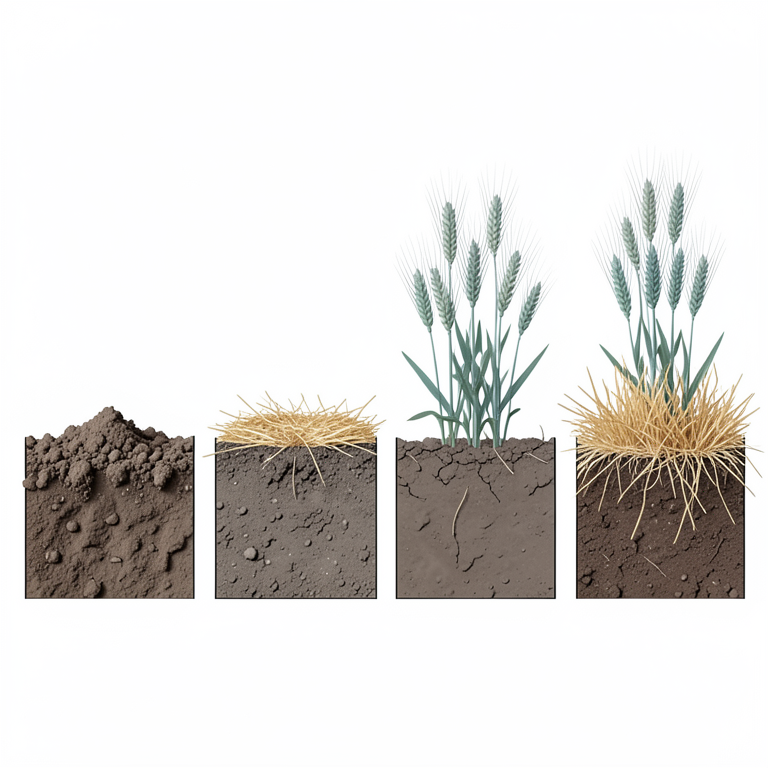
Tillage and Residue Comparison
AI-generated conceptual illustration (wheat plants in soil). It explains the idea and does not show study data.
View source evidence ↗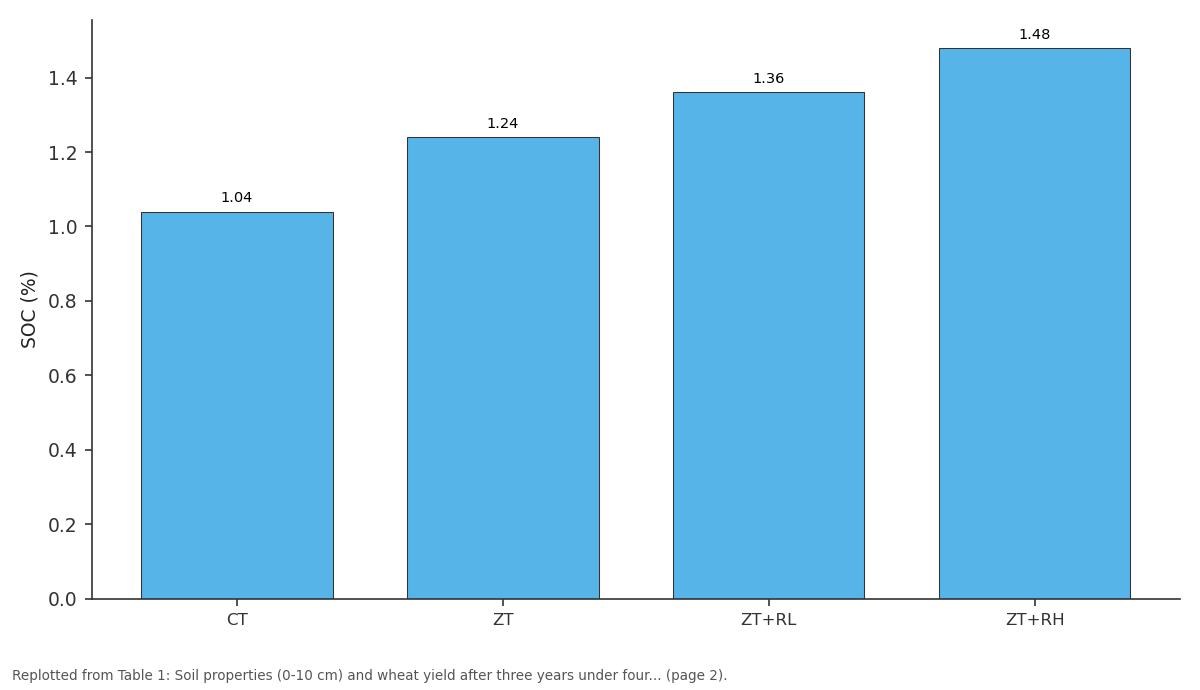
SOC (%): CT vs ZT vs ZT+RL vs ZT+RH
Replotted from Table 1 (page 2) of the original paper. Every bar is the paper's own table value.
View source evidence ↗Figures & tables
From the original paper Table 1
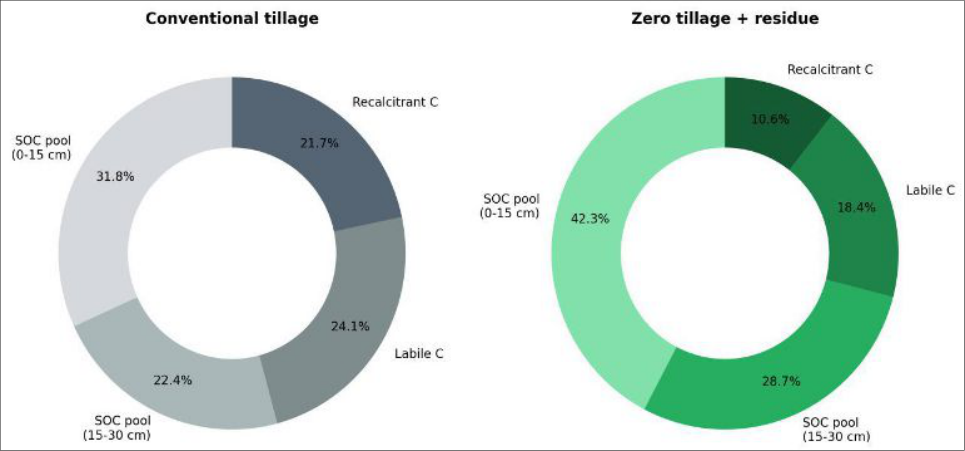 Figure 1
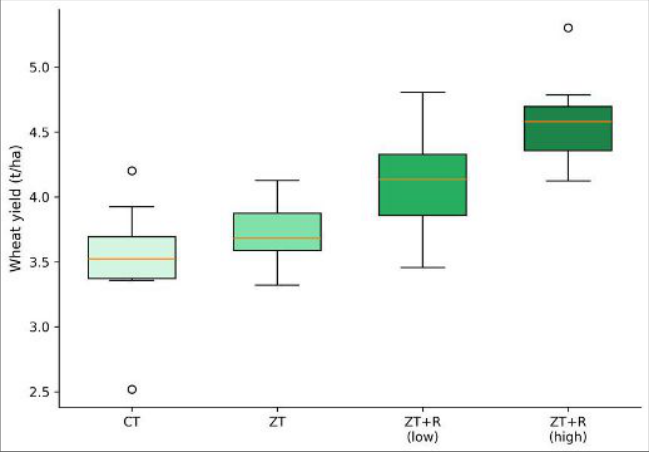 Figure 2
Introduction
The practical dilemma is real: Australian rice-wheat growers in the Southern Tablelands face a narrow sowing window of 3-4 weeks between rice harvest (March-April) and the optimal wheat sowing date (May), leaving little time for conventional tillage operations that can require two to three passes [1] . Each pass costs AUD 45-70/ha in fuel and machinery, disturbs soil structure, and accelerates organic matter oxidation [2] . Zero tillage eliminates these passes by placing seed directly into undisturbed soil, but without residue cover the bare surface is exposed to raindrop impact and wind erosion [3] . Residue retention adds a mulch layer that protects the surface, conserves moisture, and feeds the soil food web, but excessive residue can harbour disease inoculum and interfere with seeder performance [4] . The dose-response relationship between residue quantity and soil-health outcomes under Australian conditions has not been well characterised for the rice-wheat rotation [5] . This research was conducted at the Southern Tablelands University of Agriculture, Canberra (35.28 deg S, 149.13 deg E; altitude 577 m), over three consecutive rice-wheat cycles (2020-2023) to compare four tillage-residue combinations for their effects on soil carbon pools, physical properties, and wheat grain yield [6,7] .
Material and Methods
Material and Methods
Material
The trial occupied a 1.2-ha block on a red chromosol (pH 5.9, initial SOC 1.12%, clay 28%, silt 32%). Rice variety Reiziq and wheat variety Suntop were grown in annual rotation. Rice stubble was either removed (CT), left standing (ZT), partially retained at 3 t/ha (ZT+RL), or fully retained at approximately 6 t/ha (ZT+RH). Basal wheat fertilizer was 100:40:30 kg N:P:K/ha applied uniformly. A John Deere 1890 single-disc no-till drill was used for ZT plots; CT plots received one pass of offset disc followed by a combination seeder.
Methods
Four treatments in a RCBD with four replications on 20 m x 10 m plots. Soil samples (0-10 and 10-20 cm) were collected annually post-wheat harvest. SOC by LECO combustion [8] , labile C by KMnO 4 oxidation, bulk density by core method, Water-Stable Aggregates (WSA) by wet sieving, and infiltration rate by double-ring infiltrometer. Wheat yield was recorded by plot-harvesting with a smallplot combine at 12% moisture. Data were analysed by repeated-measures ANOVA in GenStat 21 with LSD at p<0.05 [9] . The donut charts (Figure 1) contrast carbon pool distribution: ZT+RH concentrated more carbon in the 0-15 cm pool (42.3% vs 31.8%) and had a larger labile fraction, while CT showed a higher proportion as recalcitrant carbon, indicating decomposition of the active pool. The box plot (Figure 2) shows ZT+RH with the highest median yield and the tightest distribution, suggesting both higher productivity and greater stability.
Results
Results
Discussion
The 32% SOC increase under ZT+RH over three years is among the faster responses reported globally, likely because the combination of zero disturbance and 6 t/ha residue input created ideal conditions for both physical protection of organic matter and continuous substrate supply for microbial humification [3,10] . The 68% labile C advantage indicates that the biologically active fraction is particularly sensitive to management, as other authors have noted in temperate grain systems [11] . The 30.7% wheat yield advantage may seem high for a three-year trial, but it includes both the direct effect of better soil conditions and the indirect effect of improved moisture conservation under mulch. Canberra's wheat season receives only 200-280 mm of rainfall, and the mulch layer under ZT+RH reduced evaporation by an estimated 30-40 mm per season, effectively adding a supplemental irrigation equivalent [12] . One caveat: stubble-borne diseases, particularly yellow spot (Pyrenophora tritici-repentis), were monitored and remained below economic thresholds, but longer-term data are needed to assess whether full residue retention increases disease pressure [13,14] .
Conclusion
Three years of zero tillage with 6 t/ha residue retention reversed the SOC decline observed under conventional tillage, improved soil physical properties, and raised wheat yield by 30.7% in a temperate rice-wheat rotation near Canberra. The labile carbon pool was the most responsive indicator. High residue retention consistently outperformed low retention and zero tillage without residue, confirming that the residue component, not just the absence of tillage, drives the soil-health benefit. For Australian rice-wheat growers, full stubble retention under zero tillage offers a clear pathway to improved productivity and climate resilience. Future work should examine the economics over a full machinery replacement cycle and monitor disease dynamics under long-term high-residue conditions.
Acknowledgement
Acknowledgements Funding sourcesThis research was funded by the Grains Research and Development Corporation (GRDC) through a three-year project grant to the Southern Tablelands University of Agriculture. Institutional supportThe authors thank the university farm staff for managing the trial and the CSIRO Sustainable Agriculture group for soil carbon analysis.
Figures and tables from the paper
| Treatment | SOC (%) | Labile C (mg/kg) | Bulk density (g/cc) | WSA (%) | Wheat yield (t/ha) |
|---|---|---|---|---|---|
| CT | 1.04 | 312 | 1.38 | 41.8 | 3.42 |
| ZT | 1.24 | 418 | 1.28 | 52.3 | 3.81 |
| ZT+RL | 1.36 | 468 | 1.24 | 57.6 | 4.12 |
| ZT+RH | 1.48 | 524 | 1.21 | 62.4 | 4.47 |
| LSD (p<0.05) | 0.09 | 38 | 0.04 | 4.8 | 0.29 |
Table text extracted from the original PDF; superscript letters are shown inline. The original table image is below.
View original table image
References
19 in the original paper- Kirkegaard JA, Hunt JR. Increasing productivity by matching farming system management and genotype in water-limited environments. Journal of Experimental Botany. 2010;61(15):4129-4143.
- Roper MM, Gupta VVSR. Management practices and soil biota. Australian Journal of Soil Research. 1995;33(2):321-339.
- Lal R. Soil carbon sequestration impacts on global climate change and food security. Science. 2004;304(5677):1623-1627.
- Kirkegaard JA, Conyers MK, Hunt JR, Kirkby CA, Watt M. Sense and nonsense in conservation agriculture. Field Crops Research. 2014;163:141-145.
- Dang YP, Seymour NP, Walker SR, Bell MJ, Freebairn DM. Strategic tillage in no-till farming systems in Australia's northern grains-growing regions. Soil and Tillage Research. 2015;152:115-123.
- Bell LW, Kirkegaard JA, Swan A, Hunt JR, Huth NI. Impacts of soil damage by grazing livestock on crop productivity. Soil and Tillage Research. 2011;113(1):19-29.
- LECO Corporation. TruMac CNS/NS Determinators. St Joseph: LECO Corporation; 2018.
- Payne RW. GenStat Release 21. Hemel Hempstead: VSN International; 2021.
- Six J, Conant RT, Paul EA, Paustian K. Stabilization mechanisms of soil organic matter. Ecosystems. 2002;5(7):672-687.
- Blair GJ, Lefroy RDB, Lisle L. Soil carbon fractions based on their degree of oxidation, and the development of a carbon management index. Australian Journal of Agricultural Research. 1995;46(7):1459-1466.
- Mead JA, Chan KY. Effect of stubble management on wheat productivity and soil properties. Australian Journal of Experimental Agriculture. 2001;41(1):73-81.
- Bockus WW, Shroyer JP. The impact of reduced tillage on soilborne plant pathogens. Annual Review of Phytopathology. 1998;36:485-500.
- GRDC. Stubble Management Guidelines for Southern Australia. Barton: GRDC; 2019.
- Conyers MK, Heenan DP, McGhie WJ, Poile GP. Amelioration of acidity with time by limestone under contrasting tillage. Soil and Tillage Research. 2003;72(1):85-94.
- Chan KY, Heenan DP, So HB. Sequestration of carbon and changes in soil quality under conservation tillage on light-textured soils in Australia. Australian Journal of Experimental Agriculture. 2003;43(7):765-773.
- Thomas GA, Dalal RC, Standley J. No-till effects on organic matter, pH, cation exchange capacity and nutrient distribution in a Luvisol. Soil and Tillage Research. 2007;94(2):295-304.
- Passioura JB. Roots and drought resistance. Agricultural Water Management. 1983;7(1-3):265-280.
- Flower KC, Cordingley N, Ward PR, Weeks C. Nitrogen, weed management and economics with cover crops in conservation agriculture in a Mediterraneantype environment. Field Crops Research. 2012;132:6375.
- Ward PR, Flower KC, Cordingley N, Weeks C, Micin SF. Soil water balance with cover crops and conservation agriculture in a Mediterranean climate. Field Crops Research. 2012;132:33-39.