
Research article · 2025 · Full text
International Journal of Agriculture and NutritionInfluence of slow-release fertilizers on nitrogen use efficiency in flooded rice systems
Volume 7(3) · Pages 46–49 · DOI: 10.33545/26646064.2025.v7.i3a.607 ↗
Research areasRice Cultivation and Yield ImprovementPolymer-Based Agricultural EnhancementsAgricultural Science and Fertilization
Abstract
Author-writtenFlooded rice systems lose up to 60% of applied nitrogen through volatilisation, denitrification, and runoff. This research compared prilled urea, neem-coated urea, sulfur-coated urea, and polymer-coated urea, each at 120 kg N/ha, for their effect on soil ammonium dynamics, Nitrogen Use Efficiency (NUE), and grain yield in transplanted rice (cv. Samba Mahsuri). The trial was conducted during kharif 2022 at the Rajmata Vijayaraje Scindia Agricultural University, Gwalior, in a randomised complete block design with four replications. Polymer-coated urea-maintained soil ammonium above 30 mg/kg through the ninth week, while prilled urea peaked at 82.1 mg/kg in week two and fell below 10 mg/kg by week seven. Cumulative N uptake at maturity was 131.7 kg/ha under polymer-coated urea versus 91.6 kg/ha under prilled urea. Agronomic NUE reached 34.8 with polymer-coated urea versus 22.3 with prilled, a 56% improvement. Grain yield followed: polymer-coated (5.97 t/ha) > sulfur-coated (5.62) > neem-coated (5.31) > prilled (4.47). Switching from prilled to polymer-coated urea can reduce nitrogen losses and lift yields without increasing the total N rate.
Summary
Source-checkedPlain-language reading of the full paper, prepared with AI and checked against the text. Each point links to the authors' own words.
Why it matters
- Flooded rice systems are inefficient, losing as much as 60% of applied nitrogen to runoff, denitrification, and volatilisation. View evidence ↗
- Although urea makes up over 80% of nitrogen fertilizer used in India, its efficiency in flooded rice is typically only 30-40%. View evidence ↗
- The inefficiency of nitrogen recovery leads to economic losses and environmental damage via nitrous oxide emissions. View evidence ↗
The question
- The study aimed to compare four different nitrogen sources at the same total application rate to evaluate their impact on grain yield, nitrogen uptake, nitrogen use efficiency (NUE) indices, and soil ammonium dynamics. View evidence ↗
What they did
- The researchers tested prilled urea, neem-coated urea, sulfur-coated urea, and polymer-coated urea, all applied at a rate of 120 kg N/ha. View evidence ↗
- The experiment used a randomized complete block design with four replications on a deep Vertisol soil (pH 7.9, OC 0.52%) in Gwalior, India, from July to November 2022. View evidence ↗
- Prilled urea was applied in three splits (at transplanting, 21, and 42 days after transplanting), whereas the slow-release fertilizers (SRFs) were applied as a single basal dose. View evidence ↗
What they found
- Polymer-coated urea achieved the highest grain yield at 5.97 t/ha, which was 33.6% higher than the 4.47 t/ha produced by prilled urea. View evidence ↗
- At maturity, cumulative nitrogen uptake was 131.7 kg/ha for polymer-coated urea compared to 91.6 kg/ha for prilled urea. View evidence ↗
- Polymer-coated urea improved agronomic nitrogen use efficiency (NUE) by 56%, reaching 34.8 compared to 22.3 for prilled urea. View evidence ↗
- The apparent recovery efficiency of nitrogen nearly doubled, increasing from 38.7% with prilled urea to 72.3% with polymer-coated urea. View evidence ↗
- Polymer-coated urea kept soil ammonium above 30 mg/kg until the ninth week, whereas prilled urea peaked early at 82.1 mg/kg in week two and dropped below 10 mg/kg by week seven. View evidence ↗
- Neem-coated urea provided a modest improvement in nitrogen use efficiency, with recovery efficiency increasing from 38.7% to 52.7%. View evidence ↗
What it means
- The authors conclude that polymer-coated urea is recommended for farmers in Vertisol areas because it simplifies management through a single application while increasing yield and efficiency. View evidence ↗
- The authors note that the performance gap might have been smaller if prilled urea had been applied using an optimized four-split schedule instead of the three-split schedule used. View evidence ↗
- The authors suggest that future research should investigate how alternate wetting and drying water management interacts with these fertilizers to further reduce nitrogen losses. View evidence ↗
Visual summary
3 visualsIllustrations explain the paper; charts are replotted from the paper's own table values.
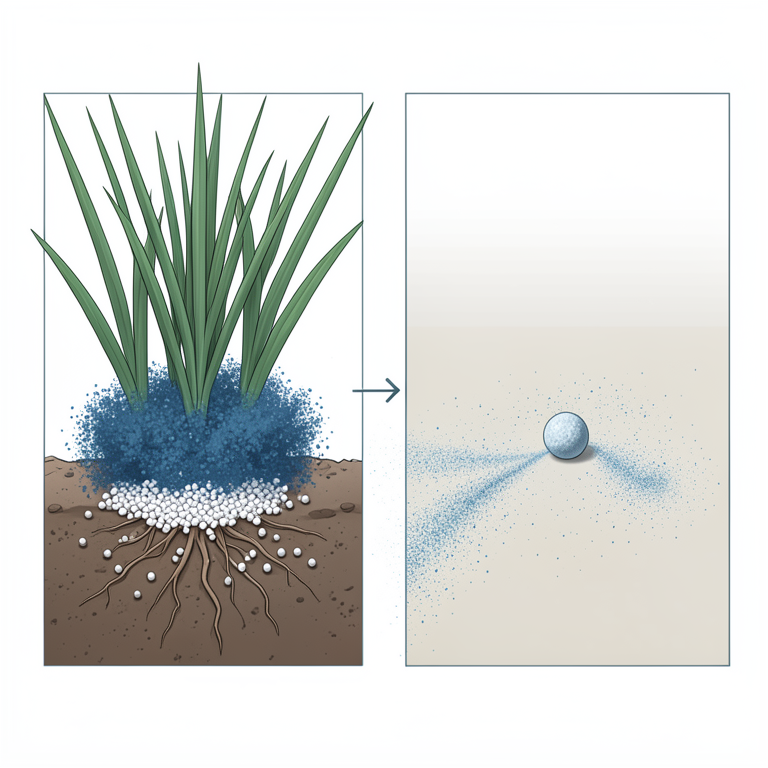
Nitrogen Release Comparison
AI-generated conceptual illustration (flooded rice plants in soil). It explains the idea and does not show study data.
View source evidence ↗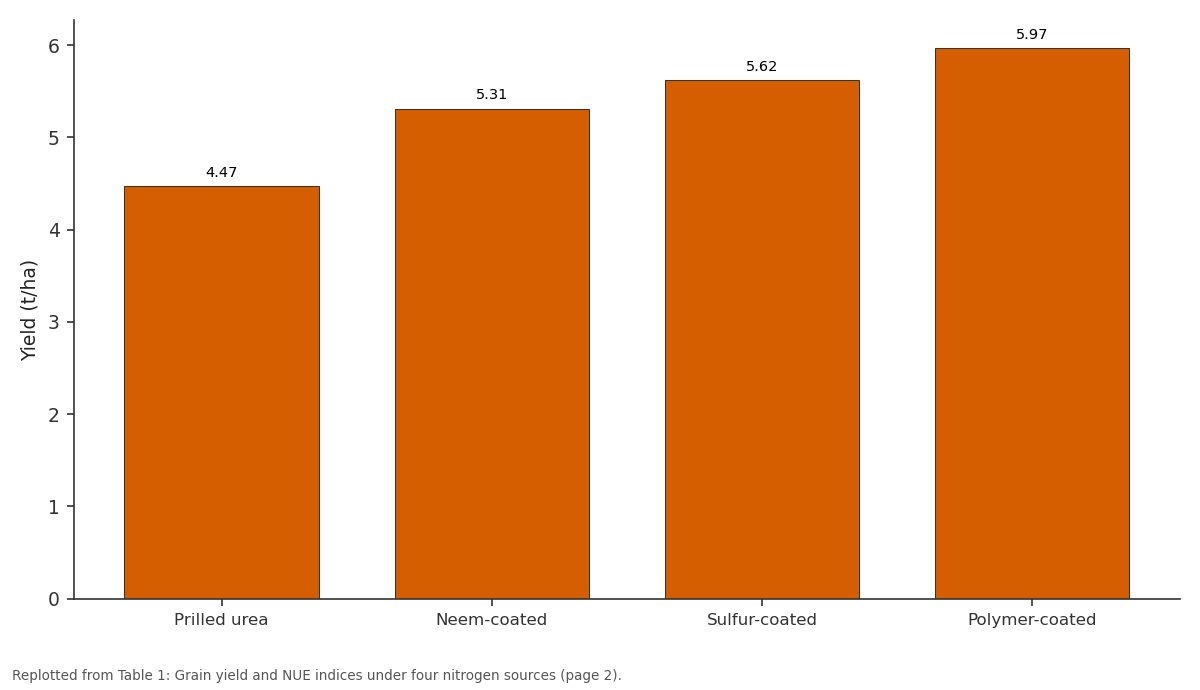
Yield (t/ha): Prilled urea vs Neem-coated vs Sulfur-coated vs Polymer-coated
Replotted from Table 1 (page 2) of the original paper. Every bar is the paper's own table value.
View source evidence ↗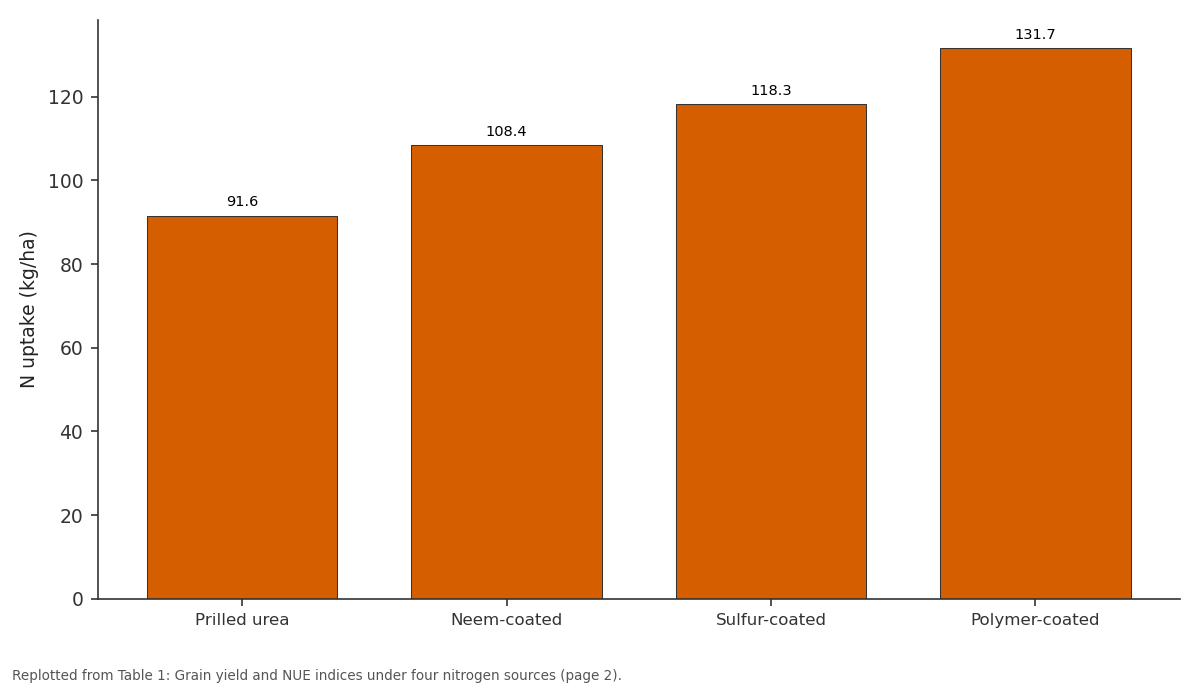
N uptake (kg/ha): Prilled urea vs Neem-coated vs Sulfur-coated vs Polymer-coated
Replotted from Table 1 (page 2) of the original paper. Every bar is the paper's own table value.
View source evidence ↗Figures & tables
From the original paper Table 1
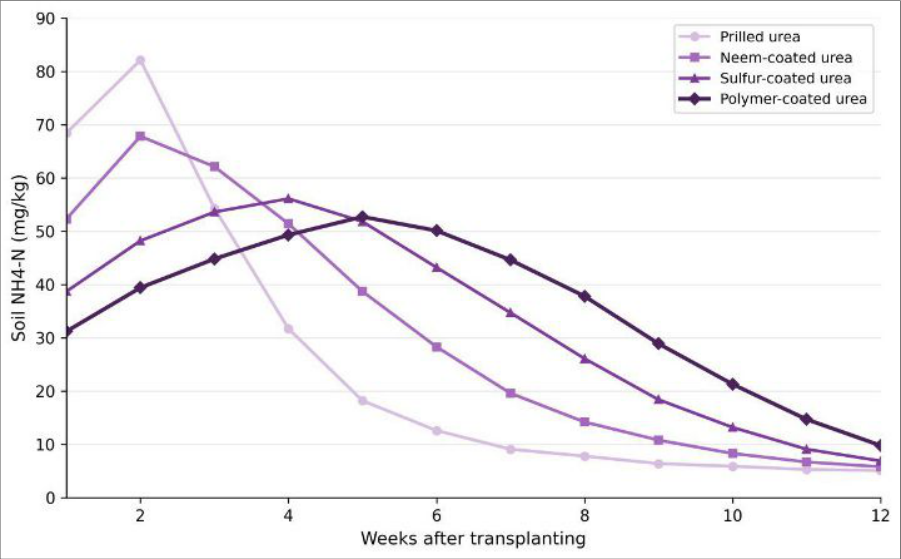 Figure 1
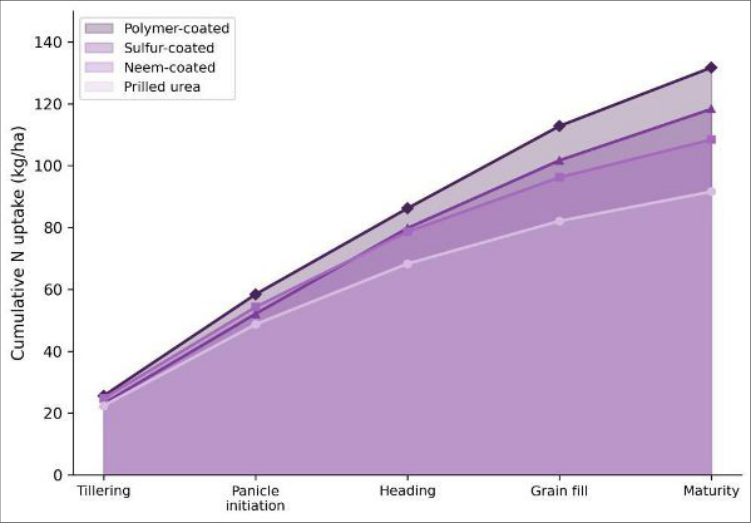 Figure 2
Introduction
When urea was first promoted in Indian agriculture during the 1960s, it was a breakthrough: a cheap, high-analysis nitrogen source manufactured at scale [1] . Six decades later, urea still accounts for over 80% of nitrogen fertilizer consumed in India, yet its efficiency in flooded rice rarely exceeds 30-40% because of rapid hydrolysis and volatilisation [2] . The gap between applied and recovered nitrogen represents both economic waste and environmental hazard through nitrous oxide emissions [3] . Slow-Release Fertilizers (SRFs) aim to bridge this gap. Neem-coated urea uses nitrificationinhibiting properties of neem oil [4] . Sulfur-coated urea releases nitrogen as the sulfur shell degrades through microbial oxidation [5] . Polymer-coated urea encases each granule in a semi-permeable resin controlling dissolution rate [6] . Despite decades of development, headto-head comparisons of these three SRF technologies under identical field conditions in central Indian Vertisols are uncommon [7] . The Gwalior region grows roughly 220,000 hectares of rice annually under transplanted conditions [9] . Farmers apply urea in two or three splits, but compliance is often poor. A slow-release product applied as a single basal dose would simplify management [10] . This research compared the four nitrogen sources at the same total N rate for their effect on soil ammonium dynamics, N uptake, NUE indices, and grain yield of transplanted rice, conducted at the university research farm (26.22 deg N, 78.18 deg E; altitude 196 m) during July-November 2022 on a deep Vertisol (pH 7.9, OC 0.52%) [8,11] .
Material and Methods
Material and Methods
Material
Rice seedlings (cv. Samba Mahsuri, 25 days old) were raised in a wet nursery. Prilled urea (46% N), neem-coated urea (46% N, 0.15% neem oil), sulfur-coated urea (37% N, 13% S, Koch Agronomic Services), and polymer-coated urea (43% N, AGRIUM Inc.) were analysed for actual N content and rates adjusted to deliver exactly 120 kg N/ha. Phosphorus (60 kg P 2 O 5 /ha) and potassium (40 kg K 2 O/ha) were applied uniformly as basal doses.
Methods
A randomised complete block design with four treatments and four replications (16 plots, 5 m x 4 m each) was used. Prilled urea was split three ways (transplanting, 21 DAT, 42 DAT); the three SRFs were applied as single basal doses.
Transplanting was on 18 July 2022 at 20 cm x 15 cm spacing. Flood water was maintained at 5 +/-2 cm. Soil samples (0-15 cm) were collected weekly, extracted with 2M KCl, and ammonium-N measured by the indophenol blue method [12] . Plant samples at five growth stages were dried, ground, and N determined by micro-Kjeldahl. Agronomic Efficiency (AE), Recovery Efficiency (RE), and Partial Factor Productivity (PFP) were computed [8] . Grain yield was adjusted to 14% moisture. ANOVA in GenStat 21; LSD at p<0.05 [13] .
Results
Table Polymer-coated urea produced the highest grain yield (5.97 t/ha), a 33.6% advantage over prilled urea (4.47 t/ha). Apparent recovery efficiency doubled from 38.7% to 72.3%. The temporal pattern differed sharply: prilled urea generated a strong early pulse (82.1 mg/kg at week 2) that depleted rapidly, while polymer-coated urea peaked at roughly 50 mg/kg around weeks 5-6 and remained above 20 mg/kg into week 10. The line chart (Figure 1) highlights the mismatch between prilled urea's release and crop demand: the early spike coincides with transplanting shock when uptake capacity is low. Polymer-coated urea avoids this. The area chart (Figure 2) shows uptake curves diverge most between heading and maturity, the window when grain nitrogen loading peaks. The wider shaded area under polymer-coated urea directly corresponds to its higher yield.
Discussion
The 33.6% yield advantage is at the upper end of published comparisons, likely because the Vertisol at our site is prone to cracking and preferential flow, which accelerates nitrogen loss from conventional urea [14] . Our finding that RE doubled from 38.7% to 72.3% aligns with Yang et al. [6] who reported 65-78% for polymer-coated urea in Chinese paddy fields. Neem-coated urea improved NUE modestly (RE: 38.7% to 52.7%). The neem layer is thin and degrades within a few weeks, after which the granule behaves like uncoated urea [4] . Sulfur-coated urea occupied an intermediate position; the sulfur barrier is more durable but is eventually broken by Thiobacillus bacteria [16] . From a practical standpoint, single basal application of polymer-coated urea saves labour over three-split prilled urea. The cost premium (40-60% over prilled) [17] is offset by the yield gain: at INR 2,200/quintal, the 1.50 t/ha increase translates to INR 33,000/ha additional revenue against an incremental cost of about INR 3,500/ha [18] . One caveat: our trial compared three-split prilled with singlebasal SRFs. Had prilled urea been applied in an optimised four-split schedule, the gap might have narrowed [19,20] .
Conclusion
This research demonstrated clear advantages of slow-release nitrogen sources over prilled urea in flooded transplanted rice on a Vertisol. Polymer-coated urea delivered the highest yield (5.97 t/ha), best agronomic efficiency (34.8 kg/kg N), and greatest nitrogen recovery (72.3%), representing improvements of 33.6%, 56%, and 87% over prilled urea.
The mechanism behind these gains is better synchronisation of nitrogen supply with crop demand. Prilled urea released most of its N within three weeks, well before peak uptake, while polymer-coated urea maintained adequate ammonium through week ten. For farmers in similar Vertisol areas, polymer-coated urea offers a single application that simplifies operations and lifts both yield and efficiency, with strong economic returns. Future work should examine interactions with alternate wetting and drying water management, which may further reduce losses [21] .
Figures and tables from the paper
| N source | Yield (t/ha) | N uptake (kg/ha) | AE* | RE (%) | PFP** | HI |
|---|---|---|---|---|---|---|
| Prilled urea | 4.47 | 91.6 | 22.3 | 38.7 | 37.3 | 0.43 |
| Neem-coated | 5.31 | 108.4 | 29.3 | 52.7 | 44.3 | 0.45 |
| Sulfur-coated | 5.62 | 118.3 | 31.8 | 60.8 | 46.8 | 0.46 |
| Polymer-coated | 5.97 | 131.7 | 34.8 | 72.3 | 49.8 | 0.47 |
| LSD (p<0.05) | 0.38 | 8.7 | 3.1 | 6.4 | 2.9 | NS |
Table text extracted from the original PDF; superscript letters are shown inline. The original table image is below.
View original table image
References
21 in the original paper- Chand R. Policy Issues and Options in Fertilizer Sector. New Delhi: National Institute for Transforming India; 2019.
- Prasad R. Nitrogen fertilizer use efficiency in Indian agriculture. Indian Journal of Fertilisers. 2014;10(1):2228.
- Snyder CS, Bruulsema TW, Jensen TL, Fixen PE. Review of greenhouse gas emissions from crop production systems. Agriculture Ecosystems and Environment. 2009;133(3):247-266.
- Kumar R, Sharma JR, Singh H. Effect of neem-coated urea on growth and yield of rice. Oryza. 2017;54(4):418-424.
- Trenkel ME. Slow-and Controlled-Release and Stabilized Fertilizers. 2 nd ed. Paris: International Fertilizer Industry Association; 2010.
- Yang YC, Zhang M, Li YC, Fan XH, Geng YQ. Controlled release urea improved nitrogen use efficiency and yield of wheat. Agronomy Journal. 2012;104(6):1727-1735.
- Shoji S, Delgado J, Mosier A, Miura Y. Use of controlled release fertilizers for increasing nitrogen use efficiency. Communications in Soil Science and Plant Analysis. 2001;32(7-8):1051-1070.
- Dobermann A. Nitrogen use efficiency: state of the art. In: IFA International Workshop on EnhancedEfficiency Fertilizers. Frankfurt; 2005. p. 1-16.
- Directorate of Agriculture, Madhya Pradesh. Crop Statistics Handbook 2021-22. Bhopal: Government of Madhya Pradesh; 2022.
- Naz MY, Sulaiman SA. Slow release coating remedy for nitrogen loss from conventional urea: A review. Journal of Controlled Release. 2016;225:109-120.
- Azeem B, KuShaari K, Man ZB, Basit A, Thanh TH. Review on materials and methods to produce controlled-release coated urea fertilizer. Journal of Controlled Release. 2014;181:11-21.
- Keeney DR, Nelson DW. Nitrogen: inorganic forms. In: Page AL, editor. Methods of Soil Analysis Part 2. 2nd ed. Madison: ASA-SSSA; 1982. p. 643-698.
- Gomez KA, Gomez AA. Statistical Procedures for Agricultural Research. 2nd ed. New York: Wiley; 1984.
- Patil MD, Das BS, Barak E, Bhadoria PBS, Bhatt BP. Nitrogen dynamics in a Vertisol under rice-wheat cropping. Nutrient Cycling in Agroecosystems. 2014;99(1):37-51.
- Guo JH, Liu XJ, Zhang Y, Shen JL, Han WX. Significant acidification in major Chinese croplands. Science. 2010;327(5968):1008-1010.
- Chien SH, Prochnow LI, Cantarella H. Recent developments of fertilizer production and use to improve nutrient efficiency and minimize environmental impacts. Advances in Agronomy. 2009;102:267-322.
- Fertiliser Association of India. Fertiliser Statistics 202223. New Delhi: FAI; 2023.
- Commission for Agricultural Costs and Prices. Kharif Price Policy Report 2022-23. New Delhi: Government of India; 2022.
- Xue LH, Yang LZ, Shi WM, Li ZA, Yao LX. Nitrogen management options for rice-wheat rotations in the Taihu Lake region. Field Crops Research. 2014;155:112.
- Majumdar B, Saha AR, Ghorai AK, Sarkar SK, Chowdhury H. Effect of neem-coated urea on jute productivity. Indian Journal of Agricultural Sciences. 2016;86(9):1173-1177.
- Linquist BA, Anders MM, Adviento-Borbe MA, Chaney RL, Nalley LL. Reducing greenhouse gas emissions and improving rice management. Agriculture Ecosystems and Environment. 2015;208:15-25.