
Research article · 2025 · Full text
International Journal of Agriculture and NutritionEffect of lime and gypsum application on soil acidity and aluminum toxicity in laterite soils
Volume 7(3) · Pages 77–79 · DOI: 10.33545/26646064.2025.v7.i3b.609 ↗
Research areasSoil Management and Crop YieldAgricultural Science and FertilizationPlant Growth and Agriculture Techniques
Abstract
Author-writtenSoil acidity is defined as the condition where hydrogen and aluminum ions dominate the exchange complex, and it affects roughly 49 million hectares of arable land in India. This research investigated the individual and combined effects of lime (CaCO3) and gypsum (CaSO4.2H2O) on soil pH, exchangeable aluminum, base saturation, and root growth of groundnut in acid laterite soils at Professor Jayashankar Telangana Agricultural University, Hyderabad. Five treatments were tested in a randomised complete block design with four replications during kharif 2022: control, lime at 2 and 4 t/ha, gypsum at 2 t/ha, and lime 2 t/ha combined with gypsum 2 t/ha. After six months, lime at 4 t/ha raised soil pH from 4.82 to 6.31 and reduced exchangeable Al from 3.41 to 0.74 cmol/kg. The combined lime-gypsum treatment raised pH to 5.87, reduced Al to 1.12 cmol/kg, and improved root length by 102% over the control. Gypsum alone had a modest effect on surface pH but reduced subsoil Al more effectively than lime alone. These results suggest that combining lime with gypsum addresses both surface acidity and subsoil aluminum toxicity in laterite soils.
Summary
Source-checkedPlain-language reading of the full paper, prepared with AI and checked against the text. Each point links to the authors' own words.
Why it matters
- Soil acidity, characterized by the dominance of hydrogen and aluminum ions, impacts approximately 49 million hectares of arable land in India. View evidence ↗
- Laterite soils are especially susceptible to aluminum toxicity due to low base saturation resulting from intense weathering and leaching. View evidence ↗
- While lime neutralizes surface acidity, it has poor mobility; gypsum can migrate deeper into the soil profile to displace aluminum from subsoil sites. View evidence ↗
The question
- The study aimed to determine if a combination of lime and gypsum could simultaneously correct surface acidity and reduce subsoil aluminum toxicity to improve groundnut root penetration. View evidence ↗
What they did
- The experiment was conducted during kharif 2022 at Professor Jayashankar Telangana Agricultural University, Hyderabad, using Typic Haplustox acid laterite soil with a pH of 4.82. View evidence ↗
- Five treatments (control, lime at 2 and 4 t/ha, gypsum at 2 t/ha, and a lime-gypsum combination at 2 t/ha each) were applied in a randomized complete block design with four replications. View evidence ↗
- Researchers measured soil pH, exchangeable aluminum, and base saturation at depths of 0-15 and 15-30 cm after six months, and measured root length at 60 days after sowing (DAS). View evidence ↗
What they found
- Applying lime at 4 t/ha resulted in the highest pH increase (from 4.82 to 6.31) and the greatest reduction in exchangeable aluminum (78.3%). View evidence ↗
- The combined lime and gypsum treatment raised the soil pH to 5.87 and reduced exchangeable aluminum to 1.12 cmol/kg. View evidence ↗
What it means
- The authors conclude that combining 2 t/ha of lime with 2 t/ha of gypsum is a practical strategy for laterite soils, as it achieves results similar to 4 t/ha of lime but at half the lime cost. View evidence ↗
- The study was limited to one crop and one season, meaning the long-term residual effects of these amendments require further monitoring. View evidence ↗
- Future research is needed to evaluate the longevity of the amendments over multiple seasons and their interaction with phosphorus fertilization. View evidence ↗
Visual summary
3 visualsIllustrations explain the paper; charts are replotted from the paper's own table values.
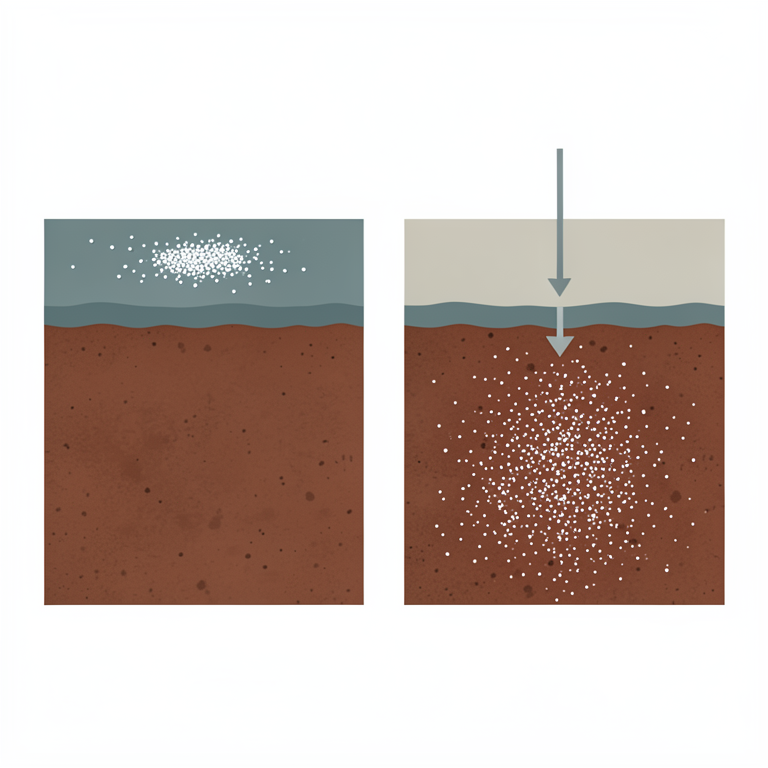
Comparative Mobility of Soil Amendments
AI-generated conceptual illustration (laterite soil profile). It explains the idea and does not show study data.
View source evidence ↗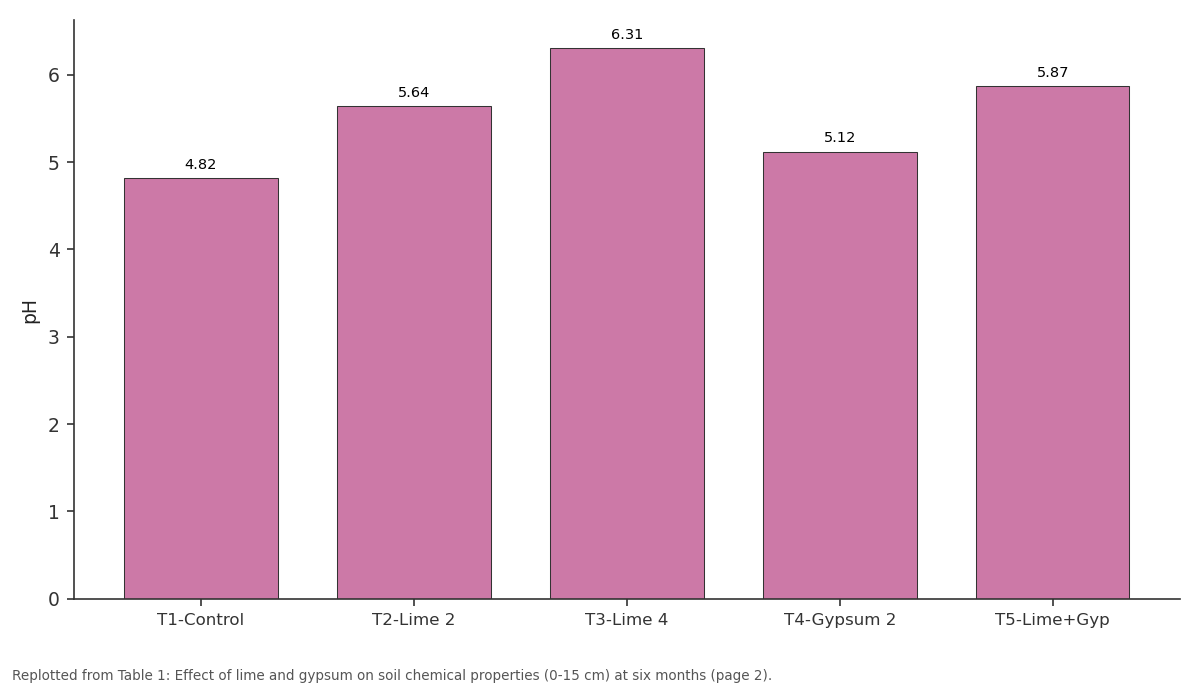
pH: T1-Control vs T2-Lime 2 vs T3-Lime 4 vs T4-Gypsum 2 vs T5-Lime+Gyp
Replotted from Table 1 (page 2) of the original paper. Every bar is the paper's own table value.
View source evidence ↗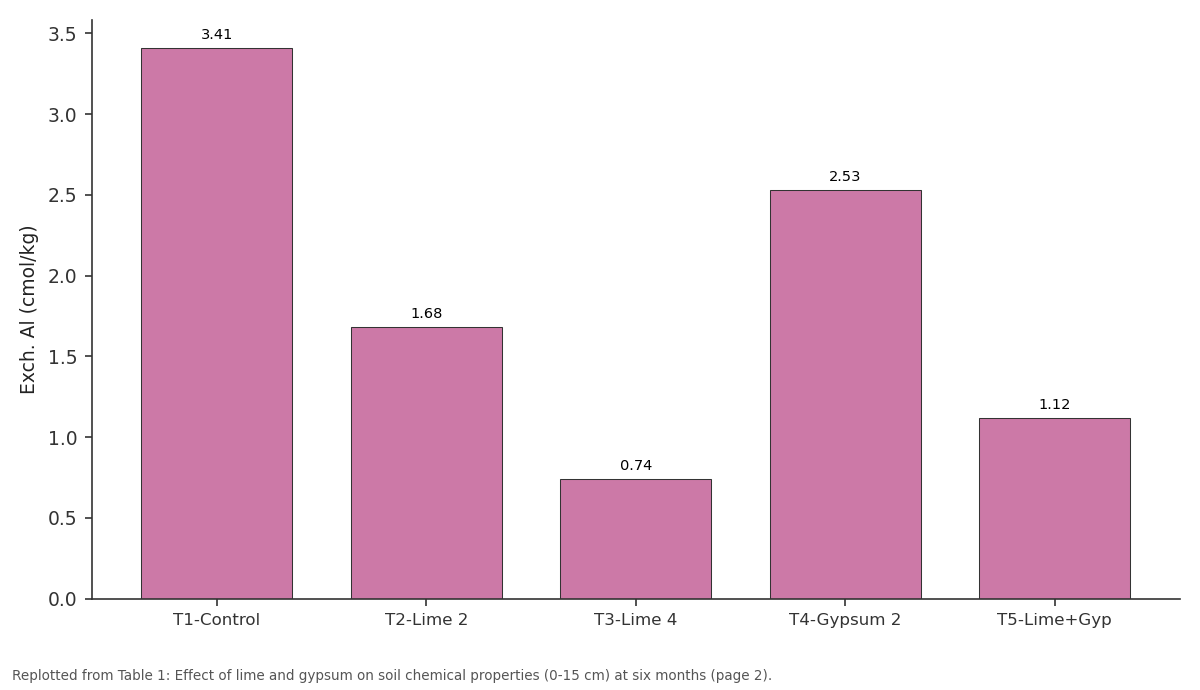
Exch. Al (cmol/kg): T1-Control vs T2-Lime 2 vs T3-Lime 4 vs T4-Gypsum 2 vs T5-Lime+Gyp
Replotted from Table 1 (page 2) of the original paper. Every bar is the paper's own table value.
View source evidence ↗Figures & tables
From the original paper Table 1
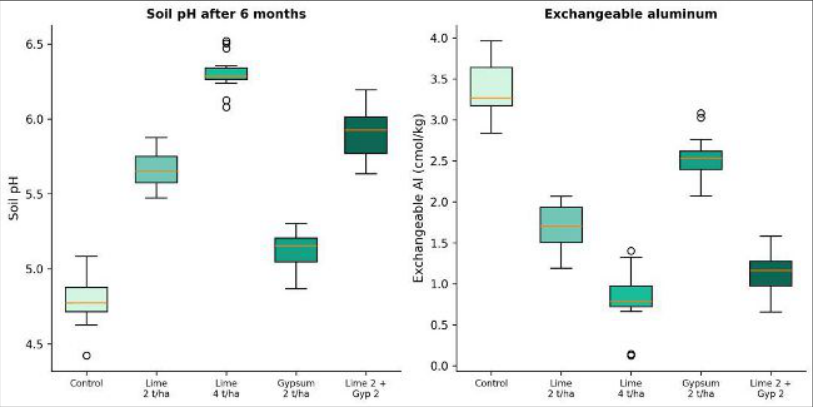 Figure 1
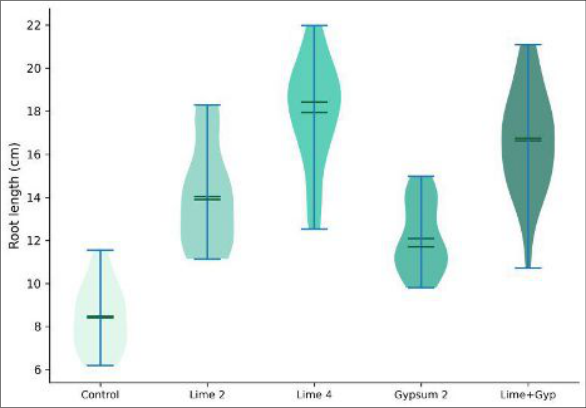 Figure 2
Introduction
Soil acidity, broadly defined as a pH below 5.5 in the surface horizon, constrains crop production across large tracts of the humid and sub-humid tropics [1] . In India, acid soils cover nearly 49 million hectares, concentrated in the north-east, the Western Ghats, and parts of the Deccan Plateau [2] . Laterite soils, formed under intense weathering and leaching, are particularly prone to aluminum toxicity because their low base saturation leaves Al3+ as the dominant cation on the exchange complex [3] . Liming is the standard remedy: calcium carbonate neutralises acidity by consuming hydrogen ions and precipitating aluminum as insoluble hydroxides [4] . But lime is poorly mobile in soil and its effects are largely confined to the depth of incorporation, usually the top 15 cm. Gypsum, though not an alkaliser, supplies calcium ions that can migrate deeper in the profile and displace aluminum from subsoil exchange sites [5] . The combination of surface-applied lime with gypsum has been recommended in Brazilian Cerrado soils, but its effectiveness under Indian laterite conditions has received little attention [6] . This research was conducted at the Professor Jayashankar Telangana Agricultural University, Hyderabad (17.32 deg N, 78.47 deg E), during kharif 2022 on an acid laterite soil (Typic Haplustox, pH 4.82, OC 0.61%) to evaluate whether combining lime and gypsum can simultaneously correct surface acidity and reduce subsoil Al toxicity, thereby improving root penetration in groundnut [7,8] .
Material and Methods
Material and Methods
Material
Agricultural-grade lime (CaCO 3 , 92% purity, effective calcium carbonate equivalent 88%) was sourced from a local supplier. Gypsum (CaSO 4 .2H 2 O, 78% purity, 18% S) was obtained from the university stores. Groundnut seeds (cv. K-6) were procured from the ICRISAT seed unit, Patancheru. The experimental soil was a gravelly clay laterite (Typic Haplustox) with pH 4.82, exchangeable Al 3.41 cmol/kg, base saturation 28.3%, organic carbon 0.61%, and available P (Bray-I) 4.7 mg/kg. All laboratory chemicals (1M KCl, 0.01M CaCl 2 , NaF reagent) were analytical grade from Merck India.
Methods
Five treatments were arranged in a randomised complete block design with four replications on 5 m x 4 m plots. Treatments were: T 1 , untreated control; T 2 , lime at 2 t/ha; T 3 , lime at 4 t/ha; T 4 , gypsum at 2 t/ha; T 5 , lime 2 t/ha + gypsum 2 t/ha. Lime and gypsum were broadcast and incorporated into the top 15 cm by disc ploughing in June 2022, four weeks before sowing. Groundnut was sown on 10 July 2022 at 30 cm x 10 cm spacing. Soil samples were collected at 0-15 and 15-30 cm depth at six months after application. Soil pH was measured in 1:2.5 soil-water suspension, exchangeable Al by 1M KCl extraction with titration [9] , and base saturation by the ammonium acetate method [10] . Root length was measured on three plants per plot at 60 DAS using the line-intersect method. Data were analysed in R (v4.3.1) with Tukey's HSD at p<0.05. The box plots (Figure 1) show that lime treatments produced tighter distributions around higher pH values, while the control had wide variability reflecting patchy acidity. The violin plot (Figure 2) reveals that the combined treatment generated a broad, right-skewed root length distribution, suggesting that some plants in amended plots explored considerably deeper soil layers.
Results
Results
Discussion
The 78.3% reduction in exchangeable Al under lime at 4 t/ha aligns with the well-established mechanism of Al precipitation as Al(OH) 3 above pH 5.5 [4] . The combined lime-gypsum treatment achieved a comparable 67.2% Al reduction with half the lime rate, suggesting that gypsum's downward movement of calcium compensated for the smaller neutralising dose at the surface. Caires et al. [5] reported a similar synergistic pattern in Brazilian Oxisols, where gypsum reduced subsoil Al saturation by 30-40% within 12 months. The root length improvement (102% over control in T 5 ) translates directly into better water and nutrient access in a soil where the effective rooting depth is often limited to 10-15 cm by an Al-toxic subsoil [3] . The pod yield data confirm this link: T 5 produced 1,841 kg/ha versus 1,124 kg/ha in the control, a 63.8% gain. That said, this research covered only one season and one crop; the residual effect of lime and gypsum on subsoil chemistry over multiple years needs monitoring [11,12] .
Conclusion
Combining lime at 2 t/ha with gypsum at 2 t/ha corrected surface acidity and reduced both surface and subsoil aluminum toxicity in acid laterite soils, achieving results comparable to liming alone at 4 t/ha but at roughly half the lime cost. Root penetration and groundnut pod yield improved markedly. For laterite soils on the Deccan Plateau where subsoil Al constrains root growth, the lime-gypsum combination offers a practical dual-action strategy. Future research should track the longevity of these amendments across multiple cropping seasons and evaluate their interaction with phosphorus fertilization [13,14,15] .
Figures and tables from the paper
| Treatment | pH | Exch. Al (cmol/kg) | Base sat. (%) | Root length (cm) | Pod yield (kg/ha) | Al reduction (%) |
|---|---|---|---|---|---|---|
| T1-Control | 4.82 | 3.41 | 28.3 | 8.3 | 1124 | - |
| T2-Lime 2 | 5.64 | 1.68 | 52.7 | 14.7 | 1687 | 50.7 |
| T3-Lime 4 | 6.31 | 0.74 | 71.4 | 18.2 | 1923 | 78.3 |
| T4-Gypsum 2 | 5.12 | 2.53 | 36.8 | 11.6 | 1398 | 25.8 |
| T5-Lime+Gyp | 5.87 | 1.12 | 63.1 | 16.8 | 1841 | 67.2 |
| HSD (p<0.05) | 0.23 | 0.31 | 5.4 | 1.9 | 142 | - |
Table text extracted from the original PDF; superscript letters are shown inline. The original table image is below.
View original table image
References
13 in the original paper- Von Uexkull HR, Mutert E. Global extent, development and economic impact of acid soils. Plant and Soil. 1995;171(1):1-15.
- Sharma PD, Sarkar AK. Managing Acid Soils for Enhancing Productivity. New Delhi: National Bureau of Soil Survey; 2005.
- Sanchez PA, Salinas JG. Low-input technology for managing Oxisols and Ultisols in tropical America. Advances in Agronomy. 1981;34:279-406.
- Haynes RJ, Mokolobate MS. Amelioration of Al toxicity and P deficiency in acid soils by additions of organic residues. Nutrient Cycling in Agroecosystems. 2001;59(1):47-63.
- Caires EF, Churka S, Garbuio FJ, Ferrari RA, Morgano MA. Soybean yield and quality as a function of lime and gypsum applications. Scientia Agricola. 2006;63(4):370-379.
- Sumner ME, Shahandeh H, Bouton J, Hammel J. Amelioration of an acid soil profile through deep liming and surface application of gypsum. Soil Science Society of America Journal. 1986;50(5):1254-1258.
- Kamprath EJ. Exchangeable aluminum as a criterion for liming leached mineral soils. Soil Science Society of America Journal. 1970;34(2):252-254.
- Ritchey KD, Silva JE, Costa UF. Calcium deficiency in clayey B horizons of savanna Oxisols. Soil Science. 1982;133(6):378-382.
- Edmeades DC, Ridley AM. Using lime to ameliorate topsoil and subsoil acidity. Handbook of Soil Acidity. 2003;5:297-336.
- Alva AK, Sumner ME, Noble AD. Alleviation of aluminum toxicity by phosphogypsum. Communications in Soil Science and Plant Analysis. 1988;19(4):385-403.
- Foy CD. Physiological effects of hydrogen, aluminum, and manganese toxicities in acid soil. Soil Acidity and Liming. 1984;12:57-97.
- Tiecher T, Pias OHC, Bayer C, Martins AP, Denardin LGO. Lime and gypsum effects on soil organic matter pools in southern Brazil. Geoderma. 2018;328:35-44.
- Fageria NK, Baligar VC. Ameliorating soil acidity of tropical Oxisols by liming for sustainable crop production. Advances in Agronomy. 2008;99:345-399.