
Research article · 2026 · Full text
International Journal of Advanced Chemistry ResearchThe Use of Nanoparticles in the Development of Chemical and Biological Sensors: A Review
Volume 8(4) · Pages 27–30 · DOI: 10.33545/26646781.2026.v8.i4a.644 ↗
Research areasElectrochemical sensors and biosensorsAnalytical Chemistry and SensorsGold and Silver Nanoparticles Synthesis and Applications
Abstract
Author-writtenIn this review we highlight the important contributions of nanoparticles in the enhanced performance of chemical and biological sensor. These materials have unique properties such as high surface area, excellent electrical conductivity and optical properties that make them suitable for the design of sensitive and selective sensing systems for detection of a large variety of analytes. Metallic nanoparticles, carbon-based nanomaterials, quantum dots etc have been widely employed in a number of sensing platforms [11]. Further innovations have been made in many fields such as environmental monitoring , medical diagnostics and industrial safety creating new applications of sensors. Moreover, the chemical modification has been used to improve the efficiency and selectivity of the sensor, such as hybrid nanomaterials, surface functionalization, etc. However, to make possible their safe use in clinical practice, the current issues of stability, reproducibility and toxicity need to be solved. Nanoparticle-based sensors: A new and promising field with great potential for future development and real-world implementation.
Summary
Source-checkedPlain-language reading of the full paper, prepared with AI and checked against the text. Each point links to the authors' own words.
Why it matters
- Nanoparticles are essential for next-generation sensors because they are inexpensive and possess unique properties, including high surface-to-volume ratios, adjustable optical behavior, and better electrical conductivity. View evidence ↗
- The physicochemical properties of nanoparticles enable more effective interaction with analytes at the molecular level, improving response times and sensitivity compared to traditional materials. View evidence ↗
- In biological sensing, nanoparticles are critical tools that enable the highly specific detection of pathogens, disease markers, and biomolecules. View evidence ↗
The question
- The aim of this review is to highlight how nanoparticles contribute to the enhanced performance of biological and chemical sensors. View evidence ↗
What they did
- The authors analyzed selected review articles to summarize the types of nanoparticles used, their primary applications, and the key results of those studies. View evidence ↗
What they found
- Gold and silver nanoparticles provide high sensitivity for detecting toxins and gases due to their large surface area. View evidence ↗
- Carbon nanotubes (CNTs) and graphene improve glucose sensing by enabling faster electron transfer rates in electrochemical sensors. View evidence ↗
- Zinc oxide (ZnO) and titanium dioxide (TiO₂) nanoparticles allow for a high response to low gas concentrations during air quality monitoring. View evidence ↗
- Gold (AuNPs) and magnetic nanoparticles enable rapid detection and high specificity when identifying cancer biomarkers. View evidence ↗
- Quantum dots are used for DNA detection, offering tunable emission and high stability in fluorescent sensing. View evidence ↗
- Iron oxide (Fe₃O₄) nanoparticles facilitate easy separation and detection in immunoassays due to their magnetic properties. View evidence ↗
- Graphene and carbon nanotubes (CNTs) are used in wearable health monitoring sensors to provide high sensitivity and flexibility. View evidence ↗
- Combining different nanomaterials into hybrid systems creates a synergistic effect that improves the overall sensitivity, stability, and selectivity of the sensor. View evidence ↗
- Functionalizing nanoparticles with chemical or biological recognition elements is an effective strategy for achieving high selectivity for specific target analytes. View evidence ↗
What it means
- The authors conclude that nanoparticle-based sensors are a rapidly evolving field with significant potential, and future developments are expected to increase their practical use. View evidence ↗
- Before these sensors can be applied practically, issues regarding nanoparticle toxicity, stability, and reproducibility must be resolved. View evidence ↗
Visual summary
1 visualsIllustrations explain the paper; they do not show study data.
Nanoparticle Advantage
AI-generated conceptual illustration (gold nanoparticles and bulk gold material). It explains the idea and does not show study data.
View source evidence ↗Figures & tables
From the original paper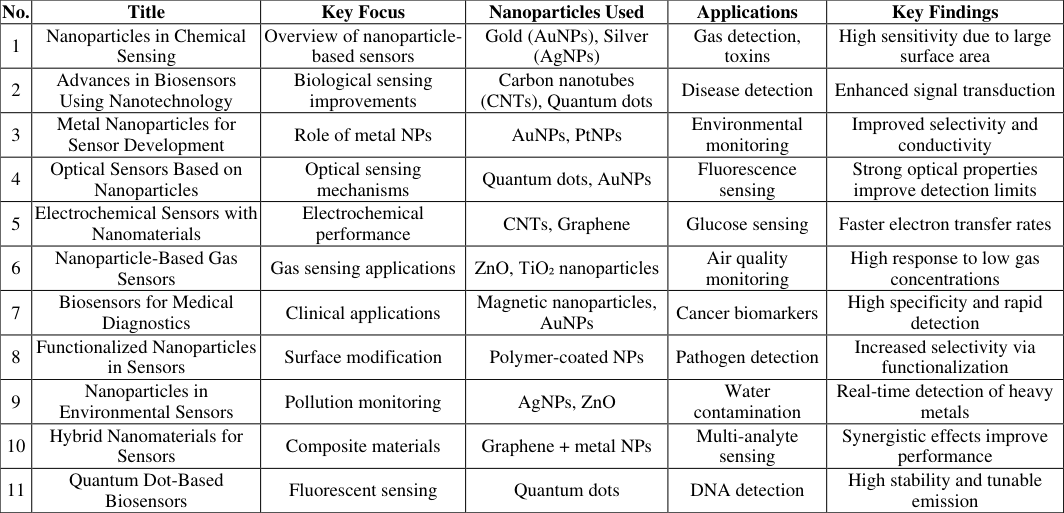 Table 1
Introduction
The advances in nanotechnology have also revolutionized chemical and biological sensing providing ultrasensitive, -selective and rapid detection systems. Nanoparticles are important building blocks for next generation sensor platforms due to their low cost and unique physicochemical properties like high surface to volume ratio, tuneable optical behaviour and improved electrical conductivity [1][2] . These properties allow the nanoparticles of the standard chemistry to interact effectively with the analytes on the molecular scale and enhance the sensitivity limits and response times over the conventional sensing materials [3] . Metal oxides, gold and silver nano-particles have been widely used for gas sensors [2] , toxin sensors [3] and environmental pollutant sensors [4] . These nanozymes are appropriate for real time monitoring systems because of their catalytic activity and surface reactivity which improve signal generation [5] . Nanoparticles are also now very important tools for biological sensing. They allow the detection of biomolecules, pathogens and disease markers with high specificity [6] . Gold nanoparticles and quantum dots are widely employed in biosensor applications due to their better biocompatibility and optical properties [7] . Moreover, the use of nanomaterials in combination with transduction approaches (electrochemical, optical and piezoelectric systems) is also advantageous to improve the performance of sensors [8] . For instance, it has been reported that the use of nanomaterials such as multi-walled carbon nanotubes and graphene can improve the electrochemical sensitivity of electron transferbased biosensors [9] . In addition, nanoparticles can be functionalized on the surface with specific ligands or biomolecules that can selectively detect in vixno only in complex biological environments [10] . However, some important issues such as toxicity of nanoparticles, reproducibility and stability should be addressed before practical application. Research is underway for the development of safer and more effective nanomaterials and more recently the coupling of sensor systems with artificial intelligence or portable
Practical Aspect
These tiny entities for environmental monitoring, medical diagnostics, and industrial safety led to real-world applications of nanoparticles in functional chemical and biological sensors. High sensitivity and rapid on-site analysis are the main advantages of nanoparticle-based sensors which are routinely employed in environmental settings for the detection of toxic gases or heavy metals and pollutants in air and water. Thus, gas sensors working from low levels of toxic gases are constructed with the help of metal oxide nanoparticles like ZnO and TiO₂. Nanobiotechnology has also been successfully applied in the design of nanoparticle-enhanced biosensors for biomedical applications as detecting glucose, cancer biomarkers and infectious pathogens. Gold nanoparticles and quantum dots are highly biocompatible and capable of signal amplification, making them popular candidates in devices for diagnostic applications; they can be used to detect diseases at an early stage, allowing fast point-of-care testing. Magnetic nanoparticles have been employed in immunoassays for the rapid separation and specific detection of biomolecules. From an industrial standpoint, nanoparticle-based sensors provide real time process control and safety by monitoring chemical leaks, hazardous substances and reaction conditions. Furthermore, the recent progress in the development of portable and wearable selfpowered sensing devices (graphene-based/supercapacitive and carbon nanotube (CNT) based) using nanomaterials is of high importance for continuous health/environmental monitoring. To summarize, the application of the application of nanoparticle-based sensors in real-world conditions demonstrates their efficiency, reliability and versatility. However, long-term stability, cost-effectiveness and possible toxicity issues need to be investigated for safe and sustainable large-scale applications.
Literature Review: Nanotechnology has received a lot of attention in recent years and many efforts have been made to use nanoparticles for chemical and biological sensing applications. The benefit of using nanoparticles on the sensors performance in terms of sensitivity, selectivity and response time has been reported in several review articles [24][25][26][27] . These improvements mainly depend on the intrinsic properties of the nanoparticles, such as large specific surface area, good electric conductivity and tunable optical properties. Journey so far on metal nanoparticles particularly gold, silver targeting chemical and bio-sensing applications. For their outstanding catalytic and optical properties [12] , it has been reported in previous studies that carbon-based nanomaterials, such as graphene and carbon nanotubes, can improve the electron transfer process in electrochemical sensors [13] . Quantum dots are also extensively investigated because of their unique fluorescence properties that can be employed in ultra-sensitive optical detection systems [14] . Furthermore, some recent reviews summarized the use of hybrid nanomaterials composed of different type of nanoparticles in order to produce synergetic effect with better sensing performance [15] . Much effort has been directed to functionalization techniques as a way of achieving enhanced selectivity at the nanoparticle surface level via attachment of biomolecule entities [10] . In this context, the progress made has resulted in the creation of sensors for different analytes such as gases, heavy metals, biomolecules and pathogens [11] . However, despite these promising advances, some challenges remain to be resolved such as those related to nanoparticle stability, reproducibility and toxicity [12] . New solutions are still under investigation to overcome these limitations while increasing the scalability and practical utility of nanoparticle-based sensors [13] . The table below summarizes selected review articles on the use of nanoparticles for the design of chemical and biological sensors. It summarizes the type of nanoparticles, the main applications and the main results of each of the studies. This comparison provides a holistic view of the trends and development in this fast evolving area.
Discussion
The studies examined from this viewpoint demonstrate that the nanoparticles are a significant contributor to the enhancement of the chemical and biological sensor performance. Their unique physicochemical properties, especially the large surface area and increased reactivity, are of great importance for the improvement of the sensitivity and detection limits [16,17] . This makes nano-particle based sensors ideal for the detection of trace analytes in complex environments, a requirement for many applications such as environmental monitoring and medical diagnostics. It is well known thatOne of the advantages from the literature is that metal nanoparticles especially gold and silver are very well known for optical and electrochemical sensing systems. These properties are known to be responsible for the high generation of signals through plasmonic and catalytic effects [18] . Besides, carbon-based nanomaterials such as graphene and carbon nanotubes possess good electron transfer ability, which may improve the efficiency of electrochemical sensors [19] . Moreover, it was proved that the development of hybrid nanomaterials is favorable for enhancing the sensor performance. The synergistic effect of the combination of different nano materials improves the selectivity, stability and total sensitivity [20] . An alternative efficient strategy for excellent selectivity for target analytes is the functionalization of nanoparticles with biological or chemical recognition elements [16] . However, there are still some challenges. Sensor performance and reliability can be affected by the problems such as nanoparticle aggregation, long term stability and reproducibility [17] . However, the application of nanoparticles should be carefully done to overcome the potential toxicity and environmental concerns associated with their large-scale application [18] . Future research should be focused on the fabrication of stable, lowcost and eco-friendly nanomaterials for incorporating these nano-sensors with the new generation devices like portable devices and smart systems. To summarize, nanoparticle based sensors is a fast developing field with great potential applications. Future research and technology development are expected to surpass current limitations and to increase practical applicability [19,20] .
Conclusion
Conclusion
Figures and tables from the paper
References
20 in the original paper- Mustafa F, Andreescu S. Nanotechnology-based approaches for food sensing and packaging applications. RSC Adv. 2020;10:19309-19336. doi:10.1039/D0RA01084G.
- Shrivastava S, Dash D. Applying nanotechnology to human health: revolution in biomedical sciences. J Nanotechnol. 2009;2009:184702. doi:10.1155/2009/184702.
- Moradi S, Firoozbakhtian A, Hosseini M, Karaman O, Kalikeri S, Raja GG, et al. Advancements in wearable technology for monitoring lactate levels using lactate oxidase enzyme and free enzyme as analytical approaches: a review. Int J Biol Macromol. 2024;254:127577. doi:10.1016/j.ijbiomac.2023.127577.
- Mohammed Ameen SS, Algethami F, Omer KM. Pine needle-derived oxidase-like Mn nanozymes: sustainable nanozyme, scalable synthesis, and visual and colorimetric nitrite detection. Microchim Acta. 2025;192:146. doi:10.1007/s00604-025-07024-0.
- Han Y, Zhang P, Duan X, Gao X, Gao L. Advances in precise synthesis of metal nanoclusters and their applications in electrochemical biosensing of disease biomarkers. Nanoscale. 2025;17:3616-3634. doi:10.1039/D4NR04714A.
- Nasrollahpour H, Sánchez BJ, Sillanpää M, Moradi R. Metal nanoclusters in point-of-care sensing and biosensing applications. ACS Appl Nano Mater. 2023;6:12609-12672. doi:10.1021/acsanm.3c01569.
- Qian S, Wang Z, Zuo Z, Wang X, Wang Q, Yuan X. Engineering luminescent metal nanoclusters for sensing applications. Coord Chem Rev. 2022;451:214268. doi:10.1016/j.ccr.2021.214268.
- Shang L, Xu J, Nienhaus GU. Recent advances in synthesizing metal nanocluster-based nanocomposites for application in sensing, imaging and catalysis. Nano Today. 2019;28:100767.
- Bazzi F, Hosseini M, Ebrahimi-Hoseinzadeh B, Al Lawati HAJ, Ganjali MR. A dual-targeting nanobiosensor for gender determination applying signal amplification methods and integrating fluorometric gold and silver nanoclusters. Microchim Acta. 2023;190:368. doi:10.1007/s00604-023-05947-0.
- Pebdeni AB, Mousavizadegan M, Hosseini M. Sensitive detection of S. aureus using aptamer-and vancomycin-copper nanoclusters as dual recognition strategy. Food Chem. 2021;361:130137. doi:10.1016/j.foodchem.2021.130137.
- Bahmani A, Shokri E, Hosseini M, Hosseinkhani S. A fluorescent aptasensor based on copper nanoclusters for optical detection of CD44 exon v10, an important isoform in metastatic breast cancer. Anal Methods. 2021;13:3837-3844. doi:10.1039/D1AY01087E.
- Longo A, de Boed EJJ, Mammen N, van der Linden M, Honkala K, Häkkinen H, et al. Towards atomically precise supported catalysts from monolayer-protected clusters: the critical role of the support. Chem Eur J. 2020;26:7051-7058. doi:10.1002/chem.202000637.
- Yan Z, Taylor MG, Mascareno A, Mpourmpakis G. Size-, shape-, and composition-dependent model for metal nanoparticle stability prediction. Nano Lett. 2018;18:2696-2704. doi:10.1021/acs.nanolett.8b00670.
- Islamoglu T, Chen Z, Wasson MC, Buru CT, Kirlikovali KO, Afrin U, et al. Metal-organic frameworks against toxic chemicals. Chem Rev. 2020;120:8130-8160. doi:10.1021/acs.chemrev.9b00828.
- Howarth AJ, Liu Y, Li P, Li Z, Wang TC, Hupp JT, et al. Chemical, thermal and mechanical stabilities of metal-organic frameworks. Nat Rev Mater. 2016;1:15018. doi:10.1038/natrevmats.2015.18.
- Kreno LE, Leong K, Farha OK, Allendorf M, Van Duyne RP, Hupp JT. Metal-organic framework materials as chemical sensors. Chem Rev. 2012;112:1105-1125. doi:10.1021/cr200324t.
- Mohammed Ameen SS, Bedair A, Hamed M, Mansour FR, Omer KM. Recent advances in metal-organic frameworks as oxidase mimics: a comprehensive review on rational design and modification for enhanced sensing applications. ACS Appl Mater Interfaces. 2024;17:110-129. doi:10.1021/acsami.4c17397.
- Karrat A, Benssbihe J, Mohammed Ameen SS, Omer KM, Amine A. Development of a silver-based MOF oxidase-like nanozyme modified with molecularly imprinted polymers for sensitive and selective colorimetric detection of quercetin. Spectrochim Acta A Mol Biomol Spectrosc. 2025:125735. doi:10.1016/j.saa.2025.125735.
- Mohammed Ameen SS, Omer KM. Lanthanide and functionalization-free dual-state emitting zinc-based MOFs followed by dual-state detection: ratiometric and color-tonality visual detection of tetracycline in solution and on paper in food and environmental samples. Microchim Acta. 2025;192:22. doi:10.1007/s00604024-06896-y.
- Mohammed Ameen SSM, Mohammed NMS, Omer KM. Visual monitoring of silver ions and cysteine using bi-ligand Eu-based metal organic framework as a reference signal: color tonality. Microchem J. 2022;181:107721. doi:10.1016/j.microc.2022.107721.