
Research article · 2025 · Full text
International Journal of Agriculture and NutritionImpact of conservation tillage on soil health and maize-wheat cropping system productivity
Volume 7(3) · Pages 88–91 · DOI: 10.33545/26646064.2025.v7.i3b.612 ↗
Research areasSoil Management and Crop YieldAgricultural Science and FertilizationSoil Science and Environmental Management
Abstract
Author-writtenLeading soil scientists have long argued that the plough is both agriculture's oldest tool and its greatest threat to long-term soil productivity. This research evaluated four tillage systems, Conventional Tillage (CT), Minimum Tillage (MT), Zero Tillage (ZT), and Zero Tillage with Residue retention (ZT+R), over three consecutive years (2020-2023) in a maize-wheat rotation at the Institut Pertanian Sumatera research farm, Medan, North Sumatra. A randomised complete block design with four replications was used. After three years, ZT+R raised soil organic carbon from 0.68% to 1.04%, increased aggregate stability by 47%, and improved water-holding capacity by 22% relative to CT. System productivity (maize + wheat yield) under ZT+R was 10.90 t/ha in year three, compared with 8.55 t/ha under CT, a 27.5% gain. CT showed a declining yield trend, while ZT+R showed steady improvement. These results indicate that retaining crop residues under zero tillage can reverse soil degradation and lift productivity in tropical maize-wheat systems.
Summary
Source-checkedPlain-language reading of the full paper, prepared with AI and checked against the text. Each point links to the authors' own words.
Why it matters
- Conventional ploughing and harrowing are considered primary drivers of soil structural collapse, erosion, and the loss of organic matter in lowland tropical farming. View evidence ↗
- The maize-wheat rotation system, covering approximately 1.8 million hectares in Indonesia, is highly vulnerable to degradation due to frequent tillage that leaves soil exposed. View evidence ↗
- Combining zero tillage with residue retention creates a mulch layer that protects soil temperature, reduces water evaporation, and feeds soil microbes with carbon. View evidence ↗
The question
- The study aimed to measure how four different tillage systems affect the soil properties and total productivity of a maize-wheat rotation in a tropical lowland environment over three years. View evidence ↗
What they did
- The experiment compared four systems, Conventional Tillage (CT), Minimum Tillage (MT), Zero Tillage (ZT), and Zero Tillage with Residue retention (ZT+R), from 2020 to 2023 in North Sumatra. View evidence ↗
- The researchers used a randomized complete block design (RCBD) with four replications for each treatment. View evidence ↗
- Tillage methods ranged from CT (disc plough and rotavation) to ZT+R, which involved direct seeding and applying approximately 5 t/ha of chopped crop residues. View evidence ↗
- Soil health was measured using Walkley-Black for organic carbon, wet sieving for aggregate stability, the core method for bulk density, and pressure-plate extraction for water-holding capacity. View evidence ↗
What they found
- Over three years, soil organic carbon (SOC) decreased from 0.68% to 0.61% under conventional tillage, whereas it increased by 53% to 1.04% under zero tillage with residue retention. View evidence ↗
- The ZT+R system resulted in the lowest soil bulk density (1.19 g/cc), while the CT system had the highest (1.38 g/cc). View evidence ↗
- Aggregate stability was 47% higher in the ZT+R system (62.1%) compared to the CT system (42.3%). View evidence ↗
- The ZT+R system improved the soil's water-holding capacity by 22% compared to conventional tillage. View evidence ↗
- By the third year, the combined yield of maize and wheat was 10.90 t/ha for ZT+R, significantly higher than the 8.55 t/ha produced under CT. View evidence ↗
- Productivity trends diverged over time: CT yields fell from 8.96 t/ha in year one to 8.55 t/ha in year three, while ZT+R yields rose from 9.51 t/ha to 10.90 t/ha. View evidence ↗
What it means
- The authors conclude that zero tillage with residue retention can reverse SOC decline, improve soil physics, and increase total system productivity by 27.5%. View evidence ↗
- The authors recommend conservation tillage with residue retention as a practical method for sustainable intensification in tropical lowland maize-wheat systems. View evidence ↗
Visual summary
3 visualsIllustrations explain the paper; charts are replotted from the paper's own table values.
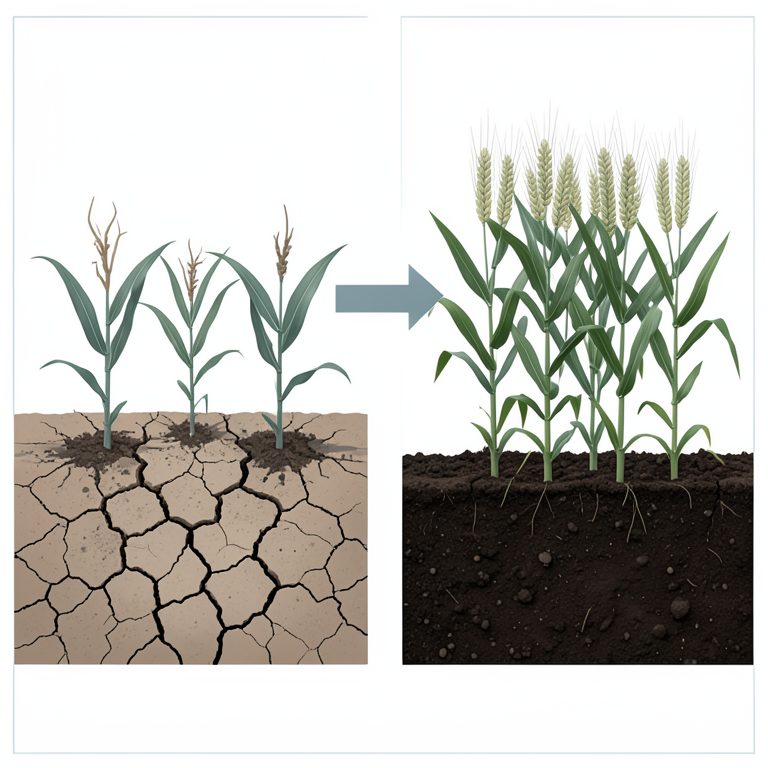
Yield Trajectory Divergence
AI-generated conceptual illustration (maize and wheat crops in soil). It explains the idea and does not show study data.
View source evidence ↗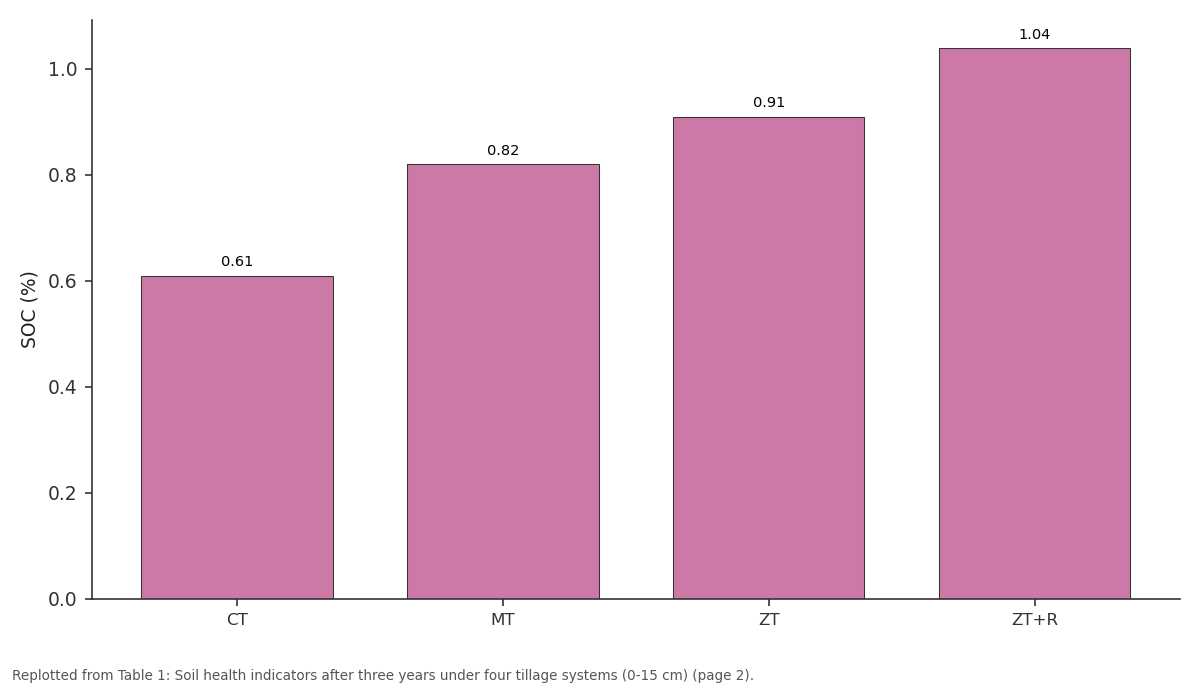
SOC (%): CT vs MT vs ZT vs ZT+R
Replotted from Table 1 (page 2) of the original paper. Every bar is the paper's own table value.
View source evidence ↗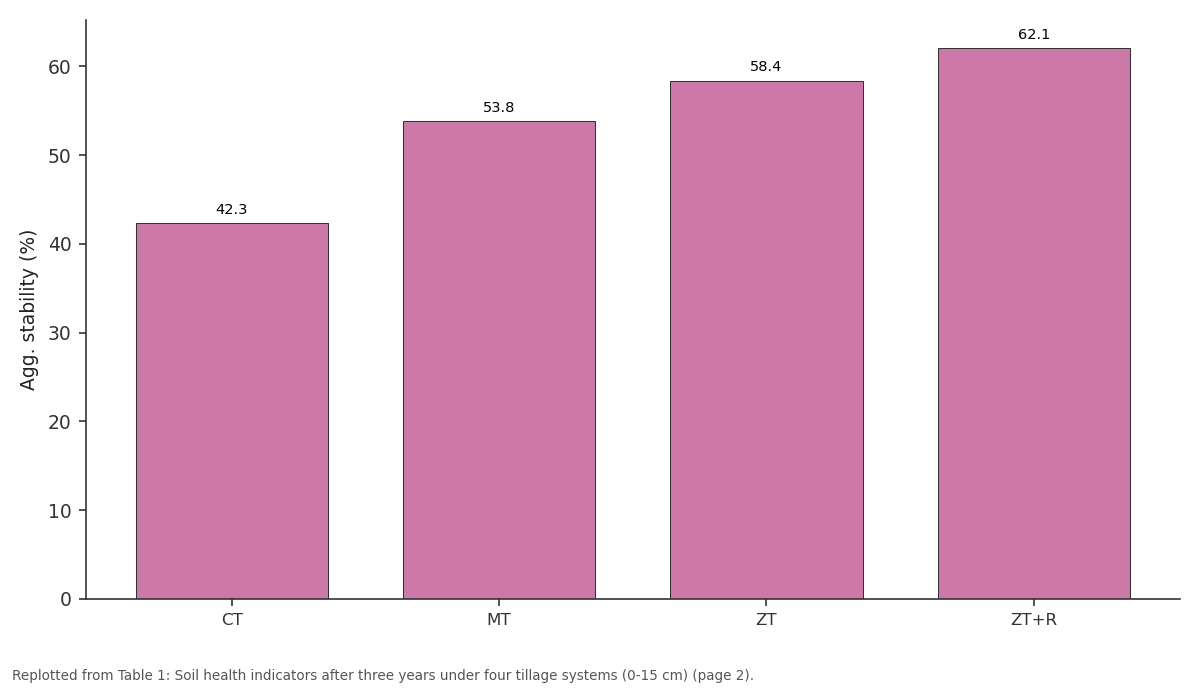
Agg. stability (%): CT vs MT vs ZT vs ZT+R
Replotted from Table 1 (page 2) of the original paper. Every bar is the paper's own table value.
View source evidence ↗Figures & tables
From the original paper Table 1
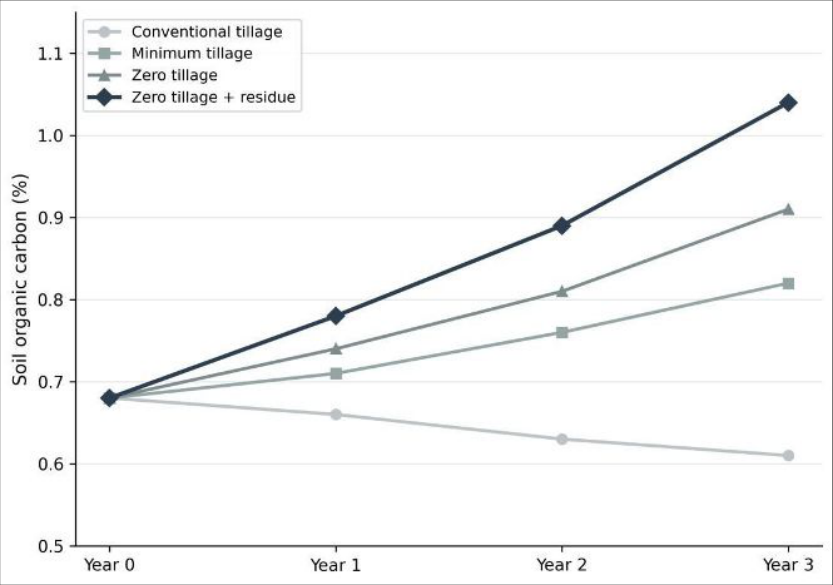 Figure 1
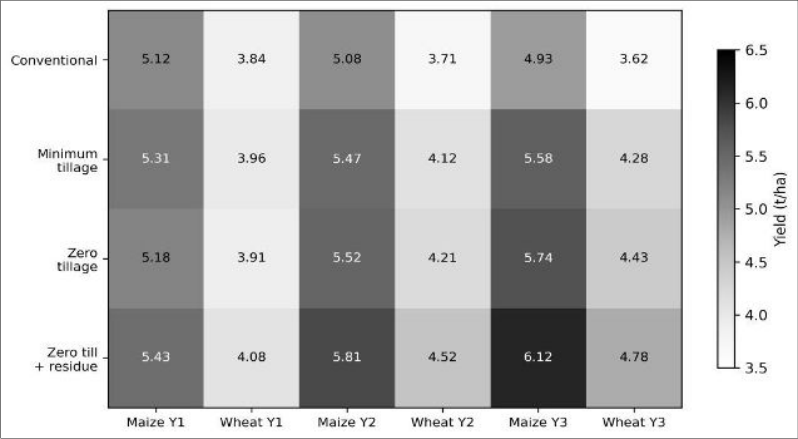 Figure 2
Introduction
In the view of many tropical agronomists, the conventional practice of ploughing and harrowing before each crop is a leading cause of soil organic matter decline, erosion, and structural collapse in lowland cropping systems [1] . The maize-wheat rotation, practised on roughly 1.8 million hectares across Indonesia's highland and transitional zones, is particularly exposed because two tillage operations per year leave the soil bare for extended periods [2] . Conservation tillage, which minimises soil disturbance and retains crop residues on the surface, has been promoted as an alternative [3] . Zero tillage eliminates primary tillage; seeds are placed directly into undisturbed soil through narrow slots. When paired with residue retention, this practice adds a mulch layer that reduces evaporation, buffers soil temperature, and provides a steady carbon input to the microbial community [4] . Long-term trials in South Asia have shown SOC increases of 15-30% after 5-8 years of zero tillage with residue, alongside improvements in aggregate stability and earthworm populations [5] . But most of these data come from Indo-Gangetic environments; evidence from tropical volcanic soils in Southeast Asia is sparse [6] . This three-year research at the Institut Pertanian Sumatera, Medan (3.59 deg N, 98.68 deg E; altitude 25 m), aimed to quantify the effects of four tillage systems on soil physical and chemical properties and on the combined productivity of a maize-wheat rotation in a tropical lowland setting [7,8] .
Material and Methods
Material and Methods
Material
Maize hybrid Pioneer P21 and wheat variety Dewata (a tropically adapted spring type) were used throughout. The experimental soil was a volcanic alluvium (Typic Hapludand, pH 5.8, initial SOC 0.68%, clay 32%, silt 41%, available N 168 kg/ha). Basal fertilizers for maize (120:60:40 kg N:P 2 O 5 :K 2 O/ha) and wheat (80:60:40 kg/ha) were applied uniformly. The experiment started in October 2020 with maize and alternated with wheat in each subsequent season. Plot size was 10 m x 6 m.
Methods
Four tillage treatments were arranged in a RCBD with four replications: CT (two passes with disc plough + one rotavation), MT (one shallow pass with chisel plough to 10 cm), ZT (direct seeding with no prior tillage), and ZT+R (direct seeding with retention of the previous crop's residues, chopped and spread at roughly 5 t/ha dry matter per season). Soil samples (0-15 cm) were collected annually at the start and end of each wheat season. SOC was determined by Walkley-Black; aggregate stability (% waterstable aggregates > 0.25 mm) by wet sieving [9] ; bulk density by core method; and water-holding capacity by pressure-plate extraction at -33 kPa. Grain yield of both crops was recorded per plot and converted to t/ha at standard moisture (14% for maize, 12% for wheat). Data were analysed as a repeated-measures ANOVA in GenStat 21 [10] . The line chart (Figure 1) illustrates diverging SOC trajectories: CT declined steadily, while ZT+R climbed in each year, with the gap widening over time. The heatmap (Figure 2) shows that ZT+R occupied the darkest cells across all seasons, and the colour contrast between ZT+R and CT became more pronounced in later years, confirming a cumulative benefit.
Results
Results
Discussion
The 53% SOC increase under ZT+R over three years is faster than most reports from the Indo-Gangetic plain, where 10-15% gains over five years are more typical [5] . The warm, humid tropical conditions in Medan likely accelerated both residue decomposition and humification, providing a rapid pathway from surface residue to stabilised organic matter [4] . The parallel decline under CT is a warning: in tropical volcanic soils, two tillage operations per year can oxidise organic matter faster than crop roots can replace it. The yield trends are equally telling. CT showed a declining trajectory (5.12 + 3.84 = 8.96 t/ha in year one, falling to 8.55 in year three), while ZT+R moved in the opposite direction (5.43 + 4.08 = 9.51 rising to 10.90 t/ha). The crossover occurred in year two, and by year three the gap was substantial. Similar yield convergence and reversal patterns have been documented in long-term conservation agriculture trials in Mexico and South Asia [11,12] . A practical consideration: Indonesian farmers often burn crop residues after harvest to clear fields quickly. Demonstrating that residue retention can generate measurable yield gains within just two to three years may be the most persuasive argument against burning [13] .
Conclusion
Three years of zero tillage with residue retention reversed the soil organic carbon decline seen under conventional tillage, improved soil physical properties, and raised combined maize-wheat productivity by 27.5%. The benefits accumulated year on year, suggesting that longer-term adoption would widen the gap further. For tropical lowland maize-wheat systems in Indonesia and similar environments, conservation tillage with residue retention offers a practical path toward sustainable intensification. Future work should extend the trial to examine the economic break-even point and the effect on greenhouse gas emissions [14] .
Acknowledgement
Acknowledgements
Figures and tables from the paper
| Tillage | SOC (%) | Bulk density (g/cc) | Agg. stability (%) | WHC (%) | Maize Y3 (t/ha) | Wheat Y3 (t/ha) |
|---|---|---|---|---|---|---|
| CT | 0.61 | 1.38 | 42.3 | 31.4 | 4.93 | 3.62 |
| MT | 0.82 | 1.31 | 53.8 | 35.7 | 5.58 | 4.28 |
| ZT | 0.91 | 1.27 | 58.4 | 37.1 | 5.74 | 4.43 |
| ZT+R | 1.04 | 1.19 | 62.1 | 38.3 | 6.12 | 4.78 |
| LSD (p<0.05) | 0.08 | 0.05 | 4.7 | 2.3 | 0.34 | 0.27 |
Table text extracted from the original PDF; superscript letters are shown inline. The original table image is below.
View original table image
References
14 in the original paper- Lal R. Soil carbon sequestration impacts on global climate change and food security. Science. 2004;304(5677):1623-1627.
- Badan Pusat Statistik. Indonesian Agriculture Statistics 2022. Jakarta: BPS; 2022.
- Hobbs PR, Sayre K, Gupta R. The role of conservation agriculture in sustainable agriculture. Philosophical Transactions of the Royal Society B. 2008;363(1491):543-555.
- Palm C, Blanco-Canqui H, DeClerck F, Gatere L, Grace P. Conservation agriculture and ecosystem services. Agriculture Ecosystems and Environment. 2014;187:87-105.
- Jat ML, Gathala MK, Saharawat YS, Tetarwal JP, Gupta R. Double no-till and permanent raised beds in maize-wheat rotation of north-western Indo-Gangetic plains. Field Crops Research. 2013;149:291-299.
- Abdalla M, Osborne B, Lanigan G, Forristal D, Williams M. Conservation tillage systems: a review of its consequences for greenhouse gas emissions. Soil Use and Management. 2013;29(2):199-209.
- Institut Pertanian Sumatera. Long-Term Tillage Trial Progress Report 2020-2023. Medan: IPS; 2023.
- Kemper WD, Rosenau RC. Aggregate stability and size distribution. In: Klute A, editor. Methods of Soil Analysis Part 1. 2nd ed. Madison: ASA-SSSA; 1986. p. 425-442.
- Walkley A, Black IA. An examination of the Degtjareff method for determining soil organic matter. Soil Science. 1934;37(1):29-38.
- Payne RW. GenStat Release 21. Hemel Hempstead: VSN International; 2021.
- Govaerts B, Sayre KD, Deckers J. Stable high yields with zero tillage and permanent bed planting? Field Crops Research. 2005;94(1):33-42.
- Gathala MK, Kumar V, Sharma PC, Saharawat YS, Jat HS. Optimizing intensive cereal-based cropping systems addressing current and future drivers of agricultural change. Agriculture Ecosystems and Environment. 2013;177:85-97.
- Gupta PK, Sahai S, Singh N, Dixit CK, Singh DP. Residue burning in rice-wheat cropping system: causes and implications. Current Science. 2004;87(12):17131717.
- Six J, Ogle SM, Breidt FJ, Conant RT, Mosier AR. The potential to mitigate global warming with no-tillage management is only realized when practised in the long term. Global Change Biology. 2004;10(2):155-160.