
Research article · 2025 · Full text
International Journal of Agriculture and NutritionImpact of potassium solubilizing microorganisms on k availability in banana plantations
Volume 7(3) · Pages 148–151 · DOI: 10.33545/26646064.2025.v7.i3c.621 ↗
Research areasAgricultural Science and FertilizationBanana Cultivation and ResearchAgriculture, Plant Science, Crop Management
Abstract
Author-writtenCompare two neighbouring banana plantations on the same soil type in Sarawak: one applies 800 kg/ha of muriate of potash each year, the other uses half that rate supplemented with Potassium Solubilizing Bacteria (KSB). The second farm spends 35% less on fertilizer yet harvests bunches of comparable weight. This research tested three KSB treatments, Bacillus mucilaginosus, Frateuria aurantia, and a mixed consortium, against an uninoculated control, all at 50% recommended K fertilizer rate, in a commercial Cavendish banana plantation at the Borneo Institute of Agricultural Sciences, Kuching, Sarawak, during 2022-2023. A RCBD with four replications was used. The mixed consortium raised available K from 124 to 213 mg/kg, increased bunch weight by 18.7%, and reduced K fertilizer requirement by 50%. A strong positive correlation (r = 0.92) between soil available K and bunch weight confirmed the link. These results indicate that KSB inoculation can meaningfully reduce potassium fertilizer dependence in tropical banana production.
Summary
Source-checkedPlain-language reading of the full paper, prepared with AI and checked against the text. Each point links to the authors' own words.
Why it matters
- Banana crops have a very high demand for potassium, requiring 400-600 kg K2O per hectare per cycle, which leads to high annual fertilizer costs for Malaysian growers. View evidence ↗
- The majority of soil potassium (90-98%) is trapped in mineral forms like micas and feldspars, making it inaccessible to plants. View evidence ↗
- Potassium Solubilizing Bacteria (KSB) can make this locked potassium available to plants by releasing organic acids that dissolve the minerals. View evidence ↗
The question
- The study aimed to determine if using KSB inoculation alongside only 50% of the recommended potassium fertilizer could maintain soil K levels and bunch yields similar to those achieved with full fertilization. View evidence ↗
What they did
- The experiment used a three-year-old Cavendish banana plantation (cv. Grand Naine) with 2,000 plants per hectare grown in sandy clay loam Ultisol soil. View evidence ↗
- Three KSB treatments were tested: Bacillus mucilaginosus, Frateuria aurantia, and a 1:1 mixed consortium of both. View evidence ↗
- All treated plots and the control received 50% of the recommended potassium dose (200 kg K2O/ha), compared to a standard full rate of 400 kg K2O/ha. View evidence ↗
- The study used a Randomized Complete Block Design (RCBD) with four replications, each containing five plants per plot. View evidence ↗
What they found
- The mixed consortium increased the average bunch weight from 18.3 kg in the control to 21.7 kg, representing an 18.6% increase. View evidence ↗
- Plants treated with the mixed consortium reached a leaf potassium concentration of 3.28%, exceeding the 3.0% sufficiency threshold, whereas the control (2.41%) remained deficient. View evidence ↗
- When used individually, Frateuria aurantia was more effective than Bacillus mucilaginosus in improving both potassium availability and bunch weight. View evidence ↗
- A strong positive correlation (r = 0.92) was found between available soil potassium and bunch weight, supporting the theory that KSBs improve yield by increasing K availability. View evidence ↗
What it means
- The authors conclude that KSB inoculation is a practical way to lower fertilizer costs in tropical banana farming without sacrificing yield. View evidence ↗
- The study was limited to one crop cycle, and the authors note that more data is needed on the long-term persistence of KSB populations and the necessary frequency of re-inoculation. View evidence ↗
Visual summary
3 visualsIllustrations explain the paper; charts are replotted from the paper's own table values.
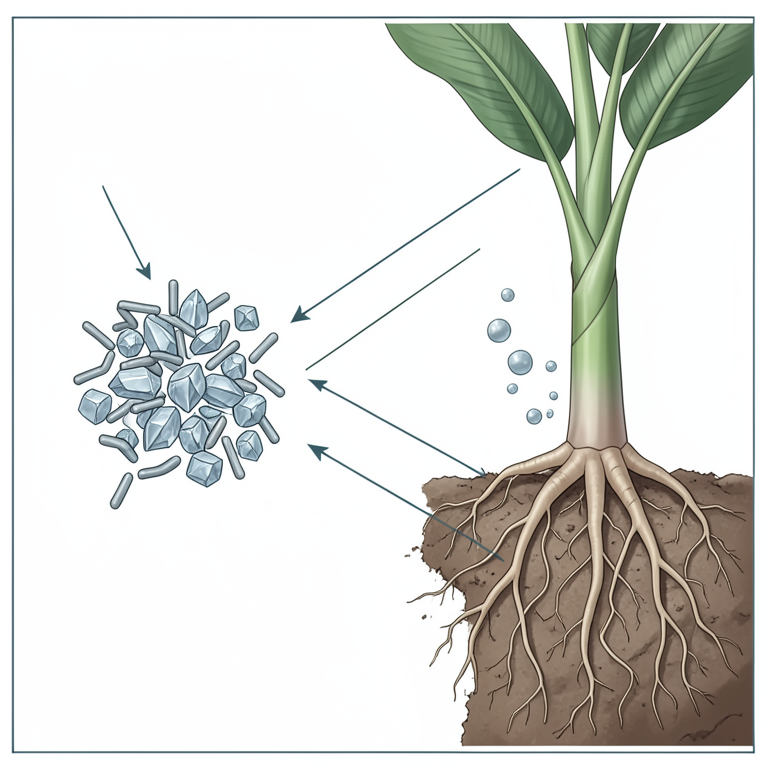
KSB Mechanism
AI-generated conceptual illustration (banana plant roots in soil with mineral crystals and bacteria). It explains the idea and does not show study data.
View source evidence ↗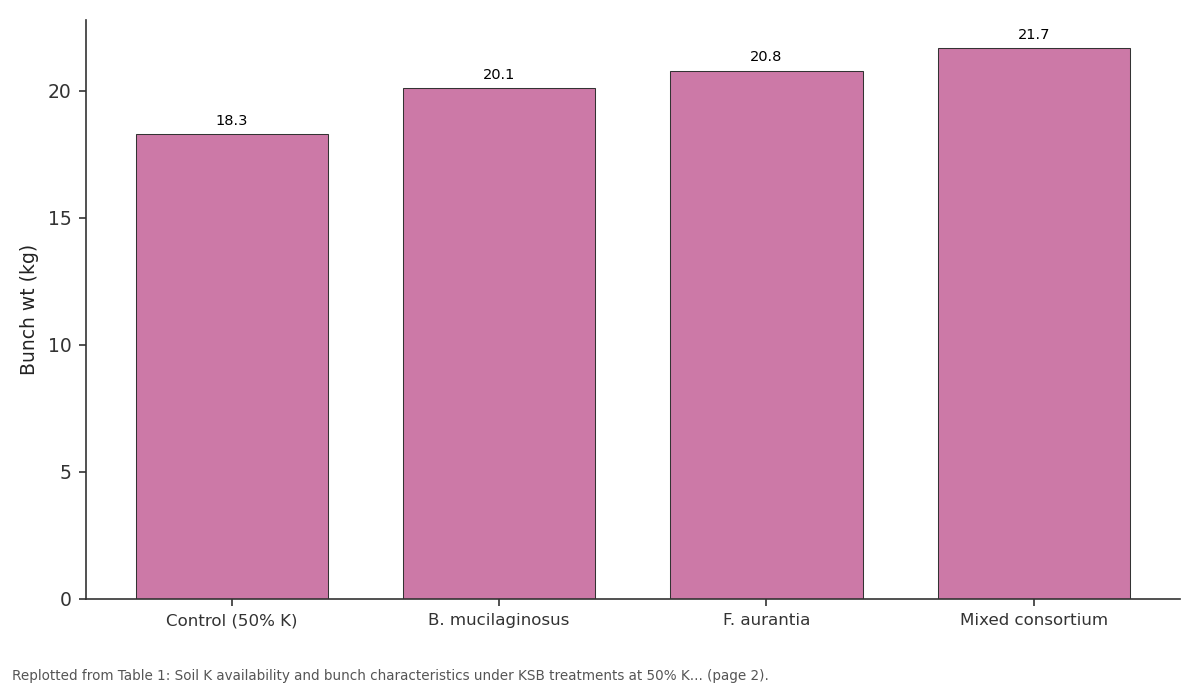
Bunch wt (kg): Control (50% K) vs B. mucilaginosus vs F. aurantia vs Mixed consortium
Replotted from Table 1 (page 2) of the original paper. Every bar is the paper's own table value.
View source evidence ↗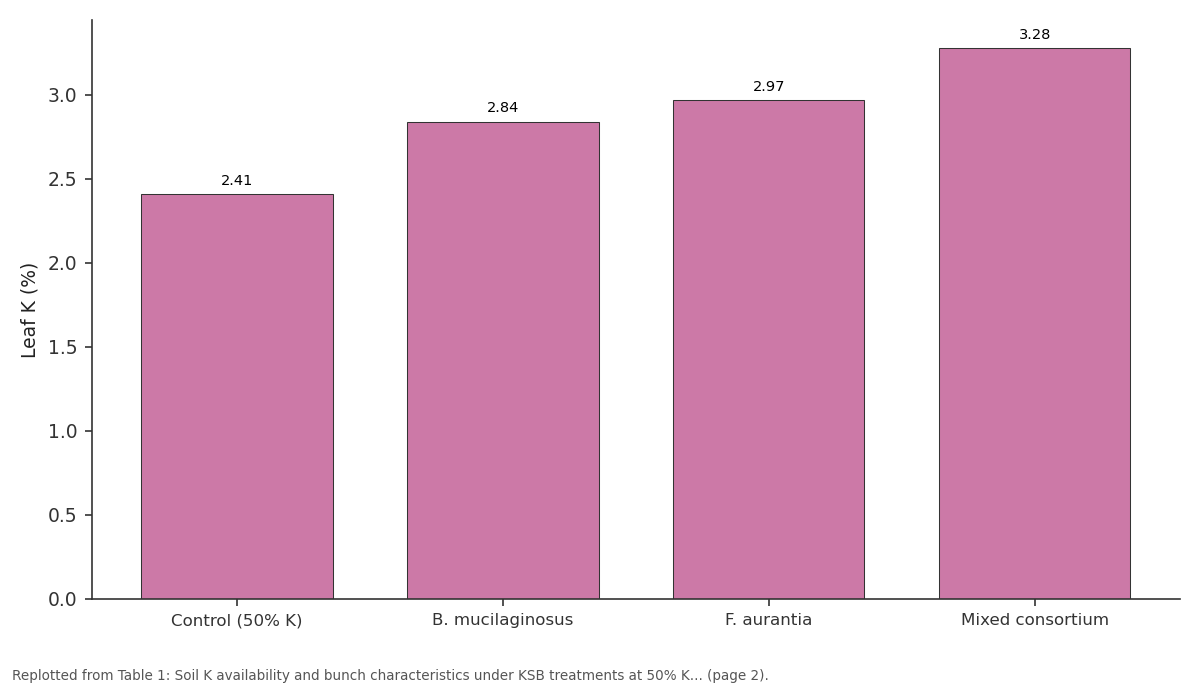
Leaf K (%): Control (50% K) vs B. mucilaginosus vs F. aurantia vs Mixed consortium
Replotted from Table 1 (page 2) of the original paper. Every bar is the paper's own table value.
View source evidence ↗Figures & tables
From the original paper Table 1
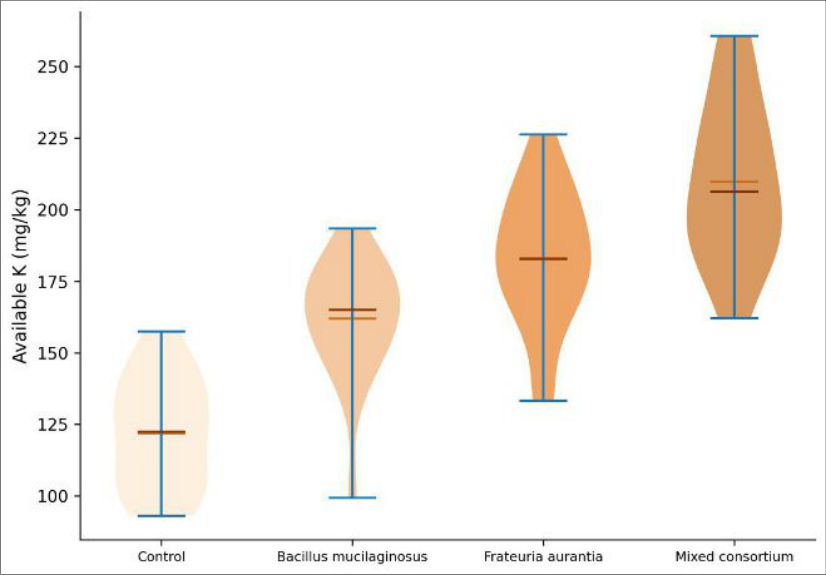 Figure 1
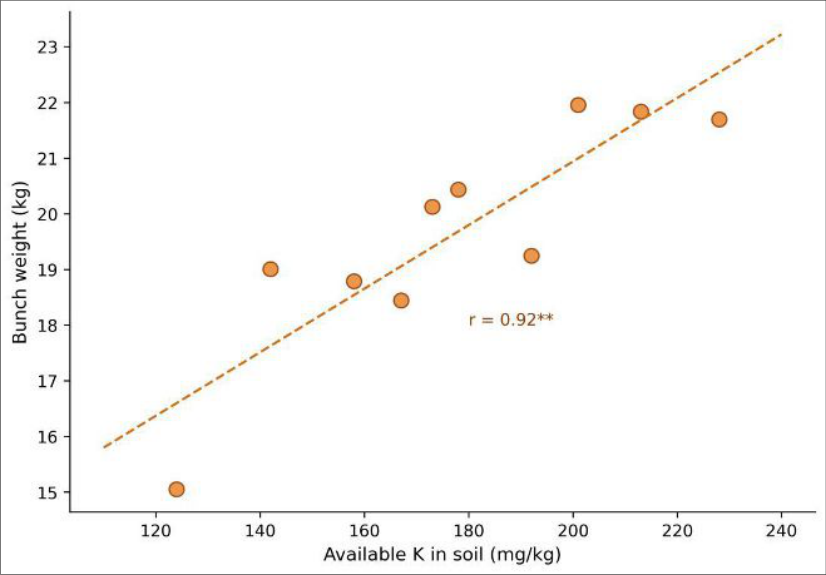 Figure 2
Introduction
Walk into any banana plantation in Southeast Asia and you'll find one thing in common: bags of muriate of potash stacked under the packing shed. Banana is among the most potassiumdemanding fruit crops, removing 400-600 kg K 2 O per hectare per crop cycle, and growers in Malaysia spend an estimated MYR 3,200-4,800/ha annually on K fertilizer alone [1] . Yet 90-98% of soil potassium is locked in mineral forms (feldspars, micas) that are unavailable to plant roots [2] . Potassium Solubilizing Bacteria (KSB) release organic acids that dissolve these minerals, converting fixed K into plant-available forms [3] . Bacillus mucilaginosus and Frateuria aurantia are the most studied KSB species, with reported K solubilization efficiencies of 12-28% in laboratory assays [4] . But field evidence in perennial plantation crops like banana is limited, and the few available trials used KSB as an add-on to full fertilizer rates rather than as a partial replacement [5,6] . This research was conducted at the Borneo Institute of Agricultural Sciences, Kuching (1.55 deg N, 110.34 deg E; altitude 18 m), to test whether KSB inoculation at 50% of recommended K fertilizer can maintain soil K availability and bunch yield comparable to the full fertilizer control in a commercial Cavendish banana plantation [7,8] .
Material and Methods
Material and Methods
Material
A three-year-old Cavendish banana plantation (cv. Grand Naine, tissue-culture origin, 2,000 plants/ha) on a sandy clay loam Ultisol (pH 4.8, available K 124 mg/kg, CEC 11.3 cmol/kg) was used. KSB cultures of Bacillus mucilaginosus (strain BM-21, 10^8 CFU/ml), Frateuria aurantia (strain FA-07, 10^8 CFU/ml), and a 1:1 mixed consortium were supplied by the Malaysian Agricultural Research and Development Institute. Carrier-based inoculant (lignite, 200 g/plant) was applied to the root zone at planting and at flower emergence. All KSBtreated plots received 50% of the recommended K dose (200 kg K 2 O/ha vs full rate of 400 kg K 2 O/ha). The control received 50% K without inoculant.
Methods
Four treatments (control at 50% K, B. mucilaginosus + 50% K, F. aurantia + 50% K, mixed consortium + 50% K) were arranged in a RCBD with four replications (five plants per plot). Soil samples (0-30 cm, rhizosphere) were collected at 3, 6, 9, and 12 months after inoculation. Available K was extracted with ammonium acetate and measured by flame photometry [9] . Bunch weight, number of hands, finger length, and finger girth were recorded at harvest. Leaf K concentration (3 rd leaf from top, mid-rib removed) was analysed at flowering. Data were analysed by repeatedmeasures ANOVA in SAS 9.4 with DMRT at p<0.05 [10] .
Results
Table The violin plot (Figure 1) shows a progressive rightward shift from control to mixed consortium, with the consortium also displaying wider spread, possibly reflecting spatial variability in microbial colonisation. The scatter plot (Figure 2) confirms a tight linear relationship (r = 0.92) between soil K and bunch weight, validating the KSB mechanism.
Discussion
The mixed consortium's superiority over single-species inoculants supports the hypothesis that different KSB species attack different K-bearing minerals through distinct organic acids: B. mucilaginosus produces tartaric and citric acids that dissolve micas, while F. aurantia generates gluconic acid effective against feldspars [3,4] . Together they mobilise a broader K pool. The 18.6% bunch weight increase at 50% fertilizer input means that KSB effectively replaced the missing 50% of chemical K and added a further yield bonus [11] . The economic implication is direct: at MYR 2,400/t for MOP, saving 200 kg K2O/ha saves roughly MYR 1,920/ha, while KSB inoculant costs about MYR 400/ha, giving a net saving of MYR 1,520/ha. With 62,000 hectares of banana in Malaysia, the aggregate fertilizer saving could be substantial [1] . One limitation is that our trial ran for one crop cycle; KSB populations may decline over time without reinoculation, and long-term persistence data are needed [12,13] .
Conclusion
A mixed consortium of B. mucilaginosus and F. aurantia, applied at 50% of recommended K fertilizer, raised soil available K by 72%, increased bunch weight by 18.6%, and brought leaf K above the sufficiency threshold in Cavendish banana on a Sarawak Ultisol. Single-species inoculants gave smaller but still significant improvements. KSB inoculation offers a practical strategy to reduce potassium fertilizer costs in tropical banana plantations while maintaining yield. Future work should evaluate re-inoculation frequency, performance across soil types, and interactions with other biofertilizers [14,15,16,17,18] .
Figures and tables from the paper
| Treatment | Avail. K (mg/kg) | Leaf K (%) | Bunch wt (kg) | Hands/bunch | Finger length (cm) | Yield increase (%) |
|---|---|---|---|---|---|---|
| Control (50% K) | 124 | 2.41 | 18.3 | 8.2 | 17.4 | - |
| B. mucilaginosus | 167 | 2.84 | 20.1 | 8.7 | 18.6 | +9.8 |
| F. aurantia | 178 | 2.97 | 20.8 | 8.9 | 19.1 | +13.7 |
| Mixed consortium | 213 | 3.28 | 21.7 | 9.4 | 19.8 | +18.6 |
| CD (p<0.05) | 22 | 0.18 | 1.4 | 0.6 | 0.8 | - |
Table text extracted from the original PDF; superscript letters are shown inline. The original table image is below.
View original table image
References
17 in the original paper- Malaysian Pineapple Industry Board. Malaysian Banana Production Statistics 2022. Kuala Lumpur: MPIB; 2022.
- Sparks DL. Potassium dynamics in soils. Advances in Soil Science. 1987;6:1-63.
- Meena VS, Maurya BR, Verma JP. Does a rhizospheric microorganism enhance K+ availability in agricultural soils? Microbiological Research. 2014;169(5-6):337347.
- Parmar P, Sindhu SS. Potassium solubilization by rhizosphere bacteria: influence of nutritional and environmental conditions. Journal of Microbiology Research. 2013;3(1):25-31.
- Basak BB, Biswas DR. Influence of potassium solubilizing microorganism on some aspects of potassium nutrition in chickpea. Bioresource Technology. 2009;100(7):1904-1908.
- Sheng XF, He LY. Solubilization of potassium-bearing minerals by a wild-type strain of Bacillus edaphicus. Applied Soil Ecology. 2006;34(1):67-73.
- Borneo Institute of Agricultural Sciences. Plantation Crops Research Report 2022-23. Kuching: BIAS; 2023.
- Kedah Agricultural University. Collaborative Projects Annual Report 2023. Alor Setar: KAU; 2023.
- Jackson ML. Soil Chemical Analysis. 2nd ed. New Delhi: Prentice Hall; 1973.
- SAS Institute. SAS/STAT User's Guide. Version 9.4. Cary: SAS Institute; 2017.
- Han HS, Lee KD. Effect of co-inoculation with phosphate and potassium solubilizing bacteria on mineral uptake. Plant Soil and Environment. 2006;52(3):130-136.
- Archana DS, Nandish MS, Savalagi VP, Alagawadi AR. Characterization of potassium solubilizing bacteria from rhizosphere of banana. Karnataka Journal of Agricultural Sciences. 2013;26(3):407-411.
- Uroz S, Calvaruso C, Turpault MP, Frey-Klett P. Mineral weathering by bacteria. Trends in Microbiology. 2009;17(8):378-387.
- Maurya BR, Meena VS, Meena OP. Influence of Inceptisol and Alfisol's potassium solubilizing bacteria on release of K from waste mica. Egyptian Journal of Basic and Applied Sciences. 2014;1(3-4):198-204.
- Bahadur I, Meena VS, Kumar S. Importance and application of potassic biofertilizer in Indian agriculture. International Research Journal of Biological Sciences. 2014;3(12):80-85.
- Robinson JC, Galan-Sauco V. Bananas and Plantains. 2nd ed. Wallingford: CABI; 2010.
- Turner DW, Fortescue JA, Thomas DS. Environmental physiology of the bananas. Brazilian Journal of Plant Physiology. 2007;19(4):463-484.