
Research article · 2025 · Full text
International Journal of Agriculture and NutritionImpact of regulated deficit irrigation on fruit quality and water savings in apple orchards
Volume 7(3) · Pages 50–52 · DOI: 10.33545/26646064.2025.v7.i3a.608 ↗
Research areasIrrigation Practices and Water ManagementPlant Physiology and Cultivation StudiesPlant Water Relations and Carbon Dynamics
Abstract
Author-writtenWater scarcity is the largest constraint on expanding fruit production in arid North Africa. This research assessed Regulated Deficit Irrigation (RDI) on fruit quality, yield, and Water Use Efficiency (WUE) in a seven-year-old Anna apple orchard at Nile Delta Agricultural University, Mansoura, Egypt, during 2022 and 2023. Four drip-irrigation treatments were imposed during fruit development: 100%, 80%, 60%, and 40% crop evapotranspiration (ETc) in a randomised complete block design with four replications. Reducing irrigation to 80% ETc caused only a 4.9% yield decline (30.8 vs 32.4 t/ha) while improving total soluble solids by 11.3% and firmness by 8.5%. At 60% ETc, yield loss reached 16.4% but WUE increased by 39.5%. Severe deficit (40% ETc) reduced fruit weight to 132.7 g and yield to 21.3 t/ha, penalties too large for commercial acceptance. Mild RDI at 80% ETc offers the best compromise between water savings and marketable quality for Anna apple in the Egyptian delta.
Summary
Source-checkedPlain-language reading of the full paper, prepared with AI and checked against the text. Each point links to the authors' own words.
Why it matters
- Water scarcity is the primary obstacle to increasing fruit production in the arid regions of North Africa. View evidence ↗
- Egypt faces severe water poverty, with annual rainfall under 80 mm and per capita water availability below 570 m³, which is significantly lower than the 1,000 m³ poverty threshold. View evidence ↗
- Agriculture accounts for approximately 85% of water withdrawals in Egypt, with fruit orchards being particularly water-intensive. View evidence ↗
The question
- The study aimed to evaluate how four different irrigation levels (100%, 80%, 60%, and 40% of crop evapotranspiration) affect the yield, water use efficiency (WUE), and physical and chemical quality of Anna apples. View evidence ↗
What they did
- The experiment used seven-year-old Anna apple trees on MM.106 rootstock planted in sandy loam soil at the Nile Delta Agricultural University orchard in Mansoura. View evidence ↗
- The study employed a randomized complete block design (RCBD) with four irrigation treatments and four replications of four trees each, totaling 64 trees. View evidence ↗
- Irrigation treatments were applied from fruit set (March 1) to harvest (June 30) during the 2022 and 2023 seasons. View evidence ↗
- Researchers measured fruit weight, diameter, firmness, total soluble solids (TSS), titratable acidity, and red color coverage. View evidence ↗
What they found
- Reducing irrigation to 80% ETc resulted in a minor yield decline of 4.9% (30.8 vs 32.4 t/ha) but improved fruit firmness by 8.5% and total soluble solids by 11.3%. View evidence ↗
- At 60% ETc, the yield loss increased to 16.4%, although water use efficiency (WUE) improved by 39.5%. View evidence ↗
- Severe water deficit at 40% ETc reduced yield to 21.3 t/ha and fruit weight to 132.7 g, which the authors consider commercially unacceptable. View evidence ↗
- Fruit firmness reached its maximum value of 73.8 N under the 60% ETc treatment. View evidence ↗
- Red color coverage was most extensive at 60% ETc (63.1%) and least extensive under full irrigation (48.3%). View evidence ↗
- Total soluble solids (TSS) increased from 12.4 to 15.1 °Brix at 60% ETc, but then decreased to 14.6 °Brix under the severe 40% ETc stress. View evidence ↗
- Water use efficiency (WUE) improved by 18.8% when moving from full irrigation (100% ETc) to a mild deficit (80% ETc). View evidence ↗
What it means
- The authors conclude that regulated deficit irrigation (RDI) at 80% ETc provides the optimal balance between conserving water and maintaining fruit quality for Anna apples. View evidence ↗
- The authors recommend 80% ETc as a practical, low-cost strategy for Egyptian growers to save water and potentially improve the quality of fruit for export markets. View evidence ↗
- A limitation of the study was the uniform application of RDI throughout fruit development; the authors suggest that staged RDI could further optimize the balance between yield and quality. View evidence ↗
Visual summary
3 visualsIllustrations explain the paper; charts are replotted from the paper's own table values.
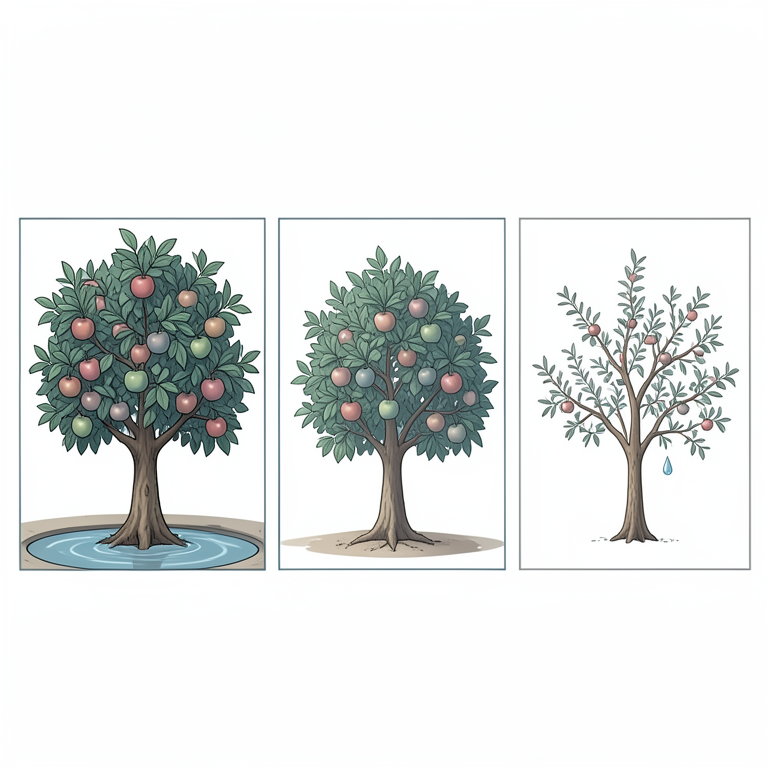
Trade-off between Water Savings and Yield
AI-generated conceptual illustration (apple trees in an orchard). It explains the idea and does not show study data.
View source evidence ↗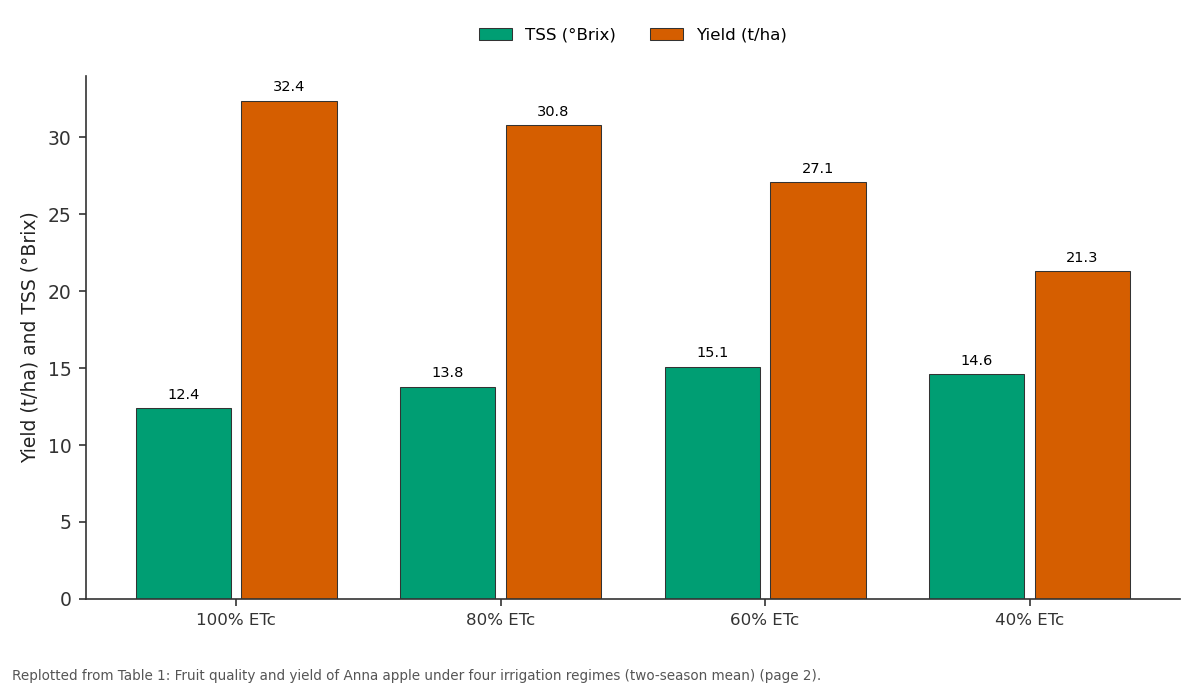
TSS (°Brix) and Yield (t/ha): 100% ETc vs 80% ETc vs 60% ETc vs 40% ETc
Replotted from Table 1 (page 2) of the original paper. Every bar is the paper's own table value.
View source evidence ↗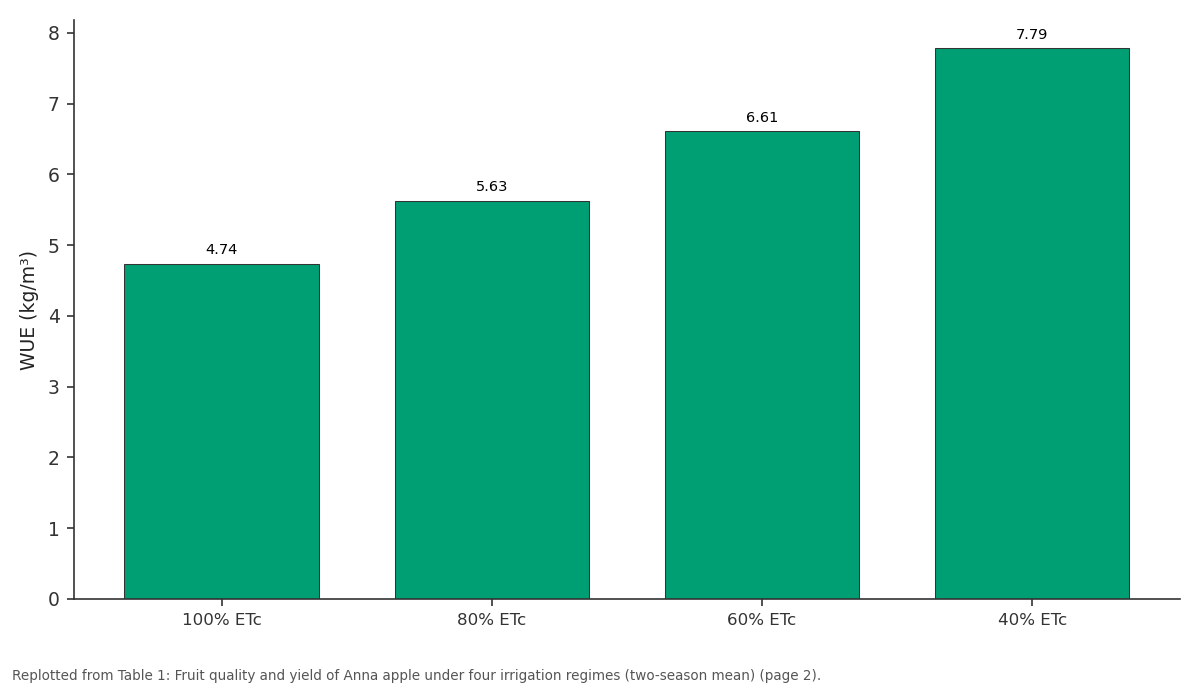
WUE (kg/m³): 100% ETc vs 80% ETc vs 60% ETc vs 40% ETc
Replotted from Table 1 (page 2) of the original paper. Every bar is the paper's own table value.
View source evidence ↗Figures & tables
From the original paper Table 1
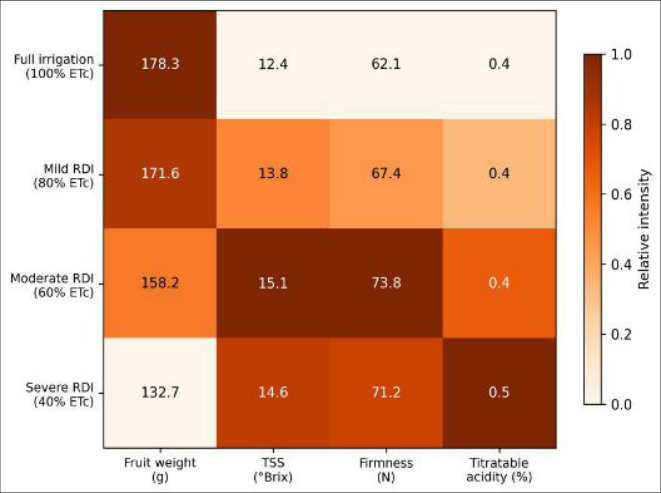 Figure 1
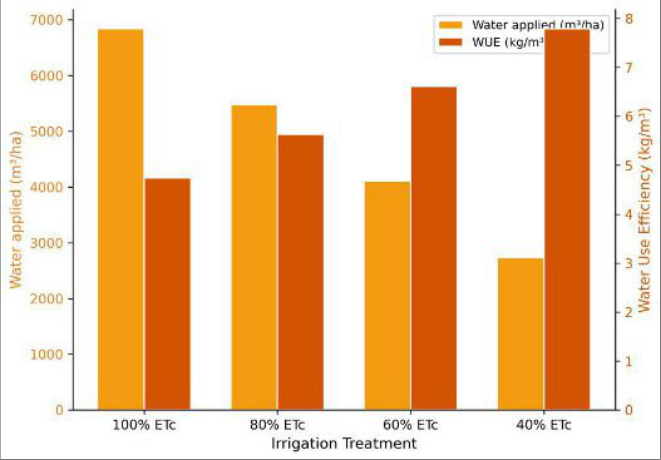 Figure 2
Introduction
Egypt receives less than 80 mm of rainfall annually and depends almost entirely on the Nile for agricultural water, yet per capita availability has fallen below 570 m3, well under the water-poverty threshold of 1,000 m3 [1] . Agriculture consumes roughly 85% of withdrawals, and fruit orchards are among the most water-demanding enterprises [2] . Regulated deficit irrigation reduces water supply below full crop requirements during less sensitive growth stages while maintaining supply during critical periods [3] . The concept was first applied to peach by Chalmers et al. [4] and has since been tested on several fruits. Mild water stress during cell expansion can improve sugar concentration without proportionally affecting yield [5] . Apple is a relatively new crop in the Egyptian Delta, introduced through low-chill cultivars like Anna [6] . Growers apply 600-800 mm per season with drip systems but few have adopted water-saving strategies because local RDI data are scarce [7] . Existing literature comes mainly from temperate regions where conditions differ markedly [8] . This research evaluated four irrigation levels (100%, 80%, 60%, 40% ETc) on Anna apple for effects on physical quality, chemical quality, yield, and WUE at the university experimental orchard (31.04 deg N, 31.38 deg E) over two seasons [9] .
Material and Methods
Material and Methods
Material
Seven-year-old Anna apple trees on MM.106 rootstock, planted at 4 m x 3 m (833 trees/ha) in sandy loam soil (pH 7.8, EC 1.2 dS/m) at the Nile Delta Agricultural University orchard, Mansoura. Trees were trained as central leaders with standard commercial management. Treatments were imposed from 1 March (fruit set) to 30 June (harvest) in 2022 and 2023. Reference ET0 was estimated daily using Penman-Monteith; ETc was calculated using FAO crop coefficients [10] . The 100% treatment received 684 mm seasonally (6,840 m3/ha). Irrigation was applied every two days through 4 L/h drippers, three per tree.
Methods
Four treatments (100%, 80%, 60%, 40% ETc) were arranged in a RCBD with four replications of four trees each (64 trees total). At harvest, 20 fruits per replicate were sampled. Fruit weight, diameter, firmness (Chatillon DFE-050 penetrometer, 11.1-mm tip), TSS (digital refractometer), titratable acidity (NaOH titration to pH 8.1), and red colour coverage (visual 0-100% scale by two assessors) were recorded. Yield per tree was converted to t/ha. WUE = yield / water applied [11] . Data from both seasons were pooled; ANOVA in SAS 9.4 with Duncan's test at p<0.05 [12] . The heatmap (Figure 1) reveals a trade-off: moving from full to severe deficit, fruit weight declines while firmness and TSS rise. The 80% ETc row offers the most balanced pattern. The bar chart (Figure 2) shows WUE increased almost linearly, with the steepest practical gain between 100% and 80% ETc where 20% less water produced only 5% less fruit.
Results
Results
Discussion
The 11.3% TSS increase at 80% ETc without meaningful yield loss echoes Mpelasoka et al. [14] in Braeburn apple. The mechanism involves a concentration effect as cell water declines, together with enhanced sucrose synthase activity triggered by abscisic acid [5] . Improved red colour is consistent with stress-mediated anthocyanin biosynthesis [15] . The sharp decline at 40% ETc underlines the need to keep the deficit within tolerable limits. At this level, stomatal conductance likely fell below the threshold for carbon fixation, reducing sugar translocation. Similar breakpoints have been reported for olive at 30-40% ETc [3] and grape at 45% ETc [16] . WUE improved by 18.8% between 100% and 80% ETc. In a country facing absolute water scarcity, even modest perhectare savings matter when aggregated across Egypt's estimated 38,000 hectares of apple orchards [2] . And because mild-RDI fruit had firmer flesh and higher sugar, it's better suited to export cold-chain requirements [13] . A limitation is that RDI was applied uniformly across the entire fruitdevelopment period; staged RDI might further optimise the quality-yield balance [17] .
Conclusion
This two-season research showed that RDI at 80% ETc delivered the best balance between water conservation and fruit quality in Anna apple. The mild deficit reduced water use by 20%, improved TSS by 11.3%, raised firmness by 8.5%, and enhanced red colour from 48.3% to 56.7%, while limiting yield loss to 4.9%. At 60% ETc, quality gains were larger but the 16.4% yield reduction may be too steep commercially. Severe deficit at 40% ETc caused unacceptable losses. For Egyptian orchardists under tight water allocations, RDI at 80% ETc represents a practical, low-cost adjustment that conserves a scarce resource and may improve access to premium export markets. Future work should explore stagespecific RDI protocols and test different rootstock-scion combinations.
Acknowledgement
Acknowledgements Funding sourcesThis research was partially supported by the Science and Technology Development Fund of Egypt through a competitive grant to the Nile Delta Agricultural University. Institutional supportThe authors thank the Nile Delta Agricultural University for maintaining the experimental orchard and the Alexandria College of Agriculture for hydrological data analysis.
Figures and tables from the paper
| Treatment | Wt. (g) | Diameter (mm) | Firmness (N) | TSS (°Brix) | Yield (t/ha) | WUE (kg/m³) |
|---|---|---|---|---|---|---|
| 100% ETc | 178.3 | 72.6 | 62.1 | 12.4 | 32.4 | 4.74 |
| 80% ETc | 171.6 | 70.8 | 67.4 | 13.8 | 30.8 | 5.63 |
| 60% ETc | 158.2 | 66.3 | 73.8 | 15.1 | 27.1 | 6.61 |
| 40% ETc | 132.7 | 59.4 | 71.2 | 14.6 | 21.3 | 7.79 |
| CD (p<0.05) | 8.4 | 3.1 | 4.7 | 0.9 | 2.3 | 0.52 |
Table text extracted from the original PDF; superscript letters are shown inline. The original table image is below.
View original table image
References
17 in the original paper- Ministry of Water Resources and Irrigation. Egypt Water Strategy 2050. Cairo: Government of Egypt; 2018.
- CAPMAS. Egypt in Figures 2023: Agriculture. Cairo: Central Agency for Public Mobilization and Statistics; 2023.
- Fereres E, Soriano MA. Deficit irrigation for reducing agricultural water use. Journal of Experimental Botany. 2007;58(2):147-159.
- Chalmers DJ, Mitchell PD, van Heek L. Control of peach tree growth and productivity by regulated water supply, tree density and summer pruning. Journal of the American Society for Horticultural Science. 1981;106(3):307-312.
- Naor A. Irrigation scheduling and evaluation of tree water status in deciduous orchards. Horticultural Reviews. 2006;32:111-165.
- El-Shereif AR, Abou-Taleb SA, Aly MA. Performance of Anna and Dorsett Golden apple cultivars in northern Egypt. Egyptian Journal of Horticulture. 2013;40(1):114.
- Amer SA, Abdelfattah EM. Water use efficiency of drip-irrigated apple under Egyptian conditions. Alexandria Journal of Agricultural Sciences. 2019;64(3):167-176.
- Leib BG, Caspari HW, Redulla CA, Andrews PK, Jabro JD. Partial rootzone drying and deficit irrigation of Fuji apples. Irrigation Science. 2006;24(2):85-99.
- Allen RG, Pereira LS, Raes D, Smith M. Crop Evapotranspiration: Guidelines for Computing Crop Water Requirements. FAO Irrigation and Drainage Paper 56. Rome: FAO; 1998.
- Doorenbos J, Pruitt WO. Crop Water Requirements. FAO Irrigation and Drainage Paper 24. Rome: FAO; 1977.
- Howell TA. Enhancing water use efficiency in irrigated agriculture. Agronomy Journal. 2001;93(2):281-289.
- Gomez KA, Gomez AA. Statistical Procedures for Agricultural Research. 2nd ed. New York: Wiley; 1984.
- UNECE. Standard FFV-50 Concerning the Marketing and Commercial Quality Control of Apples. Geneva: United Nations Economic Commission for Europe; 2017.
- Mpelasoka BS, Behboudian MH, Green SR. Water use, yield and fruit quality of lysimeter-grown apple trees. Agricultural Water Management. 2001;50(1):73-81.
- Tahir II, Johansson E, Olsson ME. Improvement of apple quality and storability by deficit irrigation. Journal of Horticultural Science and Biotechnology. 2009;84(2):113-120.
- Intrigliolo DS, Castel JR. Response of grapevine cv. Tempranillo to timing and amount of irrigation. Agricultural Water Management. 2010;97(5):689-699.
- Girona J, Mata M, del Campo J, Arbones A, Bartra E, Marsal J. The use of midday leaf water potential for scheduling deficit irrigation in vineyards. Irrigation Science. 2006;24(2):115-127.