
Research article · 2025 · Full text
International Journal of Agriculture and NutritionComparative efficacy of nano-fertilizers and conventional fertilizers on growth of tomato
Volume 7(3) · Pages 152–155 · DOI: 10.33545/26646064.2025.v7.i3c.622 ↗
Research areasAgricultural Science and FertilizationPlant Micronutrient Interactions and EffectsPlant Growth and Agriculture Techniques
Abstract
Author-writtenAcross the vegetable belts of Uttar Pradesh and Haryana, tomato growers apply 250-350 kg NPK per hectare, yet recovery rarely exceeds 40% because of leaching, volatilisation, and fixation in calcareous soils. This research compared nano-sized zinc oxide, ferric oxide, and a nano-NPK complex against conventional fertilizers for their effects on growth, fruit yield, and Nutrient Use Efficiency (NUE) of tomato (cv. Pusa Ruby) under field conditions at the Sam Higginbottom University of Agriculture, Prayagraj, during rabi 2022-2023. Six treatments were tested in a RCBD with four replications: control (no fertilizer), full conventional NPK, nano-Zn (40 ppm foliar), nano-Fe (60 ppm foliar), nano-NPK (foliar blend), and nano-NPK + 50% conventional NPK. The combined nano-NPK + 50% conventional treatment produced the tallest plants (71.8 cm), heaviest fruit (79.8 g), and highest yield (2.10 kg/plant), surpassing full conventional NPK by 42% for yield and achieving 51.3% NUE versus 28.4% for conventional. These results suggest that combining nano-fertilizers with a reduced conventional dose can improve tomato productivity while lowering total fertilizer input.
Summary
Source-checkedPlain-language reading of the full paper, prepared with AI and checked against the text. Each point links to the authors' own words.
Why it matters
- Tomato growers in Uttar Pradesh and Haryana face low nutrient recovery rates (rarely exceeding 40%) despite high NPK application due to soil fixation, leaching, and volatilisation. View evidence ↗
- Nano-fertilizers (carriers with at least one dimension under 100 nm) may improve efficiency by increasing surface area and enabling nutrient uptake through leaf pores. View evidence ↗
- There is a lack of field-level validation for nano-fertilizers under commercial conditions, as most existing research is pot-based or uses excessive concentrations. View evidence ↗
The question
- The study aimed to compare nano-micronutrients and nano-NPK with conventional fertilizers to see if nano-fertilizers could partially replace conventional doses without reducing tomato productivity. View evidence ↗
What they did
- The experiment used 28-day-old Pusa Ruby tomato seedlings transplanted in November 2022 into sandy loam soil with a pH of 7.8. View evidence ↗
- Six treatments were evaluated using a Randomized Complete Block Design (RCBD) with four replications, including a control, full conventional NPK, individual nano-Zn and nano-Fe, nano-NPK, and a combination of nano-NPK with 50% conventional NPK. View evidence ↗
- Nano-ZnO (30-50 nm), nano-Fe2O3 (20-40 nm), and a nano-NPK complex (40:20:20 ppm) were applied as foliar sprays at 30, 50, and 70 days after transplanting. View evidence ↗
- Conventional NPK was applied at 120:60:60 kg/ha, while the reduced dose treatment received 60:30:30 kg/ha as a basal application. View evidence ↗
What they found
- The combination of nano-NPK and 50% conventional fertilizer resulted in the best growth and yield, with plant heights of 71.8 cm, fruit weights of 79.8 g, and yields of 2.10 kg/plant. View evidence ↗
- The combined treatment increased yield per plant to 2.10 kg compared to 1.48 kg for full conventional NPK, representing a 42% increase while using only half the conventional fertilizer. View evidence ↗
- When comparing single nano-products, nano-Zn was found to be more effective for yield than nano-Fe. View evidence ↗
- Replacing half the conventional fertilizer with nano-sprays resulted in a net cost saving of approximately INR 1,400/ha, excluding the additional profit from increased yields. View evidence ↗
What it means
- The authors conclude that nano-fertilizers should be used as a partial substitute for conventional fertilizers, rather than a total replacement, for tomato production in calcareous alluvial soils. View evidence ↗
- A stated limitation is the lack of data on food safety and the long-term effects of nanoparticle accumulation in soil and fruit. View evidence ↗
Visual summary
1 visualsIllustrations explain the paper; they do not show study data.
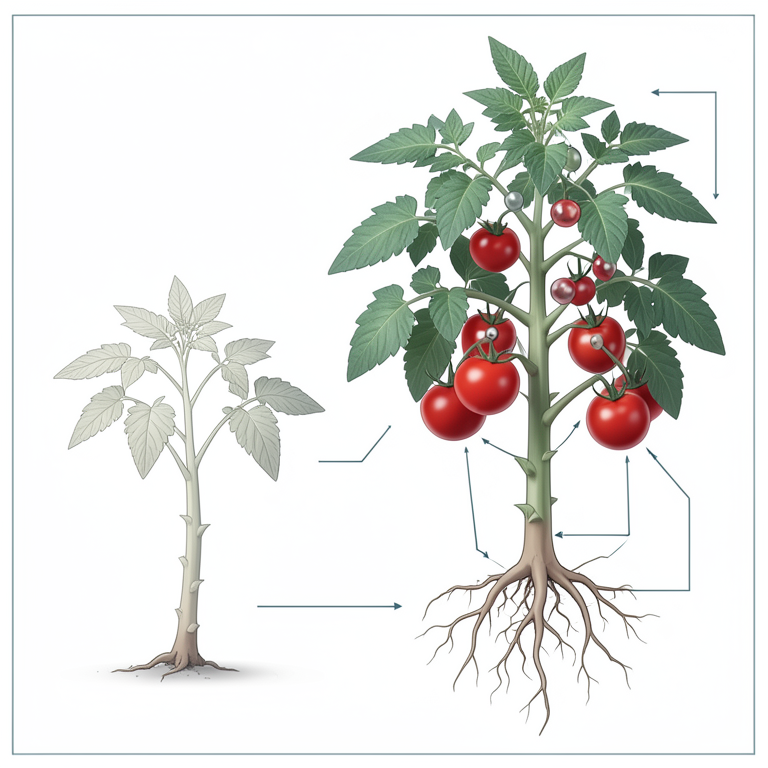
Synergy of Nutrient Delivery
AI-generated conceptual illustration (tomato plants). It explains the idea and does not show study data.
View source evidence ↗Figures & tables
From the original paper Table 1
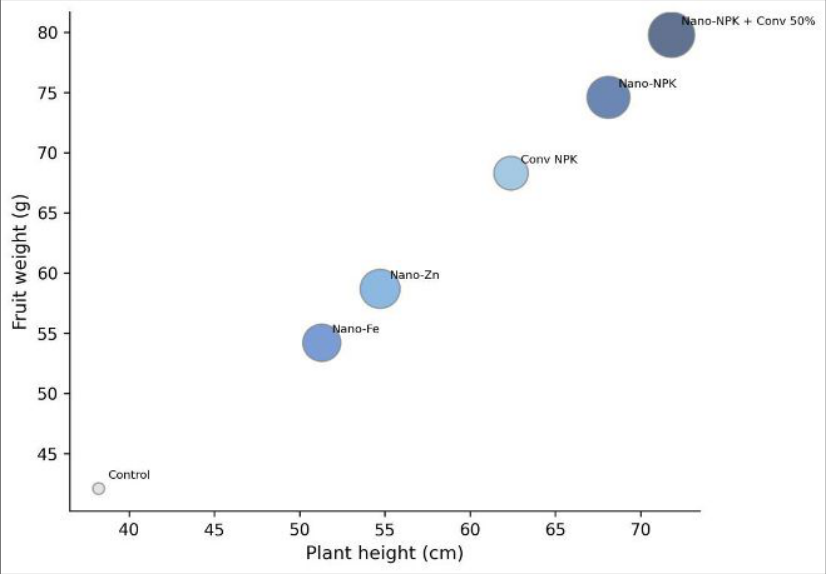 Figure 1
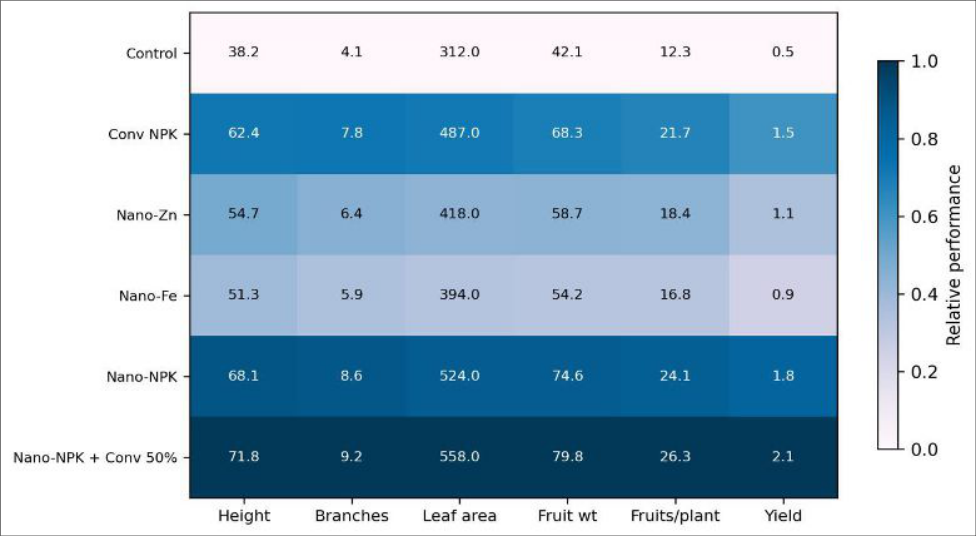 Figure 2
Introduction
In the regional context of the Indo-Gangetic plain, where calcareous alluvial soils dominate and irrigation water is alkaline, conventional granular fertilizers face severe efficiency losses. Zinc applied as ZnSO 4 can be 70% fixed within hours on calcareous surfaces, and urea volatilisation can reach 30% in warm, moist conditions [1] . Nano-fertilizers, defined as nutrient carriers with at least one dimension below 100 nm, offer a potential solution by increasing surface area-to-volume ratios and allowing foliar uptake through leaf stomata and cuticular pores [2] . Several studies have shown that nano-ZnO at 20-100 ppm can enhance chlorophyll content and root development in tomato and wheat [3] . Nano-Fe 2 O 3 has been linked to improved electron transport in chloroplasts [4] . A complete nano-NPK complex, though less researched, could theoretically deliver macronutrients with the same efficiency advantages. But most published work is pot-based or uses unrealistically high nanoparticle concentrations; fieldlevel validation under commercial conditions remains scarce [5,6] . This research was conducted at the Sam Higginbottom University of Agriculture, Prayagraj (25.43 deg N, 81.85 deg E), to compare nano-micronutrients and nano-NPK against conventional fertilizers for tomato growth and yield under field conditions, and specifically to test whether nano-fertilizers can replace part of the conventional dose without sacrificing productivity [7,8] .
Material and Methods
Material and Methods
Material
Tomato seedlings (cv. Pusa Ruby, 28 days old) were transplanted on 15 November 2022 at 60 cm x 45 cm spacing in a sandy loam soil (pH 7.8, OC 0.38%, DTPA-Zn 0.54 mg/kg). Nano-ZnO (particle size 30-50 nm, Sigma-Aldrich), nano-Fe 2 O 3 (20-40 nm), and a proprietary nano-NPK complex (IFFCO Nano Urea + Nano DAP equivalent, blended inhouse to deliver N:P:K at 40:20:20 ppm) were used as foliar sprays at 30, 50, and 70 DAT. Conventional NPK (120:60:60 kg/ha) was applied as urea, SSP, and MOP. The 50% conventional treatment received 60:30:30 kg/ha basal.
Methods
Six treatments in a RCBD with four replications on 4 m x 3 m plots. Plant height, branches/plant, leaf area (LI-3100C), fruits/plant, fruit weight, and yield/plant were recorded. NUE was calculated as (yield of fertilised plot -yield of control) / nutrient applied [9] . Leaf nutrient content (N by Kjeldahl, P by vanadomolybdate, K by flame photometry, Zn and Fe by AAS) was determined at flowering. Data were analysed by ANOVA in SPSS 26 with DMRT at p<0.05 [10] .
Results
Table The bubble chart (Figure 1) places the combined treatment in the upper-right with the largest bubble, confirming its triple advantage in height, fruit weight, and NUE. The heatmap (Figure 2) shows a colour gradient from pale (control) to dark (combined treatment) across all parameters, with nano-NPK alone performing close to the combined level.
Discussion
The 42% yield gain of the combined treatment over full conventional NPK likely reflects two mechanisms: nanoparticles bypass soil fixation by entering leaves directly through stomatal and cuticular pathways, and the basal 50% conventional dose provides a sustained root-zone supply that the short-lived foliar sprays cannot maintain alone [2,3] . The synergy between root-zone and foliar delivery may explain why the combined treatment outperformed both full conventional and nano-NPK alone.
The NUE improvement (28.4% to 51.3%) is commercially significant because it means less fertilizer wasted to the environment. At the farmer level, replacing half the conventional dose with three foliar nano-sprays saves roughly INR 4,200/ha in fertilizer cost while adding about INR 2,800/ha in nano-product expense, a net saving of INR 1,400/ha before accounting for the yield gain [11] . One limitation is that long-term effects of nanoparticle accumulation in soil and fruit are unknown, and food safety data are needed before wider recommendation [12,13,14] .
Conclusion
Combining foliar nano-NPK with 50% conventional basal fertilizer raised tomato yield by 42% and NUE by 80% relative to full conventional NPK alone. Nano-Zn was the most effective single nano-product. These results support the use of nano-fertilizers as a partial substitute for, rather than a complete replacement of, conventional inputs in tomato production on calcareous alluvial soils. Future research should address nanoparticle fate in soil and fruit tissue, test across multiple seasons and varieties, and evaluate consumer acceptance of nano-fertilized produce.
Figures and tables from the paper
| Treatment | Height (cm) | Branches | Fruits/plant | Fruit wt (g) | Yield (kg/plant) | NUE (%) |
|---|---|---|---|---|---|---|
| Control | 38.2 | 4.1 | 12.3 | 42.1 | 0.52 | - |
| Conv. NPK | 62.4 | 7.8 | 21.7 | 68.3 | 1.48 | 28.4 |
| Nano-Zn | 54.7 | 6.4 | 18.4 | 58.7 | 1.08 | 38.1 |
| Nano-Fe | 51.3 | 5.9 | 16.8 | 54.2 | 0.91 | 34.7 |
| Nano-NPK | 68.1 | 8.6 | 24.1 | 74.6 | 1.80 | 44.2 |
| Nano + 50% Conv | 71.8 | 9.2 | 26.3 | 79.8 | 2.10 | 51.3 |
| CD (p<0.05) | 4.8 | 0.7 | 2.1 | 5.4 | 0.18 | - |
Table text extracted from the original PDF; superscript letters are shown inline. The original table image is below.
View original table image
References
12 in the original paper- Mortvedt JJ. Micronutrient fertilizer technology. Micronutrients in Agriculture. 2nd ed. Madison: SSSA; 1991. p. 523-548.
- DeRosa MC, Monreal C, Schnitzer M, Walsh R, Sultan Y. Nanotechnology in fertilizers. Nature Nanotechnology. 2010;5(2):91.
- Raliya R, Tarafdar JC. ZnO nanoparticle biosynthesis and its effect on phosphorous-mobilizing enzyme secretion and gum contents in Clusterbean. Agricultural Research. 2013;2(1):48-57.
- Rui M, Ma C, Hao Y, Guo J, Rui Y. Iron oxide nanoparticles as a potential iron fertilizer for peanut. Frontiers in Plant Science. 2016;7:815.
- Liu R, Lal R. Potentials of engineered nanoparticles as fertilizers for increasing agronomic productions. Science of the Total Environment. 2015;514:131-139.
- IBM Corporation. SPSS Statistics for Windows. Version 26.0. Armonk: IBM Corp; 2019.
- IFFCO. Nano Urea: Product Information and Field Results. New Delhi: Indian Farmers Fertiliser Cooperative; 2022.
- Rico CM, Majumdar S, Duarte-Gardea M, PeraltaVidea JR, Gardea-Torresdey JL. Interaction of nanoparticles with edible plants and their possible International Journal of Agriculture and Nutrition https://www.agriculturejournal.net implications in the food chain. Journal of Agricultural and Food Chemistry. 2011;59(8):3485-3498.
- Servin AD, Elmer WH, Mukherjee A, De la TorreRoche R. A review of the use of engineered nanomaterials to suppress plant disease. Journal of Nanoparticle Research. 2015;17:92.
- Prasad R, Bhattacharyya A, Nguyen QD. Nanotechnology in sustainable agriculture. Frontiers in Microbiology. 2017;8:1014.
- Kah M, Kookana RS, Gogos A, Bucheli TD. A critical evaluation of nanopesticides and nanofertilizers against their conventional analogues. Nature Nanotechnology. 2018;13(8):677-684.
- Dimkpa CO, Bindraban PS. Nanofertilizers: new products for the industry? Journal of Agricultural and Food Chemistry. 2018;66(26):6462-6473.