
Research article · 2025 · Full text
International Journal of Agriculture and NutritionIntegrated weed management strategies for organic sugarcane production systems
Volume 7(3) · Pages 111–114 · DOI: 10.33545/26646064.2025.v7.i3b.618 ↗
Research areasWeed Control and Herbicide ApplicationsAllelopathy and phytotoxic interactionsPlant and soil sciences
Abstract
Author-writtenAn old Indian farming saying holds that weeds eat before the farmer does. In organic sugarcane, where synthetic herbicides are forbidden, this proverb rings especially true. This research evaluated six weed management strategies for organic sugarcane (variety Co 86032) over two plant-crop cycles (2021-2022 and 2022-2023) at Dr. Panjabrao Deshmukh Krishi Vidyapeeth, Akola, Maharashtra. Treatments included a weedy check, hand weeding (three rounds), stale seedbed technique, trash mulching at 10 t/ha, cowpea intercrop as living cover, and an Integrated Weed Management (IWM) package combining stale seedbed + mulching + one hand weeding. The IWM package reduced weed density by 71% (from 186 to 54 plants/m2) and weed dry weight by 78% compared with the weedy check. Cane yield under IWM reached 84.7 t/ha, statistically comparable to three-round hand weeding (81.3 t/ha) but at 40% lower labour cost. Trash mulching alone reduced weed density by 58% and was the most cost-effective single intervention. These results suggest that combining cultural and mechanical methods into an IWM package can control weeds effectively in organic sugarcane without relying on herbicides.
Summary
Source-checkedPlain-language reading of the full paper, prepared with AI and checked against the text. Each point links to the authors' own words.
Why it matters
- Sugarcane is particularly vulnerable to weed competition because its slow early canopy closure leaves rows open for 90 to 120 days after planting. View evidence ↗
- In organic sugarcane production, synthetic herbicides are prohibited by certification standards, making manual weeding the standard practice. View evidence ↗
- Standard hand weeding is often unsustainable for farmers in Maharashtra and Odisha due to high costs (INR 15,000-20,000/ha) and high labour requirements (80-100 person-days). View evidence ↗
The question
- The study aimed to compare individual and combined non-chemical weed management strategies to find the most effective approach relative to labour cost. View evidence ↗
What they did
- The research tested six weed management strategies on sugarcane variety Co 86032 over two cycles (2021-2023) in Akola, Maharashtra. View evidence ↗
- The experimental design used a randomized complete block design (RCBD) with four replications, comparing a weedy check, hand weeding, stale seedbed, trash mulching (10 t/ha), cowpea intercropping, and an Integrated Weed Management (IWM) package. View evidence ↗
- Researchers measured weed density and dry weight at 60 and 120 days after planting, and recorded cane yield, commercial cane sugar (CCS %), and labour costs at harvest. View evidence ↗
What they found
- The IWM package was the most effective, achieving the highest weed control at 78.1% and the highest cane yield at 84.7 t/ha. View evidence ↗
- The IWM package produced yields statistically similar to three-round hand weeding (81.3 t/ha) but reduced labour costs by 39% (INR 11,200 vs 18,400/ha). View evidence ↗
- The absence of weed management (weedy check) resulted in a 61% loss of potential yield. View evidence ↗
- The IWM package effectively reduced broadleaf weeds but led to a relative increase in perennial weeds, which were harder to suppress. View evidence ↗
- The IWM package resulted in the highest commercial cane sugar (CCS) value of 11.6%. View evidence ↗
What it means
- The authors conclude that combining a stale seedbed, trash mulching, and one hand weeding provides a viable alternative to intensive hand weeding by matching yields while significantly reducing labour costs. View evidence ↗
- The authors state that future research is needed to evaluate the IWM package over multiple ratoon cycles and to track the long-term behavior of perennial weed populations. View evidence ↗
Visual summary
3 visualsIllustrations explain the paper; charts are replotted from the paper's own table values.
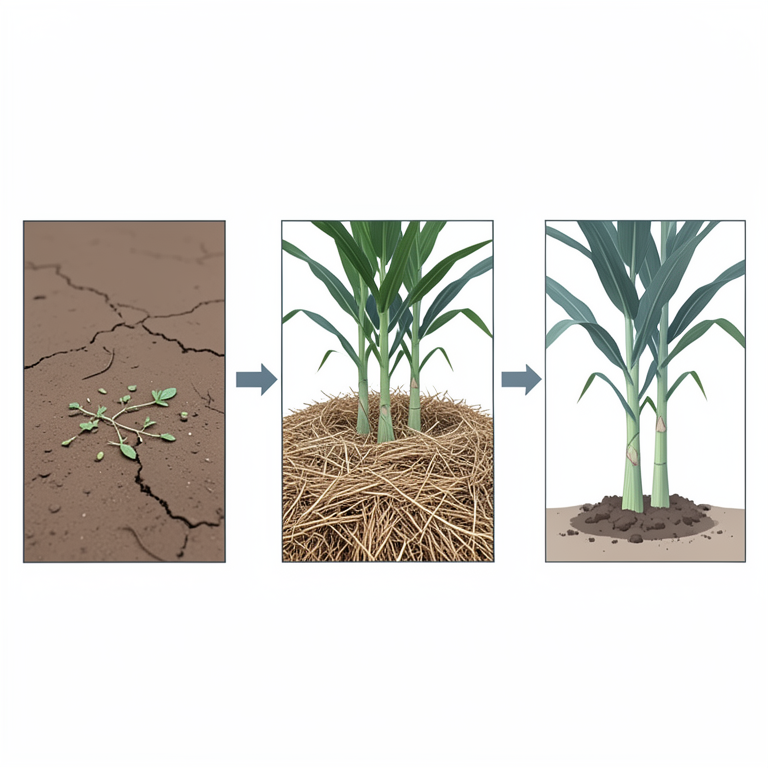
IWM Layered Defense Concept
AI-generated conceptual illustration (sugarcane plants in an organic field). It explains the idea and does not show study data.
View source evidence ↗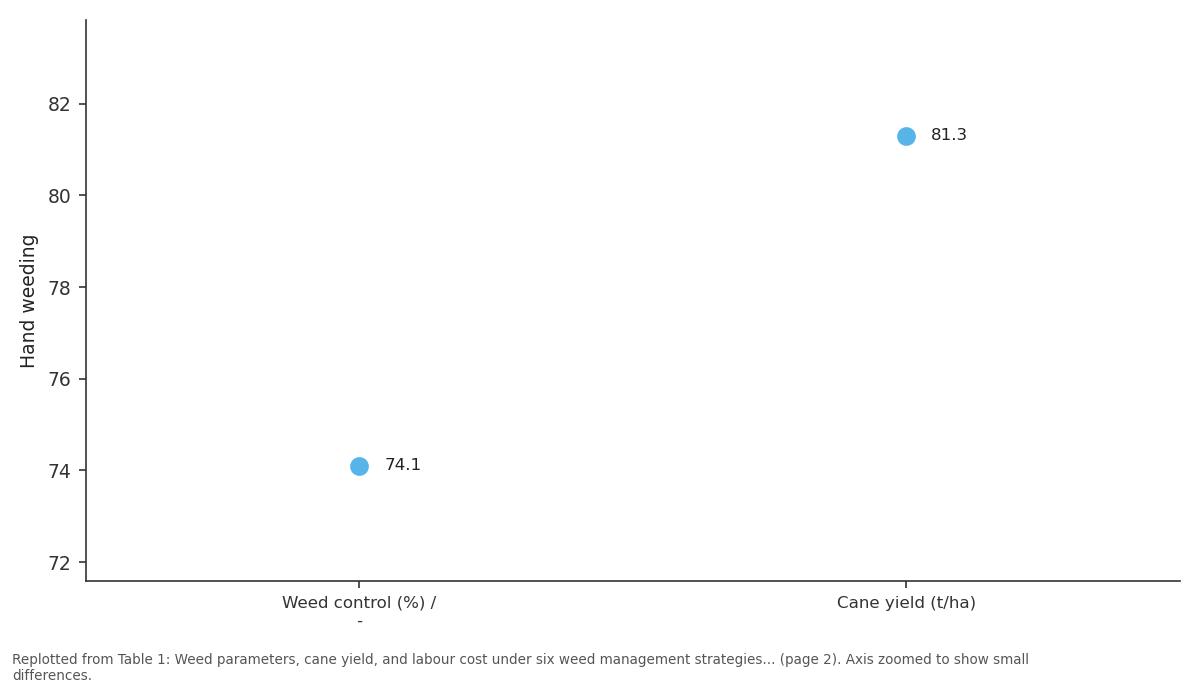
Hand weeding: Weed control (%) / - vs Cane yield (t/ha)
Replotted from Table 1 (page 2) of the original paper. Every bar is the paper's own table value.
View source evidence ↗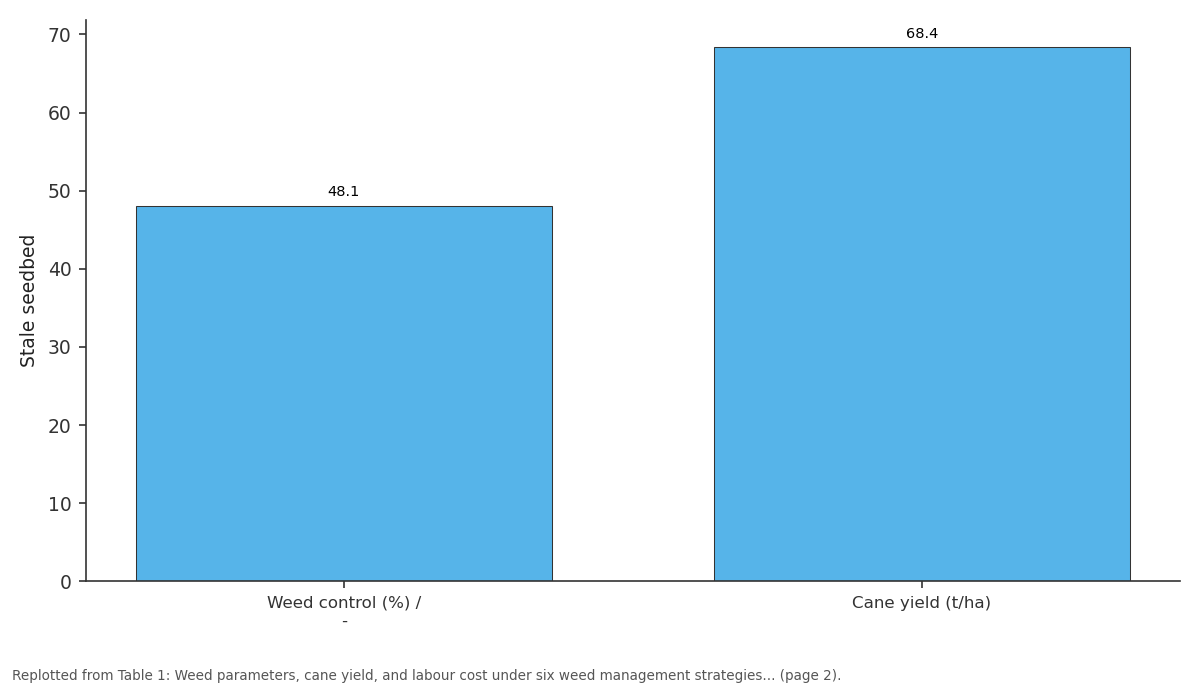
Stale seedbed: Weed control (%) / - vs Cane yield (t/ha)
Replotted from Table 1 (page 2) of the original paper. Every bar is the paper's own table value.
View source evidence ↗Figures & tables
From the original paper Table 1
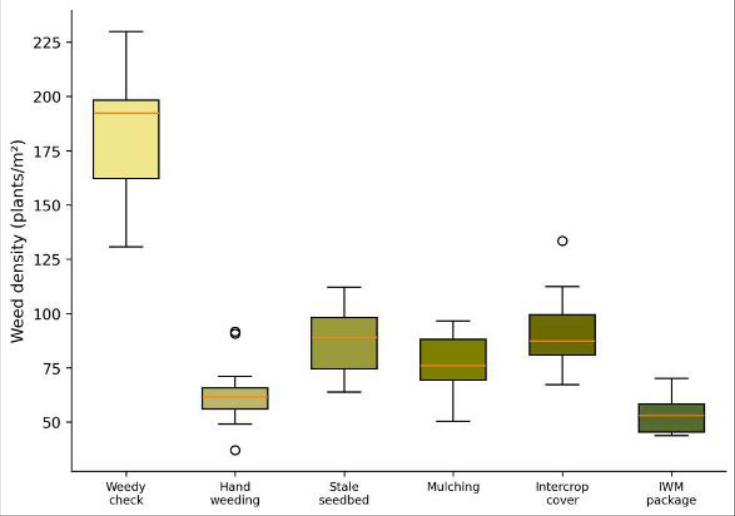 Figure 1
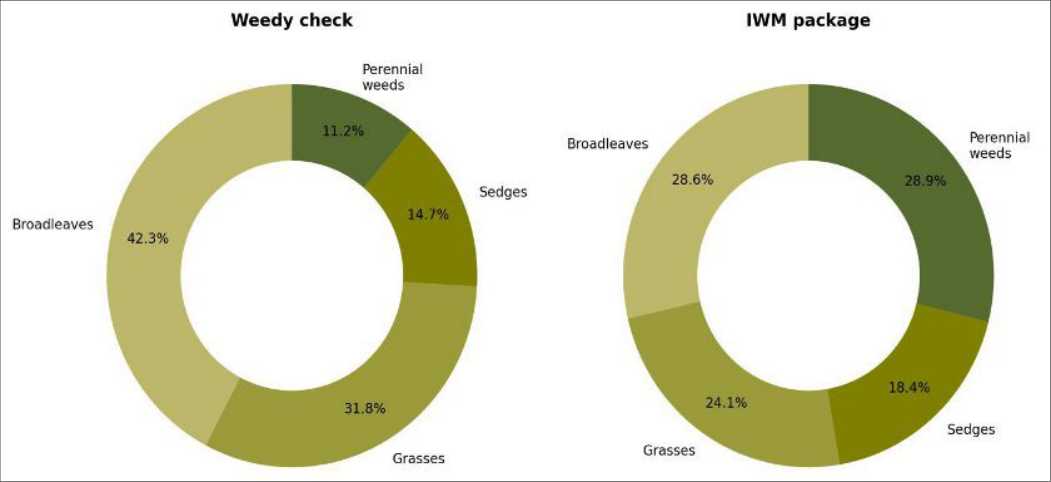 Figure 2
Introduction
As the proverb suggests, weeds have always competed with crops for the farmer's resources. In sugarcane, the problem is acute because the crop's slow early canopy closure leaves rows open for 90-120 days after planting, giving weeds a long window to establish [1] . Conventional growers rely on pre-emergence herbicides (atrazine, metribuzin) to bridge this gap, but organic certification standards prohibit all synthetic herbicides, leaving manual weeding as the default [2] . Three rounds of hand weeding cost INR 15,000-20,000/ha and consume 80-100 person-days, a labour burden that many organic farmers in Maharashtra and Odisha find unsustainable [3] . Cultural alternatives include the stale seedbed technique (irrigating before planting to flush weed seeds, then killing emerged seedlings mechanically), trash mulching with dried sugarcane leaves, and inter-row cover cropping with fast-growing legumes [4,5] . Each method attacks a different phase of the weed life cycle, and combining them into an integrated package should multiply their individual effects [6] . This research was conducted at the Dr. Panjabrao Deshmukh Krishi Vidyapeeth, Akola (20.70 deg N, 77.00 deg E; altitude 282 m), to compare individual and combined nonchemical weed management strategies for organic sugarcane and to identify the approach that delivers the best weed control per unit of labour cost [7,8] .
Material and Methods
Material and Methods
Material
Sugarcane variety Co 86032 (early-maturing, high-sugar) was planted using three-bud setts. The experimental field had been under organic management for three years (certified by OneCert International). Soil was a medium-black vertisol (pH 7.8, OC 0.71%). Trash mulch was prepared from the previous season's dried cane leaves. Cowpea (cv. Pusa Komal) served as the intercrop cover. The stale seedbed was prepared by irrigating the levelled field and allowing weeds to emerge for 14 days before destroying them with a power tiller set to shallow depth (5 cm).
Methods
Six treatments were arranged in a RCBD with four replications on 8 m x 6 m plots: T 1 weedy check, T 2 hand weeding (at 30, 60, 90 DAP), T 3 stale seedbed, T 4 trash mulching (10 t/ha applied at planting), T 5 cowpea intercrop (sown between rows at 30 DAP, incorporated at 60 DAP), T 6 IWM package (stale seedbed + trash mulching + one hand weeding at 60 DAP). Planting was in December each year. Weed density and dry weight were recorded in two 0.5 m2 quadrats per plot at 60 and 120 DAP. Weed species were identified and categorised as broadleaves, grasses, sedges, or perennials. Cane yield (t/ha) and commercial cane sugar (CCS %) were recorded at harvest (November). Labour cost for each treatment was documented. Data were analysed by ANOVA in R v4.3.1 with Tukey's HSD at p<0.05 [9] .
Results
Table The box plot (Figure 1) shows that the IWM package had the tightest distribution at the lowest median weed density, while the weedy check was both high and variable. The donut charts (Figure 2) reveal that the IWM package shifted composition away from broadleaves (which the stale seedbed and mulch controlled effectively) and toward perennial weeds, which were harder to suppress without repeated tillage.
Discussion
The IWM package's success rests on attacking weeds at three different life-cycle stages: the stale seedbed depletes the surface seed bank before planting, the trash mulch physically blocks light and suppresses germination of lateemerging cohorts, and the single hand weeding at 60 DAP removes escapes before they set seed [4,6] . This layered approach explains why the combined effect (78.1% control) exceeded any single method. The shift toward perennial weeds under IWM is a common finding in systems that eliminate surface-seed-bank weeds: perennials, which regenerate from underground rhizomes, gain a competitive advantage when annual weeds are suppressed [10] . In future cycles, a targeted inter-row cultivation or spot removal of perennial species would be needed to prevent their gradual build-up [11] . The commercial cane sugar under IWM (11.6%) was the highest in the trial, possibly because reduced weed competition allowed better partitioning of photosynthate into sucrose rather than defensive compounds [12,13] .
Conclusion
An integrated package of stale seedbed + trash mulching + one hand weeding matched the weed control and cane yield of three-round hand weeding at 39% lower labour cost in organic sugarcane. Mulching alone was the most costeffective single intervention. The IWM approach is well suited to organic growers in Maharashtra and Odisha who lack access to herbicides and face chronic labour shortages. Future research should test the IWM package across multiple ratoon cycles and monitor the long-term trajectory of perennial weed populations.
Figures and tables from the paper
| Treatment | Weed density (no./m²) | Weed DW (g/m²) | Weed control (%) | Cane yield (t/ha) | CCS (%) | Labour cost (INR/ha) |
|---|---|---|---|---|---|---|
| Weedy check | 186 | 324 | - | 52.8 | 10.2 | 0 |
| Hand weeding | 67 | 84 | 74.1 | 81.3 | 11.4 | 18400 |
| Stale seedbed | 92 | 168 | 48.1 | 68.4 | 10.8 | 6200 |
| Mulching | 78 | 112 | 65.4 | 74.6 | 11.1 | 4800 |
| Intercrop cover | 84 | 143 | 55.9 | 71.2 | 10.9 | 5600 |
| IWM package | 54 | 71 | 78.1 | 84.7 | 11.6 | 11200 |
| HSD (p<0.05) | 14 | 32 | - | 6.8 | 0.4 | - |
Table text extracted from the original PDF; superscript letters are shown inline. The original table image is below.
View original table image
References
12 in the original paper- Srivastava TK, Singh KP, Srivastava SN. Weed management in sugarcane: A review. Sugar Tech. 2003;5(3):173-182.
- NPOP. National Programme for Organic Production Standards. New Delhi: Ministry of Commerce and Industry; 2014.
- Kadam BS, Patil SL, Pawar AB. Labour economics in sugarcane weed management in Maharashtra. Indian Sugar. 2018;68(4):47-53.
- Riemens MM, Van der Weide RY, Bleeker PO, Lotz LAP. Effect of stale seedbed preparations and subsequent weed control in lettuce. Weed Research. 2007;47(4):349-356.
- Cheema ZA, Khaliq A, Saeed S. Weed control in maize through sorghum allelopathy. Journal of Sustainable Agriculture. 2004;23(4):135-145.
- Swanton CJ, Weise SF. Integrated weed management: the rationale and approach. Weed Technology. 1991;5(3):657-663.
- Dr. Panjabrao Deshmukh Krishi Vidyapeeth. Annual Report Weed Management 2022-23. Akola: PDKV; 2023.
- R Core Team. R: A Language and Environment for Statistical Computing. Vienna: R Foundation; 2023.
- Peachey RE, William RD, Mallory-Smith C. Effect of no-till or conventional planting and cover crops residues on weed emergence. Weed Technology. 2004;18(2):484-491.
- Chauhan BS, Gill GS, Preston C. Factors affecting weed seed emergence. Weed Science. 2006;54(4):658668.
- Singh AK, Lal M, Singh SN. Integrated weed management in sugarcane ratoon. Indian Journal of Sugarcane Technology. 2015;30(1):24-29.
- Yadav RL, Shukla SK, Suman A, Singh PN. Trichoderma inoculation and trash management effects on soil microbial biomass. Biology and Fertility of Soils. 2009;45(7):687-692.