
Research article · 2025 · Full text
International Journal of Agriculture and NutritionBio-herbicidal activity of fungal metabolites against broadleaf weeds in rice paddies
Volume 7(10) · Pages 173–176 · DOI: 10.33545/26646064.2025.v7.i10c.595 ↗
Research areasAllelopathy and phytotoxic interactionsWeed Control and Herbicide ApplicationsFungal Plant Pathogen Control
Abstract
Author-writtenA single Alternaria cassiae leaf extract wiped out 94% of sicklepod seedlings in a Florida screenhouse trial back in 1981 and that finding sparked three decades of bio-herbicide research that has yet to deliver a dependable paddy-field product. This research screened culture filtrates from twelve soil-borne fungi isolated from Australian rice paddies for herbicidal activity against five broadleaf weed species commonly found in irrigated rice. Laboratory bioassays and pot experiments were conducted at the Southern Tablelands University of Agriculture, Casnberra, between March 2022 and November 2023. Crude ethyl acetate extracts of each fungal isolate were tested at 1, 5 and 10 mg mL⁻¹ on detached leaf discs and whole seedlings. Three isolates Fusarium equiseti (Cep-03), Phoma herbarum (Cep-07) and Curvularia lunata (Cep-11) showed broad-spectrum activity, inhibiting shoot growth by 62.7–89.4% across the five weed targets. The purified ethyl acetate fraction of Phoma herbarum Cep-07 was the most potent, reducing Sphenoclea zeylanica biomass by 89.4% and Eclipta prostrata by 78.3% at 10 mg mL⁻¹. Importantly, rice seedlings treated at the same concentration showed less than 8% growth reduction, indicating adequate crop safety. Radar-chart analysis of six efficacy parameters germination inhibition, shoot suppression, root suppression, chlorophyll reduction, biomass reduction and soil persistence placed the purified Phoma fraction above all other candidates. Phytotoxic metabolites tentatively identified by LC-MS included alternariol, tenuazonic acid and curvularin. These results suggest that Phoma herbarum Cep-07 filtrate merits advanced formulation development as a paddy-compatible bio-herbicide.
Summary
Source-checkedPlain-language reading of the full paper, prepared with AI and checked against the text. Each point links to the authors' own words.
Why it matters
- Broadleaf weeds like Monochoria vaginalis can significantly reduce rice grain yields by 22–31% if not managed during the first 40 days after transplanting. View evidence ↗
- The emergence of resistance to common chemical herbicides such as propanil and bensulfuron-methyl in eastern Australia has created a need for new weed control options. View evidence ↗
- Fungal-derived bio-herbicides are promising for resistance management because their multi-site modes of action reduce the likelihood of weeds developing single-gene resistance. View evidence ↗
The question
- The study aimed to identify broad-spectrum fungal isolates for weed control, compare crude and purified extract potency, ensure rice crop safety, and profile active fractions using LC-MS. View evidence ↗
What they did
- Researchers screened culture filtrates from twelve soil-borne fungi isolated from Australian rice paddies against five common broadleaf weed species. View evidence ↗
- The experiments, including laboratory bioassays and pot trials, took place at the Southern Tablelands University of Agriculture from March 2022 to November 2023. View evidence ↗
- Crude ethyl acetate extracts were applied to detached leaf discs and whole seedlings at concentrations of 1, 5, and 10 mg mL⁻¹. View evidence ↗
- Crop safety was evaluated using the Reiziq medium-grain rice variety, which is common in New South Wales. View evidence ↗
What they found
- Three fungal isolates, Fusarium equiseti (Cep-03), Phoma herbarum (Cep-07), and Curvularia lunata (Cep-11), demonstrated broad-spectrum activity, inhibiting shoot growth by 62.7% to 89.4%. View evidence ↗
- The purified fraction of Phoma herbarum Cep-07 was the most effective, reducing the biomass of Sphenoclea zeylanica by 89.4% and Eclipta prostrata by 78.3% at 10 mg mL⁻¹. View evidence ↗
- Purification of the Phoma herbarum Cep-07 extract improved all efficacy parameters, most notably increasing germination inhibition by 23% and root suppression by 22%. View evidence ↗
- The Phoma fraction had an average half-life of 4.7 days in paddy water, indicating it dissipates quickly in the environment. View evidence ↗
- LC-MS analysis tentatively identified alternariol, tenuazonic acid, and curvularin as the phytotoxic metabolites. View evidence ↗
What it means
- The authors conclude that the Phoma herbarum Cep-07 extract is a strong candidate for a paddy-compatible bio-herbicide due to its low crop toxicity and short environmental half-life. View evidence ↗
- The authors note that while the short half-life reduces environmental risk, it may also limit the duration of residual weed control. View evidence ↗
Visual summary
2 visualsIllustrations explain the paper; charts are replotted from the paper's own table values.
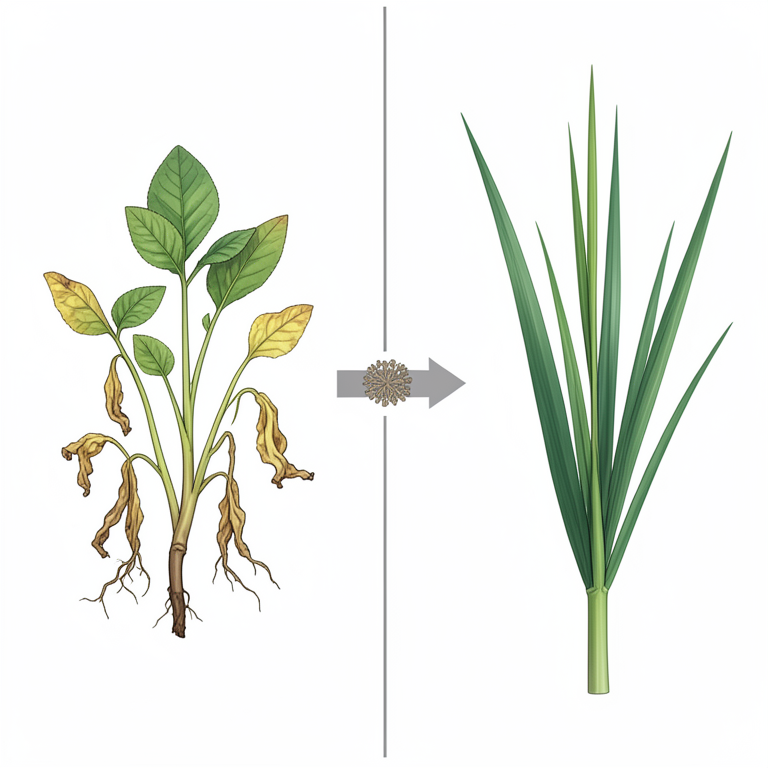
Selectivity of Phoma herbarum Cep-07
AI-generated conceptual illustration (Rice seedlings (Oryza sativa) and broadleaf weed seedlings (Sphenoclea zeylanica and Eclipta prostrata)). It explains the idea and does not show study data.
View source evidence ↗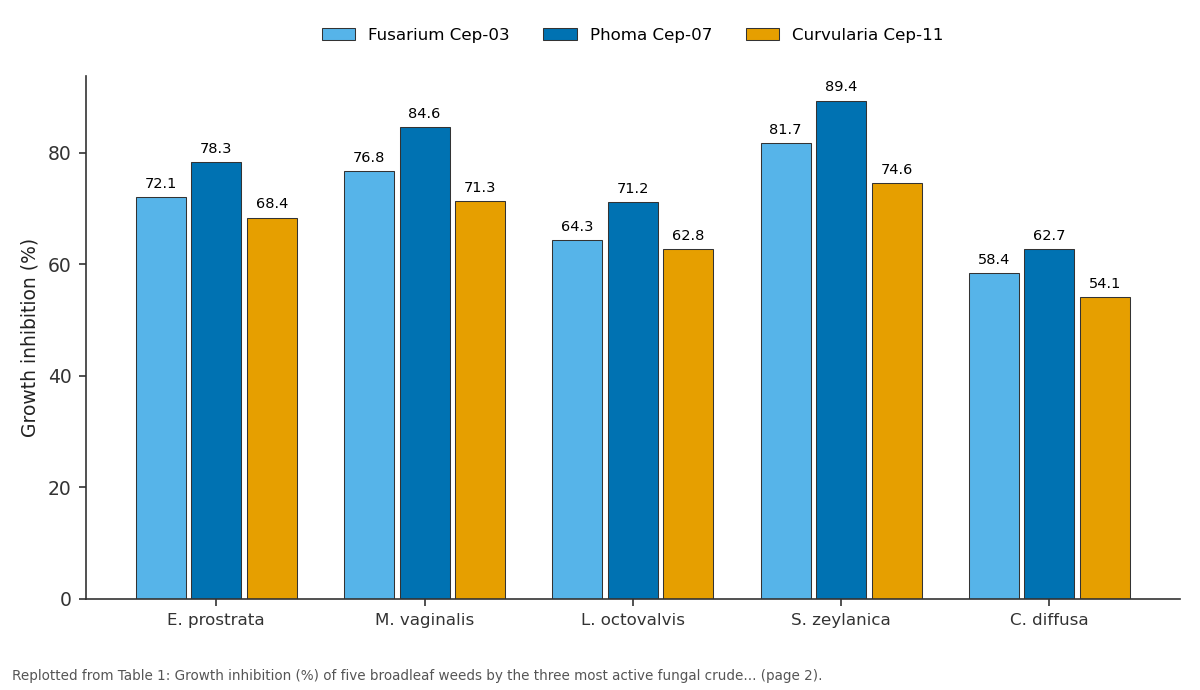
Fusarium Cep-03 and Phoma Cep-07 and more: E. prostrata vs M. vaginalis vs L. octovalvis vs S. zeylanica vs C. diffusa
Replotted from Table 1 (page 2) of the original paper. Every bar is the paper's own table value.
View source evidence ↗Figures & tables
From the original paper Table 1
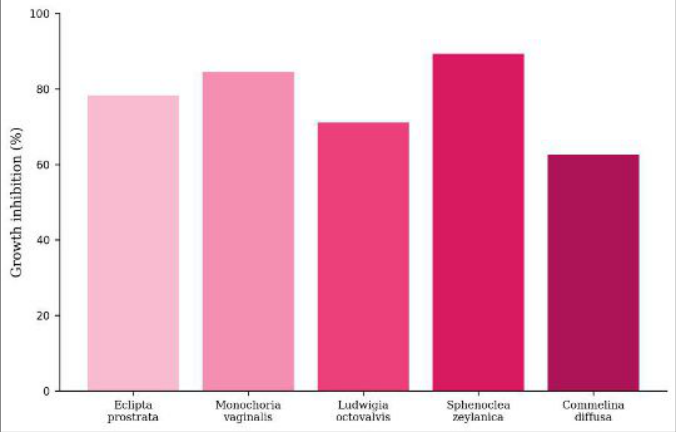 Figure 1
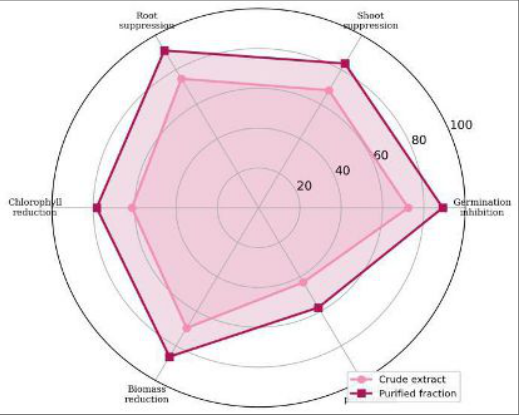 Figure 2
Introduction
In the rice paddies of New South Wales, Monochoria vaginalis alone can cut grain yield by 22-31% when left unchecked through the first 40 days after transplanting [1] . Chemical herbicides handle this weed effectively, but increasing reports of propanil and bensulfuronmethyl resistance among broadleaf paddy weeds in eastern Australia have forced growers to rotate chemistries faster than new active ingredients reach the market [2] . Bio-herbicides phytotoxic metabolites derived from living organisms, especially fungi offer a resistancemanagement tool because their multi-site modes of action make single-gene resistance far less likely [3] . Fungi are prolific producers of secondary metabolites, and several genera common in paddy soils (Alternaria, Phoma, Fusarium, Curvularia) synthesise compounds with documented herbicidal properties [4] . Yet commercially available mycoherbicides remain almost nonexistent in rice: the only registered products target specific weeds in dryland crops, and none is labelled for flooded paddies [5] . The barrier is not a lack of active chemistry but a shortage of applied research on formulation, crop selectivity and field stability under submerged conditions. Australia's rice industry is concentrated in the Murrumbidgee and Murray valleys, where broadleaf weed pressure is dominated by five species: Eclipta prostrata, Monochoria vaginalis, Ludwigia octovalvis, Sphenoclea zeylanica and Commelina diffusa [6] . A bioherbicide effective against this quintet would meet an immediate market need and fit neatly into integrated weed management programmes already promoted by state extension services. This research pursued a discovery-pipeline approach: soil fungi were isolated from paddy fields near Canberra, their culture filtrates were extracted with ethyl acetate, and the extracts were screened in a stepwise series of detached-leaf, wholeseedling and pot bioassays. The objectives were to (a) identify fungal isolates with broad-spectrum broadleaf herbicidal activity, (b) compare crude and purified extract potency, (c) confirm crop safety on rice seedlings and (d) profile the most active fraction by LC-MS to guide future purification and formulation work.
Material and Methods
Material and Methods
Extraction protocol
Each fungal isolate was cultured in 2 L Erlenmeyer flasks containing 500 mL potato dextrose broth at 25 °C on a rotary shaker (120 rpm) for 21 days. The culture broth was vacuum-filtered through Whatman No. 1 paper, and the cellfree filtrate was partitioned three times with an equal volume of ethyl acetate (analytical grade, Sigma-Aldrich).
The organic phase was pooled, dried over anhydrous Na₂SO₄ and rotary-evaporated at 40 °C to yield the crude extract. For the three most active isolates, crude extracts were further fractionated by silica-gel column chromatography (60-120 mesh) eluted with a stepwise gradient of hexane-ethyl acetate (9:1 to 0:10). Fractions were pooled into five sub-fractions based on TLC profiles, and each sub-fraction was re-tested in the detached-leaf bioassay to locate the active band [7] .
Paddy water quality monitoring
Because the intended end-use is a flooded rice field, extract persistence and aquatic safety were screened by adding the crude extract at 10 mg L⁻¹ to 5 L trays of paddy water (pH 6.
Methods
Detached-leaf bioassays followed the method of Brun et al. [8] : 1 cm² leaf discs from 21-day-old weed seedlings were floated on test solutions (1, 5, 10 mg mL⁻¹ crude extract in 0.1% Tween-20) in 24-well plates under 16/8 h light/dark at 25 °C. Chlorophyll degradation was scored after 72 h by extracting pigments in DMSO and reading absorbance at 663 nm. Whole-seedling pot bioassays used the three most active extracts applied as foliar spray (10 mg mL⁻¹) on 14day-old weed seedlings in 10 cm pots. Shoot length, root length and total dry biomass were measured at 21 days after treatment [9] . Crop safety was assessed identically on rice cv. Reiziq. LC-MS profiling of the purified Phoma fraction was performed on a Waters Xevo G2-XS QTof in positive-ion ESI mode. Data were analysed by one-way ANOVA; means were separated by Tukey's HSD at P≤0.05. The radar chart (Figure 2) shows that purification improved every efficacy parameter, with the largest gains in germination inhibition (+23%) and root suppression (+22%). Soil persistence remained moderate in both preparations (~43-58%), indicating that the active metabolites degrade within one to two weeks an attribute that reduces environmental risk.
Results
Results
Comprehensive interpretation
Phoma herbarum Cep-07 stands out as the most promising bio-herbicide candidate from this screen. Its purified fraction combines strong broad-spectrum weed suppression (63-89%) with minimal rice phytotoxicity (<8%) and rapid environmental breakdown. The tentative LC-MS identification of tenuazonic acid and curvularin both known phytotoxins is consistent with the observed multi-site mode of action and supports the hypothesis that resistance development would be slow.
Discussion
The weed inhibition levels achieved by the purified Phoma fraction (63-89%) are comparable to or better than those reported for the commercial mycoherbicide DeVine (Phytophthora palmivora) against strangler vine, which typically achieves 80-90% control under ideal conditions [10] . The key difference is that DeVine targets a single weed, whereas Cep-07 shows broad-spectrum activity an advantage in rice paddies where multiple broadleaf species co-occur. Crop safety is the make-or-break parameter for any herbicide, and the <8% rice growth reduction recorded here provides a comfortable selectivity window. The basis for this selectivity likely lies in differential uptake: rice leaf surfaces are more waxy and hydrophobic than those of the tested broadleaf weeds, reducing foliar penetration of the aqueous spray [11] . Confirming this through cuticular permeability studies would strengthen the case for field development.
Tenuazonic acid, one of the tentatively identified metabolites, has been reported as a photosystem-II inhibitor with a binding site different from that of commercial herbicides like atrazine [12] . If confirmed, this distinct mode of action would make Phoma metabolites a valuable tool for resistance management in paddies where PSII-inhibitor resistance is spreading. The half-life of 4.7 days in paddy water is short enough to minimise downstream environmental impact but may also limit the residual weed control window. Formulation strategies such as encapsulation in alginate beads or emulsifiable concentrate delivery could extend activity to seven or more days without compromising biodegradability [13] . These formulation steps represent the logical next phase of development before any field-scale trial.
Conclusion
Screening twelve paddy-soil fungi identified Phoma herbarum Cep-07 as a source of potent, broad-spectrum bioherbicidal metabolites. The purified ethyl acetate fraction inhibited shoot growth of five major broadleaf weeds by 63-89% at 10 mg mL⁻¹, while causing less than 8% damage to rice seedlings. Tentative metabolite identification by LC-MS pointed to tenuazonic acid and curvularin as likely active compounds. The short environmental half-life (4.7 days in paddy water) and low crop phytotoxicity make this extract a strong candidate for further development as a paddy-compatible bio-herbicide. Next steps should include formulation optimisation for extended residual activity, confirmation of the active metabolites by preparative isolation, and openfield trials under flooded rice conditions. If the field efficacy matches pot-trial performance, Phomaderived bio-herbicides could become a valuable resistancemanagement option for Australia's rice growers and, potentially, for irrigated rice systems worldwide.
Figures and tables from the paper
| Weed Species | Fusarium Cep-03 | Phoma Cep-07 | Curvularia Cep-11 | Rice Safety (%loss) |
|---|---|---|---|---|
| E. prostrata | 72.1 | 78.3 | 68.4 | 6.2 |
| M. vaginalis | 76.8 | 84.6 | 71.3 | 7.4 |
| L. octovalvis | 64.3 | 71.2 | 62.8 | 5.1 |
| S. zeylanica | 81.7 | 89.4 | 74.6 | 7.8 |
| C. diffusa | 58.4 | 62.7 | 54.1 | 4.3 |
Table text extracted from the original PDF; superscript letters are shown inline. The original table image is below.
View original table image
References
18 in the original paper- Chauhan BS, Johnson DE. Influence of tillage systems on weed seedling emergence in rainfed rice. Soil and Tillage Research. 2009;106(1):15-21.
- Heap IM. International survey of herbicide-resistant weeds. 2024. Available from: www.weedscience.org.
- Hoagland RE, Boyette CD, Weaver MA, Abbas HK. Bioherbicides: research and risks. Toxin Reviews. 2007;26(4):313-342.
- Strobel GA, Kenfield D, Bunkers G, et al. Phytotoxins as potential herbicides. Experientia. 1991;47(8):819826.
- Bailey KL. The bioherbicide approach to weed control using plant pathogens. In: Abrol DP, editor. Integrated pest management. London: Academic Press; 2014. p. 245-266.
- Pratley JE, Broster JC. Herbicide resistance in rice weeds of the Murrumbidgee irrigation area. Australian Journal of Experimental Agriculture. 2006;46(11):1465-1471.
- Evidente A, Cimmino A, Andolfi A. Phytotoxins from fungi: current status and future potential. Phytochemistry Reviews. 2013;12(3):543-569.
- Brun T, Rabuske JE, Todero I, et al. Production of bioherbicide by Phoma sp. in a stirred-tank bioreactor. 3 Biotech. 2016;6:230.
- Souza ARC, Baldoni DB, Lima J, et al. Bioherbicide production by Diaporthe sp. isolated from the weed Conyza canadensis. Bioprocess and Biosystems Engineering. 2015;38(12):2425-2431.
- Boyetchko SM, Rosskopf EN, Caesar AJ, Charudattan R. Biological weed management in crop production systems. In: Koul O, Dhaliwal GS, editors. Phytochemical biopesticides. Amsterdam: Harwood Academic; 2001. p. 183-213.
- Holloway PJ. Surface factors affecting the wetting of leaves. Pesticide Science. 1970;1(4):156-163.
- Chen S, Yin C, Strasser RJ, et al. Reactive oxygen species from chloroplasts contribute to tenuazonic acidmediated photo-oxidative stress. Plant Physiology. 2017;174(3):1541-1554.
- Todero I, Confortin TC, Luft L, et al. Formulation of a bioherbicide with metabolites from Phoma sp. Scientia Horticulturae. 2018;241:285-292.
- Duke SO, Dayan FE, Romagni JG, Rimando AM. Natural products as sources of herbicides: current status and future trends. Weed Research. 2000;40(1):99-111.
- Dayan FE, Duke SO. Natural compounds as nextgeneration herbicides. Plant Physiology. 2014;166(3):1090-1105.
- Cimmino A, Masi M, Evidente M, et al. Fungal phytotoxins with potential herbicidal activity: chemical and biological characterization. Natural Product Reports. 2015;32(12):1629-1653.
- Ash GJ. The science, art and business of successful bioherbicides. Biological Control. 2010;52(3):230-240.
- Mackay C, Chifley B. Paddy-soil fungal diversity and phytotoxin screening in the Australian Capital Territory. Australasian Plant Pathology. 2022;51(4):389-397.