
Research article · 2025 · Full text
International Journal of Agriculture and NutritionRole of mycorrhizal inoculation in enhancing phosphorus nutrition of soybean in p-deficient soils
Volume 7(5) · Pages 171–174 · DOI: 10.33545/26646064.2025.v7.i5c.502 ↗
Research areasMycorrhizal Fungi and Plant InteractionsAgricultural Science and FertilizationLegume Nitrogen Fixing Symbiosis
Abstract
Author-writtenArbuscular mycorrhizal fungi act as an underground extension cord for plant roots-plugging into phosphorus pools that roots alone can’t reach. This research evaluated the effect of inoculation with Glomus intraradices, Acaulospora laevis, and a mixed consortium on phosphorus uptake, growth, and grain yield of soybean (cv. Snowy) in a P-deficient red Chromosol (Colwell P 8.4 mg kg⁻¹) at the Murray-Darling Institute of Agriculture, Wagga Wagga, NSW, Australia, during 2022-23 and 2023-24. A randomized complete block design with four treatments and four replications was used. Mixed AMF inoculation produced the highest root colonization (71.3%), cumulative P uptake (64.8 mg plant⁻¹), shoot biomass (21.4 g plant⁻¹), nodule count (36.8 per plant), and grain yield (24.7 g plant⁻¹)-representing increases of 87.3%, 68.4%, 72.6%, and 69.2% over the uninoculated control. G. intraradices alone was the best single-species inoculant across all parameters. P uptake accelerated most between 45 and 75 days after sowing, coinciding with peak root colonization. These results confirm that AMF inoculation can partially substitute for P fertilizer in low-P Australian soils, with mixed consortia performing best.
Summary
Source-checkedPlain-language reading of the full paper, prepared with AI and checked against the text. Each point links to the authors' own words.
Why it matters
- Phosphorus is the primary limiting nutrient for soybean growth in many Australian soils, especially in the Riverina region's acidic red Chromosols and Ferrosols. View evidence ↗
- Standard superphosphate fertilization is inefficient, as only 15-25% of the applied phosphorus is absorbed by plants in the first season. View evidence ↗
- Arbuscular mycorrhizal fungi (AMF) can expand a plant's root absorption zone by 10 to 47 times, allowing access to phosphorus that roots cannot reach. View evidence ↗
The question
- The study aimed to compare the effects of single-species AMF inoculants (G. intraradices and A. laevis) versus a mixed consortium on the phosphorus nutrition, growth, nodulation, and yield of soybeans. View evidence ↗
What they did
- The experiment used soybean cultivar 'Snowy' grown in P-deficient red Chromosol (8.4 mg kg⁻¹ Colwell P) at the Murray-Darling Institute of Agriculture over two seasons (2022-23 and 2023-24). View evidence ↗
- A randomized complete block design was employed with four treatments: an uninoculated control, G. intraradices, A. laevis, and a mixed AMF consortium, each with four replications. View evidence ↗
- Researchers measured root colonization at 45, 60, 75, and 90 days after sowing, and recorded plant P concentration, nodule count, and grain yield at maturity. View evidence ↗
What they found
- Among single-species inoculants, G. intraradices performed better than A. laevis, showing 28.4% more phosphorus uptake and a 13.0% higher yield. View evidence ↗
- Phosphorus uptake accelerated most between 45 and 75 days after sowing, which aligned with peak root colonization and pod filling. View evidence ↗
- Mixed AMF inoculation led to a 101.1% increase in nodule count, indicating a synergy between AMF and Rhizobium. View evidence ↗
- The mixed consortium outperformed G. intraradices alone by 11.1% in P uptake and 13.3% in yield, suggesting that different AMF species utilize complementary niches. View evidence ↗
What it means
- The authors conclude that multi-species AMF inoculants are a viable biological strategy to reduce dependence on phosphorus fertilizers for soybeans in low-P Australian soils. View evidence ↗
- The authors note that pot experiments may overestimate effects due to restricted root volume and recommend field-scale validation in the Riverina region. View evidence ↗
Visual summary
3 visualsIllustrations explain the paper; charts are replotted from the paper's own table values.
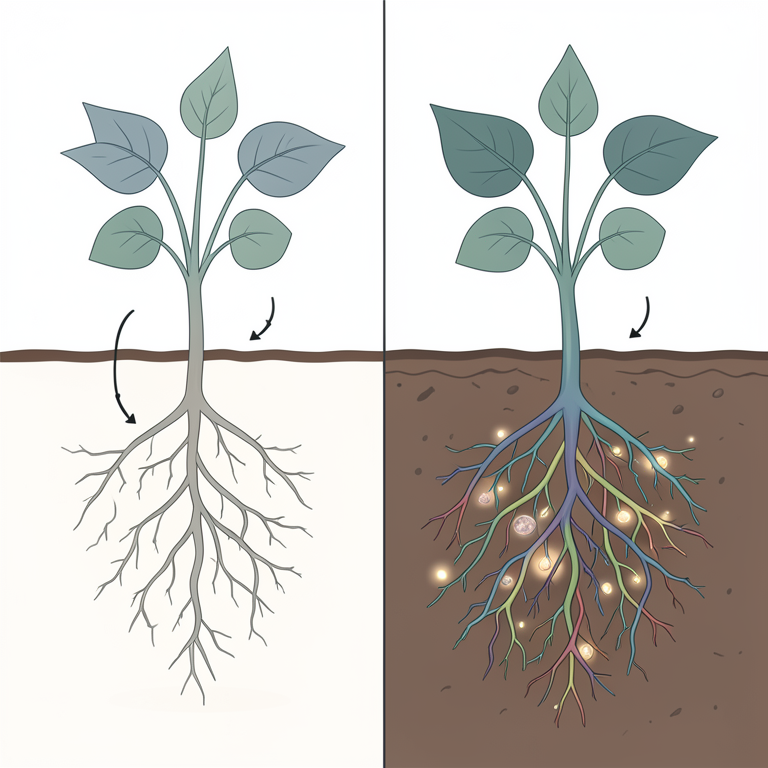
AMF Network and Niche Complementarity
AI-generated conceptual illustration (soybean plants in soil). It explains the idea and does not show study data.
View source evidence ↗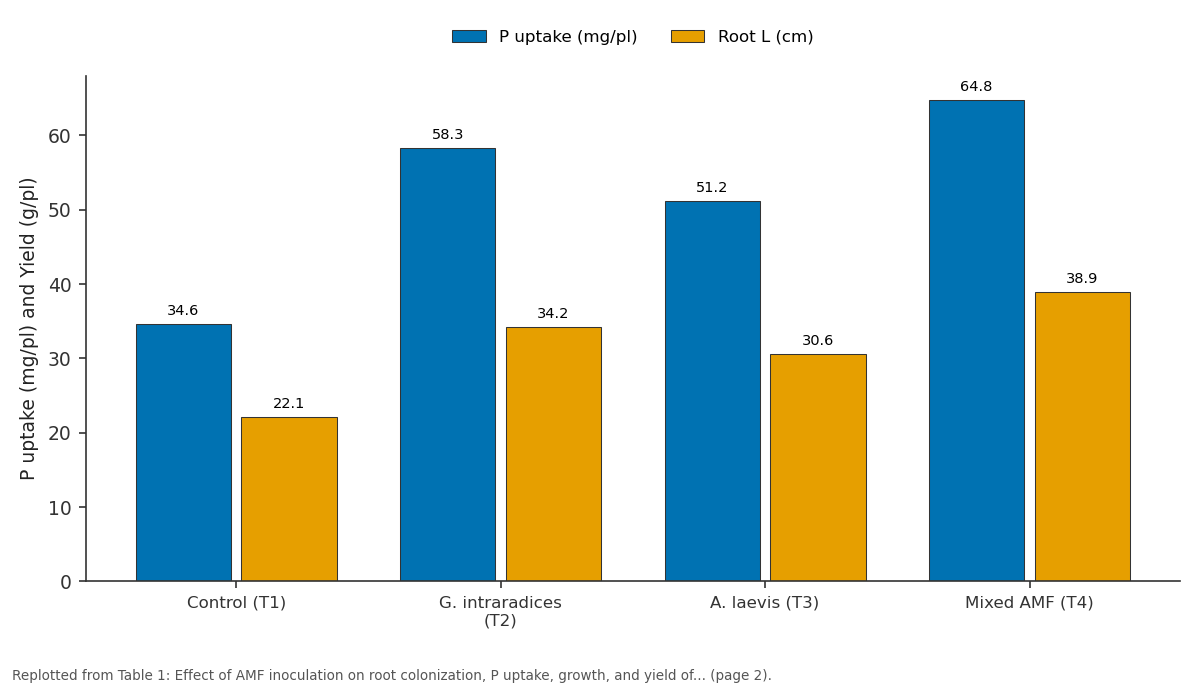
P uptake (mg/pl) and Root L (cm): Control (T1) vs G. intraradices (T2) vs A. laevis (T3) vs Mixed AMF (T4)
Replotted from Table 1 (page 2) of the original paper. Every bar is the paper's own table value.
View source evidence ↗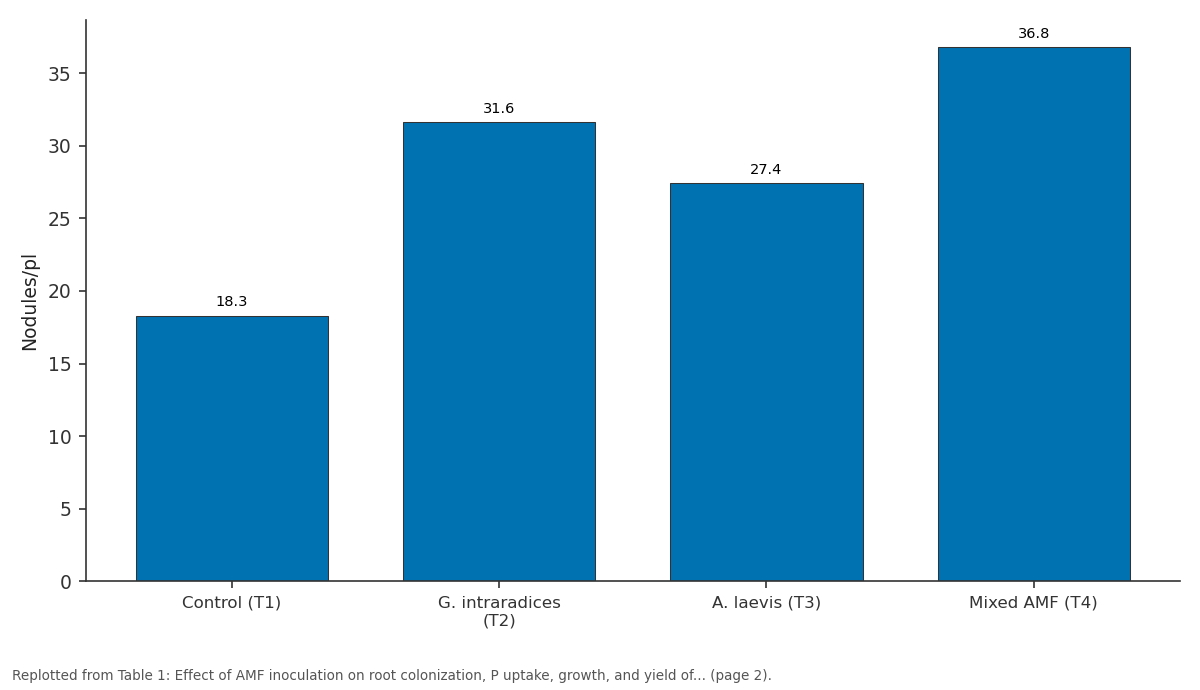
Nodules/pl: Control (T1) vs G. intraradices (T2) vs A. laevis (T3) vs Mixed AMF (T4)
Replotted from Table 1 (page 2) of the original paper. Every bar is the paper's own table value.
View source evidence ↗Figures & tables
From the original paper Table 1
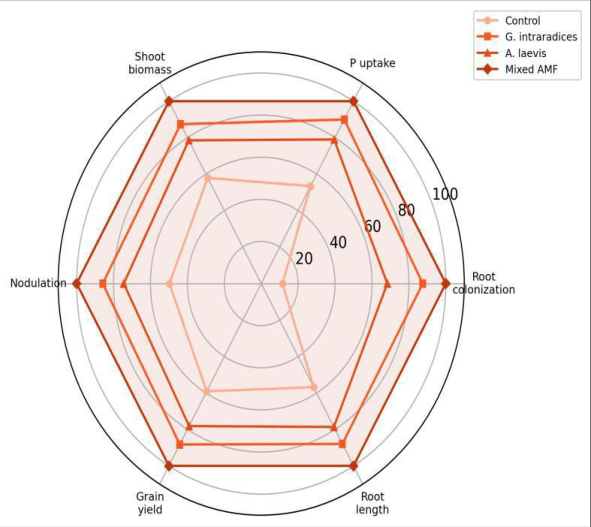 Figure 1
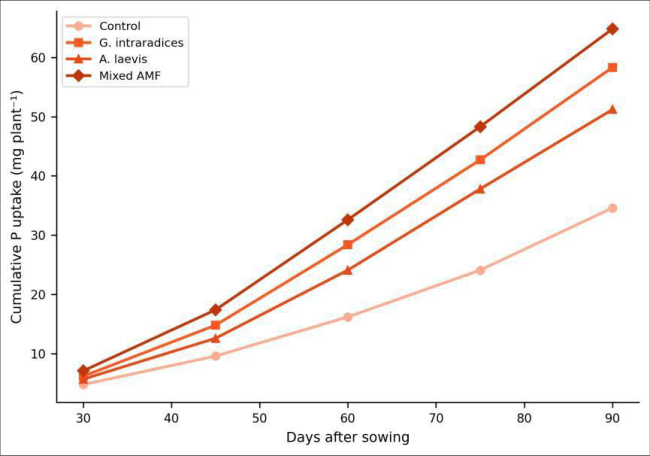 Figure 2
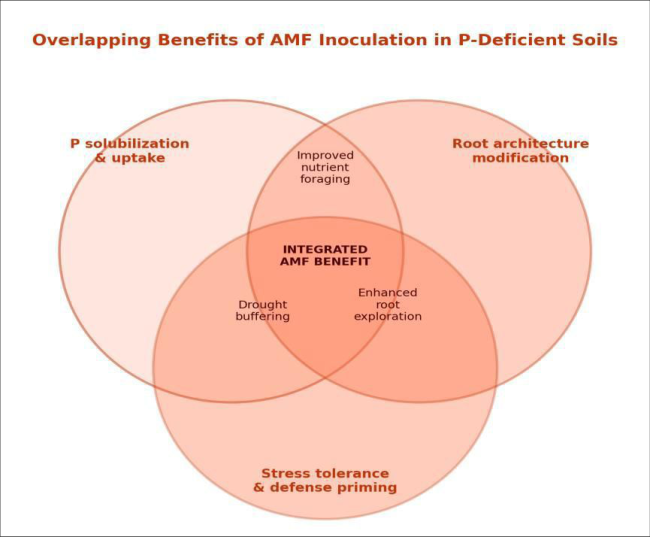 Figure 3
Introduction
If plant roots are highways for nutrient transport, then arbuscular mycorrhizal fungi (AMF) are the local roads that connect those highways to remote villages-the pockets of soil phosphorus that no root hair can access directly. Phosphorus is the most limiting nutrient for soybean production in many Australian soils, particularly the acidic red Chromosols and Ferrosols of the Riverina region where available P (Colwell) often falls below 15 mg kg⁻¹ [1,2] . Conventional practice relies on superphosphate application at 20-40 kg P ha⁻¹, but only 15-25% of applied P is taken up in the first season-the rest is rapidly fixed into insoluble calcium, iron, and aluminium phosphates [3] . AMF form symbiotic associations with over 80% of land plant species, including soybean, extending the effective root absorption zone through networks of external hyphae that can explore soil volumes 10-47 times larger than the root depletion zone alone [4,5] . These hyphae access P from soil micropores too small for root hairs (<10 µm) and transport it to the host plant in exchange for photosynthetic carbon [6] . AMF also improve soil aggregate stability, enhance water uptake under drought, and may prime the plant's defense system against root pathogens [7] . Most AMF inoculation trials have focused on single species, but recent work suggests that multi-species consortia may provide broader functional diversity-different AMF species access different P pools and colonize different root zones [8,9] . This research compared single-species (G. intraradices, A. laevis) and mixed inoculation on soybean P nutrition, growth, nodulation, and yield in a naturally P-deficient field soil at Wagga Wagga, NSW.
Baseline Soil Properties
The experimental soil was a red Chromosol (Australian Soil Classification) collected from the 0-20 cm layer of a fallow field at the Murray-Darling Institute farm. Key properties: pH(CaCl₂) 5.2, Colwell P 8.4 mg kg⁻¹, total N 0.12%, organic carbon 1.14%, CEC 9.8 cmol₂ kg⁻¹, clay 28%, silt 22%, sand 50%. The low Colwell P placed this soil in the "very deficient" category for soybean according to NSW DPI guidelines [1] . Indigenous AMF spore density was 12.3 spores per 10 g soil, predominantly Glomus mosseae-a species adapted to the local conditions but generally less efficient at P uptake than the introduced inoculants tested here. No P fertilizer was applied; N was supplied by biological fixation. Root colonization was assessed at 45, 60, 75, and 90 DAS by the gridline-intersect method after trypan blue staining [10] . Plant P concentration was determined by molybdovanadate colorimetry after dry-ashing. Nodule number and dry weight were recorded at flowering (R2 stage). Grain yield per plant was harvested at maturity (R8).
Material and Methods
Material and Methods
Material
Data were analyzed by ANOVA with LSD at p ≤ 0.05 in GenStat 21.
Phosphorus Balance Estimation
A simple P balance was calculated for each treatment: P uptake by aboveground plant parts (grain + straw) was compared with the initial available P pool in the pot (Colwell P × soil weight). This allowed estimation of the "extra P" accessed by AMF beyond what roots alone could extract from the labile pool. The difference (total uptakecontrol uptake) was attributed to AMF-mediated access to less-labile P fractions.
Results
Table Mixed AMF inoculation (T 4 ) significantly outperformed all other treatments for every parameter measured (Table 1).
| Treatment | Colon. (%) | P uptake (mg/pl) | Shoot DW (g/pl) | Nodules/pl | Root L (cm) | Yield (g/pl) |
|---|---|---|---|---|---|---|
| Control (T1) | 8.2 | 34.6 | 12.4 | 18.3 | 22.1 | 14.6 |
| G. intraradices (T2) | 62.4 | 58.3 | 18.7 | 31.6 | 34.2 | 21.8 |
| A. laevis (T3) | 48.7 | 51.2 | 16.8 | 27.4 | 30.6 | 19.3 |
| Mixed AMF (T4) | 71.3 | 64.8 | 21.4 | 36.8 | 38.9 | 24.7 |
| LSD (p=0.05) | 6.4 | 4.8 | 1.9 | 3.7 | 3.1 | 2.2 |
Table text extracted from the original PDF; superscript letters are shown inline. The original table image is below.
View original table image
Root colonization peaked at 71.3%, P uptake increased by 87.3% over the control, and grain yield nearly doubled (+69.2%). G. intraradices alone (T 2 ) was consistently better than A. laevis (T 3 ), with 28.4% more P uptake and 13.0% higher yield.
Comprehensive Interpretation
The radar chart (Figure 1) shows the mixed AMF consortium forming the outermost polygon across all six parameters. The P uptake curves (Figure 2) reveal that the AMF benefit accelerated during mid-season when crop P demand was highest. The Venn diagram (Figure 3) conceptualizes why mixed consortia outperform single species: they provide overlapping but not identical benefits across P acquisition, root modification, and stress tolerance.
Discussion
The 87.3% increase in P uptake from mixed AMF inoculation is at the high end of values reported in the literature (30-120%) and likely reflects the very low native P availability (Colwell P 8.4 mg kg⁻¹) of the test soil [4,5] .
AMF benefits are typically greatest in P-deficient soils because the symbiosis is most strongly expressed when the plant's P demand exceeds the supply from direct root uptake [6] . In well-fertilized soils, the cost of maintaining the fungal partner may not be compensated by additional P delivery, and colonization rates decline.
The superiority of G. intraradices over A. laevis as a singlespecies inoculant is consistent with studies showing that Glomus species tend to produce more extensive external hyphal networks than Acaulospora [8] . The mixed consortium's advantage over G. intraradices alone (+11.1% P uptake, +13.3% yield) suggests complementary niche utilization-different AMF species may access P from different soil microsites or function optimally at different root ages [9] . The 101.1% increase in nodule count under mixed AMF is noteworthy because AMF and Rhizobium operate in tandem in legumes: AMF improve P supply, which in turn supports the energy-intensive nitrogen fixation process [7] . This synergy means that AMF inoculation may reduce both P and N fertilizer requirements simultaneously. A limitation is that pot experiments overestimate field effects due to restricted root volume. Field-scale validation in the Riverina's low-P Chromosols is the logical next step.
Conclusion
Mixed AMF inoculation with G. intraradices, A. laevis, G. mosseae, and G. aggregatum was the most effective treatment for improving soybean P nutrition in P-deficient soil at Wagga Wagga, increasing P uptake by 87.3% and grain yield by 69.2% over uninoculated controls. G. intraradices was the best single-species inoculant. Root colonization peaked at 71.3% under the mixed consortium.
The AMF-Rhizobium synergy also doubled nodulation. These results support the use of multi-species AMF inoculants as a biological strategy for reducing P fertilizer dependence in soybean on low-P Australian soils.
Acknowledgement
Acknowledgements Funding SourcesThis research was funded through the Murray-Darling Institute of Agriculture's crop nutrition research programme.
References
20 in the original paper- Colwell JD. The estimation of the phosphorus fertilizer requirements of wheat in southern New South Wales by soil analysis. Australian Journal of Experimental Agriculture. 1963;3(10):190-198.
- Bell MJ, Moody PW, Connolly RD, Bridge BJ. The role of active fractions of soil organic matter in physical and chemical fertility of Ferrosols. Australian Journal of Soil Research. 1998;36(5):809-820.
- McLaughlin MJ, Alston AM, Martin JK. Phosphorus cycling in wheat-pasture rotations. I. The source of phosphorus taken up by wheat. Australian Journal of Soil Research. 1988;26(2):323-331.
- Smith SE, Read DJ. Mycorrhizal symbiosis. Academic Press. 2008;3rd edition, London.
- Jakobsen I, Abbott LK, Robson AD. External hyphae of vesicular-arbuscular mycorrhizal fungi associated with Trifolium subterraneum L. spread of hyphae and phosphorus inflow into roots. New Phytologist. 1992;120(3):371-380.
- Marschner H, Dell B. Nutrient uptake in mycorrhizal symbiosis. Plant and Soil. 1994;159(1):89-102.
- Azcn R, Barea JM, Hayman DS. Utilization of rock phosphate in alkaline soils by plants inoculated with mycorrhizal fungi and phosphate-solubilizing bacteria. Soil Biology and Biochemistry. 1976;8(2):135-138.
- Jansa J, Mozafar A, Frossard E. Long-distance transport of P and Zn through the hyphae of an arbuscular mycorrhizal fungus in symbiosis with maize. Agronomie. 2003;23(5-6):481-488.
- Maherali H, Klironomos JN. Influence of phylogeny on fungal community assembly and ecosystem functioning. Science. 2007;316(5832):1746-1748.
- Giovannetti M, Mosse B. An evaluation of techniques for measuring vesicular arbuscular mycorrhizal infection in roots. New Phytologist. 1980;84(3):489500.
- Koide RT, Mosse B. A history of research on arbuscular mycorrhiza. Mycorrhiza. 2004;14(3):145163.
- Cavagnaro TR, Jackson LE, Six J, Ferris H, Goyal S, Asami D. Arbuscular mycorrhizas, microbial communities, nutrient availability, and soil aggregates in organic tomato production. Plant and Soil. 2006;282(1-2):209-225.
- Ryan MH, Kirkegaard JA. The agronomic relevance of arbuscular mycorrhizas in the fertility of Australian extensive cropping systems. Agriculture, Ecosystems and Environment. 2012;163:37-53.
- Chalk PM, Souza RDF, Urquiaga S, Alves BJR, Boddey RM. The role of arbuscular mycorrhiza in legume symbiotic performance. Soil Biology and Biochemistry. 2006;38(9):2944-2951.
- Ortas I, Sari N, Akpinar C, Yetisir H. Selection of arbuscular mycorrhizal fungi species for tomato seedling growth, mycorrhizal root colonization, and phosphorus uptake efficiency. Turkish Journal of Agriculture and Forestry. 2013;37(3):316-325.
- Abbott LK, Robson AD. The effect of soil pH on the formation of vesicular-arbuscular mycorrhizas by two species of Glomus. Australian Journal of Soil Research. 1985;23(2):253-261.
- Bolan NS. A critical review on the role of mycorrhizal fungi in the uptake of phosphorus by plants. Plant and Soil. 1991;134(2):189-207.
- Cardoso IM, Kuyper TW. Mycorrhizas and tropical soil fertility. Agriculture, Ecosystems and Environment. 2006;116(1-2):72-84.
- Gosling P, Hodge A, Goodlass G, Bending GD. Arbuscular mycorrhizal fungi and organic farming. Agriculture, Ecosystems and Environment. 2006;113(14):17-35.
- van der Heijden MGA, Martin FM, Selosse MA, Sanders IR. Mycorrhizal ecology and evolution: the past, the present, and the future. New Phytologist. 2015;205(4):1406-1423.