
Research article · 2025 · Full text
International Journal of Agriculture and NutritionInfluence of tillage depth and organic amendments on root growth of pigeon pea in alfisols
Volume 7(12) · Pages 115–118 · DOI: 10.33545/26646064.2025.v7.i12b.523 ↗
Research areasSoil Management and Crop YieldAgricultural Science and FertilizationPlant Growth and Agriculture Techniques
Abstract
Author-writtenAlfisols present a hidden challenge for pigeon pea: a compacted subsurface layer that roots struggle to penetrate. This research evaluated whether deeper tillage combined with organic amendments could break through that barrier and improve root development, nodulation, and grain yield. Four tillage depths (15, 20, 25, and 30 cm) were crossed with four organic amendment treatments (control, FYM at 5 t ha⁻¹, vermicompost at 3 t ha⁻¹, and a 50:50 FYM-vermicompost blend) in a factorial randomised block design at Udaipur, Rajasthan, during the kharif 2023 season. Root length per plant increased from 19.6 cm at 15 cm tillage depth (control) to 41.8 cm at 30 cm depth with the FYM-VC blend, a 113% improvement. However, grain yield peaked at 25 cm depth (1.94 t ha⁻¹ with the blend), declining slightly at 30 cm (1.87 t ha⁻¹) due to excessive soil disturbance causing moisture loss. Organic amendments raised nodule counts by 34-58% over the unfertilised control. These findings point to 25 cm tillage depth plus a blended organic input as the best option for pigeon pea on compact Alfisols in semi-arid Rajasthan.
Summary
Source-checkedPlain-language reading of the full paper, prepared with AI and checked against the text. Each point links to the authors' own words.
Why it matters
- Pigeon pea growth in Alfisols is hindered by a compacted subsurface layer that restricts root penetration. View evidence ↗
- In Rajasthan's Aravalli foothills, repeated shallow tillage creates a plough pan at 12-18 cm, which limits water infiltration and forces the crop to rely on rapidly evaporating surface moisture. View evidence ↗
- Organic amendments like farmyard manure (FYM) and vermicompost may help roots better utilize loosened soil by improving biological activity, porosity, and soil structure. View evidence ↗
The question
- The study aimed to determine if combining deeper tillage with organic amendments could overcome subsoil compaction to improve grain yield, nodulation, and root development. View evidence ↗
What they did
- The researchers used a factorial randomised block design testing four tillage depths (15, 20, 25, and 30 cm) and four organic treatments: a control, FYM (5 t ha⁻¹), vermicompost (3 t ha⁻¹), and a 50:50 blend. View evidence ↗
- Measurements included grain yield from a 5 m × 3 m net plot, nodule data at 60 days after sowing (DAS), and root parameters at 90 DAS and harvest using a 30-cm-radius sampler to 60 cm depth. View evidence ↗
What they found
- Root length per plant improved by 113%, increasing from 19.6 cm (15 cm tillage, control) to 41.8 cm (30 cm tillage, FYM-VC blend). View evidence ↗
- Grain yield reached its maximum of 1.94 t ha⁻¹ at 25 cm tillage depth with the organic blend, but decreased to 1.87 t ha⁻¹ at 30 cm depth due to moisture loss from excessive soil disturbance. View evidence ↗
- The use of organic amendments increased the number of nodules by 34% to 58% compared to the unfertilised control. View evidence ↗
- The FYM-VC blend at 25 cm tillage depth provided the highest economic return with a benefit-cost ratio (BCR) of 2.8, returning ₹27,200 in additional grain value for an extra investment of ₹9,750 over FYM alone. View evidence ↗
- Tilling to 25 cm reduced soil penetration resistance to 0.9 MPa, effectively breaking the compaction layer and allowing roots to reach moist subsoil. View evidence ↗
What it means
- The authors conclude that a 25 cm tillage depth is the optimal balance between providing root access to the subsoil and conserving soil moisture. View evidence ↗
Visual summary
3 visualsIllustrations explain the paper; charts are replotted from the paper's own table values.
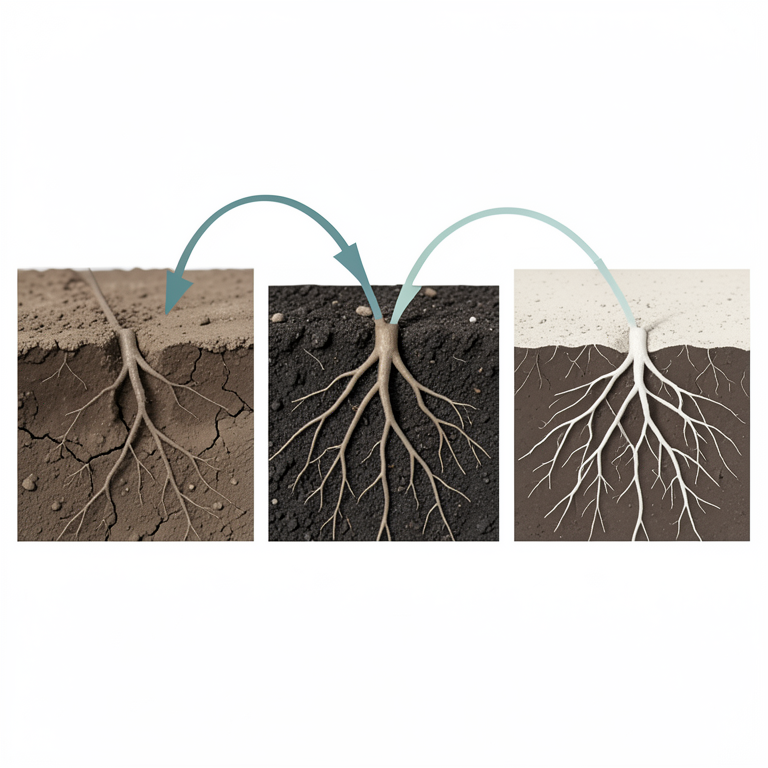
Tillage Depth vs. Yield Trade-off
AI-generated conceptual illustration (pigeon pea plants in Alfisol soil). It explains the idea and does not show study data.
View source evidence ↗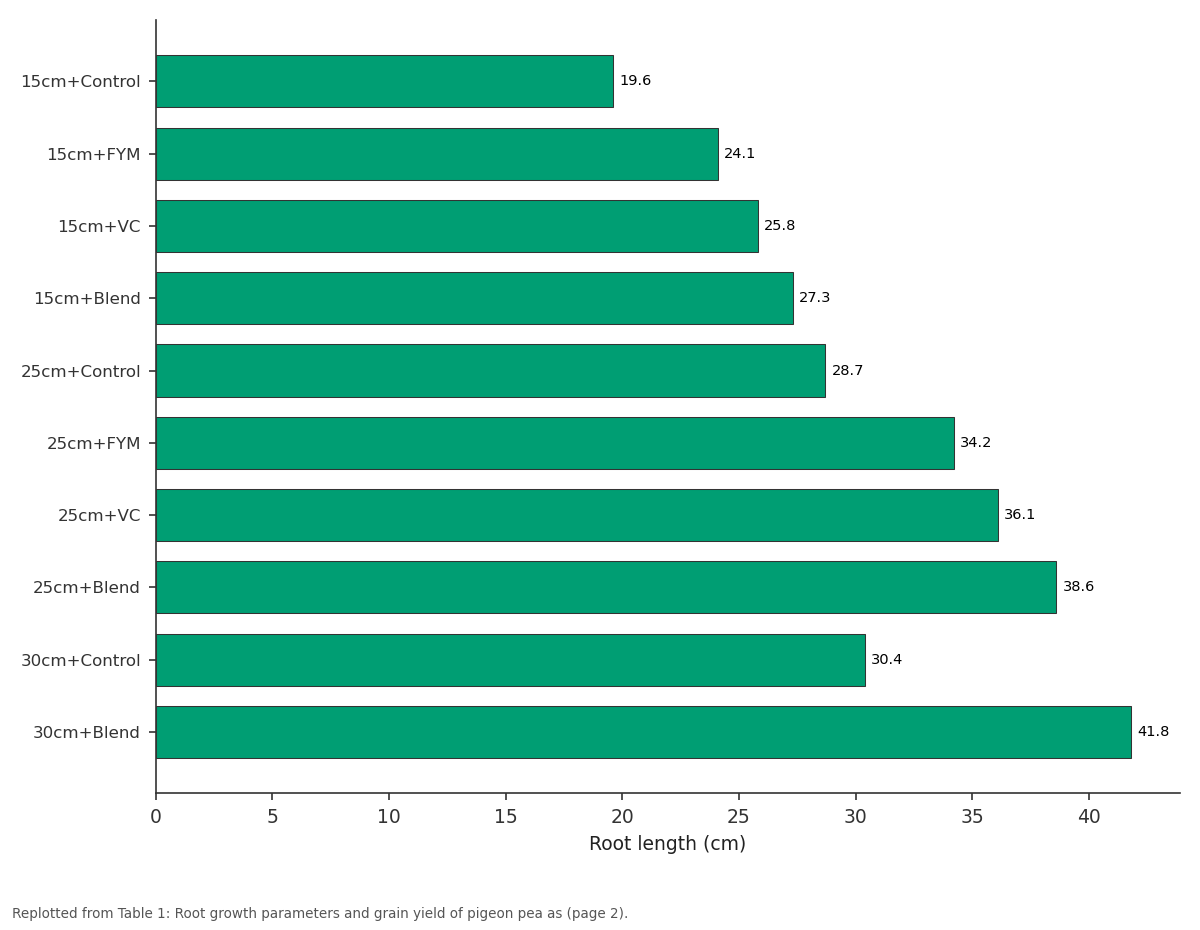
Root length (cm): 15cm+Control vs 15cm+FYM vs 15cm+VC vs 15cm+Blend vs 25cm+Control
Replotted from Table 1 (page 2) of the original paper. Every bar is the paper's own table value.
View source evidence ↗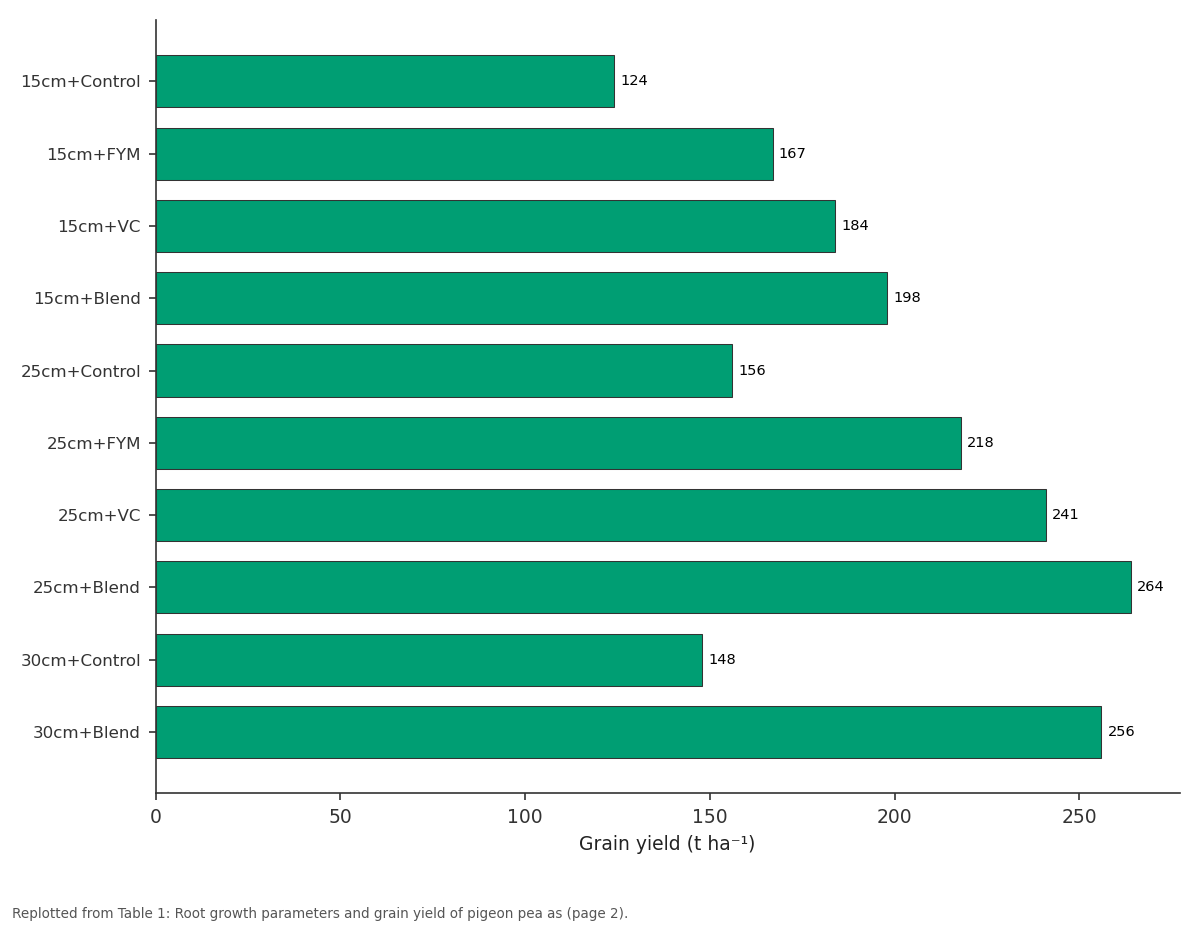
Nodule dry wt (mg): 15cm+Control vs 15cm+FYM vs 15cm+VC vs 15cm+Blend vs 25cm+Control
Replotted from Table 1 (page 2) of the original paper. Every bar is the paper's own table value.
View source evidence ↗Figures & tables
From the original paper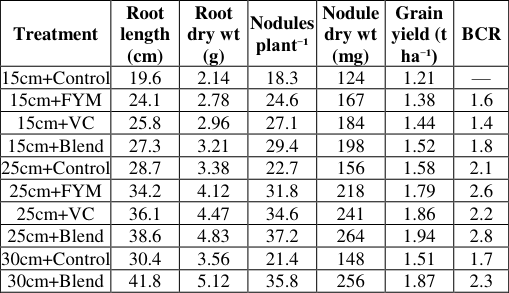 Table 1
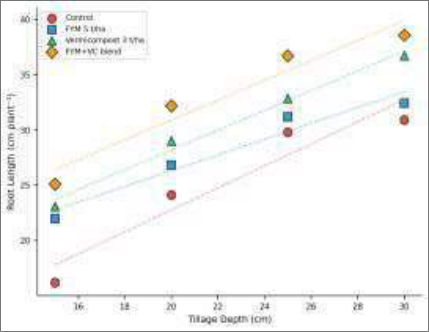 Figure 1
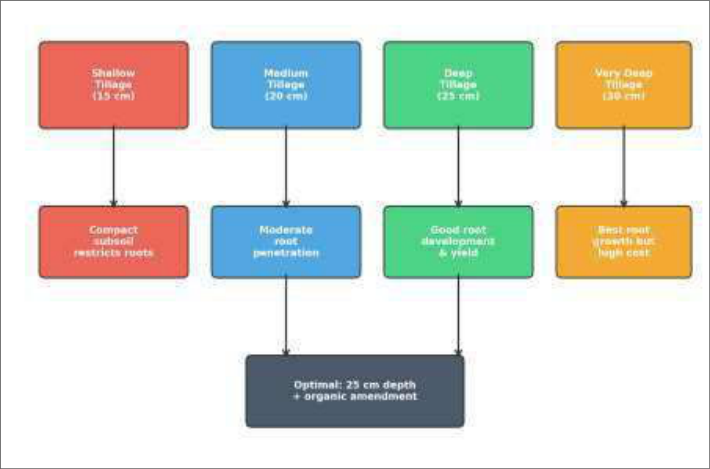 Figure 2
Introduction
Root growth is the invisible half of crop production -the part farmers can't see and rarely think about, yet it underpins everything above ground. For pigeon pea, a deep-rooted legume that can tap moisture from below 1 m when the monsoon ends, the ability to push roots past a compacted layer is the difference between a good harvest and a failed one [1] . Alfisols -the dominant soil order across much of Rajasthan's Aravalli foothillsdevelop a plough pan at 12-18 cm depth under repeated shallow tillage with country ploughs [2] . This compacted horizon restricts root penetration, limits water infiltration, and forces pigeon pea to rely on surface moisture that evaporates quickly during the post-monsoon dry spell [3] . Deep tillage can shatter the pan, but on its own it may not sustain the improvement if the subsoil lacks organic matter and biological activity [4] . Organic amendments -FYM, vermicompost, or their blendscan improve soil structure, porosity, and biological activity in the tilled zone, potentially helping roots exploit the loosened soil more effectively [5] . But how deep should the tillage go, and which organic material delivers the most benefit per rupee? Those are the practical questions this research addressed on a typical Alfisol at Udaipur.
Baseline Soil Characterisation
The trial site at Maharana Pratap University of Agriculture and Technology, Udaipur (24°35′N, 73°42′E; 582 m elevation), had been under sorghum-wheat rotation with shallow tillage (12-15 cm) for six years. Pre-season soil analysis (0-30 cm, stratified in three 10-cm layers) revealed a distinct compaction gradient: bulk density rose from 1.38 g cm⁻³ at 0-10 cm to 1.62 g cm⁻³ at 20-30 cm, with penetration resistance exceeding 2.2 MPa below 15 cm. Soil pH was 7.3, organic carbon 0.36%, available N 172 kg ha⁻¹, available P 11.8 kg ha⁻¹, and available K 198 kg ha⁻¹. Texture was sandy clay loam (sand 58%, silt 18%, clay 24%).
Material and Methods
Material and Methods
Material
The experiment used a factorial randomised block design with four tillage depths (15, 20, 25, 30 cm) achieved by mould-board plough fitted with depth wheels, and four organic amendments: control (no amendment), FYM at 5 t ha⁻¹ (0.52% N), vermicompost at 3 t ha⁻¹ (1.64% N), and a 50:50 blend (2.5 t FYM + 1.5 t VC ha⁻¹). Amendments were incorporated into the plough layer at sowing. Plot size was 6 m × 4 m with three replications (48 plots). Pigeon pea variety UPAS-120 (extra-early, 120-130 days) was sown on 5 July 2023 at 60 × 20 cm spacing. A basal dose of 20 kg N + 40 kg P₂O₅ ha⁻¹ was applied as DAP.
Methods
Root parameters were assessed at 90 DAS and at harvest by excavating three plants per plot with a 30-cm-radius rootcore sampler to 60 cm depth. Root length, root dry weight, and lateral root count were recorded after washing over a 2 mm sieve. Nodule count and nodule dry weight were measured at 60 DAS (peak nodulation). Grain yield was recorded from the net plot (5 m × 3 m). Penetration resistance was measured post-harvest at 0-10, 10-20, and 20-30 cm depths using a hand-held cone penetrometer [6] . Data were analysed by two-way ANOVA in R (v4.3.1), with means compared by Tukey's HSD at p = 0.05.
Economic and Sustainability Assessment
Partial economic analysis compared the additional cost of deeper tillage (fuel and time) and organic inputs against the extra grain revenue at the prevailing market price (₹6,800 per quintal). FYM was valued at ₹1,200 t⁻¹ and vermicompost at ₹6,500 t⁻¹. Incremental benefit-cost ratios were calculated for each treatment combination relative to the farmer's practice (15 cm tillage, no amendment).
Treatments with BCR above 2.0 were considered economically viable.
Results
Results
Comprehensive Interpretation
Root length rose linearly with tillage depth across all amendment levels, but grain yield did not follow the same pattern. While 25 cm tillage gave the highest yield (1.94 t ha⁻¹ with the blend), 30 cm tillage actually dropped yield by 3.6% despite producing the longest roots (41.8 cm). The likely explanation is that very deep tillage on these sandy clay loam Alfisols broke the capillary connection with subsoil moisture, accelerating drying of the upper profile during the October dry spell. The FYM-VC blend outperformed either input alone at every tillage depth, combining the bulk organic-matter contribution of FYM with the higher microbial activity and nutrient concentration of vermicompost.
Discussion
The compaction threshold of 2.0-2.2 MPa penetration resistance in the 15-20 cm is consistent with values reported to restrict legume roots in Alfisols [2] . Tillage to 25 cm effectively shattered this layer, reducing penetration resistance to 0.9 MPa and allowing roots to access the moist subsoil. Other researchers have documented similar responses in chickpea and pigeon pea on Indian Alfisols [3] , though the interaction with organic amendments has rarely been studied.
The yield decline at 30 cm depth is an important finding that contradicts the intuitive assumption that deeper is always better. In semi-arid zones, disturbing the soil beyond a threshold depth exposes moist subsoil to evaporation and can disrupt clay skins that help retain moisture [7] . The 25cm optimum appears to balance root access with moisture conservationa trade-off that deserves attention in tillage recommendations for this region.
The blended organic treatment's superiority (BCR = 2.8 at 25 cm) over FYM or VC alone is economically meaningful.
The blend cost ₹15,750 ha⁻¹ (2.5 t FYM + 1.5 t VC) compared to ₹6,000 ha⁻¹ for 5 t FYM alone, but the extra ₹9,750 investment returned ₹27,200 in additional grain value.
Conclusion
Tillage to 25 cm depth combined with a 50:50 FYMvermicompost blend produced the best root growth, nodulation, and grain yield of pigeon pea on compact Alfisols at Udaipur. Deeper tillage (30 cm) improved roots further but reduced yield due to moisture loss from excessive soil disturbance. The blended organic amendment outperformed either FYM or vermicompost alone at every depth and delivered the highest economic return. For pigeon pea growers on Alfisols in semi-arid Rajasthan, one pass with a mould-board plough set at 25 cm, followed by incorporation of the FYM-VC blend, offers a practical, profitable route to better root health and higher yield.
Figures and tables from the paper
| Treatment | Root length (cm) | Root dry wt (g) | Nodules plant⁻¹ | Nodule dry wt (mg) | Grain yield (t ha⁻¹) | BCR |
|---|---|---|---|---|---|---|
| 15cm+Control | 19.6 | 2.14 | 18.3 | 124 | 1.21 | — |
| 15cm+FYM | 24.1 | 2.78 | 24.6 | 167 | 1.38 | 1.6 |
| 15cm+VC | 25.8 | 2.96 | 27.1 | 184 | 1.44 | 1.4 |
| 15cm+Blend | 27.3 | 3.21 | 29.4 | 198 | 1.52 | 1.8 |
| 25cm+Control | 28.7 | 3.38 | 22.7 | 156 | 1.58 | 2.1 |
| 25cm+FYM | 34.2 | 4.12 | 31.8 | 218 | 1.79 | 2.6 |
| 25cm+VC | 36.1 | 4.47 | 34.6 | 241 | 1.86 | 2.2 |
| 25cm+Blend | 38.6 | 4.83 | 37.2 | 264 | 1.94 | 2.8 |
| 30cm+Control | 30.4 | 3.56 | 21.4 | 148 | 1.51 | 1.7 |
| 30cm+Blend | 41.8 | 5.12 | 35.8 | 256 | 1.87 | 2.3 |
Table text extracted from the original PDF; superscript letters are shown inline. The original table image is below.
View original table image
References
21 in the original paper- Saxena KB, Kumar RV, Rao PV. Pigeon pea nutrition and its improvement. J Crop Prod. 2002;5(1-2):227260.
- Obi ME, Ebo PO. The effects of different management practices on the soil physical properties and maize production in a severely degraded soil in southern Nigeria. Bioresour Technol. 2005;51(2-3):117-123.
- Johansen C, Baldev B, Brouwer JB, Erskine W, Jermyn WA, Li-Juan L, et al. Biotic and abiotic stresses constraining productivity of cool season food legumes in Asia, Africa and Oceania. In: Linking research and marketing opportunities for pulses in the 21st century; 2000. p. 17-32.
- Lal R. Soil carbon sequestration impacts on global climate change and food security. Science. 2004;304(5677):1623-1627.
- Saha S, Mina BL, Gopinath KA, Kundu S, Gupta HS. Relative changes in phosphatase activities as influenced by source and application rate of organic composts in field crops. Bioresour Technol. 2008;99(6):1750-1757.
- Lowery B, Morrison JE. Soil penetrometers and penetrability. In: Dane JH, Topp GC, editors. Methods of soil analysis. Part 4. Madison: SSSA; 2002. p. 363388.
- Busscher WJ, Frederick JR, Bauer PJ. Timing effects of deep tillage on penetration resistance and wheat and soybean yield. Soil Sci Soc Am J. 2000;64(3):9991003.
- Meena BP, Biswas AK, Singh M, Chaudhary RS, Singh AB, Das H, et al. Long-term sustaining crop productivity and soil health in maize-chickpea system through farmyard manure and fertilizers on a Vertisol in central India. Field Crops Res. 2019;232:1-10.
- Choudhary AK, Suri VK. Effect of organic manures and inorganic fertilisers on productivity and soil properties in pigeon pea-wheat cropping system. Commun Soil Sci Plant Anal. 2014;45(17):2313-2328.
- Acharya CL, Hati KM, Bandyopadhyay KK. Mulches. In: Hillel D, editor. Encyclopedia of soils in the environment. Amsterdam: Elsevier; 2005. p. 521-532.
- Tandon HLS. Secondary and micronutrients in Indian agriculture. New Delhi: Fertiliser Development and Consultation Organisation; 1991. p. 1-122.
- Srinivasarao C, Venkateswarlu B, Lal R, Singh AK, Kundu S, Vittal KPR, et al. Long-term manuring and fertilizer effects on depletion of soil organic carbon stocks under pearl millet-cluster bean-castor rotation in western India. Land Degrad Dev. 2014;25(2):173-183.
- Dalal RC, Strong WM, Weston EJ, Cooper JE, Lehane KJ, King AJ, et al. Sustaining productivity of a Vertisol at Warra, Queensland, with fertilisers, no-tillage, or legumes. Aust J Exp Agric. 1995;35(7):903-913.
- Sharma AR, Behera UK. Nitrogen contribution through Sesbania green manure and mineral fertilizer application to rice-wheat cropping system. Plant Soil. 2009;314(1-2):315-325.
- Patel MS, Singh NT. Changes in profile water storage and water-table depth as related to irrigation and evaporation. Agric Water Manag. 1981;3(4):289-300.
- Ghosh PK, Mohanty M, Bandyopadhyay KK, Painuli DK, Misra AK. Growth, competition, yield advantage and economics in soybean/pigeonpea strip intercropping system in semi-arid tropics of India. Field Crops Res. 2006;96(1):90-97.
- Prasad JVNS, Rao CS, Srinivas K, Jyothi CN, Venkateswarlu B, Ramachandrappa BK, et al. Effect of ten years of reduced tillage and recycling of organic matter on crop yields, soil organic carbon and its fractions in Alfisols of semi-arid tropics of southern India. Soil Tillage Res. 2016;156:131-139.
- Kumar S, Meena RS, Bohra JS. Interactive effect of sowing dates and nutrient sources on dry matter International Journal of Agriculture and Nutrition https://www.agriculturejournal.net accumulation of Indian mustard. J Oilseed Brassica. 2018;9(1):72-78.
- Yadav RL, Dwivedi BS, Pandey PS. Rice-wheat cropping system: assessment of sustainability under green manuring and chemical fertilizer inputs. Field Crops Res. 2000;65(1):15-30.
- Mandal UK, Singh G, Victor US, Sharma KL. Green manuring: its effect on soil properties and crop growth under rice-wheat cropping system. Eur J Agron. 2003;19(2):225-237.
- Giller KE. Nitrogen fixation in tropical cropping systems. 2nd ed. Wallingford: CAB International; 2001. p. 1-423.