
Research article · 2024 · Full text
International Journal of Geography Geology and EnvironmentIntegrating gender into climate policy: Economic empowerment through adaptation and mitigation strategies
Volume 6(2) · Pages 90–94 · DOI: 10.22271/27067483.2024.v6.i2a.508 ↗
Research areasGender, Education, and Development IssuesClimate Change and Sustainable DevelopmentClimate Change and Environmental Impact
Abstract
Author-writtenScientific study has proven the serious and future effects of global warming, making it one of the most pressing ecological issues. Because it might damage ecosystems, economy, and health, people worldwide are paying attention to it. Climate change will affect everyone, but not equally. Women are often more vulnerable due to economic, social, and structural disadvantages. Agriculture and other natural resource-based industries employ many women, making them susceptible to climate change. Apart from economic duties, they generally gather water and fuelwood, which are growing harder as natural resources deplete. They depend on common assets for existence and earnings, making them susceptible to environmental degradation. They are already exposed to climate dangers, but their lack of financial resources, property ownership, and decision-making power makes matters worse. Women farmers face various obstacles, including a lack of specialized finance, technology, and help programs, which makes it harder for them to adapt to changing weather. Climate-related water and food shortages may harm their nutrition and health. Since they utilize outdated energy sources, rural residents are more likely to get respiratory problems from interior air pollution. Poor access to basic services and infrastructure in cities limits their ability to address climate challenges. Even if they're more likely to be victims of violence and gender injustice, women can educate us about safeguarding the earth and making ends meet. Due to their close interaction with environment, they have unique expertise that can help combat and adapt to climate change. This study examines gendered climate sensitivity in India, where climate dangers are severe. Its aims include assessing existing adaptation techniques, women's particular challenges, and gender's impact on climate sensitivity. The study emphasizes gender-responsive techniques and women's active engagement in decision-making to increase resilience and ecologically friendly development.
Summary
Source-checkedPlain-language reading of the full paper, prepared with AI and checked against the text. Each point links to the authors' own words.
Why it matters
- Climate change impacts populations unevenly, with women facing higher vulnerability because of structural, social, and economic disadvantages. View evidence ↗
- Women's high employment rates in agriculture and natural resource-based industries increase their susceptibility to climate-related disruptions. View evidence ↗
- Women typically handle the collection of fuelwood and water, tasks that become more difficult as climate change depletes natural resources. View evidence ↗
The question
- The study aims to examine gendered climate sensitivity in India by assessing women's specific challenges and existing adaptation techniques. View evidence ↗
What they did
- The research focuses on India, a nation identified as particularly sensitive to climate change effects. View evidence ↗
- Data was gathered from a variety of secondary media, including government reports, regulatory documents, websites, and newspapers. View evidence ↗
What they found
- Approximately 80% of individuals displaced from their homes due to climate change are women. View evidence ↗
- In developing nations, women farmers are responsible for producing between 45% and 80% of the food supply. View evidence ↗
- Despite their central role in food production, women control only 10% of farmland. View evidence ↗
- Research indicates there could be 1.2 billion climate refugees by the year 2050. View evidence ↗
- The International Labor Organization predicts that by 2030, high temperatures will result in the loss of efficiency equivalent to 80 million full-time jobs. View evidence ↗
- Agricultural labor is highly gendered, with over two-thirds of women in emerging nations and up to 90% in some African countries working in the sector. View evidence ↗
- Climate change is linked to rising stillbirth rates in hot climates and an increase in vector-borne diseases such as malaria, dengue fever, and Zika. View evidence ↗
What it means
- The authors conclude that supporting women-owned businesses and professional growth can significantly enhance women's capacity to adapt to climate change. View evidence ↗
- The authors recommend integrating economic and development objectives to reduce vulnerability and build climate resilience. View evidence ↗
Visual summary
1 visualsIllustrations explain the paper; they do not show study data.
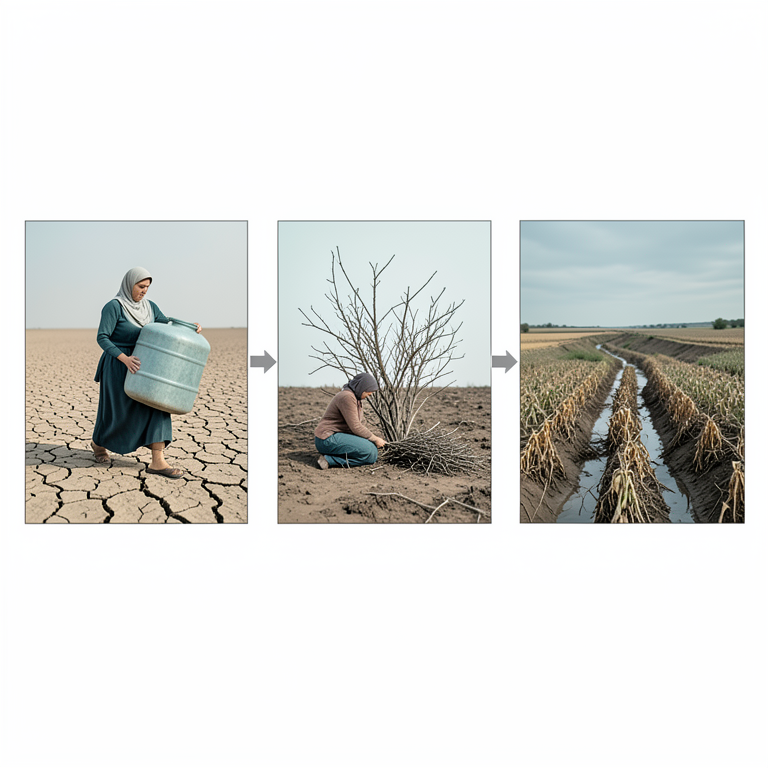
Cycle of Gendered Climate Vulnerability
AI-generated conceptual illustration (Rural women in a drought-stricken agricultural landscape). It explains the idea and does not show study data.
View source evidence ↗Introduction
When it comes to the effects of the effects of climate change women frequently find themselves on the cutting edge. Many have pointed to the threat of global warming as the most pressing issue facing the world today. There have numerous different aspects to the complex method for addressing global warming. Climate science is notoriously vague, adding another layer of intricacy to an issue whose effects will reverberate for decades, if not centuries. Many fields, including ecology, sociology, politics, and economics, are affected by climate change, making it an intricate set and multi-governmental issue on a worldwide scale. Race has no role in the climate crisis, which is among the most pressing issues of our day. More women depend on resources from nature for their livelihood, fewer women participate in public decision-making, and fewer women have access to property, all of which contribute to the disproportionate impact of climate change on women. Natural catastrophes like floods, mud and cyclones are immediate manifestations of climate change's unfavorable impacts, while the ecosystem gradually deteriorates over time. Agriculture, securing food, resources of water, health of people, communities of people, migratory patterns, transportation, energy, and industry are just a few areas where these occurrences have begun to have a detrimental impact. In several aforementioned hypotheses, women are disproportionately affected by the consequences of climate change compared to males. This is due, in part, to the fact that women constitute the bulk of the world's impoverished population and are more dependent on the finances that are at risk from this global phenomenon. On top of that, they face political, economic, and societal hurdles that make it hard for them to deal. Due to their heavy reliance on indigenous resources, women and men in rural regions of underdeveloped countries are particularly vulnerable. The hardest issues are faced by those who are responsible for obtaining food, water, and fuel for cooking and warmth. Secondly, women in rural areas face additional challenges related to climate change due to restricted mobility, uneven access to materials, and decision-making processes. The impact of climate change is causing serious environment and humanitarian challenges, thus it is crucial to find responses that take gender into account. Education, climatology experts, and politicians have long struggled to draw the necessary connections between environmental change, gender inequality, and social fairness. It is critical to address the unequal impacts of climate change and the links between the empowerment of women and successful global climate action as more studies and data reveal a strong linkage. Because of their greater dependence on natural assets and jobs that are laborious, women in developing nations are more susceptible to the effects of warming temperatures, making it imperative that they spearhead efforts to combat the issue.
Review of Literature
Financial damage, damage to the environment, extreme weather, and well-being, energy, water supplies, exodus, and nutrient availability are all consequences of climate change. According to research by Thiede et al. (2022), women suffer disproportionately from the economic effects of drought, which manifest as lower financial resources, food insecurity, and negative effects on sexual and reproductive health. A 50% mortality rate is associated with acute malaria infection in women who give birth during or soon after natural disasters. Children who are born with a low birth weight are more likely to have problems with their neuromotor performance, attention to detail, cognition, and abnormal development.
According to Huang et al. (2022), public worries about environmental degradation are fueled by a lack of understanding and education about the issue, as well as by outmoded consumer practices, insufficient incentives, inadequate laws, and a government that isn't committed to addressing the problem. Serious repercussions may result with a 2 to 3 percent increase in mercury and a dramatic change in rainfall patterns by the year 2050. When looking at scalability across countries, Mirziyoyeva and Salahodjaev (2022) came to similar conclusions. Achieving sustainable development objectives is favorably and substantially correlated with increasing the representation of women in parliaments. Expansion and improved welfare on farmers are impeded by women due to societal conventions, the absence of creative power, ambiguous rights to property, creativity, and time restrictions (Ndlovu and Mjimba, 2021). The number of casualties caused by natural and environmental catastrophes may fluctuate greatly from one year to the next, according to research by Symanski et al. (2021). According to the 2018 report by the Committee on the Elimination of Discrimination Against Women (CEDAW), "States legislatures must guarantee all governmental laws, regulations, laws, governmental strategies, initiatives, appropriations and additional activities concerning prevention of disasters and climate change adaptation are inclusive of gender and rooted in human-rights based principles." It was during the twenty-third annual Paris Agreement Conference (COP23) in 2017 when the first-ever Gender Action Plan was approved. These accords show that the world community understands that men and women will feel the effects of climate change differently. A 2015 report by the IPCC states that "human impact upon the global climate system is apparent, and present emissions from humans of green-house gases are the most significant in history." Therefore, Catastrophic occurrences like floods and bushfires are a part of climate change, as are more subtle changes like droughts and rising sea levels. Anthropogenic climate change is causing more frequent and severe extreme weather events, such as extreme temperatures, freezing waves, drier weather, tropical cyclones, erosion of the coast, water acidic conditions, catastrophic blazes, excessive rainfall, inundation, as well as elevated sea levels, putting human and environmental habitats at risk. The need of conducting simultaneous studies of many, interconnected forms of subjugation and repression is stressed by Denis ( 2008), who places emphasis on a matrix of power relations. When a person's language, gender, government, institutions, poverty, and citizenship are all factors that contribute to their marginalization, this is called structural intersectionality. Context and change characterize structural intersectionality. According to Simelton and Ostwald (2019), there is a gender gap in the distribution of economic resources. Inequality between the sexes exists on a global scale when it comes to the allocation of resources such as safe and sufficient property, financing, jobs, movement, knowledge about the weather and creative industries, opportunities for learning and development, ICTs, and financial assistance programs. According to the World Bank (2015), women face numerous challenges in the agricultural sector, which impacts their ability to earn a living. These include a lack of ownership of land freedoms, availability to credit for farming, efficient farm inputs, timely labor, support from advisory and extension services, markets and data on the climate, as well as accurate weather forecasts. According to research by Norgaard and York (2005), nations with a high percentage of female lawmakers are more likely to sign international ecological treaties, suggesting that empowering women and promoting gender equality may have a positive impact on making environmental choices both at the national and domestic levels.
Objectives of the Study
India is a particularly sensitive nation to the effects of climate change, and this research looks at how that susceptibility varies by gender. In order to create communities that are resilient, the research stresses the importance of policies that reflect gender and the involvement of women in environmental management.
Research Methodology
All of the information needed to conduct the research came from secondary sources. Quantitative and imaginative writing make up the bulk of this article. The goal of this research is to examine how adaptation and mitigation efforts have helped women gain economic independence. The majority of the information used for the research came from secondary and creative sources including websites, newspapers, magazines, reports from the government, regulation documents, and other print and online media.
The Impact of Climate Change on Women's Lives
Roughly 80% of the people forced to flee their homes as a result of climate change are women. Climate change has farreaching and diverse impacts on women in India, both in rural and urban regions. Women, for instance, often shoulder the burden of collecting water for domestic use and consumption in more remote areas. Buzz Women's creator, Uthara Narayanan, says that declining groundwater supplies are causing women emotional distress. Buzz Women provides rural women with access to information, training, and tools. A persistent source of anxiety for them is the cost of water, both for their family and their crops, and the need of water rationing. They are already under a lot of pressure because of crop losses and debt caused by unusually heavy rains in several parts of the nation in the last two years. Warmth and flooding, two of the most obvious impacts of urban climate change, cause comparable psychological distress for women living in urban settings. Slums and other densely populated urban areas are especially vulnerable to the devastating floods that hit during the monsoon season. Sometimes, a lack of proper infrastructure renders toilets in such areas useless. Although males are still able to defecate outdoors, women often find it more challenging to do so.
How Women Will Be Affected by Climate Change
Significant worldwide changes have taken place during the last 65 years, including warming, changes in the global climate that have been seen and are predicted to occur in the twenty-first century, and overall climatic shifts. As a "threat multiplier," climate change intensifies already-existing political, social, and economic stresses in already-vulnerable and conflict-wracked regions. Climate change is making women and girls more susceptible to sexual assault in conflicts, human trafficking, child marriage, and other types of abuse based on gender. When disasters strike, women have a worse chance of survival and a higher risk of injury because of historical gender disparities that have created inequalities in knowledge, mobility, decision-making, and training and resources. As a result, women and girls are less likely to get aid in the aftermath, which puts their livelihoods, health, and rehabilitation at risk and makes them even more vulnerable to disasters in the future. By increasing risks to mother and child health and decreasing access to services and healthcare, climate change and disasters harm the health of women and girls. Science has shown that stillbirth rates are rising in hot climates, and that vector-borne diseases like Zika, dengue fever, and malaria are becoming more common due to climate change. These diseases have a negative impact on both the mother and the baby. In Asia and the Pacific, the effects of climate change, environmental degradation, and natural catastrophes are not uniform. Disaster recovery and adaptation are more challenging for women and other marginalized groups due to a lack of knowledge, tools, money, and infrastructure. Furthermore, they do not have a voice in climate change, energy transition, or disaster risk reduction (DRR) debates. A lot of positive change might come from women taking the lead. A swift and coordinated effort by governments, development partners, businesses, financial institutions, civil society organizations, and communities is required to accomplish this. Climate emergency reactions and solutions will perpetuate the marginalization of their demands and harm to their rights unless they are included, represented, and led.
Advancing Women in the Agrarian Sector
There is a serious threat to poverty alleviation and the attainment of the SDGs from climate change and environmental degradation. In addition to influencing productivity and profitability, they also affect people's nutrition, food security, and overall health. Women, on the other hand, have a personal stake in finding solutions to stop the degradation and adjust to the changing environment since they have traditionally been in charge of agricultural production and obtaining water, cooking fuel, and other household resources. Significant investment in clean technology, more robust infrastructures and emergency preparedness and mitigation facilities is expected as a result of climate change. Additionally, several sectors, including industry and agriculture, will be incentivized to innovate, such as via the development of weather-resistant crops. One way to respond to climate change is to give women more agency in farming. More environmentally friendly agricultural and conservation methods may be encouraged with the right tools and funding. Moreover, we can help people adapt better to the consequences of climate change if we end poverty. Such expenditures have the potential to increase productivity, generate new jobs, and broaden the aggregate demand for goods and services. Opportunities to act in a way that puts the world on a better, more sustainable path present themselves in the face of adversity and economic shocks. As a general rule, women are responsible for ensuring that their families have enough to eat, but as agricultural circumstances worsen, they often lack the means or power to do so. Consequently, the food security of the whole population is put at risk when crops fail due to climate change (Denton 2002). Adaptation to climate change and catastrophe prevention are two areas where women are disproportionately underrepresented due to a lack of property rights, control of production methods, technology, funding, education, and training (Rodenberg 2009).
Climate Change's Effects on Low-Income Nations
There are serious threats to the well-being, security, and enjoyment of life of women all around the globe. Determination: The reliance on natural assets and labor-intensive jobs makes women in poor and less developed nations more susceptible to the effects of warming temperatures. Poverty: One factor that renders women more vulnerable to the impacts of global warming is that they are more likely to be poor than males. Accountability: This is due to the fact that women in low-income homes bear a disproportionate share of the household's unpaid labor, including food preparation and water collection.
The climatic problem has made it more difficult and time-consuming to get basic supplies, creating a regional split.
It is often the responsibility of rural women to provide their family with safe drinking water, sufficient cooking fuel, and healthy food.
Because they have to go further than men do every day to get water and fuel, women may be more vulnerable to health and safety risks. The United Nations has brought attention to the fact that, regardless of gender, women are seen as being more susceptible to the negative effects of the effects of climate change and bear a disproportionate share of the burden.
Conclusion
Although women bear a disproportionate share of the burden of climate change, they also represent the greatest hope for a society free of pollution and ecological collapse. It has been shown via the examination of the possibilities and challenges associated with combining the goals of climate adaptation and mitigation with those of economic emancipation of women in some areas of climate-related initiatives. In order to develop and disseminate adaptation measures that will be well-received in their communities, women's contextual awareness and local expertise are invaluable resources. Also, there's a chance that women entrepreneurs, in particular, may benefit from the desire for innovative approaches. The capacity of women to adapt to climate change might be greatly enhanced by supporting their professional growth and lending a hand to businesses owned by women. In order to address current development issues like unreliable water, health, and livelihoods, as well as how women can be enabled in the context of global warming adaptability and innovation, efforts to empower women economically must take a continuum approach. Cooperation between economic and development objectives is crucial for reducing vulnerability, adapting to climate change, and building resilience.
References
15 in the original paper- Dilawar A, et al. Development of a GIS based hazard, exposure, and vulnerability analyzing method for monitoring drought risk at Karachi, Pakistan. Geomatics, Natural Hazards and Risk. 2022.
- Erman A, De Vries SA, Robbe R, Thies SF, Kabir K, Maruo M. Gender dimensions of disaster risk and resilience: Existing evidence. World Bank; 2021.
- Ashraf S, et al. Anthropogenic drought dominates groundwater depletion in Iran. Scientific Reports. 2021.
- Oyetunde-Usman Z, et al. Determinants of adoption of multiple sustainable agricultural practices among smallholder farmers in Nigeria. International Soil and Water Conservation Research. 2021.
- Blakstad MM, et al. Climate change worsens global inequity in maternal nutrition. Lancet. 2020.
- Alston M, et al. Gender and climate change: a review of impacts, gender-differentiated vulnerabilities, and gender-based adaptation and mitigation action. Climatic Change. 2020.
- Dickin S, et al. Women's vulnerability to climaterelated risks to household water security in centre-east Burkina Faso. Climate and Development. 2020.
- Denton F, et al. Gender, climate change, and adaptation: introduction. World Development. 2020.
- Achandi EL, et al. Women's access to agricultural technologies in rice production and processing hubs: a comparative analysis of Ethiopia, Madagascar and Tanzania. Journal of Rural Studies. 2018.
- Fanzo J, et al. The effect of climate change across food systems: Implications for nutrition outcomes. Global Food Security. 2018.
- Denzin NK, et al. The SAGE handbook of qualitative research. 2018.
- Creswell JW, et al. Qualitative inquiry and research design: Choosing among five approaches. 2017.
- Behrman J, et al. Effects of the 2010 Haiti earthquake on women's reproductive health. Studies in Family Planning. 2016.
- Birt L, et al. Member checking: a tool to enhance trustworthiness or merely a nod to validation? Qualitative Health Research. 2016.
- Daoud M. Gender, climate change, and adaptive capacity: lessons from pastoralist communities in Kenya. Gender and Development. 2016.