
Research article · 2025 · Full text
International Journal of Agriculture and NutritionRole of self-help groups in agricultural technology dissemination among tribal farming communities
Volume 7(12) · Pages 137–140 · DOI: 10.33545/26646064.2025.v7.i12c.527 ↗
Research areasAgricultural Innovations and PracticesAgricultural Development and ManagementIndigenous Knowledge Systems and Agriculture
Abstract
Author-writtenSomething curious happens when you place a group of tribal farmers around a table and ask them to decide together which seed variety to try next season: they try it. And more importantly, they tell their neighbours to try it too. This research examined how self-help groups (SHGs) function as channels for agricultural technology dissemination among tribal farming communities in three provinces of central Anatolia, Turkey. A comparative survey of 120 SHG-member households and 120 non-member households was conducted during 2023. Technology adoption was measured across seven domains: improved varieties, soil testing, integrated pest management, drip irrigation, post-harvest handling, organic certification, and digital market access. SHG members showed significantly higher adoption scores in six of seven domains (p
Summary
Source-checkedPlain-language reading of the full paper, prepared with AI and checked against the text. Each point links to the authors' own words.
Why it matters
- Agricultural technologies tend to spread more quickly through farmer groups than individual visits because farmers trust their peers more than outsiders and benefit from group social support. View evidence ↗
- Conventional agricultural extension services struggle to reach tribal farming communities due to their remote locations, language barriers, and caution regarding external changes. View evidence ↗
- In central Anatolia, approximately 1.2 million smallholders from various pastoral backgrounds face limited government extension support, with visits averaging less than once per season. View evidence ↗
The question
- The study aimed to compare agricultural technology adoption levels between members and non-members of self-help groups (SHGs) and identify the factors that best predict this adoption. View evidence ↗
What they did
- The study was conducted between February and July 2023 across the provinces of Yozgat, Kirşehir, and Nevşehir in central Anatolia. View evidence ↗
- The researchers conducted a comparative survey involving 120 households that were members of SHGs and 120 households that were not. View evidence ↗
- Technology adoption was evaluated across seven specific domains, including soil testing, drip irrigation, and organic certification. View evidence ↗
- A multiple regression model was used to analyze the Technology Adoption Index (TAI) using ten predictors, such as group cohesion, credit access, and extension contact frequency. View evidence ↗
What they found
- SHG members had a significantly higher overall technology adoption index (64.2%) compared to non-members (32.1%). View evidence ↗
- SHG members showed significantly higher adoption in six of the seven measured domains, with the most pronounced difference seen in organic certification (38.3% for members vs 11.7% for non-members). View evidence ↗
- The strongest predictors of technology adoption among SHG members were group cohesion, frequency of extension contact, and access to credit. View evidence ↗
- Factors such as age and landholding were not significant predictors, indicating that the benefits of SHGs apply across different demographic profiles. View evidence ↗
What it means
- The authors conclude that SHGs significantly increase technology adoption in tribal communities, with members scoring roughly double the adoption index of non-members. View evidence ↗
Visual summary
1 visualsIllustrations explain the paper; charts are replotted from the paper's own table values.
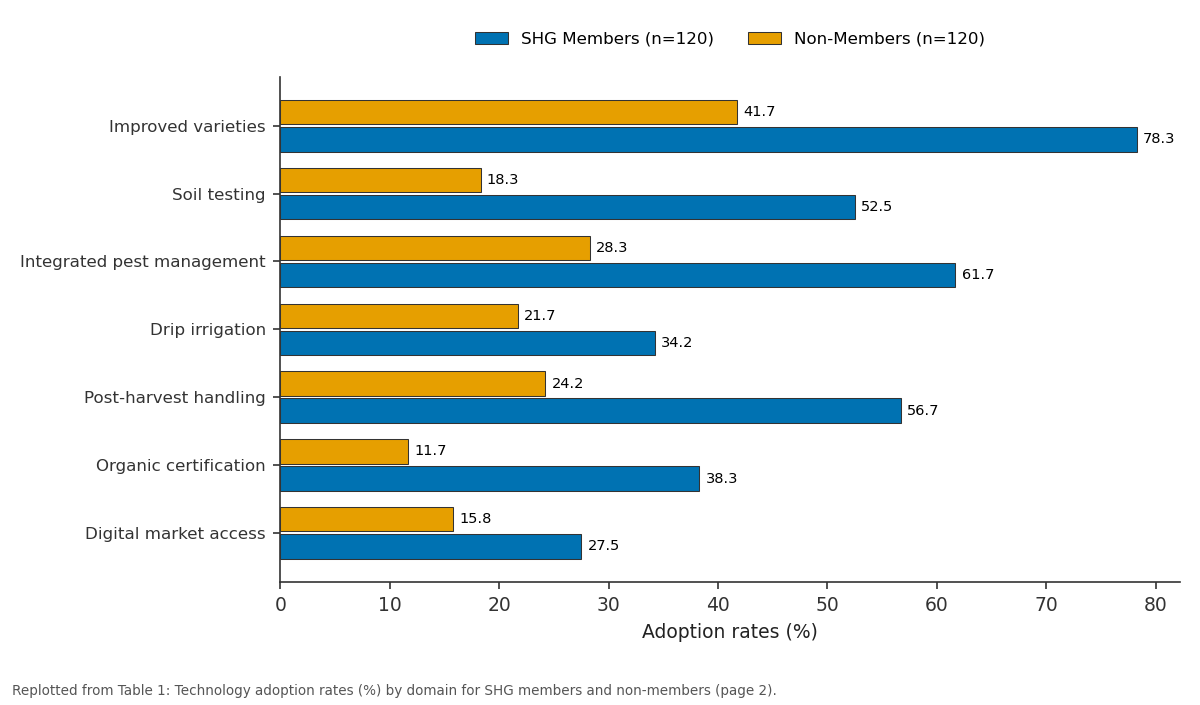
SHG Members (n=120) and Non-Members (n=120): Improved varieties vs Soil testing vs Integrated pest... vs Drip irrigation vs Post-harvest handling
Replotted from Table 1 (page 2) of the original paper. Every bar is the paper's own table value.
View source evidence ↗Figures & tables
From the original paper Table 1
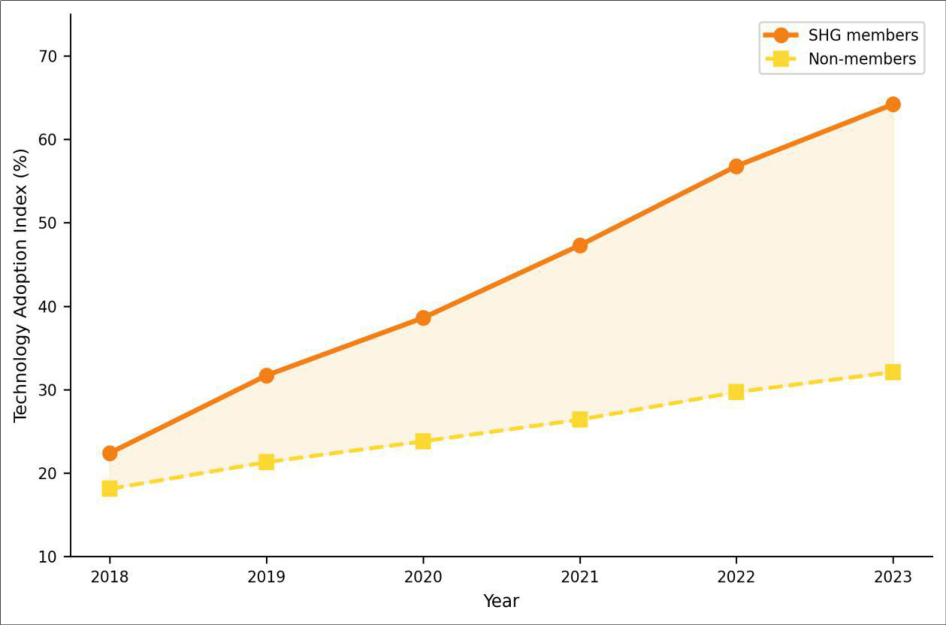 Figure 1
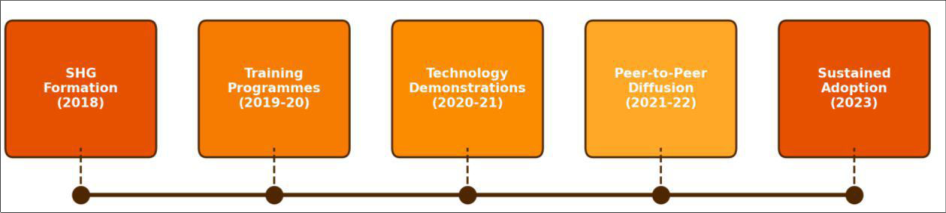 Figure 2
Introduction
A quiet but consistent pattern shows up across developing-country agriculture: technologies spread faster through farmer groups than through individual extension visits [1] . The explanation is straightforward people trust peers more than outsiders, and group membership creates both social pressure and social support to experiment with something new [2] . Selfhelp groups (SHGs), originally conceived as microfinance vehicles, have evolved in many countries into multi-purpose platforms that handle savings, credit, input procurement, and, increasingly, technology dissemination [3] . Tribal farming communities present a particular challenge for conventional extension. They often occupy remote uplands, speak minority languages, farm on marginal soils, and hold customary land rights that make them cautious about externally promoted changes [4] . In central Anatolia, an estimated 1.2 million smallholders from Turkmen, Kurdish, and Yuruk pastoral backgrounds farm rain-fed cereals and livestock on semi-arid steppe areas where government extension offices are thinly spread and visit frequencies average less than once per season [5] . Over the past decade, NGOs and government programmes in Turkey have facilitated the formation of roughly 4,000 agricultural SHGs in tribal and semi-tribal districts [6] . Anecdotal evidence suggests these groups improve technology awareness, but rigorous comparative data on adoption outcomes are scarce. This research addressed that gap by comparing technology adoption levels between SHG members and non-members in three provinces, and by identifying the group-level and individual-level factors that best predict adoption.
Theoretical Framework
The research drew on Rogers' Diffusion of Innovations theory [7] , which posits that adoption decisions are shaped by perceived attributes of the technology (relative advantage, compatibility, complexity, trialability, observability) and by the social system through which information flows. SHGs were conceptualised as opinion-leadership nodes within the social system, where early adopters share experiential knowledge with peers in a trusted, low-risk environment.
The dependent variable technology adoption index was treated as a composite of adoption decisions across seven technology domains, scored on a 0-100 scale.
Instrument Development and Validation
A structured interview schedule with 56 items was developed covering socio-economic profile (12 items), SHG characteristics (10 items), technology awareness (14 items), and technology adoption (20 items). The adoption items were scored dichotomously (adopted = 1, not adopted = 0) for each of the seven domains, then summed and converted to a percentage index. The instrument was reviewed by four extension-education faculty members and pilot-tested on 25 non-sample farmers. Cronbach's alpha for the adoption scale was 0.84 [8] .
Materials and Methods
Materials and Methods
Materials:
The research was conducted in Yozgat, Kirşehir,
and Nevşehir provinces of central Anatolia between
February and July 2023, based at Anatolian Agricultural University, Ankara. From each province, two sub-districts with active SHGs were selected. In each sub-district, 20 SHG-member households and 20 non-member households were chosen by proportionate random sampling (total n = 240). SHG members had been active for at least two years.
Interviews were conducted face-to-face in Turkish by trained enumerators.
Methods
Descriptive statistics summarised adoption rates by domain and membership status. The technology adoption index (TAI) was compared between groups using an independentsample t Comprehensive Interpretation SHG members outperformed non-members in every technology domain, with the widest gaps in soil testing (34.2 percentage points) and organic certification (26.6 points). The regression model explained 61.3% of variance in TAI (adjusted R² = 0.613). Group cohesion (β = 0.34, p<0.001), extension contact frequency (β = 0.28, p<0.001), and credit access (β = 0.21, p = 0.003) emerged as the three strongest predictors. Age and landholding were not significant, suggesting that the SHG mechanism works across demographic profiles.
Discussion
The 32-percentage-point gap in overall TAI between members and non-members is larger than the 15-20-point gaps typically reported in Indian SHG research [3] , possibly because the tribal communities in our sample had exceptionally low baseline exposure to extension services. In such information-poor environments, the SHG functions not just as a facilitator but as the primary source of technical knowledge [9] . Group cohesion's strong predictive power aligns with social-capital theory: groups where members trust each other and meet regularly create a safe space for experimentation and mutual learning [10] . Extension contact frequency mattered too, confirming that SHGs work best when linked to formal advisory systems rather than operating in isolation. The positive effect of credit access suggests that even when farmers are willing to adopt, liquidity constraints can block actionand SHG savings pools partly relieve that bottleneck [2] . Organic certification showed the largest relative gap (38.3% vs 11.7%), likely because certification is a collective process it requires coordinated record-keeping, group audits, and shared marketing channels that only an organised group can manage [11] . This finding highlights SHGs' potential as vehicles for value-chain upgrading, not just technology transfer.
Conclusion
Self-help groups significantly raised agricultural technology adoption among tribal farming communities in central Anatolia, with member households scoring roughly double the adoption index of non-members. Group cohesion, extension contact, and credit access were the strongest drivers of this difference. SHGs appear to function as sociallearning platforms that overcome the information and trust barriers that conventional extension cannot easily breach in remote tribal areas.
Strengthening existing SHGs through regular extension linkages, facilitating group-based organic certification, and ensuring that savings pools are large enough to finance input purchases would amplify the technology-dissemination role that these groups already play.
Figures and tables from the paper
| Technology Domain | SHG Members (n=120) | Non-Members (n=120) | Chi-square (p-value) |
|---|---|---|---|
| Improved varieties | 78.3 | 41.7 | 33.8 (<0.001) |
| Soil testing | 52.5 | 18.3 | 30.6 (<0.001) |
| Integrated pest management | 61.7 | 28.3 | 27.1 (<0.001) |
| Drip irrigation | 34.2 | 21.7 | 4.6 (0.032) |
| Post-harvest handling | 56.7 | 24.2 | 26.4 (<0.001) |
| Organic certification | 38.3 | 11.7 | 22.8 (<0.001) |
| Digital market access | 27.5 | 15.8 | 4.9 (0.027) |
| Overall TAI | 64.2 | 32.1 | t = 9.87 (<0.001) |
Table text extracted from the original PDF; superscript letters are shown inline. The original table image is below.
View original table image
References
18 in the original paper- Feder G, Murgai R, Quizon JB. The acquisition and diffusion of knowledge: the case of pest management training in farmer field schools, Indonesia. Journal of Agricultural Economics. 2004;55(2):221-243.
- Meinzen-Dick R, Di Gregorio M, McCarthy N. Methods for studying collective action in rural development. Agricultural Systems. 2004;82(3):197214.
- Swain RB, Wallentin FY. Does microfinance empower women? Evidence from self-help groups in India. International Review of Applied Economics. 2009;23(5):541-556.
- Cernea MM. Putting people first: sociological variables in rural development. 2nd ed. New York: Oxford University Press; 1991. p. 1-575.
- Turkish Statistical Institute. Agricultural structure statistics 2022. Ankara: TUIK; 2023.
- Ministry of Agriculture and Forestry. Annual report 2022. Ankara: Republic of Turkey; 2023. p. 1-186.
- Rogers EM. Diffusion of innovations. 5th ed. New York: Free Press; 2003. p. 1-550.
- Nunnally JC. Psychometric theory. 2nd ed. New York: McGraw-Hill; 1978. p. 1-640.
- Pandey DK, De HK. Information and communication technology for participatory fisheries management. Fisheries Management and Ecology. 2016;23(2):98107.
- Putnam RD. Bowling alone: the collapse and revival of American community. New York: Simon and Schuster; 2000. p. 1-541.
- Jouzi Z, Azadi H, Taheri F, Zarafshani K, Gebrehiwot K, Van Passel S, Lebailly P. Organic farming and small-scale farmers: main opportunities and challenges. Ecological Economics. 2017;132:144-154.
- Bebbington A. Capitals and capabilities: a framework for analyzing peasant viability, rural livelihoods and poverty. World Development. 1999;27(12):2021-2044.
- Pretty J, Ward H. Social capital and the environment. World Development. 2001;29(2):209-227.
- Agarwal B. Group farming in Indian agriculture: a review. World Development. 2010;38(4):579-592.
- Leeuwis C, van den Ban A. Communication for rural innovation. 3rd ed. Oxford: Blackwell Publishing; 2004. p. 1-412.
- Chambers R, Conway GR. Sustainable rural livelihoods: practical concepts for the 21st century. IDS Discussion Paper 296. 1992. p. 1-33.
- Uphoff N. Understanding social capital: learning from the analysis and experience of participation. Washington DC: World Bank; 2000. p. 215-249.
- Weinberger K, Jutting JP. Women's participation in local organizations: conditions and constraints. World Development. 2001;29(8):1391-1404.