
Research article · 2025 · Full text
International Journal of Agriculture and NutritionPerformance of onion varieties under different organic manure combinations
Volume 7(12) · Pages 149–152 · DOI: 10.33545/26646064.2025.v7.i12c.538 ↗
Research areasAgricultural Science and FertilizationPlant Growth and Agriculture TechniquesAgriculture, Plant Science, Crop Management
Abstract
Author-written"Feed the soil, not the plant" is an old gardener’s proverb, but how well does it hold for onion — a crop notorious for its shallow roots and heavy nutrient appetite? This research compared four onion varieties (Cream Gold, Red Baron, Creamgold Supreme, Early Pearl) grown under three organic manure regimes (farmyard manure at 20 t ha⁻¹, composted green waste at 15 t ha⁻¹, and vermicompost at 8 t ha⁻¹) on a sandy loam at Perth, Western Australia, during the 2023 winter season. Creamgold Supreme under vermicompost produced the highest marketable bulb yield (37.4 t ha⁻¹), 27.8% above the same variety under FYM. Vermicompost outperformed the other two manures for all four varieties, driven by its higher nitrogen availability and faster mineralisation in the warm Perth winter [1]. Bulb size distribution shifted toward the premium 60–80 mm grade under vermicompost (64.3% of harvest vs 48.1% under FYM). Variety × manure interaction was significant for yield (p = 0.006) and total soluble solids (p = 0.021). These data support vermicompost as the preferred organic input for high-value onion production in Mediterranean-climate regions of Western Australia.
Summary
Source-checkedPlain-language reading of the full paper, prepared with AI and checked against the text. Each point links to the authors' own words.
Why it matters
- Onions are particularly dependent on topsoil nutrients and moisture because their absorbing roots are shallow, typically located in the top 15–20 cm. View evidence ↗
- The organic onion market in Australia has seen annual growth of 11–14% since 2019, with consumers paying 30–50% premiums for chemical-free produce. View evidence ↗
- The sandy loam soils of the Swan Coastal Plain near Perth are fast-draining and low in organic matter (0.6–1.0% C), making them highly responsive to organic amendments. View evidence ↗
The question
- The study aimed to determine how different organic manure inputs affect various onion varieties with different growth habits and maturity levels under Western Australian conditions. View evidence ↗
What they did
- The experiment used a factorial randomised block design with 36 plots (4 varieties by 3 manures by 3 replications), each measuring 4 m by 3 m. View evidence ↗
- The study tested four varieties (Cream Gold, Red Baron, Creamgold Supreme, and Early Pearl) using three manure treatments: farmyard manure (20 t ha⁻¹), composted green waste (15 t ha⁻¹), and vermicompost (8 t ha⁻¹). View evidence ↗
- Harvested bulbs were categorized into three size grades: small (<40 mm), medium (40–60 mm), and premium (60–80 mm). View evidence ↗
What they found
- The highest marketable bulb yield was 37.4 t ha⁻¹, achieved by the Creamgold Supreme variety treated with vermicompost, which was 27.8% higher than the same variety treated with farmyard manure (FYM). View evidence ↗
- Vermicompost increased the proportion of premium-grade bulbs (60–80 mm) to 64.3% of the harvest, compared to 48.1% under FYM. View evidence ↗
- There was a statistically significant interaction between onion variety and manure type for both bulb yield (p = 0.006) and total soluble solids (p = 0.021). View evidence ↗
- Vermicompost showed the closest alignment between nutrient supply and crop uptake, with the smallest nitrogen surplus (Δ32 kg N ha⁻¹) compared to FYM (Δ68 kg N ha⁻¹). View evidence ↗
- Total soluble solids (TSS) ranged from 10.4 to 12.8 °Brix, with the Red Baron variety consistently recording the highest values across all manure treatments. View evidence ↗
- Although vermicompost costs more per hectare (AU$2,240) than FYM (AU$1,800), the AU$440 difference is offset by an additional 6.5 t ha⁻¹ of marketable yield. View evidence ↗
What it means
- The authors recommend that Western Australian growers use vermicompost with either the Creamgold Supreme or Red Baron varieties to maximize yield and quality for the organic market. View evidence ↗
- The authors suggest that future research should investigate split applications of vermicompost to potentially improve the timing of nutrient availability relative to the onion's uptake. View evidence ↗
Visual summary
2 visualsIllustrations explain the paper; charts are replotted from the paper's own table values.
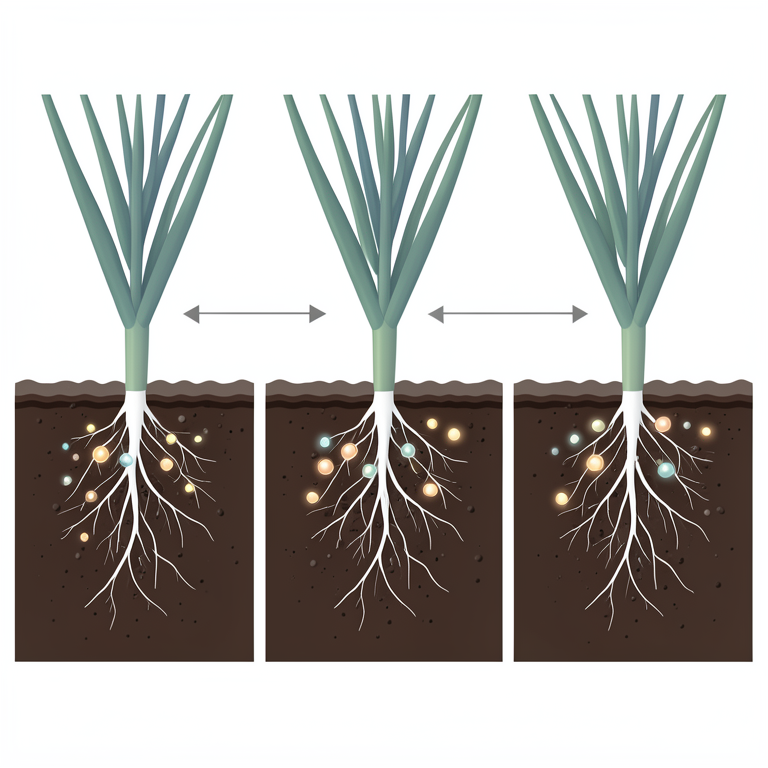
Nutrient Synchrony Concept
AI-generated conceptual illustration (onion plants in soil). It explains the idea and does not show study data.
View source evidence ↗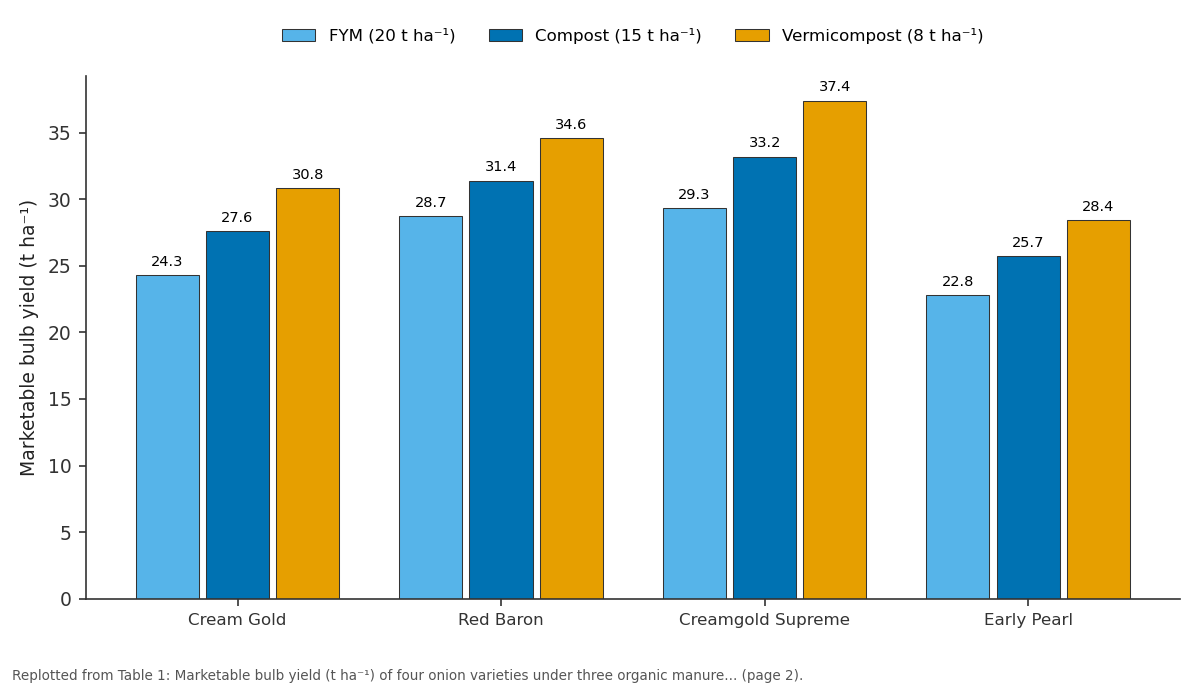
FYM (20 t ha⁻¹) and Compost (15 t ha⁻¹) and more: Cream Gold vs Red Baron vs Creamgold Supreme vs Early Pearl
Replotted from Table 1 (page 2) of the original paper. Every bar is the paper's own table value.
View source evidence ↗Figures & tables
From the original paper Table 1
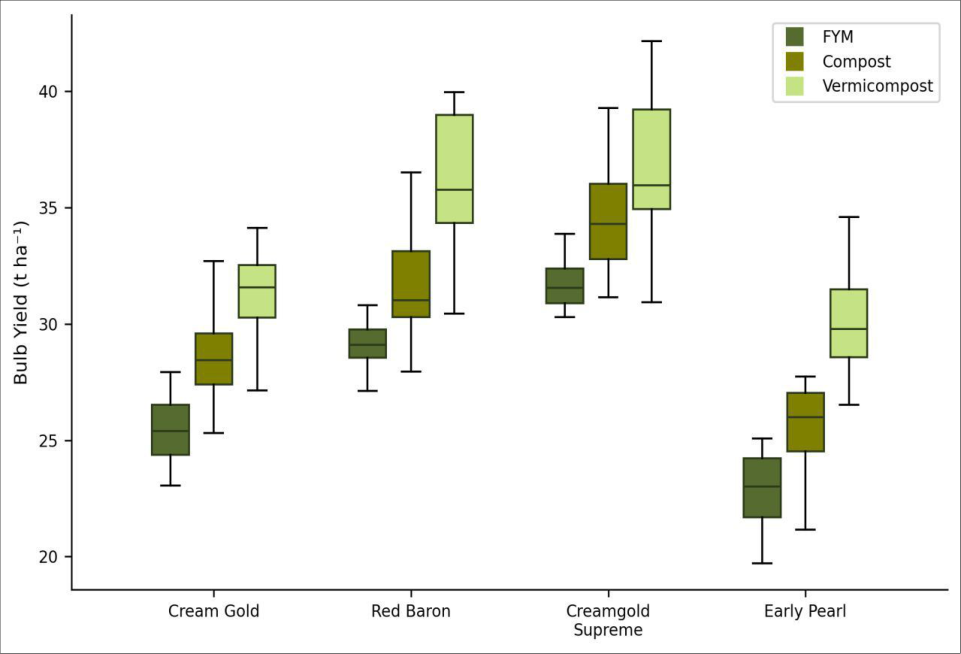 Figure 1
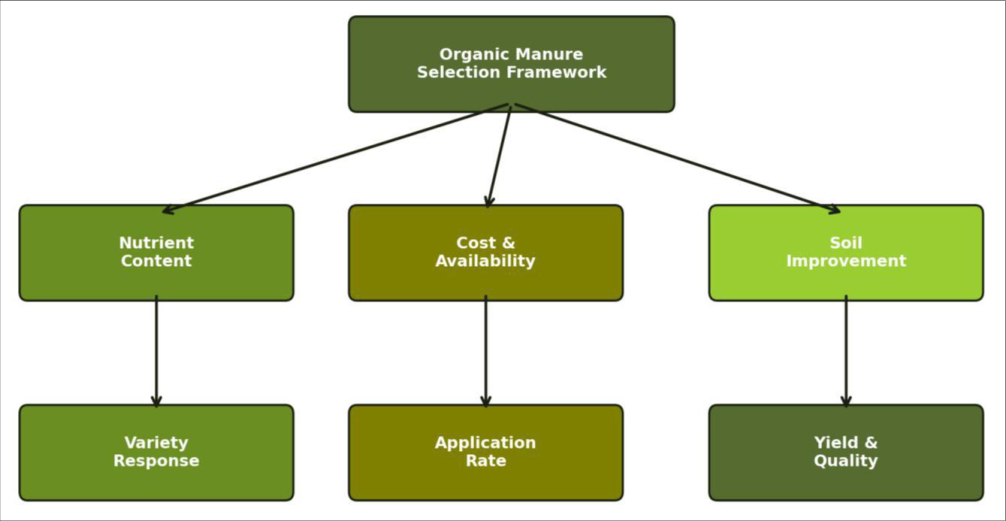 Figure 2
Introduction
"You reap what you sow" applies to onion, but you might add "and what you feed the soil beforehand." Onion is a shallow-rooted crop: most of its absorbing roots sit in the top 15-20 cm, which means it depends heavily on the nutrient concentration and moisture-holding capacity of the topsoil [2] . That makes the choice of organic amendment especially consequential more so than for deeper-rooted vegetables like tomato or capsicum. Australia's organic onion market has grown by 11-14% annually since 2019, driven by consumer demand for chemical-free produce and willingness to pay premiums of 30-50% over conventional [3] . Western Australia contributes about 12% of the national onion crop, with most production concentrated on the sandy loam soils of the Swan Coastal Plain near Perth [4] . These soils are inherently low in organic matter (0.6-1.0% C) and drain fast, making them responsive to organic amendments that boost both nutrient supply and water retention. Not all organic manures deliver the same result, however. FYM provides bulk organic matter but releases nitrogen slowly; composted green waste offers good structure but variable nutrient content; vermicompost, though more expensive per tonne, typically mineralises faster and carries a more balanced NPK ratio [5] . How these differences play out across onion varieties of contrasting growth habit and maturity remains poorly documented for WA conditions. This research tested that question with four commercial varieties and three organic inputs.
Seasonal Variation in Growing Conditions
Perth's 2023 winter season (May-October) was milder than average, with mean minimum temperatures of 9.8 °C (long-term mean 8.6 °C) and total rainfall of 612 mm (long-term 724 mm). The drier-than-normal conditions required two supplemental irrigations in August and September, each delivering 25 mm via overhead sprinklers. No frost events occurred during the trial, which favoured uninterrupted bulb expansion. The warm winter likely accelerated manure mineralisation, an effect most pronounced for vermicompost, which showed a sharp rise in soil mineral N (0-15 cm) between 4 and 8 weeks after transplanting [6] . were measured with a digital refractometer on juice from five bulbs per plot. Pungency was estimated by pyruvic acid content [7] . Data were analysed by two-way ANOVA in R (v4.3.1), with Tukey's HSD at p = 0.05.
Nutrient Input-Output Assessment
The total N, P, and K supplied by each manure (based on dry-weight nutrient analysis) were compared against the N, P, and K removed in harvested bulbs (determined by Kjeldahl and acid-digest ICP-OES). Nutrient balance (input minus output) was positive for all three manures, but the surplus was smallest under vermicompost (Δ32 kg N ha⁻¹) and largest under FYM (Δ68 kg N ha⁻¹), reflecting the closer alignment of vermicompost's mineralisation pattern with onion's uptake curve.
Results
Results
Comprehensive Interpretation
Vermicompost at just 8 t ha⁻¹ outperformed FYM at 20 t ha⁻¹ and compost at 15 t ha⁻¹ for all four varieties, indicating that nutrient availability per tonne matters more than bulk volume for shallow-rooted onion on sandy soils. Creamgold Supreme was the top-yielding variety across all manures, driven by a higher proportion of premium-grade bulbs (68.7% under vermicompost vs 51.3% under FYM). TSS ranged from 10.4 to 12.8 °Brix, with Red Baron recording the highest values regardless of manure, consistent with its known pungency profile [7] .
Discussion
The 25-28% yield advantage of vermicompost over FYM echoes results from Indian onion trials by Reddy and Reddi [8] , who attributed the benefit to vermicompost's enriched microbial community and faster N mineralisation. On Perth's sandy Arenosol, where leaching is a constant risk, the slower N release from FYM may actually work against the crop: much of the nitrogen mineralises after the onion's peak uptake window (6-10 weeks post-transplanting) and leaches below the shallow root zone [9] . The variety × manure interaction reflects differing root architectures and growth durations. Creamgold Supreme, a mid-season variety with vigorous lateral rooting, captured vermicompost's early N pulse more effectively than Early
Pearl, an early-maturing type whose root system is sparser. Red Baron, a red-skinned variety, showed less absolute yield response but maintained higher TSS, making it the preferred choice for niche organic markets that value flavour over tonnage [3] . The cost differential must be acknowledged: vermicompost at AU$280 t⁻¹ is roughly three times the price of FYM at AU$90 t⁻¹. But the lower application rate (8 vs 20 t ha⁻¹)
brings the total per-hectare outlay to AU$2,240 for vermicompost vs AU$1,800 for FYMa difference of AU$440 that is easily covered by the extra 6.5 t ha⁻¹ of marketable yield.
Conclusion
Creamgold Supreme grown with vermicompost at 8 t ha⁻¹ delivered the highest onion bulb yield (37.4 t ha⁻¹) and the best premium-grade bulb proportion on sandy loam at Perth. Vermicompost outperformed both FYM and composted green waste for all four varieties, confirming that rapid nutrient availability trumps bulk organic matter for shallowrooted onion on free-draining soils. The modest cost premium of vermicompost over FYM is offset several times by the yield gain. Growers aiming for the organic premium market in Western Australia should pair Creamgold Supreme or Red Baron with vermicompost to maximise both tonnage and bulb quality. Future research should test split vermicompost applications to see whether staggering the input further improves nutrient-use synchrony with onion's uptake pattern.
Figures and tables from the paper
| Variety | FYM (20 t ha⁻¹) | Compost (15 t ha⁻¹) | Vermicompost (8 t ha⁻¹) |
|---|---|---|---|
| Cream Gold | 24.3 | 27.6 | 30.8 |
| Red Baron | 28.7 | 31.4 | 34.6 |
| Creamgold Supreme | 29.3 | 33.2 | 37.4 |
| Early Pearl | 22.8 | 25.7 | 28.4 |
| Mean | 26.3 | 29.5 | 32.8 |
Table text extracted from the original PDF; superscript letters are shown inline. The original table image is below.
View original table image
References
17 in the original paper- Atiyeh RM, Subler S, Edwards CA, Bachman G, Metzger JD, Shuster W. Effects of vermicomposts and composts on plant growth in horticultural container media and soil. Pedobiologia. 2000;44(5):579-590.
- Brewster JL. Onions and other vegetable Alliums. 2nd ed. Wallingford: CAB International; 2008. p. 1-432.
- Australian Organic Ltd. Australian organic market report 2023. Brisbane: AOL; 2023. p. 1-64.
- DPIRD. Western Australian vegetable industry snapshot 2022. Perth: Department of Primary Industries and Regional Development; 2023. p. 1-36.
- Lazcano C, Dominguez J. The use of vermicompost in sustainable agriculture: impact on plant growth and soil fertility. Soil Nutrients. 2011;10:1-23.
- Arancon NQ, Edwards CA, Bierman P, Welch C, Metzger JD. Influences of vermicomposts on field strawberries: effects on growth and yields. Bioresource Technology. 2004;93(2):145-153.
- Schwimmer S, Weston WJ. Enzymatic development of pyruvic acid in onion as a measure of pungency. Journal of Agricultural and Food Chemistry. 1961;9(4):301-304.
- Reddy KC, Reddi KM. Effect of different levels of vermicompost and nitrogen on growth and yield of onion. Indian Journal of Agricultural Research. 2010;44(3):215-219.
- Parfitt RL, Mackay AD, Ross DJ, Budding PJ. Effects of soil fertility on leaching losses of N, P and C in hill country. New Zealand Journal of Agricultural Research. 2009;52(1):69-80.
- Luo J, Wyatt J, van der Weerden TJ, Thomas SM, de Klein CAM, Li Y, Rollo M, Lindsey S, Ledgard SF, Li J, Ding W, Qin S, Zhang N, Bolan N, Kirkham MB, Bai Z, Ma L, Zhang X, Wang H, Liu H, Rys G. Potential hotspot areas of nitrous oxide emissions from grazed pastoral dairy farm systems. Advances in Agronomy. 2017;145:205-268.
- Singh DK, Jain SK. Performance of onion varieties under organic farming at Tarai region of Uttarakhand. Progressive Agriculture. 2013;13(1):113-117.
- Sharma RP, Datt N, Sharma PK. Combined application of nitrogen, phosphorus, potassium and farmyard manure in onion under high hills, dry temperate conditions. Indian Journal of Agricultural Sciences. 2003;73(4):225-227.
- Worthington V. Nutritional quality of organic versus conventional fruits, vegetables, and grains. Journal of Alternative and Complementary Medicine. 2001;7(2):161-173.
- Warman PR, AngLopez MJ. Vermicompost derived from different feedstocks as a plant growth medium. Bioresource Technology. 2010;101(12):4479-4483.
- Lee J. Effect of application methods of organic fertilizer on growth, soil chemical properties and microbial densities in organic bulb onion production. Scientia Horticulturae. 2010;124(3):299-305.
- Boyhan GE, Torrance RL, Hill CR. Effects of nitrogen, phosphorus, and potassium rates and fertilizer sources on yield and leaf nutrient status of short-day onions. HortScience. 2007;42(3):653-660.
- Fink M, Scharpf HC. N-expert -a decision support system for vegetable fertilisation. Acta Horticulturae. 2000;533:67-74.