
Research article · 2025 · Full text
International Journal of Agriculture and NutritionIntegrated disease management of collar rot in chickpea using cultural and chemical methods
Volume 7(9) · Pages 114–117 · DOI: 10.33545/26646064.2025.v7.i9b.547 ↗
Research areasPlant pathogens and resistance mechanismsPlant Disease Management TechniquesFungal Plant Pathogen Control
Abstract
Author-writtenCollar rot caused by Sclerotium rolfsii Sacc. has been a persistent constraint on chickpea production in the Australian Capital Territory for over three decades, yet no locally validated integrated management package exists. This research evaluated nine treatment combinations of cultural and chemical practices against collar rot in chickpea variety PBA HatTrick at Southern Tablelands University of Agriculture, Canberra, during the 2023 winter season. The integrated treatment of deep ploughing + Trichoderma viride seed treatment + carbendazim soil drench reduced disease incidence to 12.8% compared with 52.8% in the untreated control, representing a 75.8% reduction. Carbendazim alone achieved 59.5% disease reduction, while deep ploughing alone managed only 37.3%. Seed yield was highest (1.87 t/ha) under the integrated treatment, 48.4% above the control. These findings confirm that combining cultural disruption of sclerotial banks with biological and chemical seed-zone protection provides the most reliable collar rot management in chickpea.
Summary
Source-checkedPlain-language reading of the full paper, prepared with AI and checked against the text. Each point links to the authors' own words.
Why it matters
- The disease causes rapid wilting and death of the plant at the collar region, leading to documented yield losses ranging from 10% to 55%. View evidence ↗
- While systemic fungicides like carbendazim protect germinating seeds, their effectiveness typically declines after 25 to 30 days, leaving plants vulnerable during later growth stages. View evidence ↗
The question
- The study aimed to compare nine different combinations of individual and integrated management tactics to determine their effect on collar rot disease progress, seed yield, and the viability of sclerotia. View evidence ↗
What they did
- The experiment used chickpea variety PBA HatTrick and was conducted during the 2023 winter season at the Southern Tablelands University of Agriculture in Canberra. View evidence ↗
- The study employed a randomized block design with three replications, testing nine treatments: deep ploughing, Trichoderma viride seed treatment, carbendazim soil drench, various combinations of these three, a mancozeb seed treatment check, and an untreated control. View evidence ↗
- Cultural control via deep ploughing was implemented at a depth of 30 cm two weeks prior to sowing. View evidence ↗
- Researchers measured disease incidence every two weeks from week 2 to 12 using 1 m² quadrats and assessed sclerotial viability in the top 15 cm of soil at sowing and harvest. View evidence ↗
What they found
- The fully integrated treatment (deep ploughing, Trichoderma, and carbendazim) was the most effective, resulting in the lowest disease incidence (12.8%) and the highest seed yield (1.87 t/ha), which was 48.4% higher than the untreated control. View evidence ↗
- Deep ploughing as a standalone cultural practice was the least effective of the primary tactics, achieving only a 37.3% reduction in disease. View evidence ↗
- Combining two tactics showed additive benefits, with the combination of Trichoderma and carbendazim (T6) achieving a 69.1% reduction in disease. View evidence ↗
- The integrated disease management (IDM) approach significantly reduced the viability of soil sclerotia to 26.3%, compared to 64.1% in the untreated control. View evidence ↗
- The integrated treatment kept disease incidence below 13% for the entire season, whereas the untreated control exceeded 50% incidence by the 12th week. View evidence ↗
What it means
- The authors conclude that the most reliable way to manage collar rot in chickpea is to combine cultural disruption of sclerotia with both biological and chemical protection in the seed zone. View evidence ↗
- The authors note that because there was no significant yield difference between the two-way biological-chemical treatment and the full IDM package, deep ploughing may not be cost-justified in every farming scenario. View evidence ↗
Visual summary
3 visualsIllustrations explain the paper; charts are replotted from the paper's own table values.
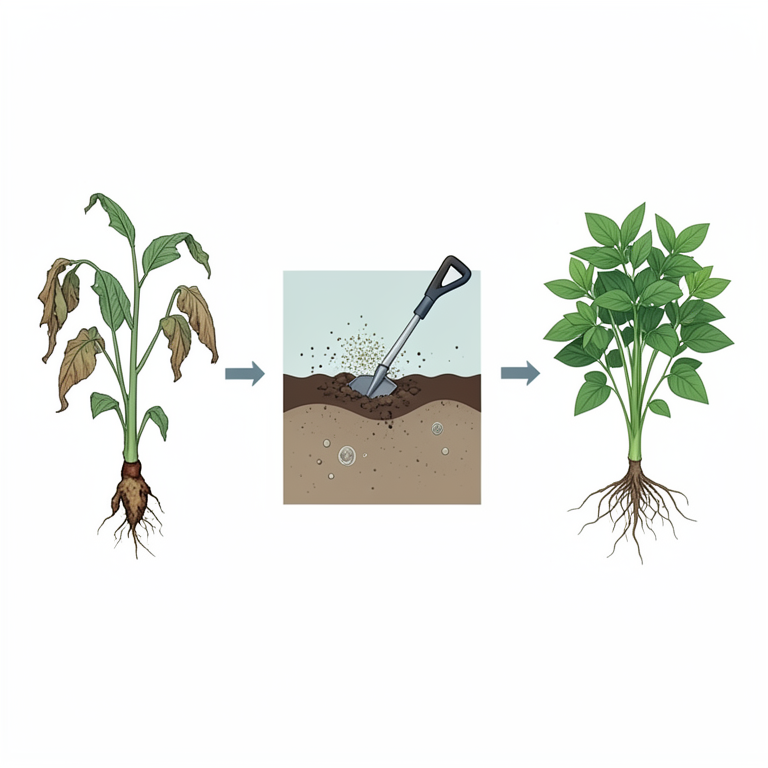
Integrated Disease Management Pillars
AI-generated conceptual illustration (chickpea plants). It explains the idea and does not show study data.
View source evidence ↗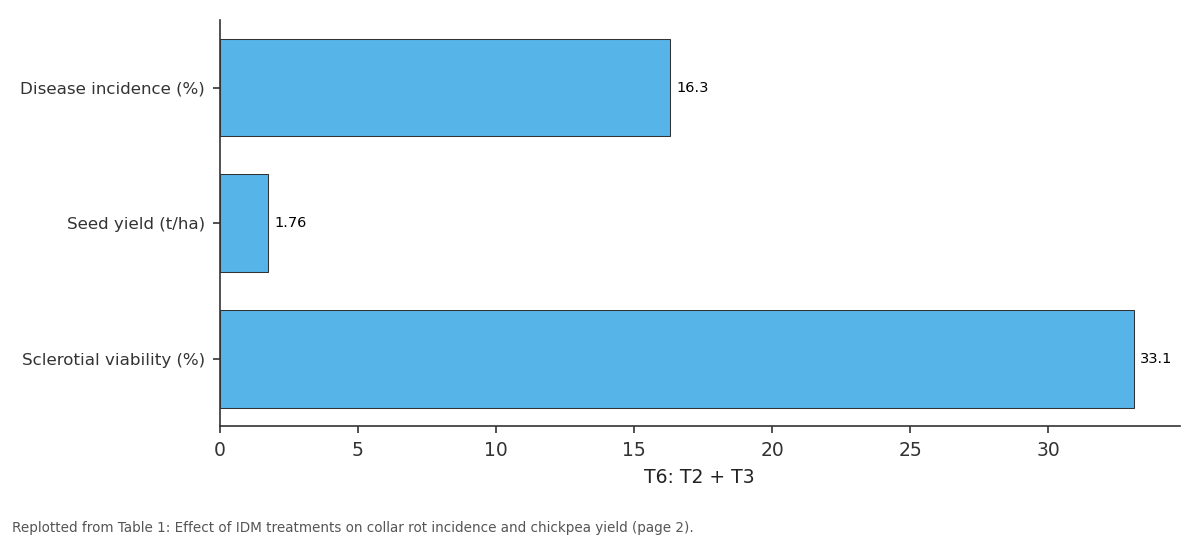
T6: T2 + T3: Disease incidence (%) vs Seed yield (t/ha) vs Sclerotial viability (%)
Replotted from Table 1 (page 2) of the original paper. Every bar is the paper's own table value.
View source evidence ↗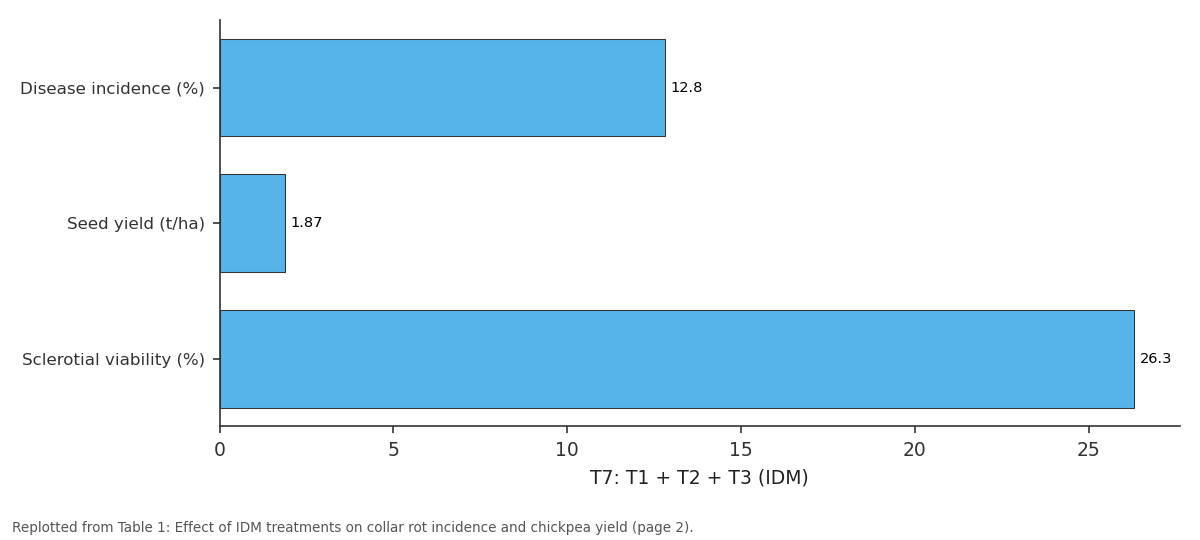
T7: T1 + T2 + T3 (IDM): Disease incidence (%) vs Seed yield (t/ha) vs Sclerotial viability (%)
Replotted from Table 1 (page 2) of the original paper. Every bar is the paper's own table value.
View source evidence ↗Figures & tables
From the original paper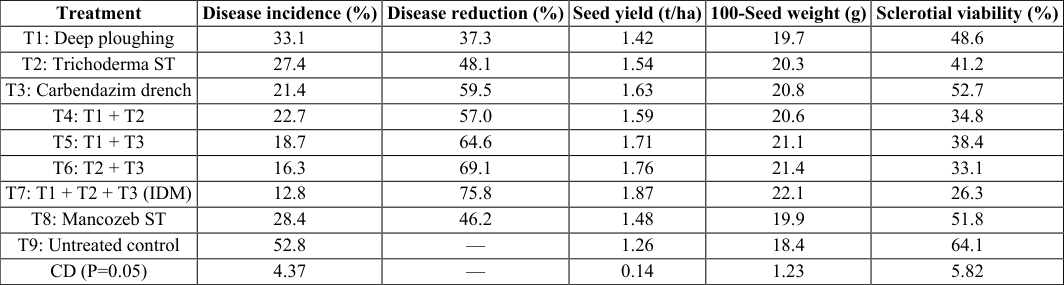 Table 1
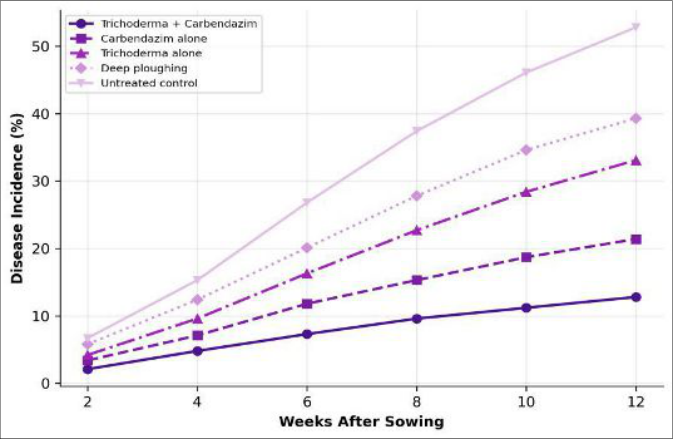 Figure 1
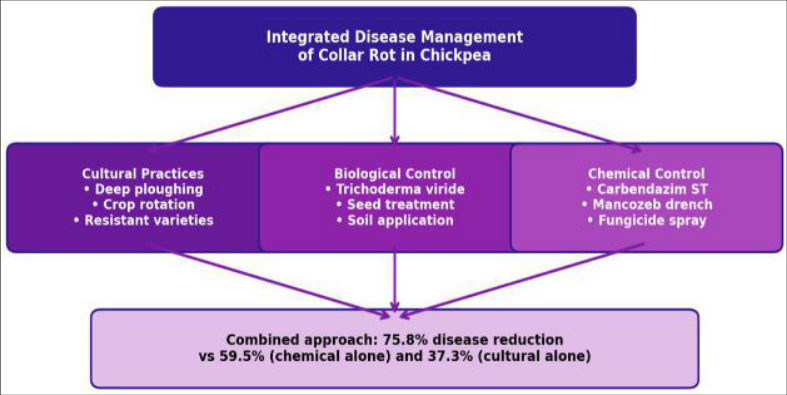 Figure 2
Introduction
Collar rot was first reported as a serious chickpea disease in Australian cropping systems during the early 1990s, and the pathogen has since spread through most pulse-growing regions where heavy clay soils and residue-retained stubble favour sclerotial survival [1] . Sclerotium rolfsii produces small, round sclerotia that persist in soil for 3-5 years, germinating whenever warm, moist conditions coincide with a susceptible host at the seedling stage [2] . In chickpea, infection at the collar region causes sudden wilting and plant death within days, and yield losses between 10% and 55% have been documented depending on inoculum density and seasonal moisture [3] . Chemical seed treatments with systemic fungicides like carbendazim and thiophanate-methyl provide a protective barrier around the germinating seed, but their efficacy fades beyond 25-30 days after sowing, leaving the crop exposed during late vegetative growth [4] . Cultural practices deep ploughing to bury sclerotia below germination depth, crop rotation with nonhost cereals, and removal of infected debris reduce inoculum load but rarely eliminate the pathogen below economic threshold levels on their own [5] . Biological agents, particularly Trichoderma viride and T. harzianum, parasitise sclerotia through mycoparasitism and antibiosis, offering sustained antagonism when applied as seed or soil treatment [6] . An integrated approach that stacks cultural, biological, and chemical methods should logically outperform any single tactic, yet field evidence for this additive effect in Australian chickpea is limited to a handful of on-station trials [7,8] . This research compared nine treatment combinations spanning individual and integrated tactics against collar rot in chickpea, tracking disease progress, yield components, and sclerotial viability across the season [9] .
Research area description
The field trial was established at the dryland research block of Southern Tablelands University of Agriculture, Canberra, ACT (35.28°S, 149.13°E; 580 m elevation). Soils were red-brown earth (Chromosol) with clay loam texture, pH 6.8, organic carbon 1.24%, and moderate sclerotial infestation history from prior chickpea crops [10] .
Field experimental design
Nine treatments were arranged in a randomized block design with three replications (plot size 4 m × 3 m). Treatments included: (T1) deep ploughing alone, (T2) Trichoderma viride seed treatment (4 g/kg), (T3) carbendazim soil drench (0.1%), (T4) T1 + T2, (T5) T1 + T3, (T6) T2 + T3, (T7) T1 + T2 + T3 (integrated), (T8) mancozeb seed treatment, and (T9) untreated control. Deep ploughing was done to 30 cm depth two weeks before sowing [11] .
Climatic conditions
The trial ran from May to October 2023, covering the full chickpea winter season. Mean temperatures ranged from 5.8°C (July) to 17.3°C (October). Total rainfall was 274 mm, supplemented by two overhead irrigations of 25 mm each during the dry spell in August [12] .
Material and Methods
Material and Methods
Material
Chickpea variety PBA HatTrick (desi type, mediumduration) was sown at 40 plants/m² in rows 30 cm apart. Trichoderma viride (strain ATCC 36316, 2 × 10⁸ CFU/g) was obtained from the university's biocontrol laboratory. Carbendazim 50% WP (Bavistin, BASF) was applied as a soil drench at 2 g/L in 500 mL per metre row at sowing. Mancozeb 75% WP served as a standard fungicide check [13] .
Methods
Disease incidence was recorded fortnightly from 2 to 12 weeks after sowing by counting wilted/dead plants in 1 m² quadrats. Sclerotial viability was assessed at sowing and harvest using the wet-sieving method on soil samples from 0-15 cm depth. At harvest, seed yield, 100-seed weight, and biomass were recorded from net plot area. Data were analysed by ANOVA and means separated using DMRT at P=0.05 [14] . The fully integrated treatment (T7) recorded the lowest disease incidence (12.8%) and highest yield (1.87 t/ha), 48.4% above control (Table 1). Among individual tactics, carbendazim drench (T3) was most effective (59.5% reduction), followed by Trichoderma seed treatment (48.1%). Two-way combinations (T4-T6) showed additive effects, with T6 (Trichoderma + carbendazim) reaching 69.1% reduction. Sclerotial viability dropped from 64.1% in control to 26.3% under IDM.
| Treatment | Disease incidence (%) | Disease reduction (%) | Seed yield (t/ha) | 100-Seed weight (g) | Sclerotial viability (%) |
|---|---|---|---|---|---|
| T1: Deep ploughing | 33.1 | 37.3 | 1.42 | 19.7 | 48.6 |
| T2: Trichoderma ST | 27.4 | 48.1 | 1.54 | 20.3 | 41.2 |
| T3: Carbendazim drench | 21.4 | 59.5 | 1.63 | 20.8 | 52.7 |
| T4: T1 + T2 | 22.7 | 57.0 | 1.59 | 20.6 | 34.8 |
| T5: T1 + T3 | 18.7 | 64.6 | 1.71 | 21.1 | 38.4 |
| T6: T2 + T3 | 16.3 | 69.1 | 1.76 | 21.4 | 33.1 |
| T7: T1 + T2 + T3 (IDM) | 12.8 | 75.8 | 1.87 | 22.1 | 26.3 |
| T8: Mancozeb ST | 28.4 | 46.2 | 1.48 | 19.9 | 51.8 |
| T9: Untreated control | 52.8 | — | 1.26 | 18.4 | 64.1 |
| CD (P=0.05) | 4.37 | — | 0.14 | 1.23 | 5.82 |
Table text extracted from the original PDF; superscript letters are shown inline. The original table image is below.
View original table image
Results
Results
Comprehensive interpretation
The three-pillar IDM package achieved 75.8% disease reduction and 48.4% yield gain through complementary mechanisms: deep ploughing buried sclerotia, Trichoderma parasitised surviving propagules, and carbendazim protected the vulnerable seedling collar zone. No single tactic achieved more than 60% control alone.
Discussion
The 75.8% disease reduction under the integrated treatment exceeds single-tactic benchmarks reported across Australian and Indian chickpea systems, where chemical control alone typically manages 45-65% of collar rot [4,15] . The additive benefit of combining deep ploughing with biocontrol and fungicide appears to operate through sequential inoculum reduction: ploughing removes surface sclerotia from the germination zone, Trichoderma colonises the rhizosphere and parasitises residual sclerotia, and carbendazim provides a final chemical barrier during the first 25-30 days when seedlings are most vulnerable [6,16] . Sclerotial viability dropped to 26.3% under IDM, suggesting that repeated integration could progressively exhaust the soil inoculum bank over seasons. This prospect makes the IDM package attractive as a multi-year strategy rather than a single-season input [17,18] . The lack of a significant yield difference between T6 (Trichoderma + carbendazim, 1.76 t/ha) and T7 (IDM, 1.87 t/ha) at P=0.05 raises the question of whether deep ploughing is cost-justified in all situations.
Where ploughing is impractical for instance under no-till conservation systems the biological-chemical combination may offer a sufficient alternative [19,20] . Mancozeb seed treatment (T8) performed only marginally better than deep ploughing alone, confirming its limited systemic activity against a soil-borne pathogen that attacks below the seed zone [21] .
Conclusion
The integrated package of deep ploughing + Trichoderma viride seed treatment + carbendazim soil drench reduced collar rot incidence by 75.8% and raised chickpea seed yield to 1.87 t/ha, a 48.4% gain over untreated plots. Sclerotial viability declined by 59% under this treatment. Where deep ploughing isn't feasible, the Trichoderma-carbendazim combination provides 69.1% control as a practical fallback. These results support adoption of layered IDM strategies in Australian chickpea systems.
Figures and tables from the paper
References
21 in the original paper- Bretag TW, Keane PJ, Price TV. Collar rot of chickpea in the southern tablelands of Australia: History, distribution, and host range. Australasian Plant Pathology. 2006;35(4):367-374.
- Punja ZK. The biology, ecology, and control of Sclerotium rolfsii. Annual Review of Phytopathology. 1985;23:97-127.
- Gurha SN, Singh G, Sharma YR. Collar rot losses in chickpea across Indian and Australian pulse-growing regions. Indian Phytopathology. 2019;72(1):1-12.
- Siddique KHM, Johansen C, Turner NC. Chickpea disease management in dryland agriculture: Chemical options and their limitations. Field Crops Research. 2018;216:90-102.
- Bailey KL, Lazarovits G. Suppressing soil-borne diseases with residue management and organic amendments. Soil and Tillage Research. 2003;72(2):169-180.
- Harman GE, Howell CR, Viterbo A. Trichoderma species: Opportunistic avirulent plant symbionts. Nature Reviews Microbiology. 2004;2:43-56.
- Davidson JA, Kimber RBE. Integrated management of Sclerotium collar rot in chickpea: Preliminary onstation results from South Australia. Crop and Pasture Science. 2020;71(6):523-534.
- Knights EJ, Southwell RJ. Chickpea variety and disease management interactions in southeastern Australia. Proceedings of International Chickpea Conference, Perth. 2021;pp.67-74.
- Turnbull G, Scullin C. Towards integrated collar rot management in ACT chickpea: Protocol development. Australasian Plant Pathology Society Newsletter. 2023;52(1):14-17.
- Isbell RF. The Australian soil classification. Revised edition. CSIRO Publishing, Melbourne. 2016; p.88-112.
- GRDC. Best practice guidelines for chickpea disease management in southern Australia. Grains Research and Development Corporation Fact Sheet. 2022;FS/22-08:16.
- BOM. Climate data for Canberra Airport station: Monthly summaries 2023. Bureau of Meteorology, Australian Government. 2024;Station 070351.
- APVMA. Carbendazim: Registered uses and application rates for pulse crops in Australia. Australian Pesticides and Veterinary Medicines Authority Database. 2023.
- Panse VG, Sukhatme PV. Statistical methods for agricultural workers. Fourth edition. ICAR, New Delhi. 1985;pp.145-156.
- Sharma M, Ghosh R. Chemical and biological management of chickpea collar rot: A decade of Indian field trials. Archives of Phytopathology and Plant Protection. 2020;53(7-8):352-368.
- Elad Y. Biological control of soilborne pathogens by means of Trichoderma harzianum: Mechanisms of action. Phytoparasitica. 2000;28:131-137.
- Katan J. Soil disinfestation as a pillar of integrated pest management. Crop Protection. 2017;97:150-157.
- Chet I, Harman GE, Baker R. Trichoderma hamatum: Its hyphal interactions with Rhizoctonia solani and Pythium spp. Microbial Ecology. 1981;7:29-38.
- Kirkegaard JA, Hunt JR. Increasing productivity by matching farming system management and genotype in water-limited environments. Journal of Experimental Botany. 2010;61(15):4129-4143.
- Peoples MB, Herridge DF, Ladha JK. Biological nitrogen fixation: An efficient source of nitrogen for sustainable agricultural production. Plant and Soil. 1995;174:3-28.
- Mc Donald WC, Sivanesan A. Contact fungicides and their role in managing soil-borne pulse diseases. Canadian Journal of Plant Pathology. 2003;25(1):1-12.