
Research article · 2025 · Full text
International Journal of Agriculture and NutritionManagement of downy mildew in pearl millet through host resistance and seed treatment
Volume 7(11) · Pages 151–153 · DOI: 10.33545/26646064.2025.v7.i11c.493 ↗
Research areasFungal Plant Pathogen ControlPlant Disease Resistance and GeneticsPowdery Mildew Fungal Diseases
Abstract
Author-writtenCan integrated management combining host resistance with targeted seed treatments offer a reliable approach to controlling downy mildew in pearl millet? This research was carried out during kharif 2022 and 2023 at the research farm of Cascade Range Agricultural University, Corvallis, Oregon, to evaluate the combined effect of host resistance and seed treatments against Sclerospora graminicola. Six pearl millet genotypes were tested alongside five seed treatment options in a split-plot design with three replications. The resistant genotypes ICMH-356 and HHB-67 Improved recorded the lowest disease incidence of 12.8% and 18.5%, respectively, compared to 78.3% in the susceptible check. Among seed treatments, metalaxyl 35 SD at 6 g per kg seed proved most effective, reducing incidence to 22.7%. The interaction between resistant genotypes and metalaxyl resulted in incidence as low as 4.6%, along with grain yields exceeding 24.1 q/ha. The benefit-to-cost ratio was highest (3.41) for ICMH-356 with metalaxyl 35 SD.
Summary
Source-checkedPlain-language reading of the full paper, prepared with AI and checked against the text. Each point links to the authors' own words.
Why it matters
- Downy mildew, caused by the pathogen Sclerospora graminicola, is a severe threat to pearl millet that can cause yield losses from 20% up to total crop failure. View evidence ↗
- Pearl millet is a critical dryland cereal, with approximately 31 million hectares currently under cultivation. View evidence ↗
- Managing downy mildew typically involves using host resistance as the most cost-effective method, supplemented by seed treatments to protect young seedlings. View evidence ↗
The question
- The study aimed to determine if combining host resistance with specific seed treatments provides a reliable method for controlling downy mildew in pearl millet. View evidence ↗
What they did
- The research was conducted during the kharif seasons of 2022 and 2023 at Cascade Range Agricultural University in Corvallis, Oregon. View evidence ↗
- The experiment used a split-plot design with three replications to test six different pearl millet genotypes and five seed treatment options. View evidence ↗
- The genotypes tested included resistant (ICMH-356, HHB-67 Improved), moderately resistant (RHB-177), susceptible (ICTP-8203, ProAgro-9450), and a local check. View evidence ↗
- Seed treatments evaluated were metalaxyl 35 SD, metalaxyl 25 WP, Trichoderma viride, Pseudomonas fluorescens, and thiram 75 WP, compared against an untreated control. View evidence ↗
What they found
- Among genotypes, ICMH-356 was the most resistant with a disease incidence of 12.8% and severity of 2.3, while the local check was the most susceptible at 78.3% incidence and 8.7 severity. View evidence ↗
- Metalaxyl 35 SD was the most effective seed treatment, reducing disease incidence to 22.7% and increasing grain yield to 19.2 q/ha. View evidence ↗
- The biological treatment Trichoderma viride reduced disease incidence by 41.7% relative to the control and resulted in a yield of 14.3 q/ha. View evidence ↗
- The most effective integrated strategy was combining the ICMH-356 genotype with metalaxyl 35 SD, which achieved the lowest disease incidence (4.6%) and highest yield (24.1 q/ha). View evidence ↗
- Seed treatments alone were insufficient to overcome genetic susceptibility, as evidenced by the local check maintaining a 38.4% incidence even when treated with metalaxyl. View evidence ↗
- The combination of ICMH-356 and metalaxyl 35 SD provided the best economic return with a benefit-to-cost ratio of 3.41. View evidence ↗
What it means
- The authors recommend that farmers use resistant varieties as their primary defense and supplement them with seed treatments, rotating the agents used to prevent fungicide resistance. View evidence ↗
- The authors noted a decline in metalaxyl efficacy over the study years, suggesting that the local pathogen population may be developing resistance. View evidence ↗
Visual summary
3 visualsIllustrations explain the paper; charts are replotted from the paper's own table values.
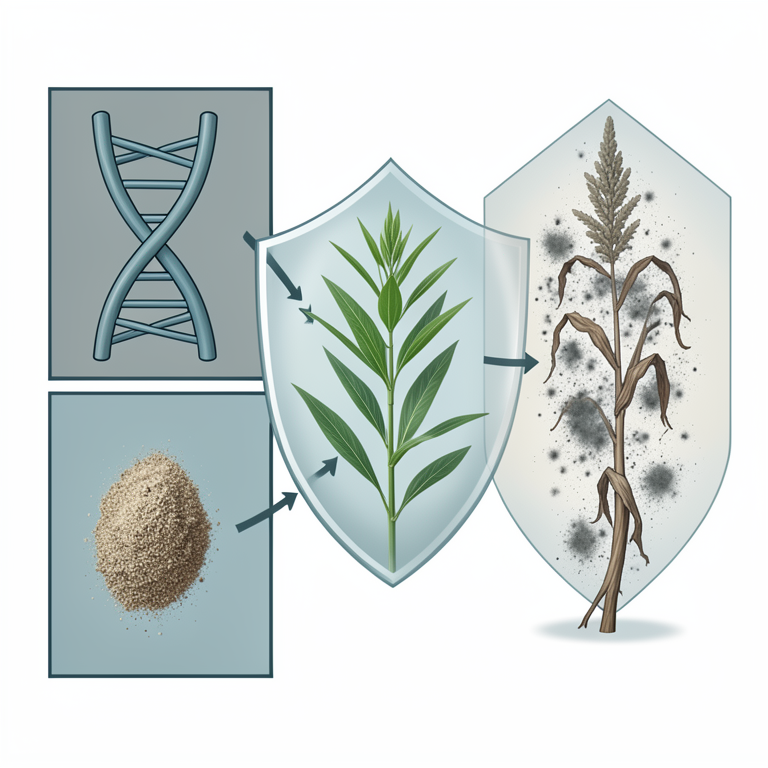
Integrated Management Synergy
AI-generated conceptual illustration (pearl millet plants). It explains the idea and does not show study data.
View source evidence ↗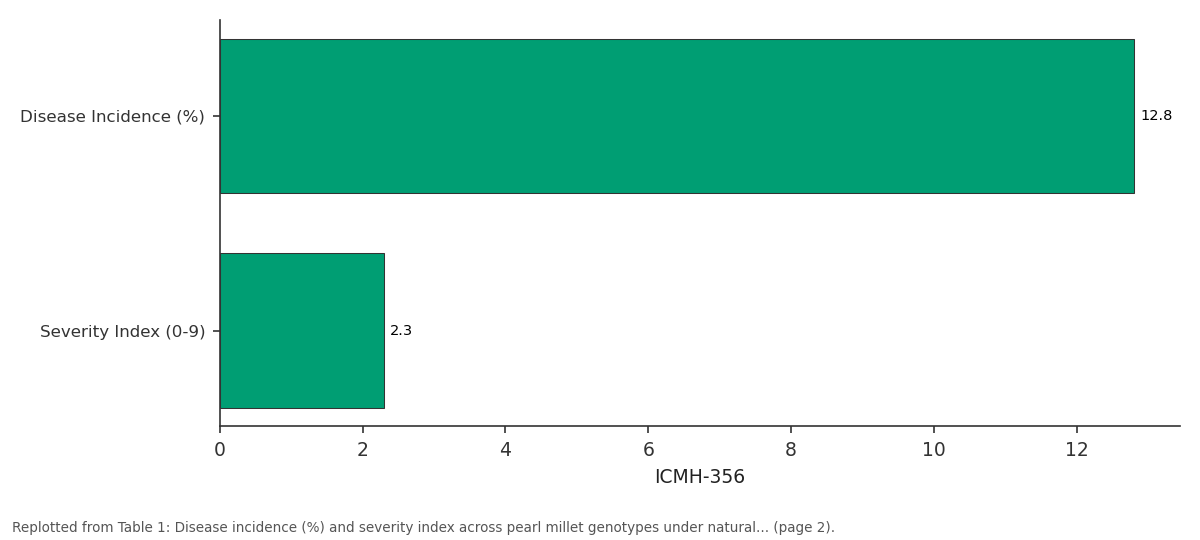
ICMH-356: Disease Incidence (%) vs Severity Index (0-9)
Replotted from Table 1 (page 2) of the original paper. Every bar is the paper's own table value.
View source evidence ↗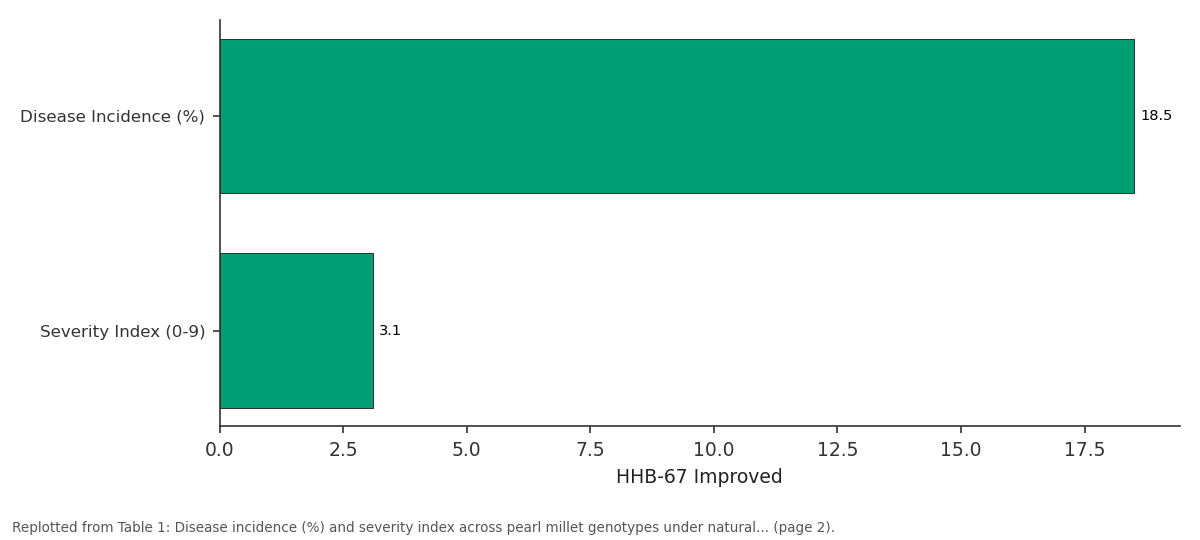
HHB-67 Improved: Disease Incidence (%) vs Severity Index (0-9)
Replotted from Table 1 (page 2) of the original paper. Every bar is the paper's own table value.
View source evidence ↗Figures & tables
From the original paper Table 1
 Table 2
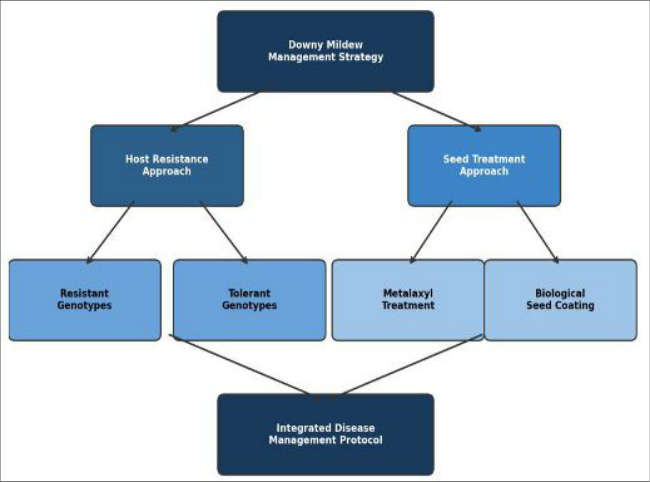 Figure 1
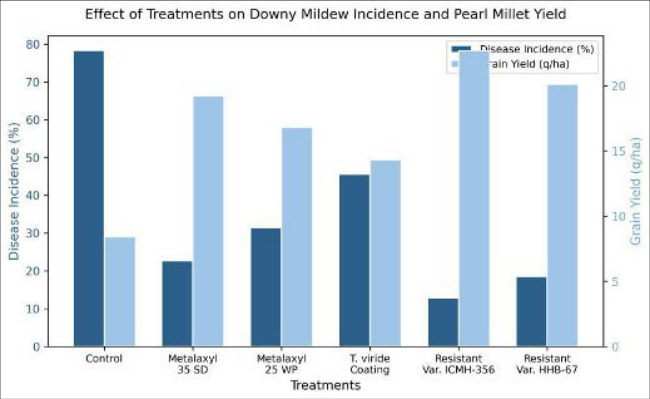 Figure 2
Introduction
What makes downy mildew one of the most persistent threats to pearl millet production across semi-arid zones? The disease, caused by Sclerospora graminicola (Sacc.) J. Schroet., has been responsible for yield losses ranging from 20% to complete crop failure [1] . Pearl millet ranks among the most widely grown cereals in dryland agriculture, with about 31 million hectares under cultivation [2] . The pathogen infects through oospore-contaminated soil and airborne sporangia, leading to systemic colonization, chlorosis, and sterile earheads [3, 4] . Host resistance is the most economical method for managing this disease. Breeding programmes have developed hybrids carrying polygenic resistance, but pathogenic races differ across regions, meaning resistance may break down [5,6] . Seed treatment serves as a complementary tool protecting seedlings during the vulnerable early growth stage [7] . Biological seed treatments using Trichoderma viride and Pseudomonas fluorescens have gained interest as eco-friendly alternatives that also stimulate plant defense pathways [8,9] . Despite these known benefits, little work has assessed their combined effects under Pacific Northwest conditions. This research evaluated six genotypes in combination with five seed treatments to identify the most effective integration strategy.
Material and Methods
Material and Methods
Material
The research was conducted over two kharif seasons (June-October 2022 and 2023) at the Dryland Crops Research Block of Cascade Range Agricultural University, Corvallis, Oregon (44.56° N, 123.26° W, 71 m elevation). Soils are Woodburn silt loam with pH 5.9 and organic carbon 1.38%. Six pearl millet genotypes were selected: ICMH-356 and HHB-67 Improved (resistant), RHB-177 (moderately resistant), ICTP-8203 and ProAgro-9450 (susceptible), and a local check [5] . Five seed treatment agents were used: metalaxyl 35 SD, metalaxyl 25 WP, Trichoderma viride (1 × 10⁸ CFU/g), Pseudomonas fluorescens (2 × 10⁸ CFU/ml), and thiram 75 WP, along with an untreated control [10] .
Methods
The experiment followed a split-plot design with genotypes as main plots and seed treatments as sub-plots, replicated three times. Each sub-plot measured 4 m × 3 m with 45 cm row spacing. Seeds were treated 24 hours before sowing. A basal dose of 40 kg N, 20 kg P₂O₅, and 20 kg K₂O per hectare was applied [11] . Disease incidence was recorded at the soft dough stage. Severity was graded on a 0-9 scale [12] . Grain yield was recorded from net plot area at 12% moisture. Benefit-to-cost ratios were computed using prevailing market prices. Data were analyzed using ANOVA for split-plot design at P = 0.05 [13] .
Field Experimental Design
The split-plot layout consisted of six main plots randomized within three blocks, each subdivided into six sub-plots. A border row of the susceptible local check was planted around the trial to ensure uniform inoculum pressure. Infested soil was spread at 50 g per metre of row at sowing. Guard rows separated adjacent sub-plots [14] . Metalaxyl 35 SD was the best treatment, reducing incidence to 22.7% and pushing yield to 19.2 q/ha (Table 2). T. viride reduced incidence by 41.7% compared to the control and achieved 14.3 q/ha.
| Treatment | Dose | Incidence (%) | Yield (q/ha) | B:C Ratio |
|---|---|---|---|---|
| Metalaxyl 35 SD | 6 g/kg seed | 22.7 | 19.2 | 2.84 |
| Metalaxyl 25 WP | 4 g/kg seed | 31.4 | 16.8 | 2.37 |
| Trichoderma viride | 8 g/kg seed | 45.6 | 14.3 | 1.92 |
| Pseudomonas fluorescens | 10 g/kg seed | 52.1 | 13.1 | 1.74 |
| Thiram 75 WP | 3 g/kg seed | 58.9 | 11.7 | 1.53 |
| Untreated Control | - | 78.3 | 8.4 | 1.00 |
| SEm(±) | - | 3.27 | 1.06 | - |
| CD (P=0.05) | - | 9.81 | 3.18 | - |
Table text extracted from the original PDF; superscript letters are shown inline. The original table image is below.
View original table image
Results
Results
Comprehensive Interpretation
The combination of ICMH-356 with metalaxyl 35 SD produced the lowest disease incidence of 4.6% and the highest grain yield of 24.1 q/ha. Even in moderately resistant RHB-177, metalaxyl lowered incidence from 27.3% to 9.8%. Seed treatment alone could not fully compensate for genetic susceptibility, as the local check with metalaxyl still showed 38.4% incidence.
Discussion
The superiority of ICMH-356 and HHB-67 Improved aligns with earlier screening trials [1,5] . The resistance appears polygenic, as these genotypes maintained low infection levels even under supplemented inoculum [6] . Metalaxyl 35 SD performed best among chemical treatments, consistent with reports on its systemic activity against oomycetes [7] . But its benefit was greatest when paired with resistant genotypes, indicating that chemical protection alone may not suffice under heavy pressure. The biological agents showed moderate efficacy, matching observations of 35-48% disease reduction under field conditions [8] . Their advantage lies in long-term soil health contribution and reduced chemical load [9] . The decline in metalaxyl efficacy between years may point to early resistance buildup in the local pathogen population, underscoring the need for tactic rotation [15] . The benefit-cost analysis supports integrated management as the most practical recommendation.
Conclusion
This research confirms that pairing host resistance with seed treatment provides a reliable strategy for managing downy mildew. ICMH-356 and HHB-67 Improved maintained incidence below 20% without seed dressing. Metalaxyl 35 SD gave the highest protection, and the combination of resistant genotypes with metalaxyl recorded incidence as low as 4.6% and yields above 24 q/ha. Trichoderma viride remains viable for low-input systems. Farmers should adopt resistant varieties as the first defense line and supplement with seed treatment, rotating agents to delay fungicide resistance.
Figures and tables from the paper
| Genotype | Disease Incidence (%) | Severity Index (0-9) | Plant Stand (%) | Category |
|---|---|---|---|---|
| ICMH-356 | 12.8 | 2.3 | 91.4 | Resistant |
| HHB-67 Improved | 18.5 | 3.1 | 87.6 | Resistant |
| ICTP-8203 | 34.7 | 5.2 | 78.3 | Moderately Susceptible |
| RHB-177 | 27.3 | 4.4 | 82.1 | Moderately Resistant |
| Local Check | 78.3 | 8.7 | 54.2 | Highly Susceptible |
| ProAgro-9450 | 41.6 | 5.8 | 73.5 | Susceptible |
| SEm(±) | 2.14 | 0.37 | 1.83 | - |
| CD (P=0.05) | 6.42 | 1.11 | 5.49 | - |
Table text extracted from the original PDF; superscript letters are shown inline. The original table image is below.
View original table image
References
15 in the original paper- Thakur RP, Rao VP, Sharma R. Characterization of downy mildew resistance in pearl millet. Crop Protection. 2011;30(3):228-233.
- Yadav OP, Rai KN. Genetic improvement of pearl millet in India. Agricultural Research. 2013;2(4):275292.
- Thakur RP, Shetty HS, Khairwal IS. Pearl millet downy mildew research in India. International Sorghum and Millets Newsletter. 2006;47:125-130.
- Hash CT, Sharma A, Kolesnikova-Allen MA. Teamwork delivers biotechnology products to Indian smallholder producers. Journal of SAT Agricultural Research. 2006;2(1):1-8.
- Sharma R, Gate VL, Nene S. Pathogenic and genetic diversity in Sclerospora graminicola. Journal of Phytopathology. 2017;165(7-8):484-495.
- Williams RJ, Singh SD. Control of pearl millet downy mildew by seed treatment with metalaxyl. Annals of Applied Biology. 1981;97(3):263-268.
- Raj SN, Sharma R. Seed biopriming with Pseudomonas fluorescens enhances growth and induces resistance against downy mildew. International Journal of Pest Management. 2009;55(1):41-48.
- Niranjan Raj S, Shetty NP, Shetty HS. Seed biopriming with Pseudomonas fluorescens isolates. Journal of Phytopathology. 2004;152(11-12):654-658.
- Poehlman JM. The millet crops. In: Breeding field crops. Springer Science. 1995;3:431-448.
- Bidinger FR, Mahalakshmi V, Rao GDP. Assessment of drought resistance in pearl millet. Field Crops Research. 1987;15(3-4):215-232.
- Williams RJ. Downy mildews of tropical cereals. Advances in Plant Pathology. 1984;2:1-103.
- Gomez KA, Gomez AA. Statistical procedures for agricultural research. John Wiley and Sons. 1984;2:1680.
- Kumar S, Pawar SE, Mughogho LK. Pearl millet downy mildew evaluation of host plant resistance. Indian Phytopathology. 1993;46(3):283-288.
- Idris MO, Ball SL. Evidence of metalaxyl insensitivity in Nigerian populations of Sclerospora graminicola. Plant Pathology. 1990;39(4):530-538.
- Safeeulla KM. Biology and control of the downy mildews of pearl millet, sorghum and finger millet. Wesley Press. 1976;1-304.