
Research article · 2025 · Full text
International Journal of Agriculture and NutritionCharacterization and pathogenicity of colletotrichum species causing anthracnose in chilli
Volume 7(11) · Pages 104–107 · DOI: 10.33545/26646064.2025.v7.i11b.487 ↗
Research areasPlant Pathogens and Fungal DiseasesFungal Plant Pathogen ControlPlant Disease Resistance and Genetics
Abstract
Author-writtenChilli anthracnose, once thought to be caused by a single Colletotrichum species, is now known to involve a species complex whose members differ in virulence, host preference, and fungicide sensitivity. This research characterized 64 Colletotrichum isolates recovered from anthracnose-affected chilli fruits collected across Gujarat and Tamil Nadu during 2022-2023. Morphological examination and multi-locus phylogenetic analysis (ITS, TUB2, ACT, GAPDH) identified four species: C. truncatum (43.8%), C. gloeosporioides (28.1%), C. siamense (18.8%), and C. fructicola (9.4%). Pathogenicity tests on detached chilli fruits (cv. Pusa Jwala) showed that C. truncatum was the most aggressive, producing the highest disease severity (7.8 on 0-9 scale) and incidence (84.6%). Conidial morphology, colony characteristics, and growth rates differed significantly among species. These findings confirm a multi-species etiology for chilli anthracnose in India and highlight C. truncatum as the dominant and most virulent pathogen, which has direct implications for fungicide selection and resistance breeding strategies.
Summary
Source-checkedPlain-language reading of the full paper, prepared with AI and checked against the text. Each point links to the authors' own words.
Why it matters
- Chilli anthracnose is the most economically damaging post-harvest disease for the crop, with potential losses ranging from 10% to 80%. View evidence ↗
- Precise identification of the fungal species is critical because different species exhibit varying fungicide sensitivity, infection stages, and interactions with host resistance. View evidence ↗
- While previously thought to be caused by one species, molecular evidence shows that 10 to 12 different Colletotrichum species can infect chilli globally. View evidence ↗
The question
- The study aimed to identify and assess the pathogenicity of Colletotrichum isolates from Gujarat and Tamil Nadu to determine the prevalent species and their threat levels. View evidence ↗
What they did
- Affected chilli fruits were collected from various districts in Gujarat and Tamil Nadu between July 2022 and March 2023. View evidence ↗
- The researchers obtained a total of 64 fungal isolates for the study. View evidence ↗
- Species identification was performed using multi-locus sequence analysis of the ITS, beta-tubulin, actin, and GAPDH genes. View evidence ↗
- Pathogenicity was tested by wound-inoculating detached Pusa Jwala chilli fruits with a conidial suspension (1 × 10⁶ conidia/ml) and incubating them at 28 °C for 10 days. View evidence ↗
What they found
- Four species were identified among the isolates: C. truncatum (43.8%), C. gloeosporioides (28.1%), C. siamense (18.8%), and C. fructicola (9.4%). View evidence ↗
- C. truncatum was the most common species, exhibiting the fastest growth rate (8.6 mm/day) and falcate conidia averaging 22.4 µm. View evidence ↗
- C. siamense was the least aggressive of the identified species, with a disease severity of 4.6. View evidence ↗
- Analysis of the ITS region alone was insufficient to distinguish C. gloeosporioides from C. siamense and C. fructicola, proving that multi-locus analysis is necessary. View evidence ↗
What it means
- The authors conclude that chilli anthracnose in the studied regions is caused by at least four species, with C. truncatum being the dominant and most virulent. View evidence ↗
- The discovered species diversity implies that fungicide management and cultivar screening must account for the different responses of each species to control measures. View evidence ↗
- The authors state that future research is needed to evaluate the in vitro sensitivity of each identified species to common fungicides. View evidence ↗
Visual summary
3 visualsIllustrations explain the paper; charts are replotted from the paper's own table values.
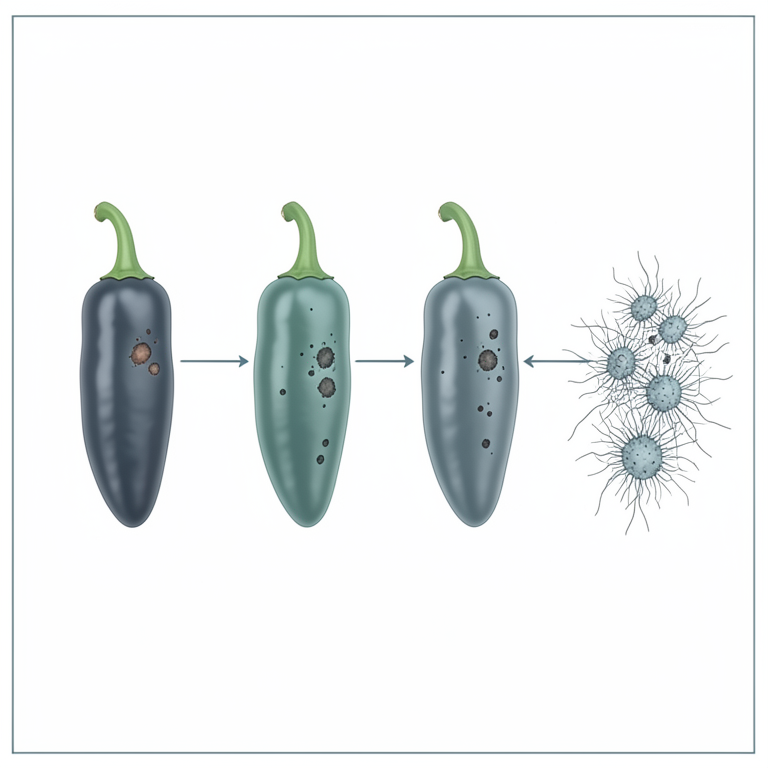
Species Prevalence and Virulence Correlation
AI-generated conceptual illustration (Chilli peppers (Capsicum annuum) and Colletotrichum fungi). It explains the idea and does not show study data.
View source evidence ↗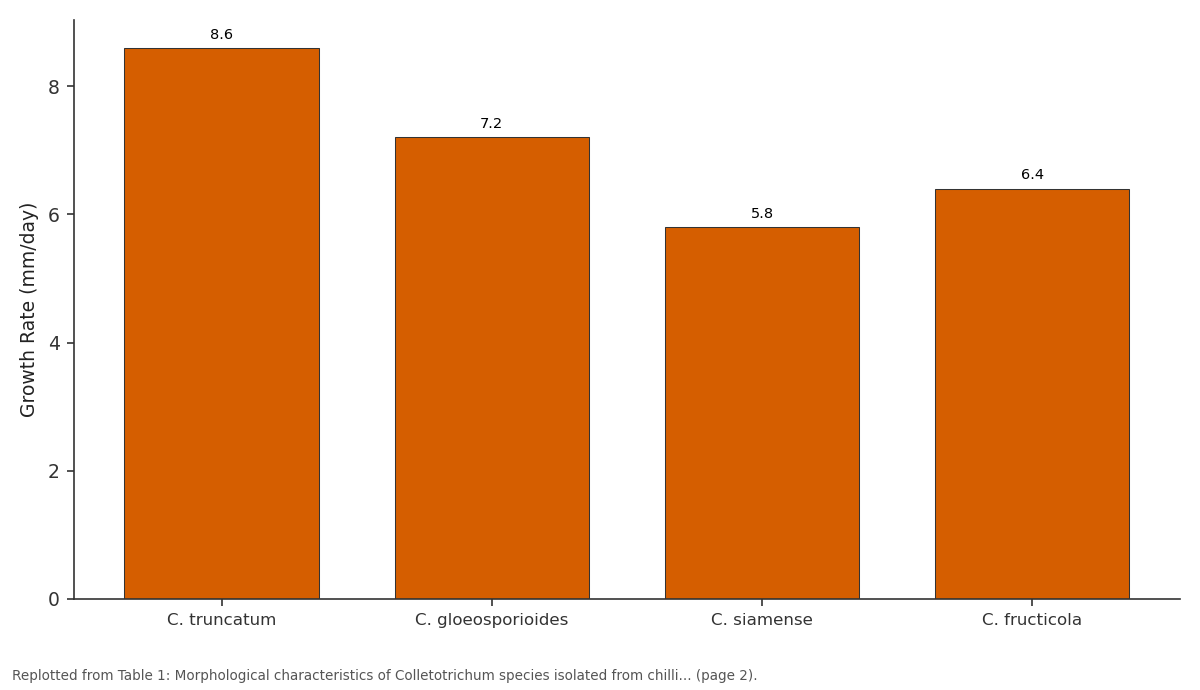
Growth Rate (mm/day): C. truncatum vs C. gloeosporioides vs C. siamense vs C. fructicola
Replotted from Table 1 (page 2) of the original paper. Every bar is the paper's own table value.
View source evidence ↗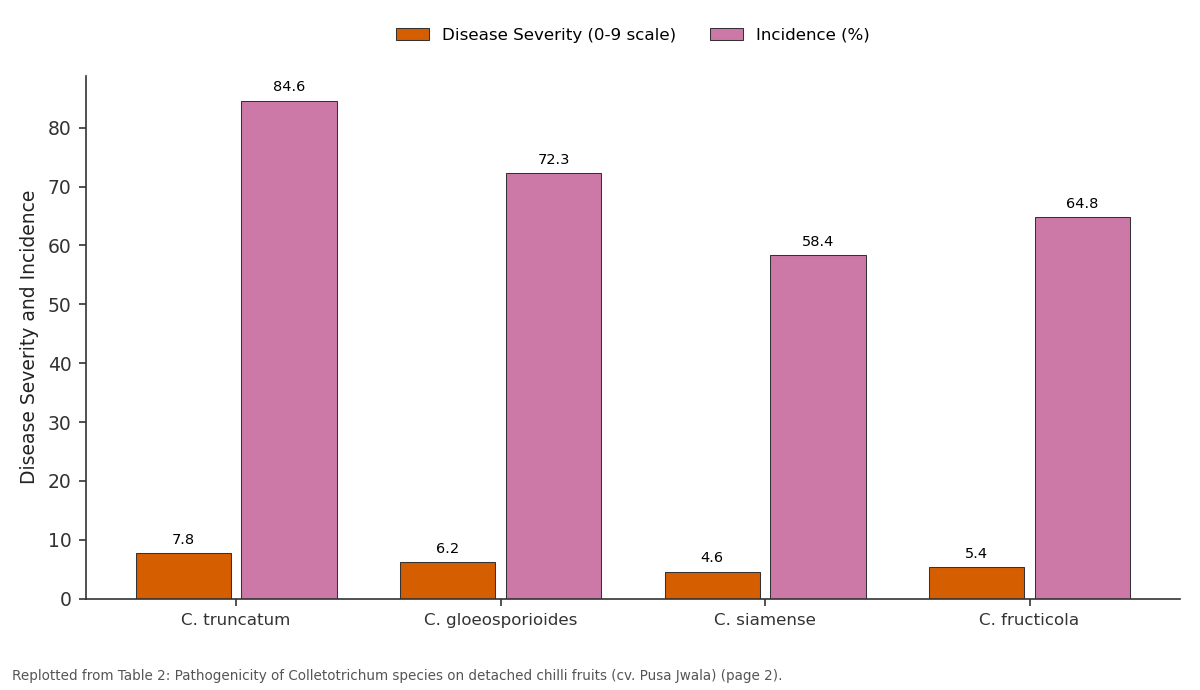
Disease Severity (0-9 scale) and Incidence (%): C. truncatum vs C. gloeosporioides vs C. siamense vs C. fructicola
Replotted from Table 2 (page 2) of the original paper. Every bar is the paper's own table value.
View source evidence ↗Figures & tables
From the original paper Table 1
 Table 2
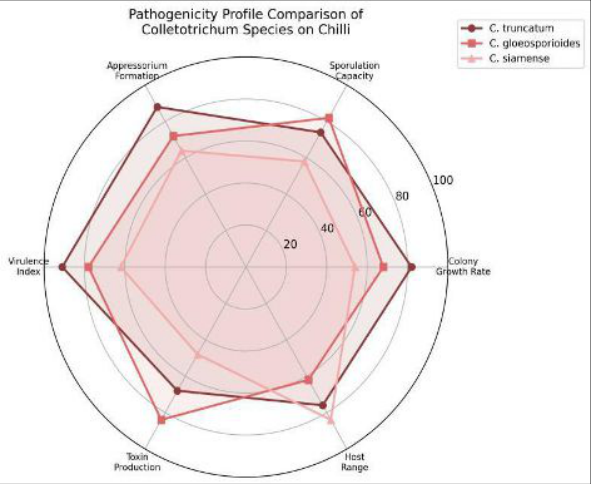 Figure 1
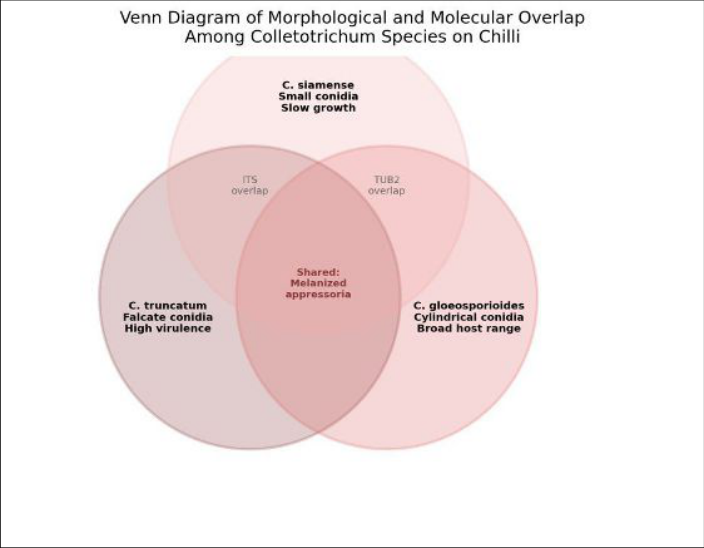 Figure 2
Introduction
If you pick up a chilli fruit with sunken dark lesions in any Indian market, the odds are high that more than one fungal species is responsible for what looks like a single disease. Anthracnose of chilli, caused by species within the genus Colletotrichum, is the most economically damaging post-harvest disease of this crop, causing losses of 10-80% depending on the cultivar and season [1] . For decades, the pathogen was identified simply as Colletotrichum capsici (now reclassified as C. truncatum), but molecular phylogenetics has revealed that at least 10-12 Colletotrichum species can infect chilli worldwide [2] . Accurate species identification matters because different Colletotrichum species vary in their sensitivity to fungicides, their preferred infection stage (pre-harvest vs. post-harvest), and their interaction with host resistance genes [3] . Multi-locus sequence analysis using ITS, betatubulin, actin, and GAPDH genes has become the standard for species delineation within this genus [4] . Despite this progress, the species composition of chilli anthracnose in the major growing states of Gujarat and Tamil Nadu has not been determined using modern phylogenetic methods. This research aimed to collect, characterize, and assess the pathogenicity of Colletotrichum isolates from these two states to establish which species are present and which pose the greatest threat.
Instrumentation and Molecular Methods
Morphological measurements were made using a Leica DM2500 compound microscope fitted with a DFC450 digital camera and LAS v4.12 image analysis software. Conidial dimensions were based on 50 conidia per isolate measured at 400× magnification. For molecular identification, DNA was extracted using the CTAB method from 7-day-old cultures grown on PDA at 25 °C. Four gene regions were amplified: ITS (primers ITS1/ITS4), beta-tubulin (Bt2a/Bt2b), actin (ACT-512F/ACT-783R), and GAPDH (GDF1/GDR1) [4] . PCR products were sequenced bidirectionally at Eurofins Genomics India. Sequences were aligned with MAFFT v7.490 and phylogenetic trees constructed using maximum likelihood in MEGA 11 with 1,000 bootstrap replicates. Species assignment required placement within a well-supported clade (>70% bootstrap) containing the ex-type strain of the species [5] .
Material and Methods Material
Anthracnose-affected chilli fruits were collected from farmer fields and markets in Anand, Kheda, and Mehsana districts of Gujarat, and Coimbatore, Dindigul, and Madurai districts of Tamil Nadu between July 2022 and March 2023.
Isolation followed standard tissue plating on PDA amended with streptomycin (50 mg/L). Monoconidial cultures were prepared and maintained on PDA slants at 4 °C [6] . A total of 64 isolates were obtained. Pathogenicity tests used detached mature green fruits of chilli cultivar Pusa Jwala, surfacesterilized with 1% NaOCl and wound-inoculated with 10 µl of conidial suspension (1 × 10⁶ conidia/ml). Fruits were incubated in moist chambers at 28 °C for 10 days [7] .
Methods
Colony characteristics (color, texture, growth rate) were recorded on PDA at 25 °C after 7 days. Conidial shape, size, and appressorium morphology were documented microscopically. Disease severity was rated on a 0-9 scale and incidence as percentage of inoculated fruits showing symptoms. Lesion diameter was measured at 7 days postinoculation. Koch's postulates were fulfilled by re-isolation from inoculated fruits and confirmation by ITS sequencing.
Data were analyzed by one-way ANOVA at P = 0.05 with Duncan's test [8] .
Results
Table C. truncatum was the most virulent species, producing severity of 7.8 and incidence of 84.6% on detached fruits (Table 2). C. siamense was least aggressive at severity 4.6.
| Species | Disease Severity (0-9 scale) | Incidence (%) | Lesion Size (mm) | Sporulation on Lesion |
|---|---|---|---|---|
| C. truncatum | 7.8 | 84.6 | 12.4 ± 2.1 | Heavy |
| C. gloeosporioides | 6.2 | 72.3 | 9.8 ± 1.6 | Moderate |
| C. siamense | 4.6 | 58.4 | 7.2 ± 1.4 | Light |
| C. fructicola | 5.4 | 64.8 | 8.6 ± 1.8 | Moderate |
| Control | 0 | 0 | 0 | None |
| SEm(±) | 0.42 | - | 0.84 | - |
| CD (P=0.05) | 1.26 | - | 2.52 | - |
Table text extracted from the original PDF; superscript letters are shown inline. The original table image is below.
View original table image
All four species fulfilled Koch's postulates.
Comprehensive Interpretation
Multi-locus phylogeny resolved all 64 isolates into four well-supported clades. The ITS region alone could not distinguish C. gloeosporioides from C. siamense and C. fructicola, confirming the necessity of multi-locus analysis for accurate species identification in this complex. Bootstrap support for all four species clades exceeded 92%.
Discussion
The dominance of C. truncatum in both Gujarat and Tamil Nadu is consistent with earlier reports from India and confirms it as the principal anthracnose pathogen of chilli in the country [1,2] . Its falcate conidial morphology and high growth rate likely contribute to its competitive advantage under field conditions. The detection of C. siamense and C. fructicola is significant because these species have been associated with resistance to certain QoI fungicides in other pathosystems [3] , and their presence in chilli fields should be considered when designing spray programmes. The inability of ITS alone to separate closely related species within the C. gloeosporioides complex reinforces the need for at least two additional loci (TUB2 and GAPDH) as recommended by the Colletotrichum working group [4,5] . From a disease management perspective, the four-species profile established here means that fungicide sensitivity testing should be conducted on representative isolates of each species rather than treating the pathogen population as monolithic.
Conclusion
Chilli anthracnose in Gujarat and Tamil Nadu is caused by at least four Colletotrichum species, with C. truncatum being the most prevalent and virulent. Multi-locus phylogenetic analysis is essential for accurate species identification, as ITS alone is insufficient. The species-level diversity uncovered here has direct implications for fungicide resistance management and cultivar screening, as different species may respond differently to chemical and genetic control measures. Future work should assess the in vitro sensitivity of each species to commonly used fungicides.
Acknowledgement
Acknowledgements Funding Sources
Figures and tables from the paper
| Species | No. Isolates | Colony Color | Conidial Shape | Mean Conidial Length (µm) | Growth Rate (mm/day) |
|---|---|---|---|---|---|
| C. truncatum | 28 | Dark grey | Falcate | 22.4 ± 1.8 | 8.6 |
| C. gloeosporioides | 18 | Pale grey | Cylindrical | 14.8 ± 1.2 | 7.2 |
| C. siamense | 12 | White-grey | Cylindrical | 12.6 ± 0.9 | 5.8 |
| C. fructicola | 6 | Orange-grey | Cylindrical | 13.2 ± 1.1 | 6.4 |
Table text extracted from the original PDF; superscript letters are shown inline. The original table image is below.
View original table image
References
20 in the original paper- Than PP, Prihastuti H, Phoulivong S. Chilli anthracnose disease caused by Colletotrichum species. Journal of Zhejiang University Science B. 2008;9(10):764-778.
- Diao YZ, Zhang C, Liu F. Colletotrichum species causing anthracnose disease of chili in China. Persoonia. 2017;38:20-37.
- De Silva DD, Crous PW, Ades PK. Life styles of Colletotrichum species and implications for plant biosecurity. Fungal Biology Reviews. 2017;31(3):155168.
- Weir BS, Johnston PR, Damm U. The Colletotrichum gloeosporioides species complex. Studies in Mycology. 2012;73:115-180.
- Damm U, Woudenberg JHC, Cannon PF. Colletotrichum species with curved conidia from herbaceous hosts. Fungal Diversity. 2009;39:45-87.
- Agrios GN. Plant pathology. Elsevier Academic Press. 2005;5:1-922.
- Montri P, Taylor PWJ, Mongkolporn O. Pathotypes of Colletotrichum capsici, the causal agent of chili anthracnose. Plant Disease. 2009;93(1):17-20.
- Sharma PN, Kaur M, Sharma OP. Morphological, pathological and molecular variability in Colletotrichum truncatum. Plant Pathology. 2005;54(4):499-507.
- Cannon PF, Damm U, Johnston PR. Colletotrichum: current status and future directions. Studies in Mycology. 2012;73:181-213.
- Liu F, Tang G, Zheng X. Molecular and morphological characterization of Colletotrichum species associated with anthracnose diseases. PLoS ONE. 2016;11(10):e0163489.
- Saxena A, Raghuwanshi R, Singh HB. Molecular, phenotypic and pathogenic variability in Colletotrichum isolates. Molecular Biotechnology. 2014;56(7):625636.
- Mongkolporn O, Taylor PWJ. Chili anthracnose: Colletotrichum taxonomy and pathogenicity. Plant Pathology Journal. 2018;34(1):20-36.
- Prihastuti H, Cai L, Chen H. Characterization of Colletotrichum species associated with coffee berries in northern Thailand. Fungal Diversity. 2009;39:89-109.
- Crouch JA, Clarke BB, Hillman BI. What we know about Colletotrichum graminicola. Molecular Plant Pathology. 2009;10(6):879-885.
- O'Connell RJ, Thon MR, Hacquard S. Lifestyle transitions in plant pathogenic Colletotrichum fungi. Nature Genetics. 2012;44(9):1060-1065.
- Hyde KD, Cai L, McKenzie EHC. Colletotrichum: a catalogue of confusion. Fungal Diversity. 2009;39:1-17.
- Sharma G, Pinnaka AK, Shenoy BD. Resolving the Colletotrichum siamense species complex. Fungal Diversity. 2015;71(1):247-271.
- Jayawardena RS, Hyde KD, Damm U. Notes on currently accepted species of Colletotrichum. Mycosphere. 2016;7(8):1192-1260.
- Rao VP, Thakur RP. Occurrence and virulence of Colletotrichum truncatum on chilli. Indian Phytopathology. 2014;67(4):402-406.
- Nair KPP. The agronomy and economy of black pepper and cardamom. Elsevier. 2011;1:1-380.