
Research article · 2025 · Full text
International Journal of Agriculture and NutritionEffect of sulphur and boron application on yield and quality of rapeseed-mustard
Volume 7(11) · Pages 158–160 · DOI: 10.33545/26646064.2025.v7.i11c.495 ↗
Research areasNitrogen and Sulfur Effects on BrassicaAgricultural Science and FertilizationPlant Micronutrient Interactions and Effects
Abstract
Author-writtenSulphur and boron deficiencies together limit rapeseed-mustard productivity more than any single nutrient gap. A two-year field trial was conducted during rabi 2021-22 and 2022-23 at Uttar Banga Krishi Viswavidyalaya, Cooch Behar, West Bengal, to assess combined effects of sulphur (0, 20, 40, 60 kg/ha) and boron (0, 1.0, 1.5 kg/ha) on yield and quality of Brassica juncea cv. NRCHB-101 in a factorial randomized block design with three replications. Application of 40 kg S/ha with 1.5 kg B/ha recorded the highest seed yield (17.1 q/ha), oil content (41.8%), and oil yield (714.8 kg/ha), which were 74.5%, 15.5%, and 101.4% higher than the control. Sulphur uptake peaked at 23.1 kg/ha with 39.5% apparent recovery. Beyond 40 kg S/ha, yield gains plateaued. These results point to 40 kg S/ha with 1.5 kg B/ha as the optimum dose for terai zone alluvial soils.
Summary
Source-checkedPlain-language reading of the full paper, prepared with AI and checked against the text. Each point links to the authors' own words.
Why it matters
- Rapeseed-mustard is a globally significant oilseed crop, but yields in India are lower than the global average due to nutrient imbalances. View evidence ↗
- Sulphur is essential for oil biosynthesis as it is a structural component of methionine and cysteine. View evidence ↗
The question
- The study aimed to determine the optimal combination of sulphur and boron to maximize the yield and quality of rapeseed-mustard. View evidence ↗
What they did
- A two-year field trial (rabi 2021-22 and 2022-23) was conducted in West Bengal using Brassica juncea cv. NRCHB-101, testing four sulphur levels (0, 20, 40, 60 kg/ha) and three boron levels (0, 1.0, 1.5 kg/ha) in a factorial randomized block design. View evidence ↗
- The experimental soil was a sandy loam with a pH of 5.7 and was deficient in both available sulphur (8.6 mg/kg) and hot water-soluble boron (0.31 mg/kg). View evidence ↗
- The researchers measured seed yield, protein, oil content, and the uptake of sulphur and boron using standardized laboratory methods. View evidence ↗
What they found
- Oil content improved from 36.2% in the control to 41.8% under the optimal S₄₀B₁.₅ treatment. View evidence ↗
- The highest oil yield of 714.8 kg/ha was achieved with 40 kg S/ha and 1.5 kg B/ha, representing a 101.4% increase over the control. View evidence ↗
- The maximum sulphur uptake recorded was 23.1 kg/ha, with an apparent recovery rate of 39.5%. View evidence ↗
- A quadratic model analysis estimated the biological optimum for sulphur application to be approximately 43 kg S/ha. View evidence ↗
What it means
- The authors conclude that 40 kg S/ha combined with 1.5 kg B/ha is the optimal dose for maximizing yield, quality, and economic return in deficient alluvial soils. View evidence ↗
- The authors recommend that farmers in the terai zone adopt this nutrient combination, while using soil testing to refine doses based on existing soil nutrients. View evidence ↗
Visual summary
2 visualsIllustrations explain the paper; charts are replotted from the paper's own table values.
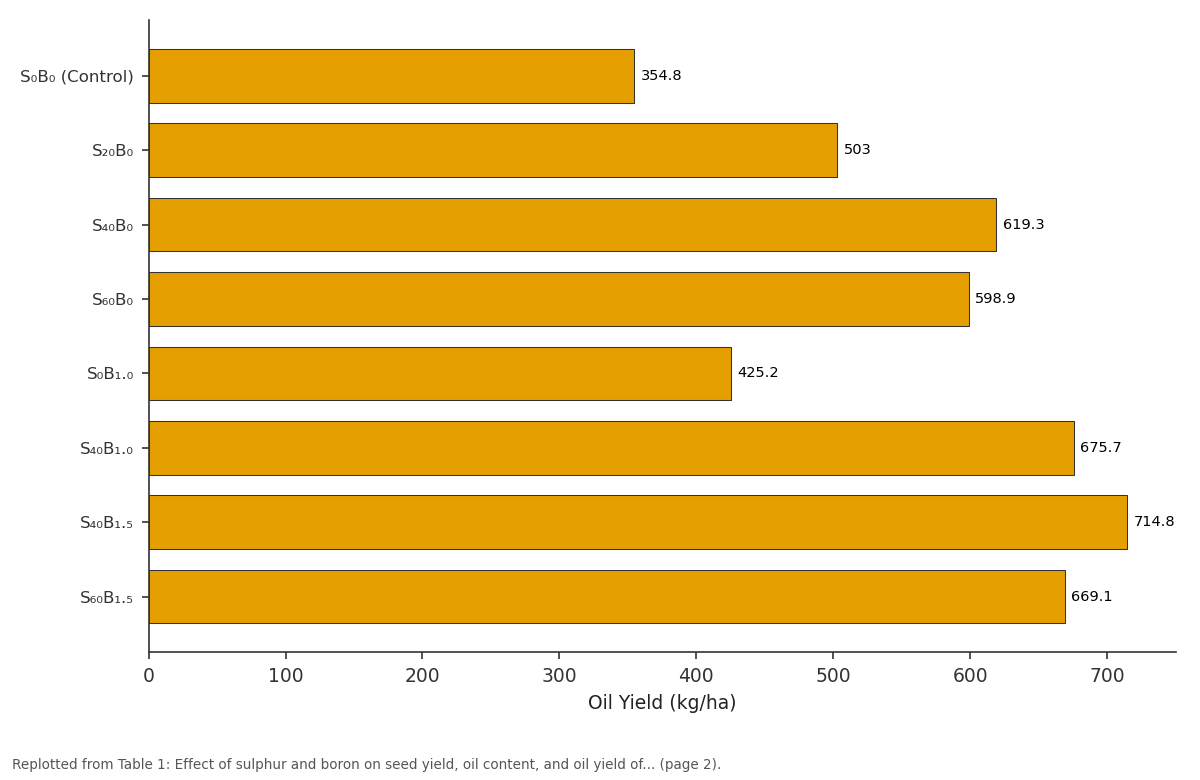
Oil Yield (kg/ha): S₀B₀ (Control) vs S₂₀B₀ vs S₄₀B₀ vs S₆₀B₀ vs S₀B₁.₀
Replotted from Table 1 (page 2) of the original paper. Every bar is the paper's own table value.
View source evidence ↗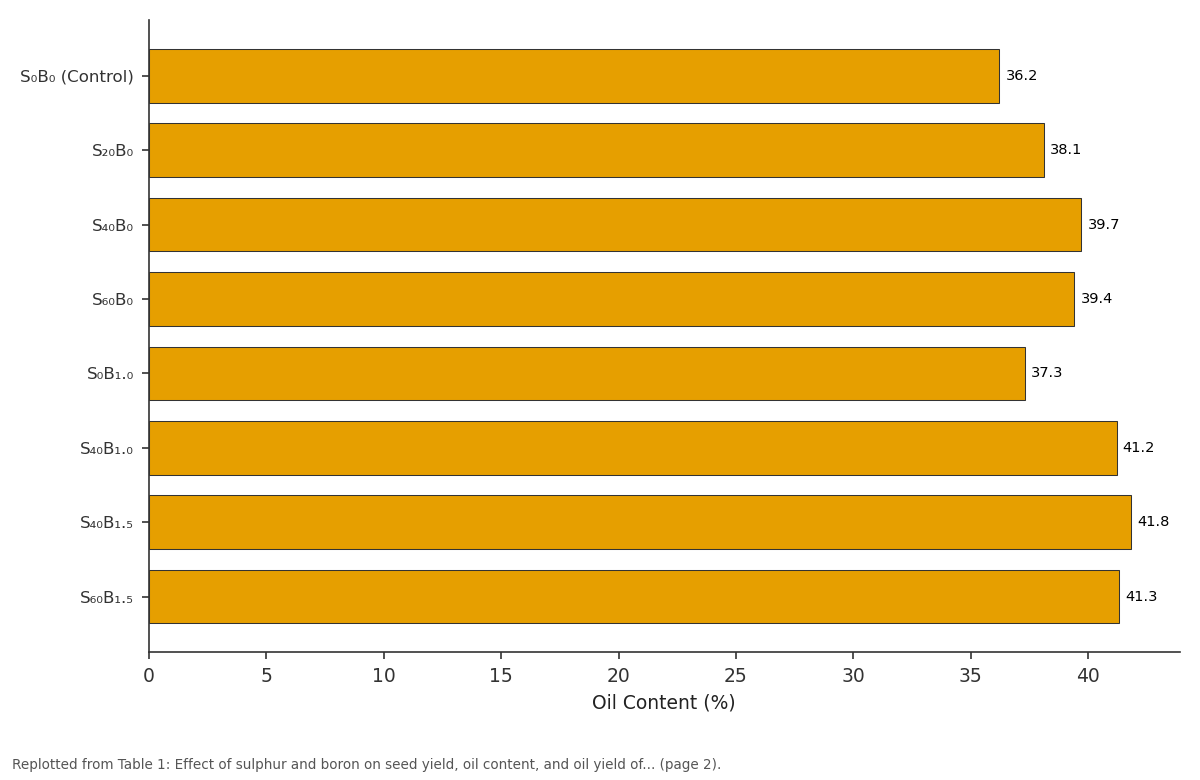
Oil Content (%): S₀B₀ (Control) vs S₂₀B₀ vs S₄₀B₀ vs S₆₀B₀ vs S₀B₁.₀
Replotted from Table 1 (page 2) of the original paper. Every bar is the paper's own table value.
View source evidence ↗Figures & tables
From the original paper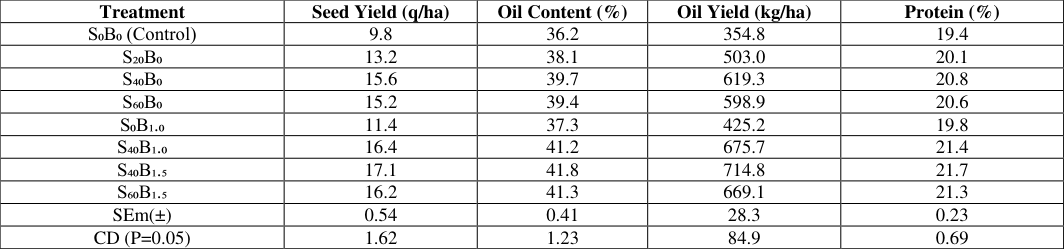 Table 1
 Table 2
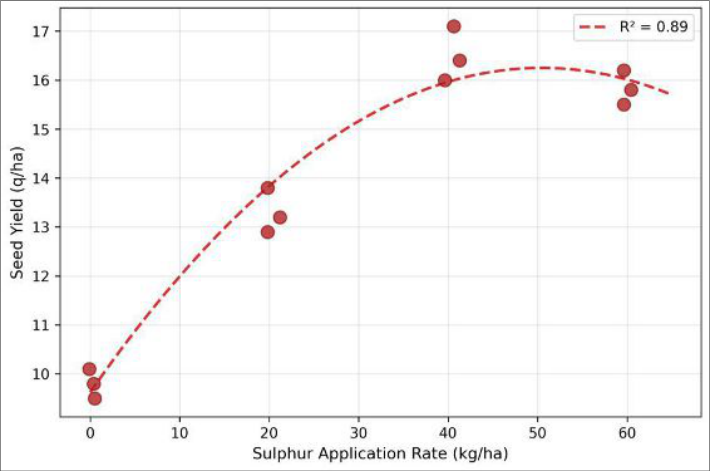 Figure 1
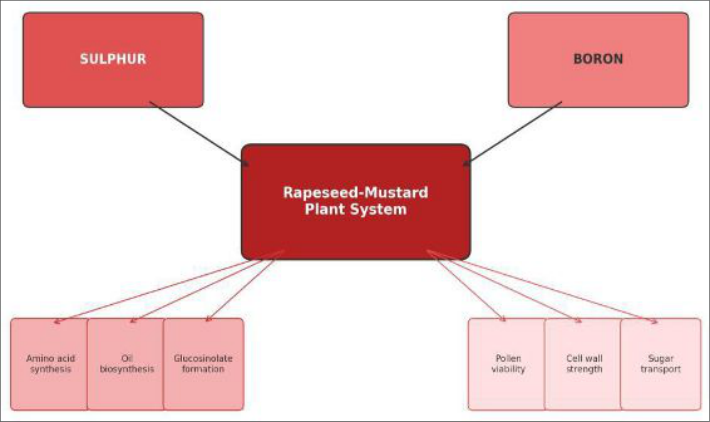 Figure 2
Introduction
Rapeseed-mustard is the third largest oilseed crop globally, yet Indian average yields remain well below the world average because of nutrient imbalances. India cultivated roughly 8.5 million hectares during 2022-23 with a national average of 13.8 q/ha versus the global mean of about 20 q/ha [1] . A significant portion of this gap traces to inadequate sulphur and boron nutrition [2] . Sulphur is a structural component of cysteine and methionine and directly influences oil biosynthesis. Mustard removes 12-15 kg S per tonne of seed, yet sulphur application is routinely neglected [3] . The shift from ammonium sulphate to urea has worsened the sulphur balance, with deficiency documented in over 40% of Indian soils [4] . Boron plays a non-substitutable role in pollen germination and sugar transport; deficient plants show poor pod set and shriveled seeds [5] . The terai zone of West Bengal is prone to boron deficiency due to leaching and acidic soils [6] . While individual responses have been examined, their combined application under terai conditions has not been adequately explored [7] . This research determined the optimum combination for maximizing yield and quality.
Material and Methods
Material and Methods
Material
The experiment was conducted during rabi 2021-22 and 2022-23 at the Instructional Farm of Uttar Banga Krishi Viswavidyalaya, Cooch Behar (26.32° N, 89.44° E, 43 m altitude). Soil was sandy loam (Typic Haplaquept), pH 5.7, organic carbon 0.82%, available S 8.6 mg/kg (deficient), and hot water-soluble B 0.31 mg/kg (deficient). Variety NRCHB-101 was sown at 5 kg/ha in 30 cm rows. Basal dose: 80 kg N, 40 kg P₂O₅, 40 kg K₂O per hectare [8] .
Methods
A factorial RBD with four sulphur levels (0, 20, 40, 60 kg/ha as elemental S) and three boron levels (0, 1.0, 1.5 kg/ha as borax) gave 12 treatments × 3 replications. Plot size was 5 m × 3 m. Sulphur was basal; boron was split at sowing and flower initiation.
Observations: seed yield, oil content (Soxhlet), protein (micro-Kjeldahl), S uptake (turbidimetric), B uptake (azomethine-H) [9] . Apparent S recovery was computed. Data were pooled and analyzed at P = 0.05 [10] .
Field Experimental Design
The 36 plots were arranged in three blocks perpendicular to field slope. A 1 m alley separated plots and 1.5 m separated blocks. Irrigation was provided at crown root initiation, flowering, and siliqua development stages. No sulphur-or boron-containing pesticides were used [11] . Boron improved S recovery from 27.8% (S₄₀B₀) to 39.5% (S₄₀B₁.₅), suggesting synergistic nutrient absorption (Table 2). B:C ratio peaked at 2.79 for S₄₀B₁.₅ and declined at higher S doses.
| Treatment | S Uptake (kg/ha) | B Uptake (g/ha) | S Recovery (%) | B:C Ratio |
|---|---|---|---|---|
| S₀B₀ | 7.3 | 42.1 | - | 1.00 |
| S₂₀B₀ | 12.8 | 48.6 | 27.5 | 1.84 |
| S₄₀B₀ | 18.4 | 52.3 | 27.8 | 2.31 |
| S₄₀B₁.₀ | 21.7 | 78.4 | 36.0 | 2.68 |
| S₄₀B₁.₅ | 23.1 | 91.6 | 39.5 | 2.79 |
| S₆₀B₁.₅ | 22.4 | 88.2 | 25.2 | 2.43 |
| SEm(±) | 1.12 | 4.37 | 2.14 | - |
| CD (P=0.05) | 3.36 | 13.11 | 6.42 | - |
Table text extracted from the original PDF; superscript letters are shown inline. The original table image is below.
View original table image
Results
Results
Comprehensive Interpretation
The quadratic model (R² = 0.89) estimates a biological optimum at about 43 kg S/ha. Adding 1.5 kg B/ha shifted yield upward by 1.5 q/ha without changing the inflection point, implying boron removes a separate bottleneck. The strong correlation between oil content and S uptake (r = 0.91) supports the biochemical link between sulphur and fatty acid desaturation.
Discussion
The oil content increase of 5.6 percentage points is economically meaningful as oilseed pricing depends directly on extractable oil. Sulphur's role through acetyl-CoA carboxylase is well established [7] . The synergistic effect of boron on S recovery (27.8% vs. 39.5%) may relate to boron's influence on root cell wall elasticity and membrane transport, improving sulphate uptake [5] . The plateau beyond 40 kg S/ha matches patterns in other oilseed crops [3] , and the declining B:C ratio at 60 kg S/ha confirms that exceeding the optimum is inadvisable.
Conclusion
The treatment of 40 kg S/ha with 1.5 kg B/ha gave the highest seed yield, oil content, oil yield, and economic return on sulphur-and boron-deficient alluvial soils. Beyond 40 kg S/ha, yield gains flattened. Boron at 1.5 kg/ha enhanced both yield and sulphur recovery. Farmers in the terai zone should adopt this combination as part of balanced nutrient management, with soil testing recommended to adjust doses based on residual nutrient status.
Figures and tables from the paper
| Treatment | Seed Yield (q/ha) | Oil Content (%) | Oil Yield (kg/ha) | Protein (%) |
|---|---|---|---|---|
| S₀B₀ (Control) | 9.8 | 36.2 | 354.8 | 19.4 |
| S₂₀B₀ | 13.2 | 38.1 | 503.0 | 20.1 |
| S₄₀B₀ | 15.6 | 39.7 | 619.3 | 20.8 |
| S₆₀B₀ | 15.2 | 39.4 | 598.9 | 20.6 |
| S₀B₁.₀ | 11.4 | 37.3 | 425.2 | 19.8 |
| S₄₀B₁.₀ | 16.4 | 41.2 | 675.7 | 21.4 |
| S₄₀B₁.₅ | 17.1 | 41.8 | 714.8 | 21.7 |
| S₆₀B₁.₅ | 16.2 | 41.3 | 669.1 | 21.3 |
| SEm(±) | 0.54 | 0.41 | 28.3 | 0.23 |
| CD (P=0.05) | 1.62 | 1.23 | 84.9 | 0.69 |
Table text extracted from the original PDF; superscript letters are shown inline. The original table image is below.
View original table image
References
13 in the original paper- Aulakh MS, Malhi SS. Interactions of nitrogen with other nutrients and water. Advances in Agronomy. 2005;86:341-409.
- Tandon HLS. Sulphur research and agricultural production in India. Fertiliser Development and Consultation Organisation. 2011;4:1-160.
- Shukla AK, Behera SK, Pakhre A. Micronutrient deficiencies vis-a-vis food and nutritional security. Indian Journal of Fertilisers. 2018;14(12):52-67.
- Goldbach HE, Wimmer MA. Boron in plants and animals. Journal of Plant Nutrition and Soil Science. 2007;170(1):39-48.
- Sarkar D, Mandal B, Kundu MC. Increasing use efficiency of boron fertilisers. Plant and Soil. 2007;301(1):77-85.
- Malhi SS, Gan Y, Raney JP. Yield, seed quality, and sulphur uptake of Brassica oilseed crops. Agronomy Journal. 2007;99(2):570-577.
- Ray K, Sengupta K, Pal AK. Effect of sulphur and boron nutrition on Indian mustard. Journal of Oilseed Brassica. 2014;5(2):122-128.
- Tandon HLS. Methods of analysis of soils, plants, waters and fertilisers. Fertiliser Development and Consultation Organisation, New Delhi. 2005;2:1-204.
- Fageria NK, Baligar VC, Jones CA. Growth and mineral nutrition of field crops. CRC Press. 2011;3:1560.
- Prasad R, Shivay YS, Kumar D. Current status of sulphur in Indian agriculture. Indian Journal of Agronomy. 2016;61(3):261-268.
- Saha B, Saha S, Poddar P. Yield and quality of rapeseed as influenced by boron. Journal of the Indian Society of Soil Science. 2015;63(2):202-208.
- Singh MV. Micronutrient nutritional problems in soils of India. Indian Journal of Fertilisers. 2009;5(4):11-26.
- Saha R, Mishra VK. Effect of organic residue management on soil characteristics. Soil and Tillage Research. 2009;104(1):64-72.