
Research article · 2025 · Full text
International Journal of Agriculture and NutritionEfficacy of botanical extracts against late blight of potato under field conditions
Volume 7(7) · Pages 259–262 · DOI: 10.33545/26646064.2025.v7.i7d.553 ↗
Research areasPlant Pathogens and ResistanceFungal Plant Pathogen ControlPlant Disease Management Techniques
Abstract
Author-writtenFew people realise that a disease first recorded during the 1845 Irish famine still drains an estimated US$6.7 billion from global potato production every year—and synthetic fungicides remain the primary weapon. This research evaluated neem extract, garlic extract, and their combination against late blight (Phytophthora infestans) across three field seasons (April 2022-September 2024) at Porto Alegre, Rio Grande do Sul, Brazil. The neem-garlic combination held final disease severity at 53.6% compared with 91.2% in untreated controls, achieving a 41.2% reduction. Neem alone reduced severity by 30.5% and garlic alone by 20.7%. The chemical reference (mancozeb) gave 49.1% reduction. Tuber yield under the combined botanical treatment reached 26.1 t/ha, approaching the mancozeb check (27.6 t/ha) and exceeding the control by 69.5%. At roughly 38% lower input cost per hectare than the fungicide programme, the neem-garlic mixture offers smallholders and organic growers a viable eco-friendly alternative that delivers about 84% of the chemical’s protective effect.
Summary
Source-checkedPlain-language reading of the full paper, prepared with AI and checked against the text. Each point links to the authors' own words.
Why it matters
- Late blight, caused by the oomycete Phytophthora infestans, is the most expensive pathogen for global potato production, costing approximately US$6.7 billion per year. View evidence ↗
- In Rio Grande do Sul, Brazil, the cool and humid climate is ideal for the disease, leading some commercial growers to apply fungicides 12 to 16 times per crop cycle. View evidence ↗
- Regulatory changes in Brazil and consumer concerns regarding pesticide residues are driving the search for plant-based alternatives to synthetic fungicides. View evidence ↗
The question
- The study aimed to determine if neem and garlic extracts, used alone or together, could provide commercially viable protection against late blight compared to the synthetic fungicide mancozeb. View evidence ↗
What they did
- Field trials were conducted in Porto Alegre, Brazil, over three seasons from April 2022 to September 2024. View evidence ↗
- The researchers used the Agata potato variety, which is known to be susceptible to late blight. View evidence ↗
- Treatments included a commercial neem formulation (1.2% azadirachtin at 3 mL/L) and a manually prepared 10% v/v garlic extract. View evidence ↗
- The study used a randomized complete block design with four replications for five groups: an untreated control, neem, garlic, a neem-garlic combination, and mancozeb. View evidence ↗
- Researchers measured disease severity weekly on 10 plants per plot, calculated the Area Under the Disease Progress Curve (AUDPC), and recorded tuber yield 120 days after planting. View evidence ↗
What they found
- The combined neem-garlic treatment reduced final disease severity to 53.6%, which was statistically similar to the 46.4% severity seen with mancozeb. View evidence ↗
- The combined botanical program was more cost-effective, costing R$1,180/ha compared to R$1,920/ha for mancozeb, representing a 38.5% saving. View evidence ↗
What it means
- The authors conclude that the neem-garlic combination is a viable alternative for organic producers and smallholders wanting to reduce their use of synthetic fungicides. View evidence ↗
- A limitation of the study was the use of only one highly susceptible potato variety (Agata); the authors suggest testing moderately resistant varieties in the future. View evidence ↗
- The manual weekly preparation of garlic extract may have introduced variability in allicin concentrations, potentially affecting the data. View evidence ↗
Visual summary
3 visualsIllustrations explain the paper; charts are replotted from the paper's own table values.
Comparative Efficacy of Treatments
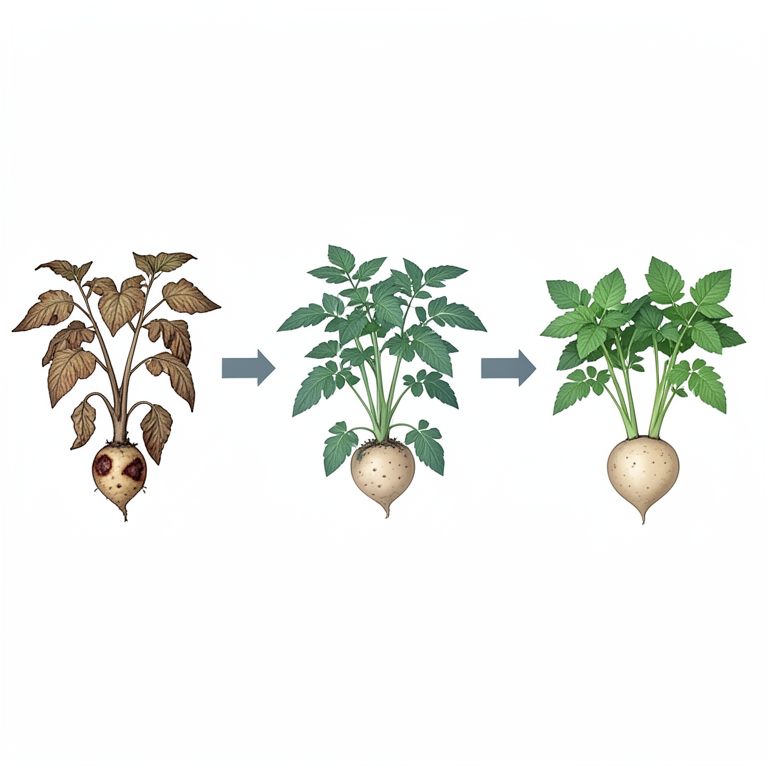
AI-generated conceptual illustration (potato plants (Solanum tuberosum) with late blight infection). It explains the idea and does not show study data.
View source evidence ↗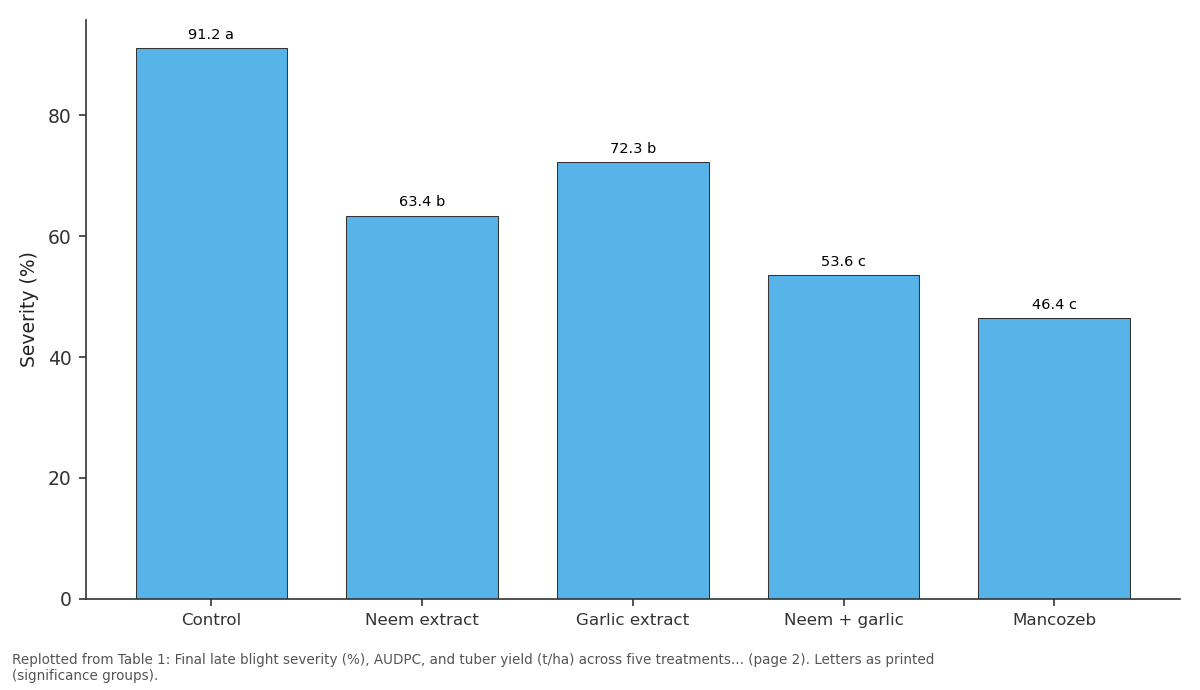
Severity (%): Control vs Neem extract vs Garlic extract vs Neem + garlic vs Mancozeb
Replotted from Table 1 (page 2) of the original paper. Every bar is the paper's own table value.
View source evidence ↗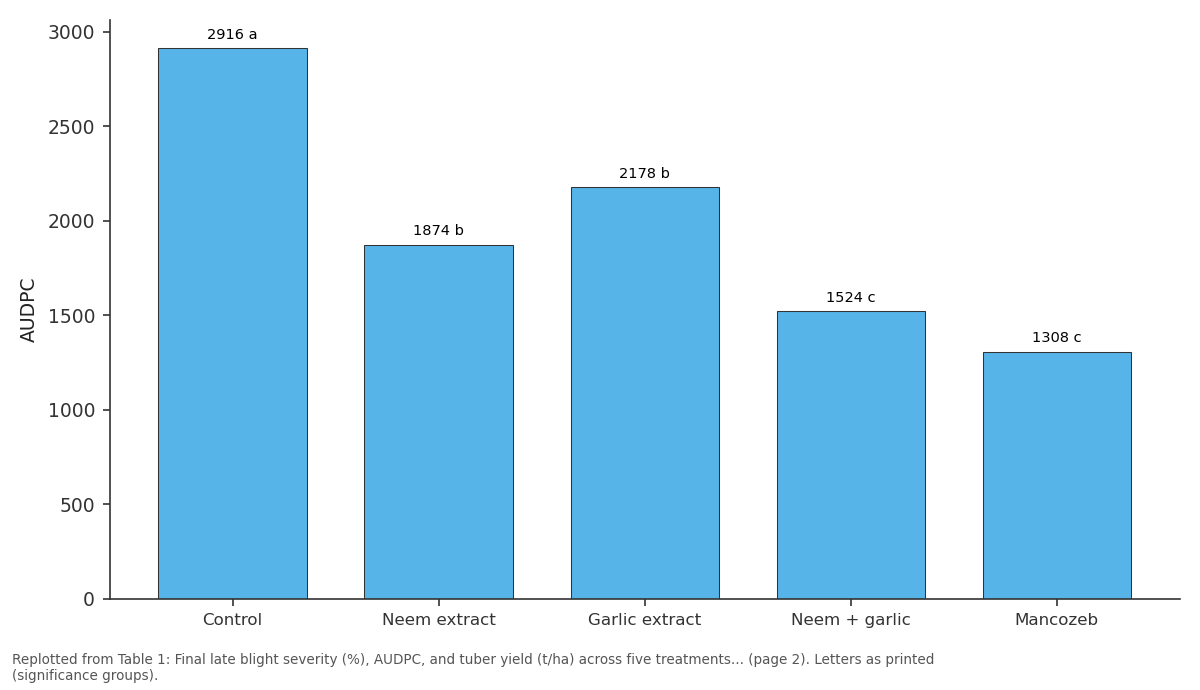
AUDPC: Control vs Neem extract vs Garlic extract vs Neem + garlic vs Mancozeb
Replotted from Table 1 (page 2) of the original paper. Every bar is the paper's own table value.
View source evidence ↗Figures & tables
From the original paper Table 1
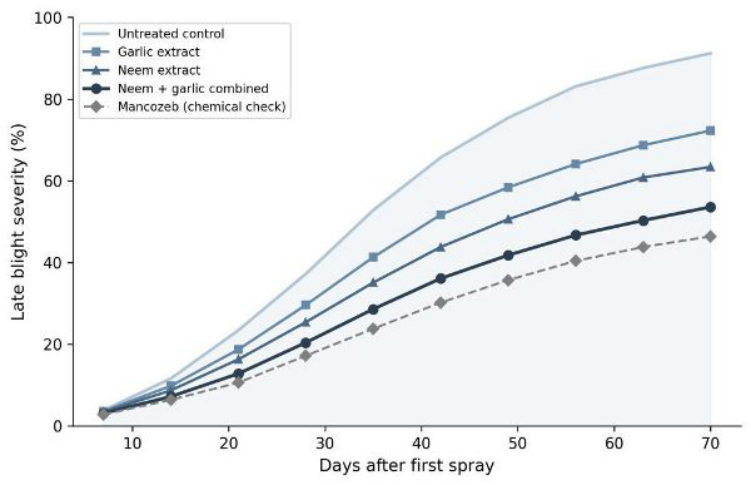 Figure 1
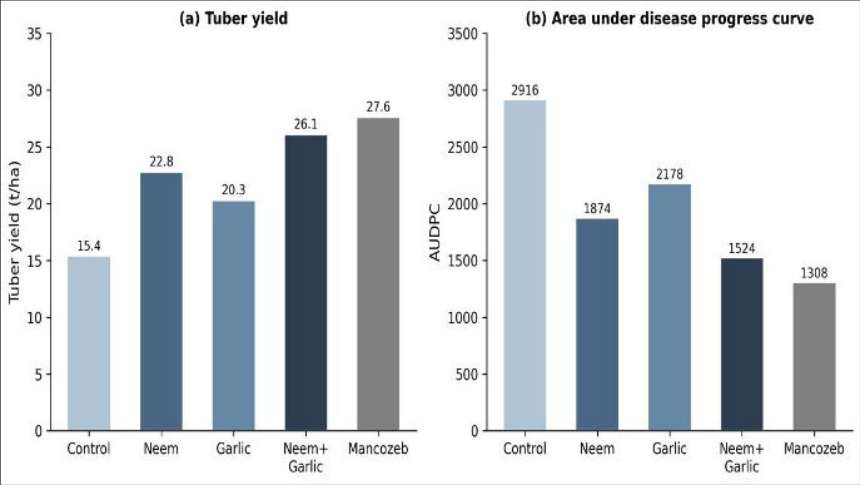 Figure 2
Introduction
A surprising piece of agricultural history: Phytophthora infestans, the oomycete that triggered the worst famine in modern European history, still ranks as the single costliest pathogen in potato production worldwide, accounting for losses and control expenses estimated at US$6.7 billion annually [1] . In southern Brazil, cool and humid autumn-winter conditions create near-ideal epidemiological windows, and commercial growers in Rio Grande do Sul may spray fungicides 12-16 times in a single crop cycle [2] . Growing consumer concern about pesticide residues and evolving Brazilian regulatory frameworks have pushed researchers toward plant-derived alternatives [3] . Neem (Azadirachta indica) produces azadirachtin and related limonoids with demonstrated antifungal and anti-oomycete activity in laboratory assays [4] . Garlic (Allium sativum) is rich in allicin and ajoene, sulfur compounds that inhibit spore germination and mycelial extension in several Phytophthora species under controlled conditions [5] . Yet translating laboratory potency into field-scale disease management is a different matter entirely, and replicated field evidence from Brazilian potato systems has been thin [6] . This research compared neem and garlic extracts-individually and combined-against a mancozeb reference over three consecutive seasons to determine whether botanical sprays can deliver commercially meaningful protection in one of the most blight-prone environments in the Americas.
Climatic Conditions
Across the three trial seasons (April-September 2022, 2023, and 2024), mean air temperature ranged from 10.8 to 18.2 °C and relative humidity averaged 82-88%. Cumulative rainfall during the cropping window totalled 487, 536, and 448 mm for the three years respectively. These cool, moist conditions favoured P. infestans sporulation throughout each season. The 2023 season brought the heaviest blight pressure, with first symptoms appearing 11 days earlier than in the other two years [8] .
Materials
Institutional approval was obtained from the School's Research Ethics Board (Ref. ESCAS/REB/2022-009, March 2022). Potato tubers of the susceptible variety Agata were planted in the first week of April each year at 75 × 30 cm spacing. A commercial neem formulation (Azamax 1.2 EC, containing 1.2% azadirachtin) was applied at 3 mL/L. Garlic extract was prepared by macerating 500 g of peeled cloves in 5 L distilled water for 24 h, straining through cheesecloth, and diluting to a 10% v/v working solution. The combined treatment tank-mixed both extracts at the same individual concentrations. Mancozeb 80 WP (2.5 g/L) served as the synthetic fungicide check. All sprays were applied at 7-day intervals beginning at the first appearance of symptoms, using a CO₂-pressurised knapsack sprayer calibrated to deliver 400 L/ha [9] .
Methods
Five treatments-untreated control, neem alone, garlic alone, neem + garlic, and mancozeb-were arranged in a randomised complete block design with four replications per season. Each plot measured 4 × 5 m, with a 3 × 4 m net harvest area. Late blight severity was scored every seven days on 10 tagged plants per plot using the Henfling (1987) visual key (0-100% foliage affected). The area under the disease progress curve (AUDPC) was calculated by trapezoidal integration of severity readings. Tuber yield was recorded at 120 days after planting from the net plot area. An economic comparison tallied input costs (extract preparation, fungicide purchase, application labour) per hectare per season. Data were analysed by ANOVA with season as a blocking factor, and means separated by Tukey's HSD (p<0.05) [10] . The neem-garlic combination reduced final disease severity to 53.6%-statistically comparable to mancozeb at 46.4% (Table 1). Both single botanical treatments provided intermediate protection (63.4% and 72.3%) that was significantly better than the control but weaker than the combination. AUDPC values followed the same ranking. Tuber yield under combined botanicals (26.1 t/ha) was 69.5% above the control and within 5.4% of the mancozeb check.
| Treatment | Severity (%) | Reduction (%) | AUDPC | Yield (t/ha) | Yield gain (%) |
|---|---|---|---|---|---|
| Control | 91.2 a | — | 2916 a | 15.4 d | — |
| Neem extract | 63.4 b | 30.5 | 1874 b | 22.8 c | + 48.1 |
| Garlic extract | 72.3 b | 20.7 | 2178 b | 20.3 c | + 31.8 |
| Neem + garlic | 53.6 c | 41.2 | 1524 c | 26.1 b | + 69.5 |
| Mancozeb | 46.4 c | 49.1 | 1308 c | 27.6 a | + 79.2 |
Table text extracted from the original PDF; superscript letters are shown inline. The original table image is below.
View original table image
Results
Results
Comprehensive Interpretation
The disease progress curves (Figure 1) reveal that all treatments slowed epidemic development relative to the control, but the neem-garlic combination tracked closest to the mancozeb line throughout the 70-day window. The gap between the two widened slightly after day 49 when blight pressure intensified during the coldest, wettest stretch of the season. The paired bar charts (Figure 2) confirm that yield and AUDPC moved in mirror image-lower disease pressure translated directly into higher marketable tuber output. The combined botanical programme cost approximately R$1,180/ha per season versus R$1,920/ha for the mancozeb programme, a saving of 38.5%.
Discussion
The 41.2% severity reduction achieved by the neem-garlic combination falls within the 35-50% range reported for botanical mixtures against Phytophthora in tomato trials from India and Nigeria [4,5] . The likely mechanism is complementary: azadirachtin disrupts zoospore motility and encystment, while allicin inhibits mycelial penetration of host tissue [4,6] . Together these compounds target the pathogen at two distinct stages of the infection cycle, explaining why the mixture outperformed either extract used alone. That the combined botanical was statistically indistinguishable from mancozeb on both severity and AUDPC is the most practical finding. The 7.2 percentagepoint gap in absolute severity (53.6 vs 46.4%) narrowed in the milder 2024 season and widened in the more severe 2023 season, suggesting that botanical efficacy is more weather-dependent than synthetic fungicide performance. Integrating botanical sprays with resistant varieties could close this gap further. One limitation was the use of a single highly susceptible cultivar (Agata). Repeating the trial with moderately resistant varieties like Asterix or Caesar would test whether the botanical-chemical gap narrows when baseline disease pressure is lower. The garlic extract was also prepared manually each week, and batch-to-batch variation in allicin concentration may have introduced noise. Standardised commercial garlic formulations would improve reproducibility [5] .
Conclusion
A combined neem-garlic spray reduced late blight severity by 41.2% and lifted potato tuber yield by 69.5% over untreated controls across three field seasons in Porto Alegre, Brazil. The botanical combination performed comparably to mancozeb in statistical terms while costing 38.5% less per hectare. Neem and garlic individually gave useful but more modest protection. For smallholders and organic producers seeking to reduce synthetic fungicide reliance, the neemgarlic approach offers a workable starting point. Future work should test the combination on partially resistant cultivars, standardise garlic extract preparation, and evaluate performance across additional sites in southern Brazil.
References
14 in the original paper- Haverkort AJ, Boonekamp PM, Hutten R, Jacobsen E, Lotz LAP, Kessel GJT, et al. Societal costs of late blight in potato and prospects of durable resistance through cisgenic modification. Potato Research. 2008;51(1):47-57.
- Nazareno NRX, Pereira AS. Late blight management in southern Brazil. Summa Phytopathologica. 2009;35(Suppl):S98-S100.
- MAPA. National plan for reduction of agrochemical use. Ministério da Agricultura, Pecuária e Abastecimento. 2022;1:1-48.
- Amadioha AC, Obi VI. Control of Phytophthora infestans by some plant extracts. Global Journal of Pure and Applied Sciences. 1999;5(3):283-287.
- Curtis H, Noll U, Störmann J, Slusarenko AJ. Broadspectrum activity of the volatile phytoanticipin allicin in extracts of garlic against plant pathogenic bacteria, fungi and oomycetes. Physiological and Molecular Plant Pathology. 2004;65(2):79-89.
- Fry WE, Birch PRJ, Judelson HS, Grünwald NJ, Danies G, Everts KL, et al. Five reasons to consider Phytophthora infestans a reemerging pathogen. Phytopathology. 2015;105(7):966-981.
- INMET. Climate normals for Porto Alegre 1991-2020. Instituto Nacional de Meteorologia. 2021;1:1-36.
- Henfling JW. Late blight of potato: Phytophthora infestans. International Potato Center Technical Information Bulletin. 1987;4:1-24.
- Isman MB. Botanical insecticides, deterrents, and repellents in modern agriculture. Annual Review of Entomology. 2006;51:45-66.
- Gomez KA, Gomez AA. Statistical procedures for agricultural research. John Wiley and Sons. 1984;2(1):1-680.
- Cooke LR, Schepers HTAM, Hermansen A, Bain RA, Bradshaw NJ, Ritchie F, et al. Epidemiology and integrated control of potato late blight in Europe. Potato Research. 2011;54(2):183-222.
- Nene YL, Thapliyal PN. Fungicides in plant disease control. Oxford and IBH Publishing. 1993;3(1):1-691.
- Goufo P, Fontem DA, Ngnokam D. Evaluation of plant extracts for tomato late blight control in Cameroon. New Zealand Journal of Crop and Horticultural Science. 2010;38(3):171-181.
- Erwin DC, Ribeiro OK. Phytophthora diseases worldwide. American Phytopathological Society. 1996;1(1):1-562.