
Research article · 2025 · Full text
International Journal of Agriculture and NutritionNitrogen dynamics and balance under organic and inorganic nutrient management in cotton
Volume 7(12) · Pages 89–92 · DOI: 10.33545/26646064.2025.v7.i12b.515 ↗
Research areasAgricultural Science and FertilizationSoil Carbon and Nitrogen DynamicsPlant Growth and Agriculture Techniques
Abstract
Author-writtenNitrogen is the nutrient cotton demands most, yet applying it efficiently remains a persistent challenge. This research compared organic and inorganic nitrogen sources at four rates (0, 40, 80, 120, and 160 kg N ha⁻¹) to track nitrogen dynamics and construct a field-scale N balance for irrigated cotton near Shiraz, Iran. Inorganic urea produced higher total N uptake than composted cattle manure at every non-zero rate, but the gap narrowed at 160 kg N ha⁻¹ (78.6 vs 62.1 kg N ha⁻¹). Apparent nitrogen recovery was consistently lower under organic management (31-39%) than under inorganic (42-49%). Soil residual mineral N at harvest was 27-44% greater in urea-treated plots, raising concerns about post-season leaching risk. The N balance showed that organic treatments retained more N in soil organic pools, while inorganic treatments lost a larger fraction to gaseous and leaching pathways. These results suggest that combining a moderate organic base with a small inorganic supplement may balance productivity with long-term soil-N conservation in arid-zone cotton.
Summary
Source-checkedPlain-language reading of the full paper, prepared with AI and checked against the text. Each point links to the authors' own words.
Why it matters
- Cotton has a high demand for nitrogen, with a single hectare producing 2.5 tonnes of seed cotton removing approximately 110-130 kg N from the soil-plant system. View evidence ↗
- Urea is the most common nitrogen source globally due to its cost and availability, but its fast-acting nature makes it susceptible to leaching and volatilization if over-applied. View evidence ↗
- In Iran's Fars Province, where 18% of national cotton is grown, the high pH and low organic matter of calcareous soils increase the risk of ammonia volatilization from urea. View evidence ↗
The question
- The study aimed to compare how different application rates of organic and inorganic nitrogen sources affect nitrogen dynamics, crop uptake, and post-season balance in irrigated cotton. View evidence ↗
- The researchers sought to find a management strategy that maintains crop yield while reducing the amount of residual mineral nitrogen that could be lost after the season. View evidence ↗
What they did
- The experiment used a randomized complete block design with four replicates, testing five rates (0, 40, 80, 120, and 160 kg N ha⁻¹) of two sources: composted cattle manure (1.8% N) and urea (46% N). View evidence ↗
- The study used the Varamin-76 cotton cultivar, sown on May 8, 2023, in 6 m × 4 m plots with 80 × 20 cm spacing. View evidence ↗
- Manure was added to the soil one week before sowing, while urea was applied in two equal splits at sowing and the first-square stage. View evidence ↗
- Nitrogen balance was calculated by subtracting crop uptake, residual soil mineral N, and estimated gaseous losses from the sum of applied and initial soil mineral N. View evidence ↗
What they found
- Urea resulted in higher total nitrogen uptake than composted manure at all non-zero rates, though the difference was smallest at 160 kg N ha⁻¹ (78.6 vs 62.1 kg N ha⁻¹). View evidence ↗
- The apparent nitrogen recovery was lower for organic management (31-39%) compared to inorganic management (42-49%). View evidence ↗
- Urea-treated plots had 27-44% more residual mineral nitrogen at harvest, which increases the risk of nitrogen leaching after the season. View evidence ↗
- At the highest application rate, residual mineral nitrogen reached 68.9 kg ha⁻¹ with urea compared to 43.6 kg ha⁻¹ with organic manure. View evidence ↗
What it means
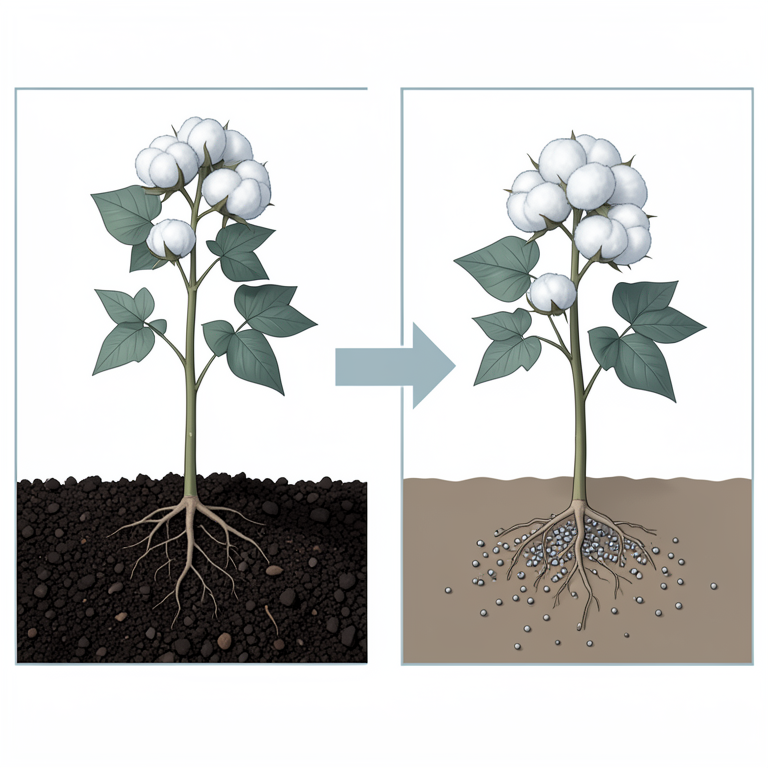
- The authors suggest a blended strategy, such as 80 kg N ha⁻¹ of compost supplemented with 40 kg of inorganic N at the first square stage, to balance long-term soil health with peak crop demand. View evidence ↗
- For irrigated cotton in arid regions with calcareous soils, combining a moderate organic base with a small inorganic supplement is recommended as the most balanced approach. View evidence ↗
- The authors state that multi-season trials are needed to determine if an integrated strategy maintains soil organic nitrogen without negatively impacting economic returns or fiber quality. View evidence ↗
Visual summary
3 visualsIllustrations explain the paper; charts are replotted from the paper's own table values.
Blended Nitrogen Management Strategy
AI-generated conceptual illustration (cotton plants in calcareous soil). It explains the idea and does not show study data.
View source evidence ↗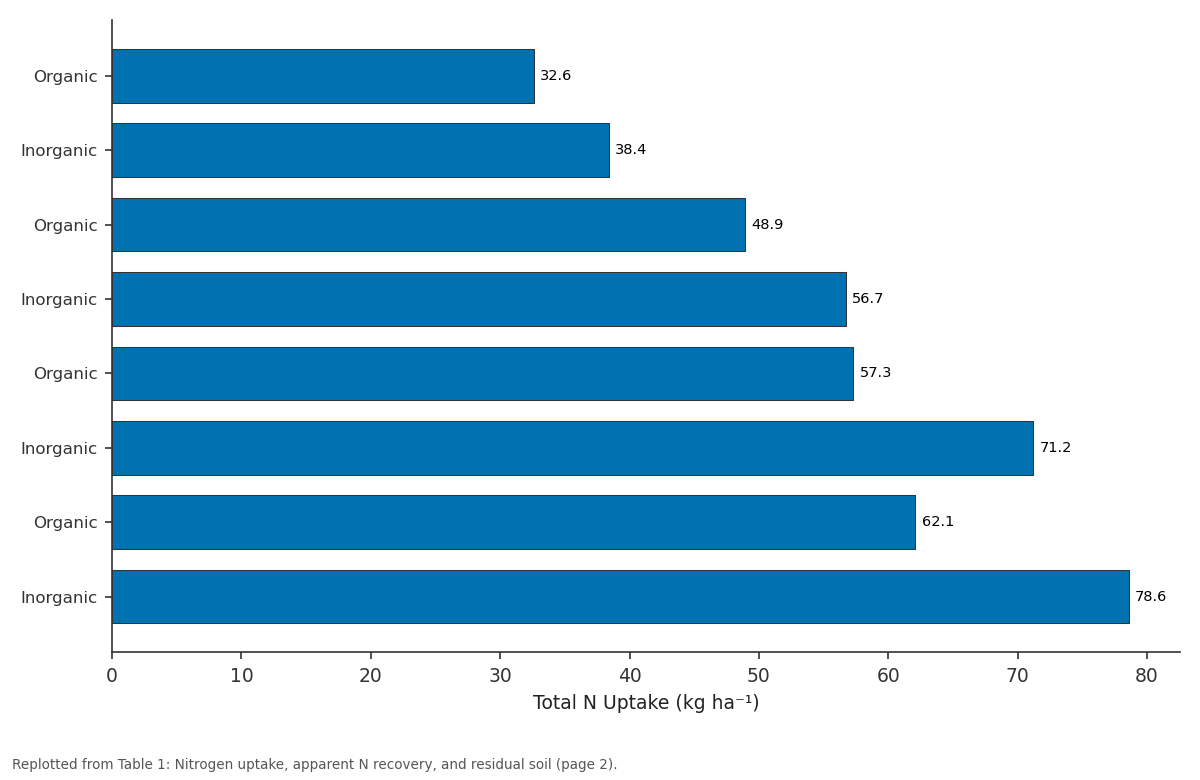
Total N Uptake: Organic vs Inorganic vs Organic vs Inorganic vs Organic
Replotted from Table 1 (page 2) of the original paper. Every bar is the paper's own table value.
View source evidence ↗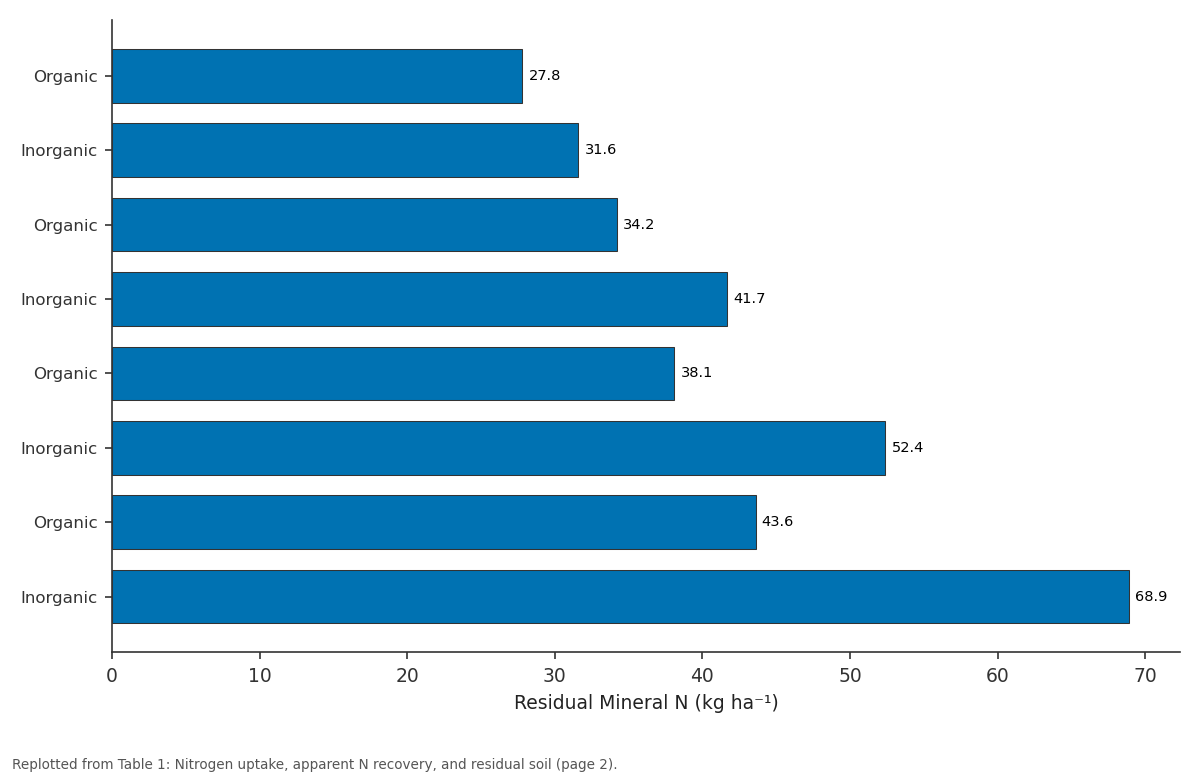
Residual Mineral N: Organic vs Inorganic vs Organic vs Inorganic vs Organic
Replotted from Table 1 (page 2) of the original paper. Every bar is the paper's own table value.
View source evidence ↗Figures & tables
From the original paper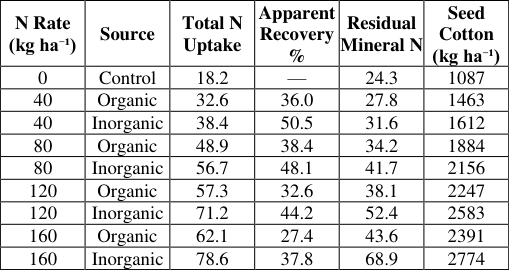 Table 1
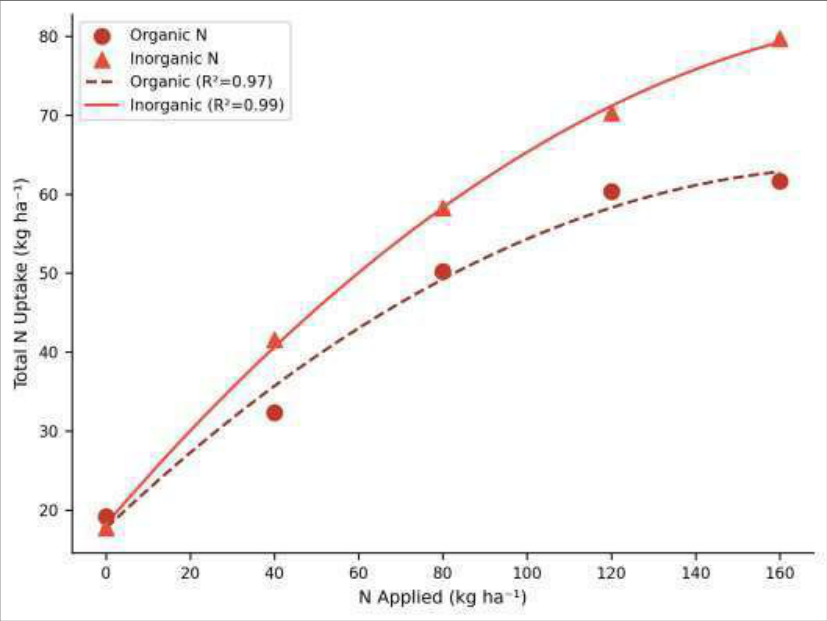 Figure 1
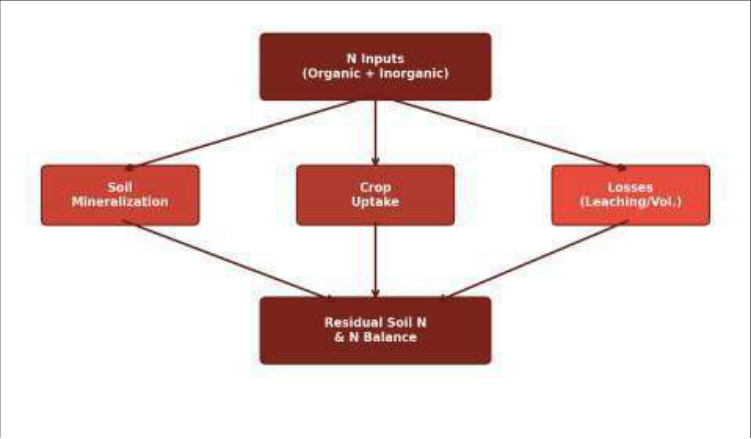 Figure 2
Introduction
Cotton is a nutrient-hungry crop, and nitrogen sits at the top of its shopping list. A single hectare producing 2.5 tonnes of seed cotton removes roughly 110-130 kg N from the soilplant system [1] . Getting that nitrogen in at the right rate and in the right form is what separates a profitable field from a wasteful one. Globally, urea remains the dominant N source for cotton. It is cheap, widely available, and fast-actingqualities that also make it prone to volatilisation and leaching when applied in excess [2] . Organic alternatives such as composted manure release nitrogen more slowly, matching the crop's extended uptake window better in theory, but often delivering less total available N per unit applied [3] . The trade-off between immediate N supply and longer-term soil health benefits is at the heart of the organic-versus-inorganic debate in cotton nutrition [4] . Iran's Fars Province grows about 18% of the country's cotton on calcareous soils with high pH and low organic matterconditions that amplify ammonia volatilisation from surfaceapplied urea [5] . Despite this, most local growers rely exclusively on mineral fertilisers. Fieldlevel N balances that could guide more nuanced recommendations are nearly absent from the regional literature. This research was set up to compare the nitrogen dynamics, crop uptake, and post-season balance of organic and inorganic N sources across a range of application rates in irrigated cotton at Shiraz. The aim was to identify a management strategy that sustains yield while minimising residual mineral N left vulnerable to off-season losses.
Climatic and Environmental Conditions
During the 2023 growing season, mean monthly temperatures ranged from 24.1 °C in May to 33.6 °C in July, with a seasonal average of 29.3 °C. Relative humidity remained between 18% and 34%. No rainfall was recorded between mid-May and late September. Cumulative reference evapotranspiration (ET₀) during the crop cycle was 1,087 mm. These hot, dry conditions are representative of arid-zone cotton environments and strongly influence nitrogen transformation rates in soil [6] .
Material and Methods
Material and Methods
Material
The trial used a randomised complete block design with two N source treatments (composted cattle manure, 1.8% N; and urea, 46% N) each at five rates (0, 40, 80, 120, 160 kg N ha⁻¹), giving ten treatment combinations replicated four times. Cotton cultivar Varamin-76, a medium-staple upland type, was sown on 8 May 2023 at 80 × 20 cm spacing in plots of 6 m × 4 m. Manure was incorporated one week before sowing; urea was split 50% at sowing and 50% at first-square stage. Phosphorus (90 kg P₂O₅ ha⁻¹ as triple super phosphate) and potassium (60 kg K₂O ha⁻¹ as potassium sulphate) were applied uniformly.
Methods
Soil mineral N (NH₄⁺-N + NO₃⁻-N) was measured at 0-30 cm depth at sowing, peak bloom, and harvest using 2M KCl extraction and a continuous-flow analyser [7] . Plant N uptake was determined by Kjeldahl digestion of seed cotton and vegetative biomass at final harvest [8] . The N balance for each plot was calculated as: N balance = (N applied + initial soil mineral N) -(crop N uptake + residual soil mineral N + estimated gaseous losses). Gaseous losses were estimated using the emission-factor approach of the IPCC Tier 1 methodology (1% of applied N as N₂O-N; 10% of urea-N as NH₃-N) [9] . All data were analysed by two-way ANOVA with Fisher's LSD at p = 0.05.
Results
Results
Comprehensive Interpretation
Inorganic urea delivered higher N uptake at every application rate, but the margin of superiority shrank progressively -from 17.8% at 40 kg N ha⁻¹ to 26.6% at 160 kg N ha⁻¹ for uptake, though apparent recovery fell in both sources as rate increased. Residual mineral N accumulated faster under urea, reaching 68.9 kg ha⁻¹ at the highest rate versus 43.6 kg ha⁻¹ for organic, indicating a larger pool of unused mineral N vulnerable to post-season leaching.
Discussion
The lower apparent recovery of organic N (27-39%) compared to inorganic N (38-49%) reflects the slower mineralisation kinetics of composted manure in calcareous soils [3] . With soil pH near 8.0 and CaCO₃ above 23%, a fraction of the urea-N is also lost to ammonia volatilisation, but the rapid hydrolysis of urea still delivers a quick pulse of plant-available N that cotton captures during the square-tobloom period [10] . Organic sources, by contrast, release N gradually -some of it after the crop's peak demand has passed.
The high residual mineral N in urea plots at harvest is cause for concern. In the semi-arid Fars environment, the first autumn rains can move this leftover nitrate below the root zone before the next crop is sown [5] . Over several seasons, this pattern degrades groundwater quality and wastes purchased nitrogen. Organic-treated plots left less residual mineral N because a larger share of the applied N remained immobilised in soil organic matter, where it mineralises slowly across subsequent years [11] . A blended strategy -say, 80 kg N ha⁻¹ from compost topped up with 40 kg inorganic N at first squarecould capture the best of both worlds: a slow organic base that feeds the soil's long-term N pool, plus a targeted mineral supplement during peak demand.
Conclusion
Inorganic urea produced higher immediate N uptake and seed-cotton yield than composted manure at equivalent rates, but it also left substantially more mineral N in the soil after harvesta surplus susceptible to leaching losses. Organic management retained more nitrogen within the soil organic pool, offering a slower but steadier N supply. Neither source alone optimised both short-term yield and long-term N conservation.
Combining a moderate organic base with a small inorganic supplement at peak demand appears to be the most balanced approach for irrigated cotton on calcareous soils in arid regions. Further trials over multiple seasons would clarify whether this integrated strategy sustains soil organic N stocks without sacrificing fibre quality or economic returns.
Figures and tables from the paper
| N Rate (kg ha⁻¹) | Source | Total N Uptake | Apparent Recovery % | Residual Mineral N | Seed Cotton (kg ha⁻¹) |
|---|---|---|---|---|---|
| 0 | Control | 18.2 | — | 24.3 | 1087 |
| 40 | Organic | 32.6 | 36.0 | 27.8 | 1463 |
| 40 | Inorganic | 38.4 | 50.5 | 31.6 | 1612 |
| 80 | Organic | 48.9 | 38.4 | 34.2 | 1884 |
| 80 | Inorganic | 56.7 | 48.1 | 41.7 | 2156 |
| 120 | Organic | 57.3 | 32.6 | 38.1 | 2247 |
| 120 | Inorganic | 71.2 | 44.2 | 52.4 | 2583 |
| 160 | Organic | 62.1 | 27.4 | 43.6 | 2391 |
| 160 | Inorganic | 78.6 | 37.8 | 68.9 | 2774 |
Table text extracted from the original PDF; superscript letters are shown inline. The original table image is below.
View original table image
References
14 in the original paper- Rochester IJ. Nutrient uptake and export from an Australian cotton field. Nutr Cycl Agroecosyst. 2007;77(3):213-223.
- Freney JR, Denmead OT, Simpson JR. Nitrous oxide emission from soils at low moisture contents. Soil Biol Biochem. 1979;11(2):167-173.
- Gaskell M, Smith R. Nitrogen sources for organic vegetable crops. HortTechnology. 2007;17(4):431-441.
- Watson CA, Atkinson D, Gosling P, Jackson LR, Rayns FW. Managing soil fertility in organic farming systems. Soil Use Manag. 2002;18(S1):239-247.
- Jalali M. Nitrates leaching from agricultural land in Hamadan, western Iran. Agric Ecosyst Environ. 2005;110(3-4):210-218.
- Ghosh PK, Dayal D, Bandyopadhyay KK, Mohanty M. Evaluation of straw and polythene mulch for enhancing productivity of irrigated summer groundnut. Field Crops Res. 2006;99(2-3):76-86.
- Mulvaney RL. Nitrogen-inorganic forms. In: Sparks DL, editor. Methods of soil analysis. Part 3. Madison: SSSA; 1996. p. 1123-1184.
- Bremner JM. Nitrogen-total. In: Sparks DL, editor. Methods of soil analysis. Part 3. Madison: SSSA; 1996. p. 1085-1121.
- IPCC. 2006 IPCC guidelines for national greenhouse gas inventories. Hayama: Institute for Global Environmental Strategies; 2006. p. 4.1-4.54.
- Suter HC, Sultana H, Turner D, Davies R, Walker C, Chen DL. Influence of urea fertiliser formulation, soil pH and rainfall on emissions of nitrous oxide. Soil Res. 2013;51(3):220-227.
- Gaskell M, Smith R, Mitchell J, Koike ST, Fouche C, Hartz TK, et al. Soil fertility management for organic crops. University of California ANR Publication 7249; 2006. p. 1-8.
- Constable GA, Rochester IJ. Nitrogen application to cotton on clay soil: timing, soil testing and simulation. Agron J. 1988;80(3):498-502.
- Halvorson AD, Wienhold BJ, Black AL. Tillage, nitrogen, and cropping system effects on soil carbon sequestration. Soil Sci Soc Am J. 2002;66(3):906-912.
- Bronson KF, Booker JD, Keeling JW, Boman RK, Wheeler TA, Lascano RJ, et al. Cotton canopy reflectance at landscape scale as affected by nitrogen fertilization. Agron J. 2005;97(3):654-660.