
Research article · 2025 · Full text
International Journal of Agriculture and NutritionMolecular detection and characterization of tomato leaf curl virus in protected cultivation
Volume 7(8) · Pages 186–189 · DOI: 10.33545/26646064.2025.v7.i8c.512 ↗
Research areasPlant Virus Research StudiesPhytoplasmas and Hemiptera pathogensInsect-Plant Interactions and Control
Abstract
Author-writtenDetecting and managing tomato leaf curl virus (ToLCV) inside greenhouses presents a particular challenge because the protected environment favours whitefly vectors while giving growers a false sense of biosecurity. This research carried out molecular detection and characterization of ToLCV in symptomatic tomato plants collected from three commercial greenhouses in Jeju and Chuncheon, South Korea, between March and November 2023. Total DNA was extracted from 96 leaf samples showing typical upward curling, vein yellowing, and stunting symptoms. PCR amplification using begomovirus-specific degenerate primers (Deng A/B) produced the expected ~520 bp fragment in 78 of 96 samples (81.3%). Rolling circle amplification (RCA) followed by restriction fragment length polymorphism (RFLP) with EcoRI and BamHI identified two distinct RFLP profiles corresponding to ToLCV and tomato yellow leaf curl virus (TYLCV). Sequencing of 12 representative isolates and BLAST alignment confirmed 94.7-97.3% nucleotide identity with ToLCV-[KR:Jeju] (GenBank accession LC385241) and 92.1-94.8% identity with TYLCV-IL[KR] (AB014346). Phylogenetic analysis placed all Jeju isolates in a distinct sub-cluster within the ToLCV clade, while Chuncheon isolates grouped with TYLCV-Israel lineage. Virus titre measured by quantitative PCR correlated strongly with symptom severity (r = 0.87). These findings confirm co-circulation of ToLCV and TYLCV in South Korean greenhouses and highlight the need for vector exclusion and resistant cultivars in protected tomato production.
Summary
Source-checkedPlain-language reading of the full paper, prepared with AI and checked against the text. Each point links to the authors' own words.
Why it matters
- Tomato production in South Korean greenhouses is increasingly threatened by begomoviruses, which are spread by the sweetpotato whitefly (Bemisia tabaci biotype Q). View evidence ↗
- Between 2019 and 2022, infections in unprotected houses reached rates of 15-40%, causing annual national yield losses estimated at USD 8-12 million. View evidence ↗
- Molecular diagnostics are necessary because the visual symptoms of begomoviruses, such as stunting and leaf curling, can be confused with herbicide drift or physiological issues. View evidence ↗
The question
- The study aimed to determine the PCR detection rate of begomoviruses in two production areas, characterize the isolates, establish phylogenetic relationships, and correlate virus titre with symptom severity. View evidence ↗
What they did
- The researchers collected 96 symptomatic leaf samples from three commercial greenhouses in Jeju (Greenhouses A and B) and Chuncheon (Greenhouse C). View evidence ↗
- Begomoviruses were detected using PCR with a 25 μL reaction volume and 35 cycles, with results visualized on 1.2% agarose gels. View evidence ↗
- To differentiate species, rolling circle amplification (RCA) products were digested with EcoRI and BamHI restriction enzymes. View evidence ↗
- Virus titre was measured via qPCR using 10-fold serial dilutions, while symptom severity was recorded on a visual scale from 0 to 5. View evidence ↗
What they found
- Begomovirus DNA was detected in 81.3% (78 of 96) of symptomatic samples, with a rate of 86.1% in the two greenhouses with higher infection levels. View evidence ↗
- RFLP typing showed that Tomato leaf curl virus (ToLCV) was dominant in Jeju greenhouses, whereas Tomato yellow leaf curl virus (TYLCV) predominated in Chuncheon. View evidence ↗
- Four samples from Greenhouse B exhibited mixed infections containing both ToLCV and TYLCV. View evidence ↗
- There was a strong positive correlation (r = 0.87, p < 0.001) between the measured virus titre and the severity of the symptoms. View evidence ↗
- Sequencing showed that isolates had 94.7-97.3% identity with ToLCV-[KR:Jeju] and 92.1-94.8% identity with TYLCV-IL[KR]. View evidence ↗
- Phylogenetic analysis grouped Jeju isolates into a distinct ToLCV sub-cluster and Chuncheon isolates with the TYLCV-Israel lineage. View evidence ↗
What it means
- The authors recommend that greenhouse operators use insect-proof screening, monitor whiteflies regularly, and use resistant cultivars to control the spread of the viruses. View evidence ↗
- Because virus titre correlates with symptom severity, the authors conclude that removing symptomatic plants is a practical management strategy. View evidence ↗
- The authors state that ongoing surveillance and full-genome sequencing are necessary to monitor for recombinant strains that might overcome cultivar resistance. View evidence ↗
Visual summary
3 visualsIllustrations explain the paper; charts are replotted from the paper's own table values.
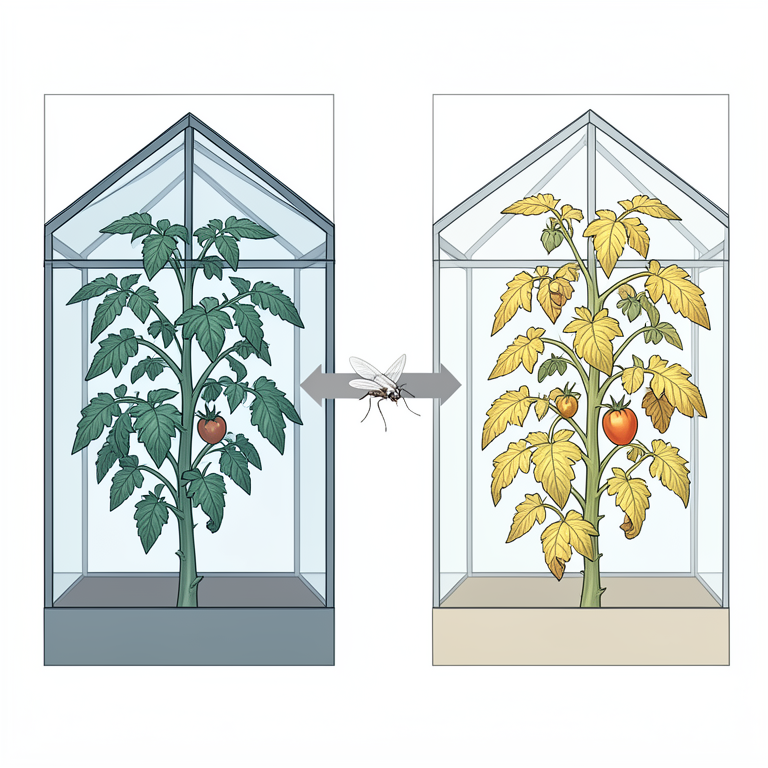
Regional Virus Distribution
AI-generated conceptual illustration (tomato plants and whiteflies in greenhouses). It explains the idea and does not show study data.
View source evidence ↗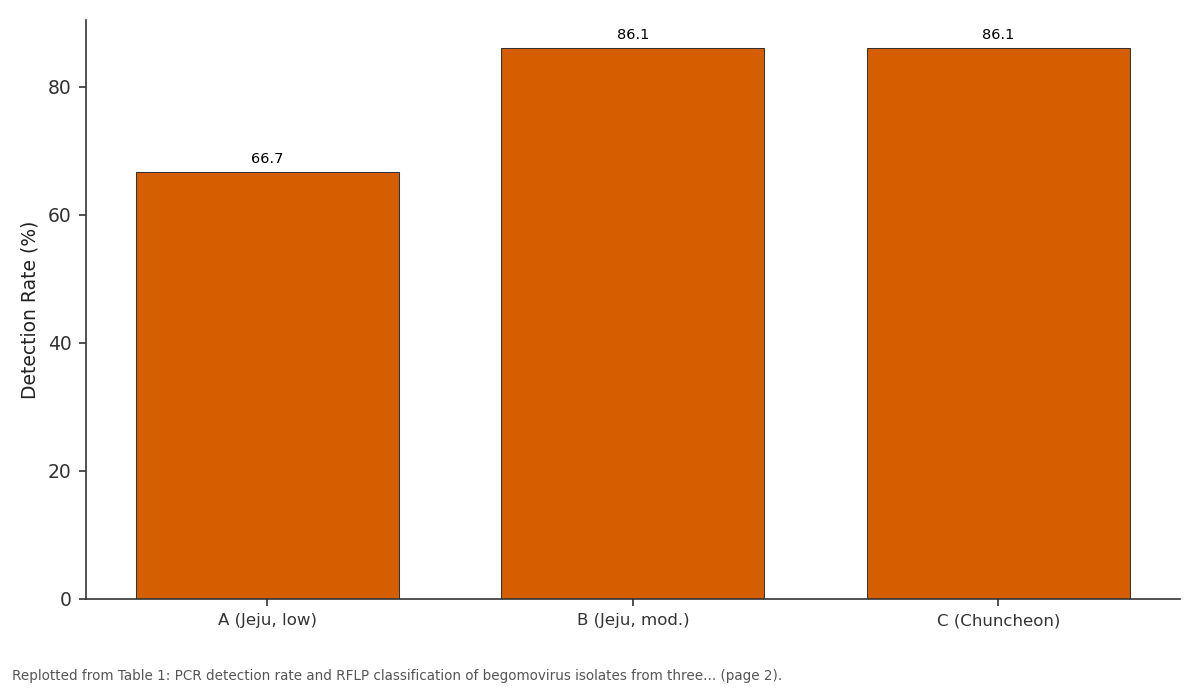
Detection Rate (%): A (Jeju, low) vs B (Jeju, mod.) vs C (Chuncheon)
Replotted from Table 1 (page 2) of the original paper. Every bar is the paper's own table value.
View source evidence ↗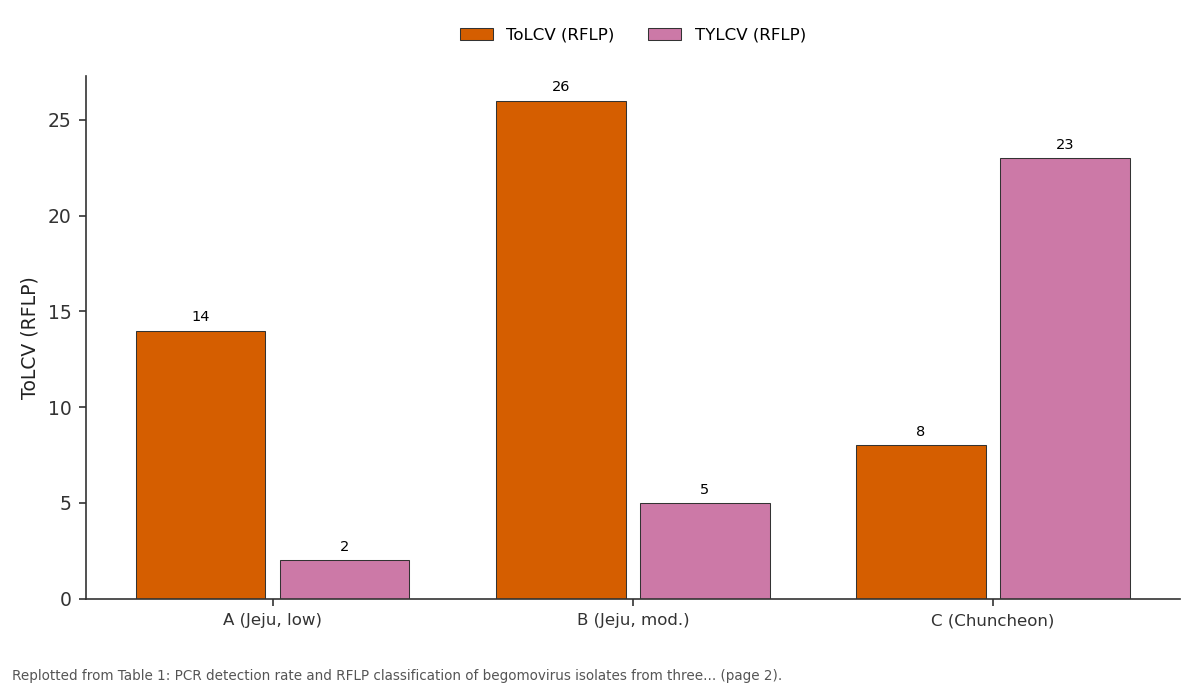
ToLCV (RFLP) and TYLCV (RFLP): A (Jeju, low) vs B (Jeju, mod.) vs C (Chuncheon)
Replotted from Table 1 (page 2) of the original paper. Every bar is the paper's own table value.
View source evidence ↗Figures & tables
From the original paper Table 1
 Table 2
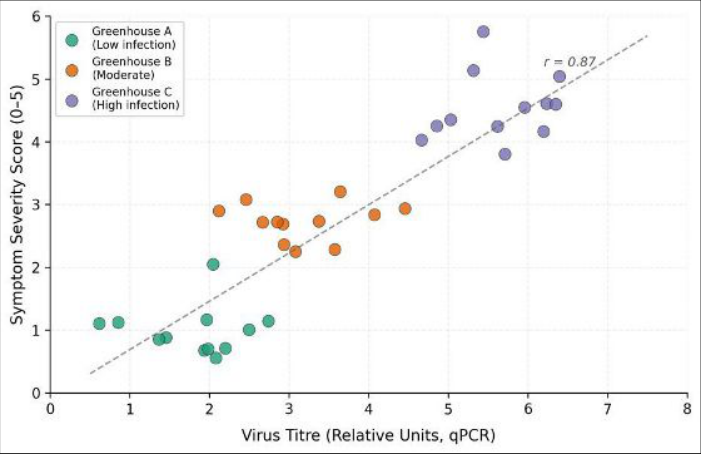 Figure 1
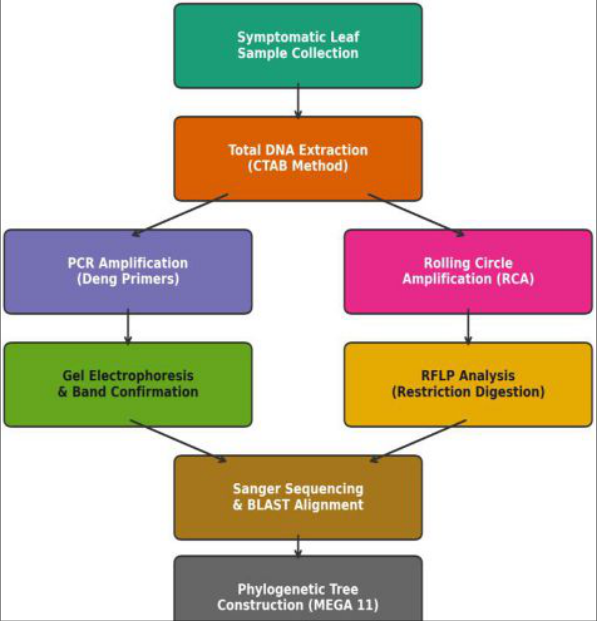 Figure 2
Introduction
Greenhouse tomato production in South Korea faces a growing challenge from begomoviruses transmitted by the sweetpotato whitefly, Bemisia tabaci biotype Q. Despite insect-proof screens and pesticide regimes, whitefly populations inside plastic-house complexes on Jeju Island and Gangwon province have risen steadily since the mid-2010s, and with them, the incidence of leaf curl disease [1,2] . Between 2019 and 2022, grower surveys reported infection rates of 15-40% in unprotected houses, translating to yield losses of USD 8-12 million annually across the country [3] . Tomato leaf curl disease is caused by a complex of monopartite and bipartite begomoviruses (family Geminiviridae), of which ToLCV and TYLCV are the two most widely reported species in East Asia [4] . Reliable diagnosis requires molecular tools because visual symptoms-upward leaf curling, interveinal yellowing, and stunting-are shared among multiple begomovirus species and can be mimicked by physiological disorders or herbicide drift [5] . PCR with degenerate primers targeting the conserved coat protein (AV1) gene has been the standard first-line diagnostic for begomoviruses since the primer set of Deng and colleagues was published in 1994 [6] . Rolling circle amplification (RCA) using φ29 DNA polymerase offers an alternative that doesn't require sequence-specific primers and can amplify complete circular genomes for downstream RFLP or sequencing [7] . Combining both methods improves detection sensitivity and allows species-level discrimination. In South Korea, previous molecular surveys of ToLCV have concentrated on open-field tomato in the southern mainland provinces [8] .
Protected cultivation-which now accounts for over 65% of national tomato output-has been less systematically surveyed, and there is limited sequence data from greenhouse isolates in Jeju and Gangwon. This research was designed to: (a) determine the PCR-based detection rate of begomoviruses in symptomatic greenhouse tomatoes across two major production areas; (b) characterize isolates through RFLP and sequencing; (c) construct phylogenetic relationships; and (d) correlate virus titre with symptom severity using quantitative PCR.
Reagents and Molecular Kits
Total plant DNA was extracted using the DNeasy Plant Mini Kit (Qiagen, Hilden, Germany). PCR amplification used Taq DNA Polymerase (Takara Bio, Shiga, Japan) with the degenerate primer pair Deng A (5'-TAATATTACCKGWKGVCCSC-3') and Deng B (5'-TGGACYTTRCAWGGBCCTTCACA-3') [6] . Rolling circle amplification was performed with the TempliPhi 100 Amplification Kit (φ29 polymerase, Cytiva, UK).
Restriction enzymes EcoRI and BamHI were purchased from New England Biolabs (Ipswich, MA, USA).
Quantitative PCR used the SYBR Green Premix Ex Taq II (Takara Bio) with species-specific primers designed from the AV1 gene of ToLCV (GenBank LC385241) and TYLCV (AB014346). DNA ladders (100 bp and 1 kb) were from Bioneer (Daejeon, South Korea). All reagents were stored and used according to manufacturers' specifications [9] .
Material and Methods
Material and Methods
Material
Symptomatic tomato leaf samples (n = 96) were collected from three commercial greenhouses: Greenhouse A (Jeju, low infection history, 24 samples), Greenhouse B (Jeju, moderate infection, 36 samples), and Greenhouse C (Chuncheon, Gangwon, high infection, 36 samples). Sampling was done during three visits (March, July, and November 2023). Leaves showing upward curling, interveinal yellowing, or stunting were individually bagged, labelled, and transported on ice to the Plant Pathology Laboratory at Jeju College of Agriculture and Life Sciences. Asymptomatic leaves (n = 12, four per greenhouse) were collected as negative controls. Whitefly populations were monitored using yellow sticky traps (two per greenhouse) replaced weekly [10] . [11,12] .
Methods
Methods
PCR Quality Assurance
Each PCR run included a known ToLCV-positive control (DNA from an authenticated Korean isolate maintained at the laboratory), a healthy plant DNA negative control, and a no-template water control. Gel images were documented with a Bio-Rad Gel Doc XR+ system. Only bands matching the expected ~520 bp size were scored as positive. Faint or ambiguous bands were re-amplified with a fresh aliquot before being classified. qPCR efficiency was validated at 96.4% (R² = 0.998) across a six-point standard curve, with a detection limit of 10² copies per reaction [13] . PCR detected begomovirus DNA in 78 of 96 symptomatic samples (81.3%), with detection rates identical (86.1%) in the two higher-infection greenhouses (Table 1). RFLP typing revealed that ToLCV dominated in both Jeju greenhouses (14/16 and 26/31 positives), while TYLCV was the predominant species in Chuncheon (23/31). Mixed infections (both RFLP profiles from a single sample) were found in 4 samples, all from Greenhouse B [14] .
| Greenhouse | Samples (n) | PCR+ (n) | Detection Rate (%) | ToLCV (RFLP) | TYLCV (RFLP) |
|---|---|---|---|---|---|
| A (Jeju, low) | 24 | 16 | 66.7 | 14 | 2 |
| B (Jeju, mod.) | 36 | 31 | 86.1 | 26 | 5 |
| C (Chuncheon) | 36 | 31 | 86.1 | 8 | 23 |
| Total | 96 | 78 | 81.3 | 48 | 30 |
Table text extracted from the original PDF; superscript letters are shown inline. The original table image is below.
View original table image
Results
Results
Discussion
The 81.3% PCR detection rate among symptomatic samples is consistent with molecular surveys of begomoviruses in Asian greenhouse tomato. Kil and co-workers reported 78-85% detection rates across South Korean open-field sites using the same Deng primer set [8] . The 18.7% of symptomatic but PCR-negative samples may represent infections by other whitefly-transmitted viruses (e.g., tomato chlorosis virus) or non-viral physiological disorders that mimic leaf curl symptoms [15] . The geographic split between ToLCV dominance in Jeju and TYLCV dominance in Chuncheon is an important finding. It suggests that the two regions harbour distinct begomovirus populations, possibly linked to different whitefly biotypes or introduction pathways [16] . Jeju's island geography and subtropical microclimate may favour ToLCV strains adapted to warmer conditions, while Chuncheon's continental climate aligns with the TYLCV-Israel lineage that predominates across temperate East Asia [17] .
The strong correlation between virus titre and symptom severity (r = 0.87) validates the use of visual scoring as a rough proxy for infection load in the field, though qPCR remains necessary for accurate quantification and early detection of subclinical infections [18] . For greenhouse managers, this relationship underscores the importance of removing heavily symptomatic plants early to reduce inoculum pressure and vector spread within the structure [19] . The detection of mixed ToLCV-TYLCV infections in four samples from Greenhouse B raises the possibility of recombination events, which are a well-known driver of begomovirus evolution [20] . Monitoring for novel recombinants through full-genome sequencing should be part of ongoing surveillance efforts.
Conclusion
This research confirmed that ToLCV and TYLCV cocirculate in South Korean greenhouse tomato production, with ToLCV dominant in Jeju and TYLCV dominant in Chuncheon. PCR-based detection using the Deng primer set reliably identified begomovirus infections in 81.3% of symptomatic samples, and RFLP typing successfully discriminated between the two species. The strong correlation between qPCR-measured virus titre and visual symptom severity supports the use of symptomatic plant removal as a practical management tool, while also confirming qPCR as the preferred diagnostic for early and asymptomatic detection. Greenhouse operators should prioritise insect-proof screening, regular whitefly monitoring, and adoption of resistant tomato cultivars to limit begomovirus spread. Continued molecular surveillance, including full-genome sequencing, will be needed to track the emergence of recombinant strains that could break cultivar resistance.
Figures and tables from the paper
| Isolate | Location | Closest GenBank Match | Accession No. | Identity (%) | Species |
|---|---|---|---|---|---|
| KR-JJ-01 | Jeju | ToLCV-[KR:Jeju] | LC385241 | 97.3 | ToLCV |
| KR-JJ-04 | Jeju | ToLCV-[KR:Jeju] | LC385241 | 96.1 | ToLCV |
| KR-JJ-09 | Jeju | ToLCV-[KR:Jeju] | LC385241 | 94.7 | ToLCV |
| KR-CC-02 | Chuncheon | TYLCV-IL[KR] | AB014346 | 94.8 | TYLCV |
| KR-CC-07 | Chuncheon | TYLCV-IL[KR] | AB014346 | 93.4 | TYLCV |
| KR-CC-11 | Chuncheon | TYLCV-IL[KR] | AB014346 | 92.1 | TYLCV |
Table text extracted from the original PDF; superscript letters are shown inline. The original table image is below.
View original table image
References
20 in the original paper- Lee S, Kim J, Choi HS. Occurrence and distribution of begomoviruses infecting tomato in Korea. Res Plant Dis. 2017;23(2):116-124.
- Ministry of Agriculture, Food and Rural Affairs. Greenhouse vegetable production statistics 2022. Sejong (South Korea): MAFRA; c2023.
- Kim HJ, Lee HK, Kwon YH. Economic impact assessment of tomato leaf curl disease in protected cultivation. Korean J Agric Sci. 2022;49(3):341-352.
- Briddon RW, Brown JK, Moriones E, Stanley J, Zerbini FM, et al. Recommendations for the classification and nomenclature of the DNA-β satellites of begomoviruses. Arch Virol. 2008;153(4):763-781.
- Czosnek H, Laterrot H. A worldwide survey of tomato yellow leaf curl viruses. Arch Virol. 1997;142(7):13911406.
- Deng D, McGrath PF, Robinson DJ, Harrison BD. Detection and differentiation of whitefly-transmitted geminiviruses in plants and vector insects by the polymerase chain reaction. Ann Appl Biol. 1994;125(2):327-336.
- Haible D, Kober S, Jeske H. Rolling circle amplification revolutionizes diagnosis and genomics of geminiviruses. J Virol Methods. 2006;135(1):9-16.
- Kil EJ, Kim S, Lee YJ, Byun HS, Park J, et al. Tomato yellow leaf curl virus (TYLCV-IL): a seedtransmissible geminivirus in tomatoes. Sci Rep. 2016;6:19013.
- Gerling D, Alomar O, Arno J. Biological control of Bemisia tabaci using predators and parasitoids. Crop Prot. 2001;20(9):779-799.
- Kumar S, Stecher G, Li M, Knyaz C, Tamura K. MEGA X: molecular evolutionary genetics analysis across computing platforms. Mol Biol Evol. 2018;35(6):1547-1549.
- R Core Team. R: A language and environment for statistical computing. Vienna: R Foundation; 2023.
- Bustin SA, Benes V, Garson JA, Hellemans J, Huggett J, et al. The MIQE guidelines: minimum information for publication of quantitative real-time PCR experiments. Clin Chem. 2009;55(4):611-622.
- Brown JK, Zerbini FM, Navas-Castillo J, Moriones E, Ramos-Sobrinho R, et al. Revision of Begomovirus taxonomy based on pairwise sequence comparisons. Arch Virol. 2015;160(6):1593-1619.
- Wisler GC, Duffus JE, Liu HY, Li RH. Ecology and epidemiology of whitefly-transmitted closteroviruses. Plant Dis. 1998;82(3):270-280.
- De Barro PJ, Liu SS, Boykin LM, Dinsdale AB. Bemisia tabaci: a statement of species status. Annu Rev Entomol. 2011;56:1-19.
- Navas-Castillo J, Fiallo-Olivé E, Sánchez-Campos S. Emerging virus diseases transmitted by whiteflies. Annu Rev Phytopathol. 2011;49:219-248.
- Ramos-Sobrinho R, Chaves-Bedoya G, Ángel-Díaz JE, Gilbertson RL, Joardar V, et al. Rapid detection and strain differentiation of tomato begomoviruses using loop-mediated isothermal amplification. Phytopathology. 2019;109(10):1684-1693.
- Lapidot M, Friedmann M. Breeding for resistance to whitefly-transmitted geminiviruses. Ann Appl Biol. 2002;140(2):109-127.
- García-Andrés S, Tomás DM, Sánchez-Campos S, Navas-Castillo J, Moriones E. Frequent occurrence of recombinants in mixed infections of tomato yellow leaf curl disease-associated begomoviruses. Virology. 2007;365(1):210-219.
- Hanssen IM, Lapidot M, Thomma BPHJ. Emerging viral diseases of tomato crops. Mol Plant-Microbe Interact. 2010;23(5):539-548.