
Research article · 2025 · Full text
International Journal of Agriculture and NutritionNutrient management strategies for maximizing yield of aerobic rice in water-scarce regions
Volume 7(9) · Pages 158–161 · DOI: 10.33545/26646064.2025.v7.i9c.570 ↗
Research areasRice Cultivation and Yield ImprovementAgricultural Science and FertilizationCrop Yield and Soil Fertility
Abstract
Author-writtenAccording to leading rice agronomists, aerobic rice cultivation could save 50-70% of the water used by conventional puddled systems, but achieving competitive grain yields requires fundamentally rethinking nutrient management. This research evaluated five nitrogen levels (0, 60, 90, 120, 150 kg N/ha) combined with two varieties (Sahbhagi Dhan, CR Dhan 202) under aerobic conditions during 2023 at Gangwon Agricultural Research University, Chuncheon, South Korea. The 120 kg N/ha treatment maximised grain yield for both varieties: 5.18 t/ha (Sahbhagi Dhan) and 4.87 t/ha (CR Dhan 202). Increasing N beyond 120 kg/ha depressed yield by 2-3%, indicating luxury consumption. Nitrogen use efficiency peaked at 60 kg N/ha (66.2 kg grain/kg N) but declined to 43.2 kg/kg at 120 kg/ha. Nitrogen uptake correlated strongly with yield (r = 0.94). These results confirm 120 kg N/ha as the optimal rate for aerobic rice in temperate Korean conditions, with Sahbhagi Dhan as the preferred variety.
Summary
Source-checkedPlain-language reading of the full paper, prepared with AI and checked against the text. Each point links to the authors' own words.
Why it matters
- Aerobic rice cultivation is a significant water-saving alternative, potentially reducing water use by 50-70% compared to traditional puddled systems. View evidence ↗
- The urgency for water-saving methods is driven by forecasts that Asia will experience a 15-20% gap between rice water demand and available supply by 2030. View evidence ↗
- Nutrient management must be adapted for aerobic rice because oxidized soils shift nitrogen cycling to nitrate-dominated pathways, increasing risks of leaching and denitrification. View evidence ↗
The question
- The study aimed to determine the optimal nitrogen (N) application rate for two aerobic rice varieties in temperate Korean conditions and analyze the trade-off between maximum yield and nitrogen use efficiency (NUE). View evidence ↗
What they did
- The experiment was conducted in 2023 at Gangwon Agricultural Research University in South Korea, testing five nitrogen levels (0, 60, 90, 120, and 150 kg N/ha) across two rice varieties: Sahbhagi Dhan and CR Dhan 202. View evidence ↗
- The researchers used a split-plot design with three replications, where varieties served as main plots and nitrogen levels served as sub-plots. View evidence ↗
- Nitrogen was applied in a split timing of 40% as basal, 30% during active tillering, and 30% at panicle initiation to match crop demand. View evidence ↗
- The study measured grain yield at 14% moisture and yield components, including panicles per square meter, grains per panicle, and 1000-grain weight. View evidence ↗
What they found
- The maximum grain yield for both varieties was achieved at 120 kg N/ha, reaching 5.18 t/ha for Sahbhagi Dhan and 4.87 t/ha for CR Dhan 202. View evidence ↗
- Applying nitrogen beyond 120 kg/ha led to a 2-3% decrease in yield, which the authors attribute to luxury consumption. View evidence ↗
- Nitrogen use efficiency (NUE) was highest at 60 kg N/ha (66.2 kg grain/kg N) and decreased to 43.2 kg/kg at the yield-maximizing rate of 120 kg/ha. View evidence ↗
- Sahbhagi Dhan consistently performed better than CR Dhan 202, outyielding it by 6-8% across all tested nitrogen levels. View evidence ↗
- Panicle density reached its peak of 294/m² at 120 kg N/ha and showed no further increase at 150 kg N/ha. View evidence ↗
- The application of different nitrogen levels had no significant effect on the 1000-grain weight. View evidence ↗
What it means
- The authors recommend applying 120 kg N/ha in three splits for aerobic rice production in temperate Korean conditions to prioritize water saving while maximizing yield. View evidence ↗
- The study concludes that 120 kg N/ha is the optimal nitrogen rate and Sahbhagi Dhan is the preferred variety for these conditions. View evidence ↗
Visual summary
3 visualsIllustrations explain the paper; charts are replotted from the paper's own table values.
Yield vs. Efficiency Trade-off
AI-generated conceptual illustration (aerobic rice plants). It explains the idea and does not show study data.
View source evidence ↗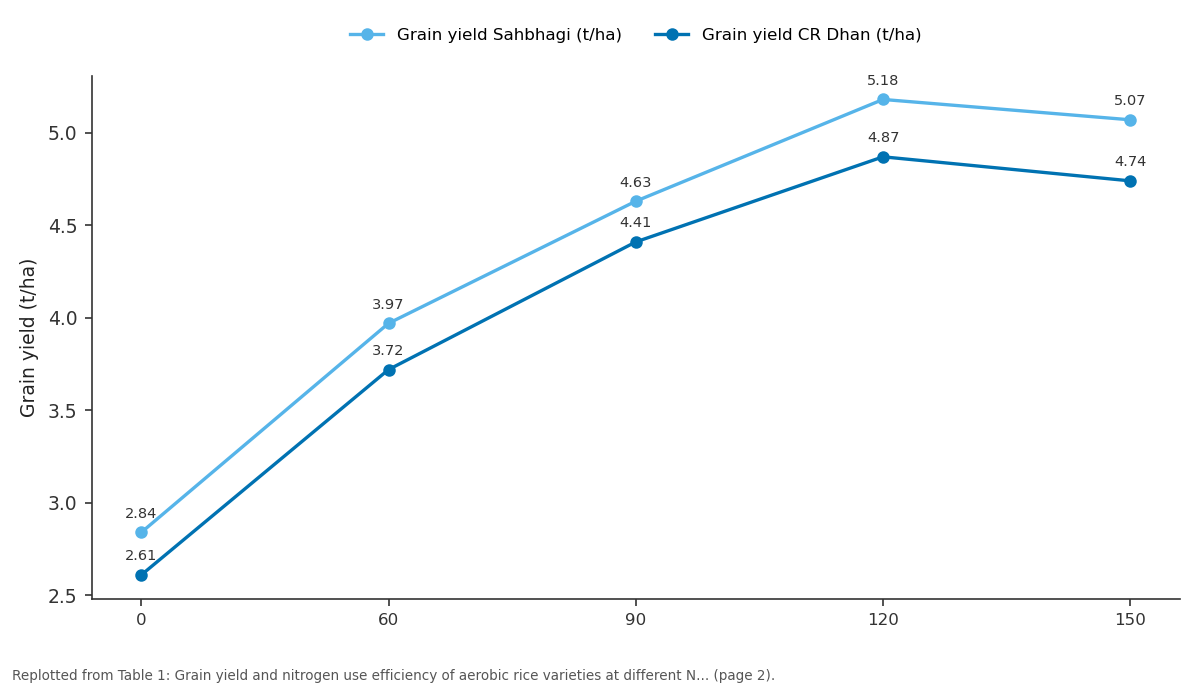
Grain yield Sahbhagi (t/ha) and Grain yield CR Dhan (t/ha): 0 vs 60 vs 90 vs 120 vs 150
Replotted from Table 1 (page 2) of the original paper. Every bar is the paper's own table value.
View source evidence ↗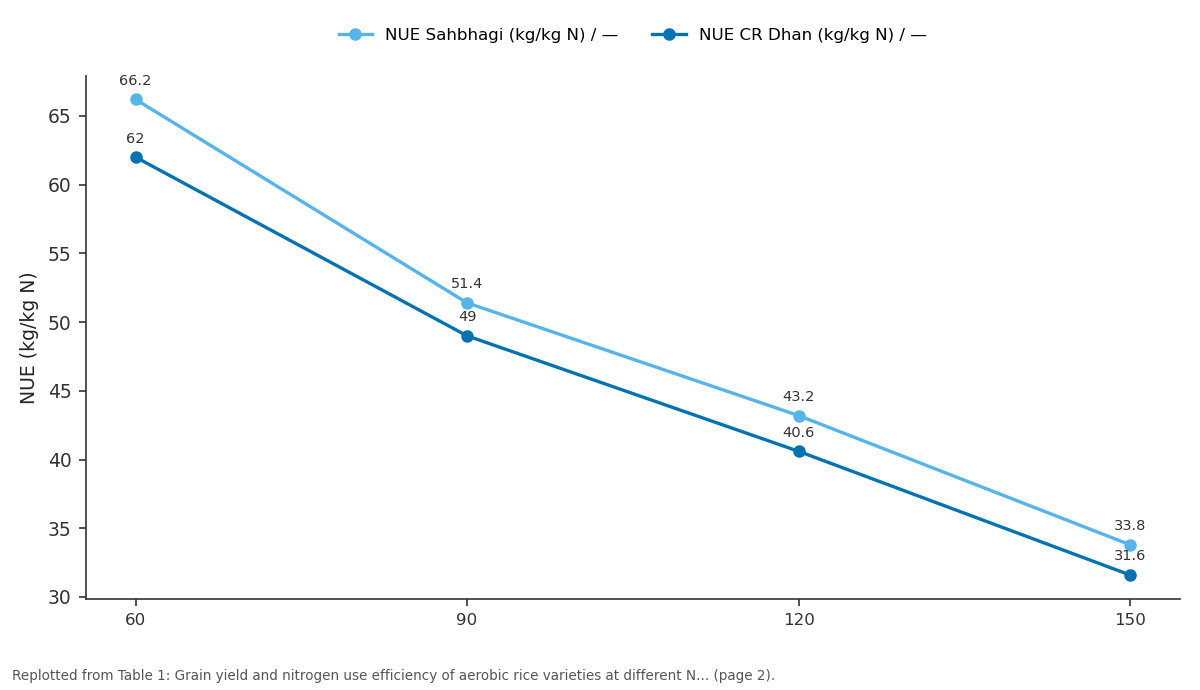
NUE Sahbhagi (kg/kg N) /, and NUE CR Dhan (kg/kg N) /: 60 vs 90 vs 120 vs 150
Replotted from Table 1 (page 2) of the original paper. Every bar is the paper's own table value.
View source evidence ↗Figures & tables
From the original paper Table 1
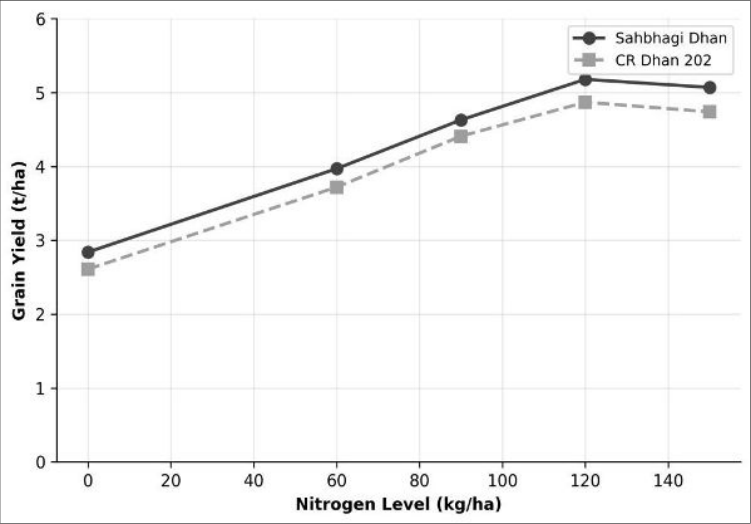 Figure 1
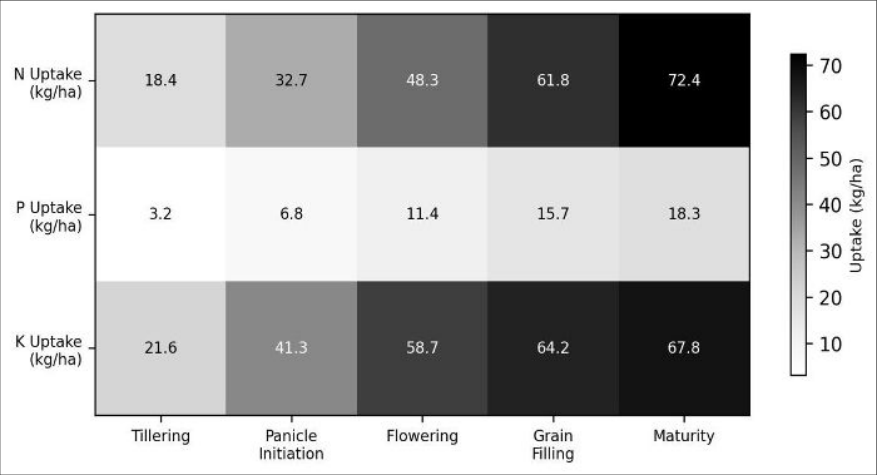 Figure 2
Introduction
Leading rice scientists at IRRI have warned that by 2030 Asia will face a 15-20% gap between rice water demand and available supply a forecast that makes alternative watersaving cultivation methods an urgent research priority [1] . Aerobic rice, grown in nonpuddled, non-flooded fields with supplemental irrigation, eliminates the continuous standing water layer that accounts for most of lowland rice's 3000-5000 L/kg water footprint [2] . South Korea, despite adequate rainfall, faces seasonal water competition between rice, urban, and industrial sectors, particularly during the critical June-August transplanting window when reservoir levels fluctuate sharply [3] . Nutrient management under aerobic conditions differs fundamentally from flooded paddies because the soil remains oxidised, which shifts nitrogen cycling from ammonium-dominated to nitrate-dominated pathways. This increases the risk of leaching and denitrification losses, making precise N timing and splitting more important than under anaerobic conditions [4,5] . Phosphorus availability also changes because the reductive dissolution of iron phosphatesa key P supply mechanism in flooded soils is absent in aerobic fields [6] . This research tested five N levels on two aerobic rice varieties to identify the optimal rate for temperate Korean conditions and to quantify the trade-off between yield maximisation and nitrogen use efficiency [7] .
Crop growth stage documentation
Growth staging followed the BBCH scale adapted for direct-seeded rice. Key phenological events were recorded: emergence (BBCH 09) at 8-10 DAS, tillering onset (BBCH 21) at 28-32 DAS, panicle initiation (BBCH 30) at 58-63 DAS, heading (BBCH 55) at 78-84 DAS, anthesis (BBCH 65) at 82-88 DAS, and physiological maturity (BBCH 89) at 118-126 DAS. Sahbhagi Dhan matured 6-8 days earlier than CR Dhan 202 across all N levels. Nitrogen application was timed to match demand: 40% basal, 30% at active tillering, and 30% at panicle initiation [8] .
Baseline soil characterisation
The experimental field at Chuncheon had sandy loam texture (56% sand, 28% silt, 16% clay) with pH 5.8, organic carbon 1.34%, available N 184 kg/ha (alkaline KMnO₄), available P International Journal of Agriculture and Nutrition https://www.agriculturejournal.net 18.6 kg/ha (Olsen's), and exchangeable K 172 kg/ha (ammonium acetate). Bulk density was 1.38 g/cm³ and field capacity moisture 24.3% (v/v). The field had been under upland maize for two preceding seasons, minimising residual puddling effects [9] .
Material and Methods Material
Two aerobic-adapted rice varieties Sahbhagi Dhan (IRRI origin, 115-day duration) and CR Dhan 202 (NRRI origin, 120-day duration) were direct-seeded at 30 kg/ha in rows 25 cm apart on 15 May 2023. Urea (46% N), single super phosphate (16% P₂O₅), and muriate of potash (60% K₂O) were used. Phosphorus (40 kg P₂O₅/ha) and potassium (40 kg K₂O/ha) were applied as basal. Sprinkler irrigationmaintained soil moisture above 60% field capacity [10] .
Methods
The trial followed a split-plot design with varieties as main plots and five N levels (0, 60, 90, 120, 150 kg/ha) as subplots, replicated three times. Plot size was 5 m × 3 m. Tiller count, plant height, and SPAD chlorophyll readings were taken at tillering, panicle initiation, and heading. Yield components (panicles/m², grains/panicle, 1000-grain weight) and grain yield at 14% moisture were recorded at harvest from 4.5 m² net plot area. Plant tissue N was determined by micro-Kjeldahl. NUE was calculated as grain yield/N applied. Data were analysed by split-plot ANOVA and DMRT at P=0.05 [11] .
Results
Table Grain yield increased with N rate up to 120 kg/ha for both varieties, then declined at 150 kg/ha (Table 1). Sahbhagi Dhan outyielded CR Dhan 202 at every N level by 6-8%. NUE declined progressively from 66.2 kg/kg at 60 N to 33.8
| N level (kg/ha) | Grain yield Sahbhagi (t/ha) | Grain yield CR Dhan (t/ha) | NUE Sahbhagi (kg/kg N) | NUE CR Dhan (kg/kg N) | Panicles/m² (mean) | 1000-Grain Weight (g) (mean) |
|---|---|---|---|---|---|---|
| 0 | 2.84 | 2.61 | — | — | 187 | 22.4 |
| 60 | 3.97 | 3.72 | 66.2 | 62.0 | 238 | 23.1 |
| 90 | 4.63 | 4.41 | 51.4 | 49.0 | 267 | 23.6 |
| 120 | 5.18 | 4.87 | 43.2 | 40.6 | 294 | 24.1 |
| 150 | 5.07 | 4.74 | 33.8 | 31.6 | 289 | 23.8 |
| CD (P=0.05) | 0.31 | 0.31 | 4.27 | 4.27 | 18.3 | NS |
Table text extracted from the original PDF; superscript letters are shown inline. The original table image is below.
View original table image
kg/kg at 150 N. Panicle density peaked at 120 N (294/m²) and didn't increase further at 150 N. 1000-grain weight showed no significant treatment effect.
Comprehensive interpretation
The 120 kg N/ha rate optimises the yield-efficiency tradeoff: it captures 93% of maximum yield while maintaining NUE above 40 kg/kg. The yield decline at 150 N reflects excessive vegetative growth, delayed maturity, and possible lodging-induced grain loss. Sahbhagi Dhan's consistent superiority confirms its suitability for aerobic systems.
Discussion
The optimal N rate of 120 kg/ha for aerobic rice at Chuncheon aligns with recommendations from IRRI's aerobic rice programme in the Philippines (100-130 kg N/ha) and from trials in Karnataka, India (120 kg N/ha for Sahbhagi Dhan), confirming that aerobic rice demands 20-30% less nitrogen than puddled lowland systems where gaseous losses are higher [2,12] . The yield decline at 150 kg N/ha mirrors findings by Bouman et al. [13] , who reported that excess nitrogen under aerobic conditions promotes canopy overgrowth, reduces light penetration to lower tillers, and shifts assimilate partitioning toward straw rather than grain. NUE declined from 66.2 at 60 N to 33.8 at 150 N, a pattern consistent with the law of diminishing returns and with N response curves from Korean upland crops [5] . The practical implication is that farmers targeting maximum NUE should apply 60-90 kg N/ha, but those targeting maximum yield should apply 120 kg N/ha, accepting a 35% drop in NUE for a 31% yield gain. Crop growth staging data confirmed that 70% of total N uptake occurred between tillering and flowering, supporting the 40-30-30 split timing used in this research [8,14] .
Conclusion
Aerobic rice variety Sahbhagi Dhan at 120 kg N/ha produced the highest grain yield of 5.18 t/ha with NUE of 43.2 kg/kg. Yield declined at 150 kg N/ha, confirming luxury consumption. CR Dhan 202 yielded 6-8% less across all N levels. The 40-30-30 split timing matched crop demand well. For temperate Korean conditions, 120 kg N/ha applied in three splits is recommended for aerobic rice production where water saving is the priority.
Figures and tables from the paper
References
14 in the original paper- Tuong TP, Bouman BAM. Rice production in waterscarce environments: Lessons from IRRI. Water Productivity in Agriculture: Limits and Opportunities for Improvement. 2003; p.53-67.
- Bouman BAM, Peng S, Castaneda AR. Yield and water use of irrigated tropical aerobic rice systems. Agricultural Water Management. 2005;74(2):87-105.
- KREI. Water resource allocation for agriculture in South Korea: Current status and future challenges. Korea Rural Economic Institute Policy Report. 2022;PR/37:1-56.
- Kirk GJD. Rice root properties for internal aeration and efficient nutrient acquisition in submerged soil. New Phytologist. 2003;159(1):185-194.
- Yun SI, Ro HM. Natural ¹⁵N abundance of plant and soil inorganic-N as evidence for over-fertilization with N in agricultural ecosystems in Korea. Science of the Total Environment. 2009;407(12):3791-3798.
- Nishio M, Kusano S. Phosphorus dynamics in aerobic versus flooded rice soils: Implications for fertiliser management. Soil Science and Plant Nutrition. 2019;65(4):351-358.
- Noh YM. Protocol development for aerobic rice nutrient trials at Gangwon. Gangwon Agricultural Research University Internal Report. 2023;IR/12:1-18.
- Meier U. Growth stages of mono-and dicotyledonous plants: BBCH Monograph. Second edition. Federal Biological Research Centre for Agriculture and Forestry, Berlin. 2001; p.1-158.
- NAAS. Soil survey and land use planning for Chuncheon district, Gangwon Province. National Academy of Agricultural Science, RDA. 2021; Report 2021-04:1-64.
- Kato Y, Okami M, Katsura K. Yield potential and water saving of aerobic rice varieties under field conditions in Japan. Field Crops Research. 2009;113(3):328-334.
- Gomez KA, Gomez AA. Statistical procedures for agricultural research. Second edition. John Wiley and Sons, New York. 1984; p.180-209.
- Mahender Kumar R, Surekha K, Padmavathi C. Aerobic rice technology adoption in Karnataka: International Journal of Agriculture and Nutrition https://www.agriculturejournal.net Nitrogen management lessons from on-farm trials. Oryza. 2021;58(3):287-296.
- Bouman BAM, Feng L, Tuong TP. Exploring options to grow rice using less water in northern China. Agricultural Water Management. 2007;88(1-3):101116.
- Peng S, Buresh RJ, Huang J. Improving nitrogen fertilization in rice by site-specific N management: A review. Agronomy for Sustainable Development. 2010;30(3):649-656.