
Research article · 2025 · Full text
International Journal of Agriculture and NutritionConjunctive use of canal water and groundwater for sustainable irrigation in command areas
Volume 7(7) · Pages 248–250 · DOI: 10.33545/26646064.2025.v7.i7d.541 ↗
Research areasIrrigation Practices and Water ManagementWater resources management and optimizationEngineering and Agricultural Innovations
Abstract
Author-writtenA trend that irrigation managers across southern Africa can’t ignore: canal systems designed decades ago now deliver water for only 5-7 months of the year, leaving crops stranded during the remaining dry months. This research assessed conjunctive use of canal water and groundwater as a strategy for year-round irrigation in the Olifants River command area near Polokwane, Limpopo Province, South Africa. Monthly water balance data were collected from 14 farming units over two hydrological years (October 2022-September 2024). Canal supply met just 58.4% of annual crop water demand, with the deficit concentrated between June and September. Groundwater pumping filled 34.1% of the gap, raising total water availability to 92.5% of demand. Conjunctive-use farms achieved 31.8% higher seasonal crop yields than canal-only farms. The benefit-cost ratio for borehole installation was 2.46 over a 10-year amortisation period. These findings support integrating groundwater into canal command area planning in water-scarce regions of South Africa.
Summary
Source-checkedPlain-language reading of the full paper, prepared with AI and checked against the text. Each point links to the authors' own words.
Why it matters
- Many irrigation canal systems in southern Africa are outdated and only provide water for 5 to 7 months annually, causing crop stress during dry periods. View evidence ↗
- In the Olifants River system of South Africa, which supports about 32,000 hectares of agriculture, canal water availability has dropped by approximately 18% over 15 years. View evidence ↗
- Conjunctive use is the coordinated use of both canal and groundwater to protect against surface water shortages during peak demand. View evidence ↗
The question
- The study aimed to evaluate whether using canal water and groundwater together could provide a sustainable strategy for year-round irrigation in the Olifants River command area. View evidence ↗
- The researchers sought to quantify the water balance gap across 14 farming units and determine if groundwater could economically fill that gap. View evidence ↗
What they did
- The study collected monthly water balance data from 14 farming units over two hydrological years, from October 2022 to September 2024. View evidence ↗
- Boreholes used in the study reached depths of 45 to 80 meters into the weathered basement aquifer, providing yields between 1.2 and 4.8 L/s. View evidence ↗
- Economic assessments for borehole installation were based on a 10-year amortization period with an 8% interest rate. View evidence ↗
What they found
- Canal water alone only met 58.4% of the annual crop water demand. View evidence ↗
- Groundwater pumping contributed an additional 34.1%, increasing the total water demand met to 92.5%. View evidence ↗
- Farms using both canal and groundwater saw a 31.8% increase in seasonal crop yields compared to those using only canal water. View evidence ↗
- Water productivity was higher for conjunctive-use farms (4.23 kg/m³) than for canal-only farms (3.14 kg/m³). View evidence ↗
- The investment in borehole installation yielded a benefit-cost ratio of 2.46 over 10 years. View evidence ↗
- Over the two-year study period, static water levels in monitoring boreholes dropped by an average of 1.3 meters. View evidence ↗
What it means
- The authors recommend integrating groundwater planning into the management of canal command areas in water-scarce regions of southern Africa. View evidence ↗
- Due to the observed decline in water levels, the authors state that managed aquifer recharge is necessary to ensure long-term pumping sustainability. View evidence ↗
- The authors note that the small sample size of 14 farming units means results should be extrapolated to the entire 32,000-hectare area with caution. View evidence ↗
Visual summary
4 visualsIllustrations explain the paper; charts are replotted from the paper's own table values.
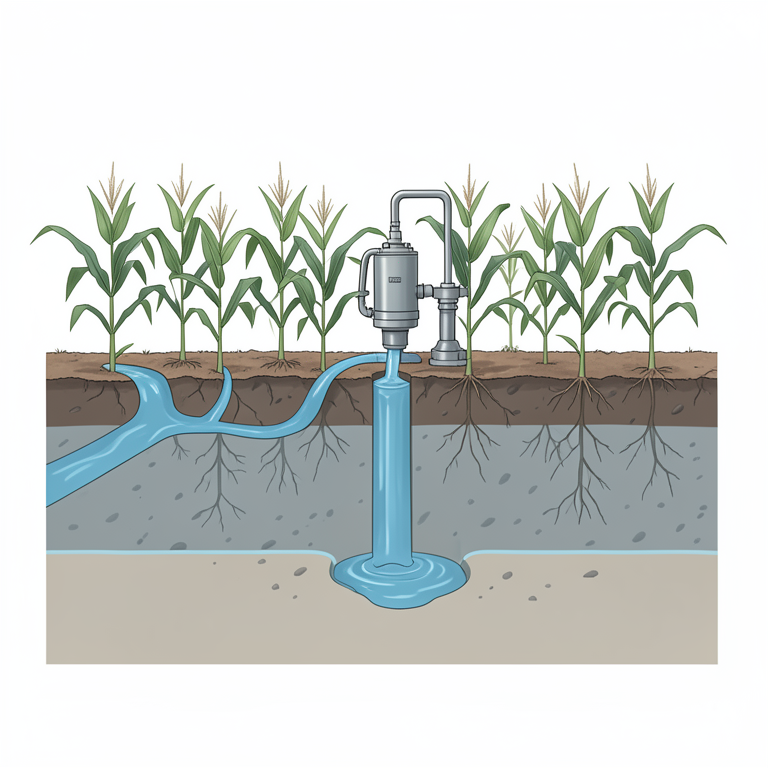
Water Demand Gap
AI-generated conceptual illustration (maize crop field with a canal and a groundwater well). It explains the idea and does not show study data.
View source evidence ↗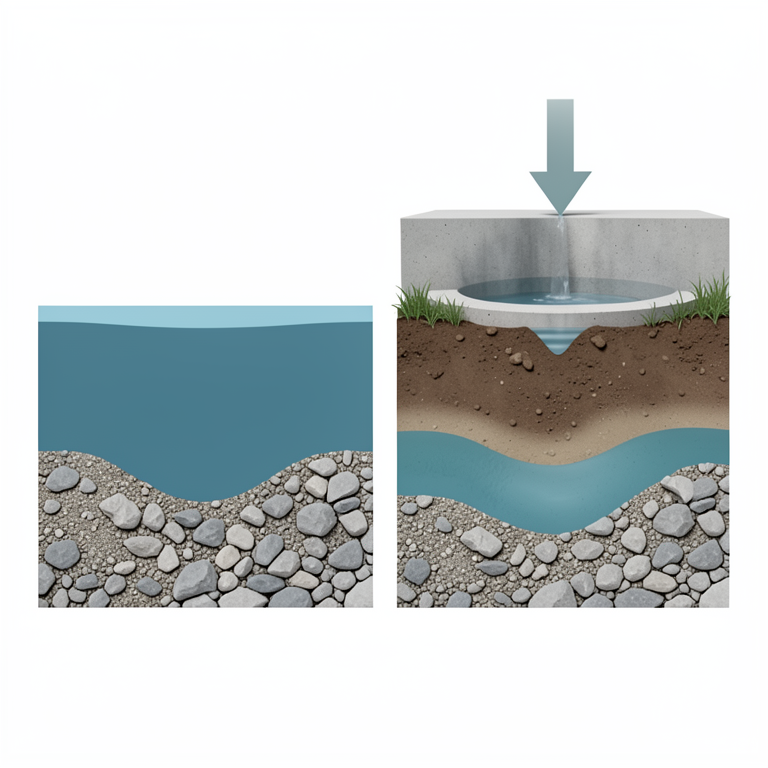
Aquifer Depletion Concept
AI-generated conceptual illustration (A cross-section of agricultural soil and a subterranean rock aquifer). It explains the idea and does not show study data.
View source evidence ↗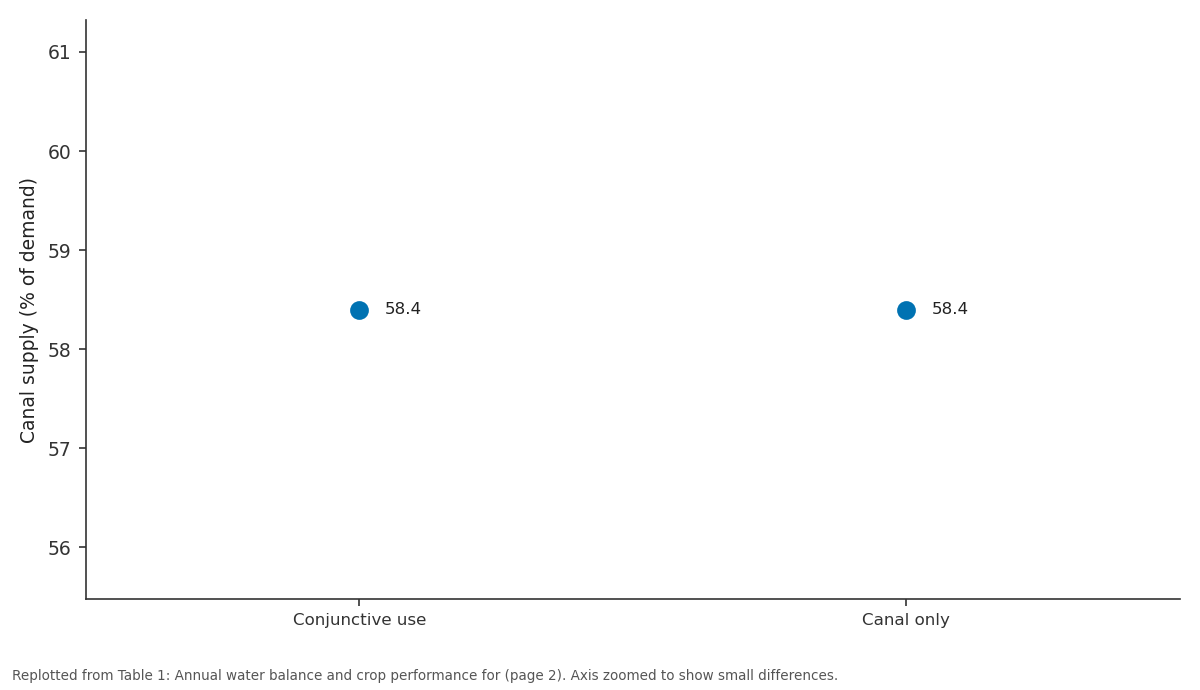
Canal supply (% of demand): Conjunctive use vs Canal only
Replotted from Table 1 (page 2) of the original paper. Every bar is the paper's own table value.
View source evidence ↗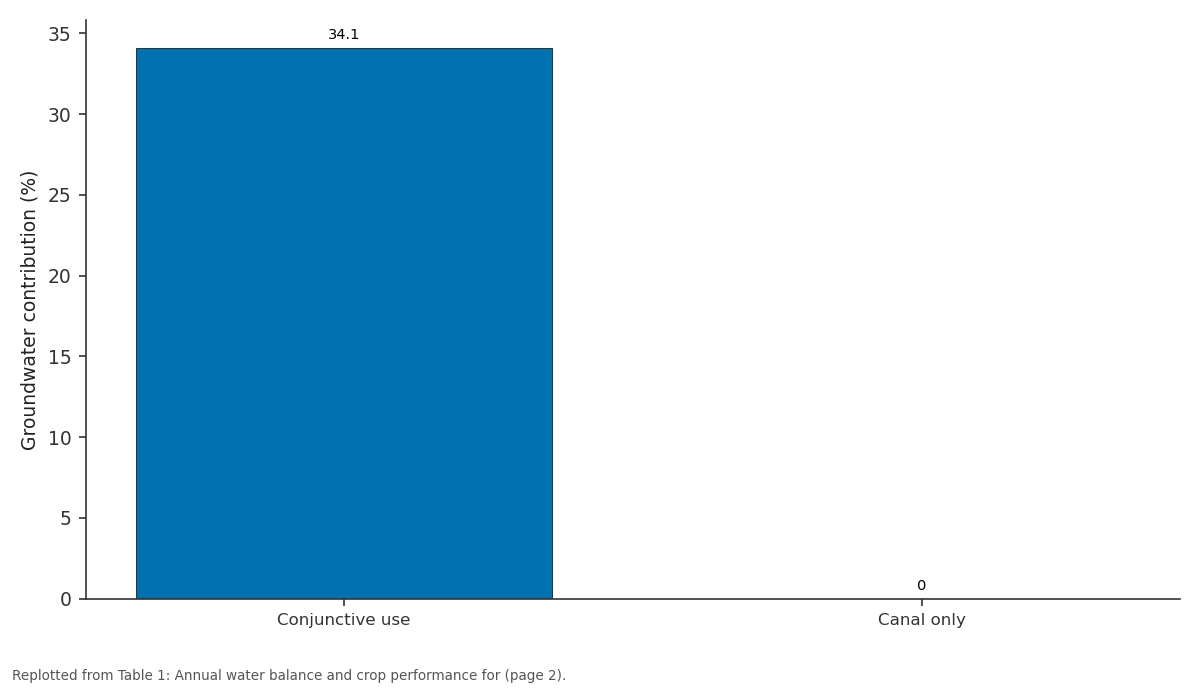
Groundwater contribution (%): Conjunctive use vs Canal only
Replotted from Table 1 (page 2) of the original paper. Every bar is the paper's own table value.
View source evidence ↗Figures & tables
From the original paper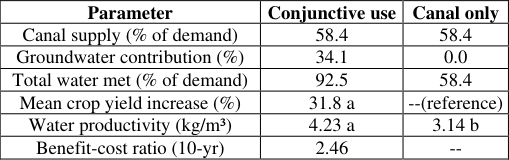 Table 1
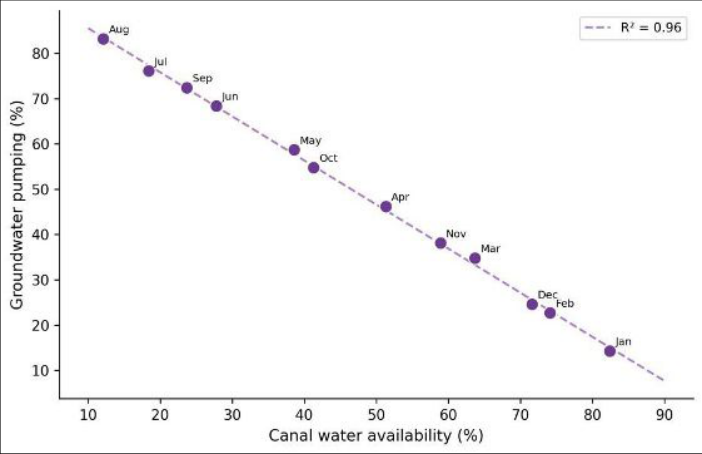 Figure 1
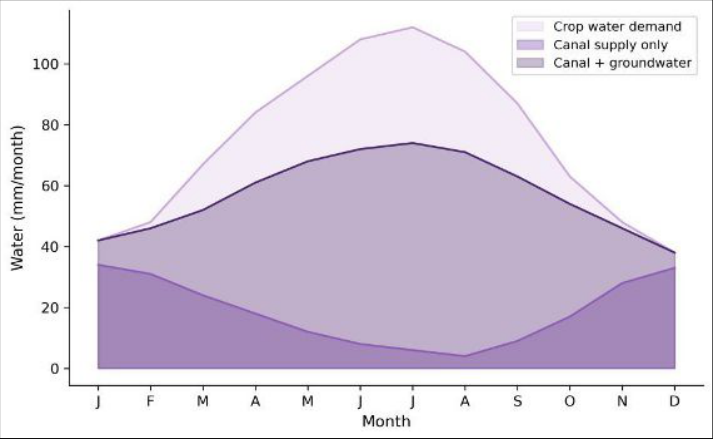 Figure 2
Introduction
The trend toward erratic canal deliveries in southern Africa isn't new, but it's accelerating [1] .
Canal irrigation systems built in the 1960s and 1970s were designed for steady river flows that no longer exist under current rainfall patterns. In South Africa's Limpopo Province, the Olifants River system supports roughly 32,000 ha of irrigated agriculture, yet canal water availability has declined by an estimated 18% over the past 15 years due to upstream abstractions and reduced rainfall [2] . Conjunctive use-the planned, coordinated operation of canal and groundwater sources-can buffer against surface water shortages by tapping aquifers during peak-demand months when canals run dry [3] . The concept has been widely implemented in India's Indus and Ganges basins, where it prevented waterlogging while extending irrigation coverage [4] . But adoption in sub-Saharan Africa remains limited, partly because groundwater data are sparse and borehole costs deter smallholders [5] . This research quantified the water balance gap at 14 farming units and tested whether groundwater supplementation could close it economically.
Materials and Methods Water Balance and Irrigation Scheduling
Monthly water balances were computed for each farming unit: canal inflow (measured at secondary offtakes), groundwater pumping (flow meters on boreholes), effective rainfall (FAO method), and crop water demand (Penman-Monteith ET₀ × crop coefficient). Irrigation scheduling followed a soil moisture deficit approach with a trigger at 50% depletion of available water in the root zone, monitored by capacitance probes at 30 and 60 cm [6] . Fourteen farming units (8-32 ha each) were monitored: eight with both canal and borehole access (conjunctive-use group) and six relying solely on canal supply (canal-only group). Crops included maize, citrus, tomato, and cabbage. Boreholes tapped the weathered basement aquifer at depths of 45-80 m, with yields of 1.2-4.8 L/s [7] .
Materials
Materials
Economic and Sustainability Assessment
Borehole installation costs (drilling, casing, pump, electrical connection) were amortised over 10 years at 8% interest. Annual operating costs included electricity for pumping and maintenance. Revenue was estimated from crop yields at district-average farmgate prices. Benefit-cost ratios were calculated for the conjunctive-use investment. Aquifer sustainability was assessed by tracking static water levels in monitoring boreholes at the start and end of each dry season [8] .
Methods
Crop yield was measured from 100-m² harvest plots in each farming unit at maturity. Seasonal yield was compared between conjunctive-use and canal-only groups using independent-samples t-test (p<0.05). Water productivity (kg yield per m³ water applied) was calculated for both groups. Groundwater level trends were analysed by linear regression [9] . 1). This translated into a 31.8% yield advantage and higher water productivity (4.23 vs 3.14 kg/m³). The borehole investment returned a benefit-cost ratio of 2.46 over the 10-year period.
Results
Results
Comprehensive Interpretation
Canal availability and groundwater pumping showed a strong inverse relationship (R² = 0.96, Figure 1), confirming that farmers instinctively increased borehole use as canal supply fell. The area chart (Figure 2) illustrates that the largest water deficit occurred between June and August, when canal supply dropped to 4-8 mm/month against crop demands of 104-112 mm. Groundwater filled most but not all of this gap. Static water levels in monitoring boreholes declined by an average of 1.3 m over the two-year period, flagging a sustainability concern if pumping intensity increases further.
Discussion
The 31.8% yield advantage from conjunctive use is consistent with Indian experiences in the Bhakra and Indira Gandhi canal commands, where studies reported 25-45% yield gains from supplemental groundwater [4] . The benefitcost ratio of 2.46 indicates that borehole investment pays back within roughly four years at current crop pricesattractive for commercial farmers but potentially out of reach for smallholders without subsidies [5] . The 1.3 m decline in static water levels over two years is a warning sign. If the trend continues at this rate, some shallower boreholes may become unproductive within a decade. Managed aquifer recharge-directing excess monsoon canal flows into recharge structures-could offset depletion but wasn't tested here [3] . One further limitation was the relatively small sample of 14 farming units; extrapolation to the full 32,000 ha command area requires caution.
Conclusion
Conjunctive use of canal water and groundwater raised total water availability from 58.4% to 92.5% of crop demand and increased yields by 31.8% in the Olifants River command area. The investment in borehole infrastructure returned a benefit-cost ratio of 2.46 over 10 years. However, declining groundwater levels (1.3 m over two years) highlight the need for managed aquifer recharge to sustain long-term pumping. Integrating groundwater planning into canal command area management is recommended for waterscarce irrigation schemes in southern Africa.
Figures and tables from the paper
| Parameter | Conjunctive use | Canal only |
|---|---|---|
| Canal supply (% of demand) | 58.4 | 58.4 |
| Groundwater contribution (%) | 34.1 | 0.0 |
| Total water met (% of demand) | 92.5 | 58.4 |
| Mean crop yield increase (%) | 31.8 a | --(reference) |
| Water productivity (kg/m³) | 4.23 a | 3.14 b |
| Benefit-cost ratio (10-yr) | 2.46 | -- |
Table text extracted from the original PDF; superscript letters are shown inline. The original table image is below.
View original table image
References
15 in the original paper- Siebert S, Burke J, Faures JM, Frenken K, Hoogeveen J, Döll P, et al. Groundwater use for irrigation: A global inventory. Hydrology and Earth System Sciences. 2010;14(10):1863-1880.
- DWA. Olifants River water resources management study. Department of Water Affairs, South Africa. 2019;1:1-148.
- Foster SSD, Chilton PJ. Groundwater: The processes and global significance of aquifer degradation. Philosophical Transactions of the Royal Society B. 2003;358(1440):1957-1972.
- Ambast SK, Tyagi NK, Raul SK. Management of declining groundwater in the Trans Indo-Gangetic Plain: Some options. Agricultural Water Management. 2006;82(3):279-296.
- Cobbing J, Hiller B. Waking a sleeping giant: Realizing the potential of groundwater in sub-Saharan Africa. World Development. 2019;122:597-613.
- Allen RG, Pereira LS, Raes D, Smith M. Crop evapotranspiration: Guidelines for computing crop water requirements. FAO Irrigation and Drainage Paper. 1998;56:1-300.
- DWAF. Groundwater resource assessment of the Limpopo River basin. Department of Water Affairs and Forestry, South Africa. 2006;1:1-96.
- Giordano M. Global groundwater: Issues and solutions. Annual Review of Environment and Resources. 2009;34:153-178.
- Gomez KA, Gomez AA. Statistical procedures for agricultural research. John Wiley and Sons. 1984;2(1):1-680.
- Sakthivadivel R, Gomathinayagam P, Shah T. Rejuvenating irrigation tanks through local institutions. Economic and Political Weekly. 2004;39(31):35213526.
- Shah T, Burke J, Villholth K. Groundwater: A global assessment of scale and significance. Water for Food, Water for Life. 2007;1:395-423.
- MacDonald AM, Bonsor HC, Dochartaigh BÉÓ, Taylor RG. Quantitative maps of groundwater resources in Africa. Environmental Research Letters. 2012;7(2):024009.
- Qureshi AS, McCornick PG, Qadir M, Aslam Z. Managing salinity and waterlogging in the Indus basin of Pakistan. Agricultural Water Management. 2008;95(1):1-10.
- Pavelic P, Giordano M, Keraita B, Ramesh V, Rao T. Groundwater availability and use in sub-Saharan Africa: A review of 15 countries. International Water Management Institute. 2012;1:1-274.
- Villholth KG. Groundwater irrigation for smallholders in sub-Saharan Africa: A synthesis of current knowledge to guide sustainable outcomes. Water International. 2013;38(4):369-391.