
Research article · 2025 · Full text
International Journal of Agriculture and NutritionRoot architecture plasticity and its role in nutrient acquisition under low phosphorus in rice
Volume 7(7) · Pages 197–200 · DOI: 10.33545/26646064.2025.v7.i7c.530 ↗
Research areasPlant nutrient uptake and metabolismRice Cultivation and Yield ImprovementPlant Micronutrient Interactions and Effects
Abstract
Author-writtenRoot architecture plasticity—the capacity of a plant to reshape its root system in response to nutrient availability—determines how efficiently rice captures phosphorus from depleted soils. This research examined root morphological and physiological responses to five phosphorus (P) supply levels in six rice genotypes (two parents and four recombinant inbred lines) grown in nutrient solution culture at Qassim Agricultural University, Saudi Arabia, from September 2022 to April 2024. Root length increased by up to 117% under P-deficient conditions compared to full-P controls. The root-to-shoot ratio rose from 0.32 in the tolerant parent IR64 to 0.61 in the P-efficient line RIL-106 under zero-P treatment. Lateral root density, root hair length, and organic acid exudation all increased as external P decreased. Genotypic differences in root plasticity accounted for 63.8% of the variation in total P uptake. These findings indicate that selecting for root architectural traits—especially lateral root density and root hair elongation—could improve phosphorus acquisition efficiency in breeding programmes targeting low-input rice systems.
Summary
Source-checkedPlain-language reading of the full paper, prepared with AI and checked against the text. Each point links to the authors' own words.
Why it matters
- Phosphorus (P) deficiency is a widespread issue affecting approximately 50% of global rice-growing soils, particularly in tropical and subtropical regions where P becomes insoluble. View evidence ↗
- Using mineral P fertilizers to combat deficiency is expensive for small-scale farmers and can lead to environmental eutrophication. View evidence ↗
- Because phosphorus is immobile in tropical soils, rice plants must use root architecture plasticity to grow roots directly toward P sources. View evidence ↗
The question
- The study aimed to identify which specific root architectural changes best predict phosphorus uptake under deficiency by examining six rice genotypes across five P supply levels. View evidence ↗
What they did
- The experiment was conducted in a controlled greenhouse at Qassim Agricultural University, Saudi Arabia, between September 2022 and April 2024. View evidence ↗
- The study tested six genotypes: IR64, Kasalath, and four recombinant inbred lines (RIL-12, RIL-47, RIL-83, RIL-106) from an IR64 × Kasalath population. View evidence ↗
- Five phosphorus treatments were used, ranging from a full-P control (0.32 mM) down to 0% P. View evidence ↗
What they found
- All tested genotypes increased their root length under phosphorus deprivation, with increases ranging from 87% in RIL-83 to 117% in RIL-106. View evidence ↗
- Under zero-P conditions, the root-to-shoot ratio varied by genotype, ranging from 0.32 in IR64 to 0.61 in RIL-106. View evidence ↗
- Lateral root density (r = 0.83) and root hair length (r = 0.79) were the strongest predictors of total P uptake, explaining 63.8% of the variation. View evidence ↗
- RIL-106 and Kasalath showed the highest plasticity and share a specific allele at the Pup1 locus on chromosome 12 associated with root elongation. View evidence ↗
- Unlike the high-plasticity lines, IR64 relied on higher organic acid exudation to mobilize phosphorus rather than significant root elongation. View evidence ↗
What it means
- The authors conclude that breeding programs for low-input rice systems should prioritize screening for lateral root density and root hair traits. View evidence ↗
- A limitation of the study is the use of hydroponic screening, which excludes the soil matrix and its influence on phosphorus availability. View evidence ↗
- The constant temperature and light of the controlled environment may not reflect the fluctuations field-grown rice faces, which could alter root plasticity. View evidence ↗
Visual summary
3 visualsIllustrations explain the paper; charts are replotted from the paper's own table values.
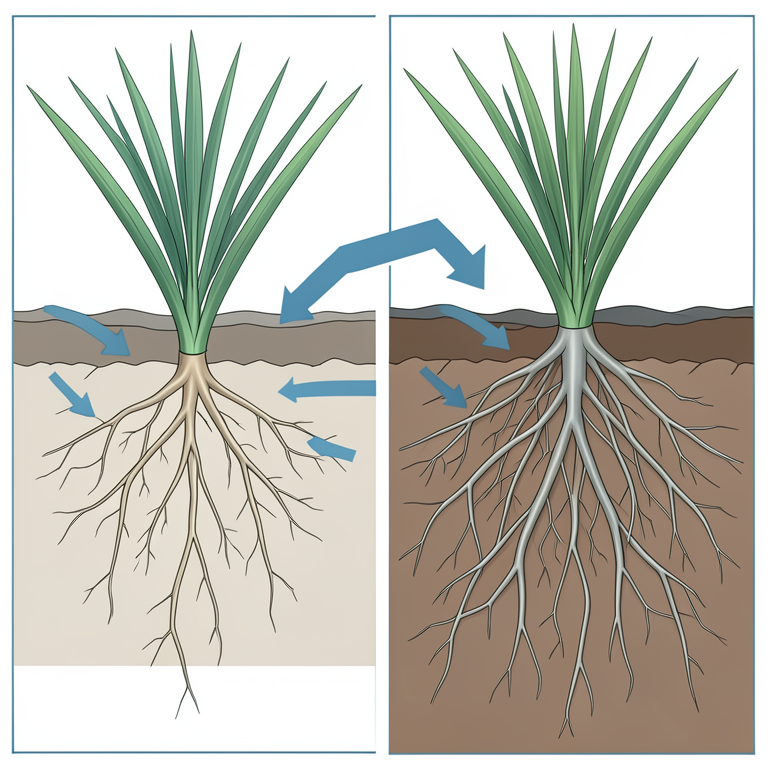
Predictors of P Uptake
AI-generated conceptual illustration (rice plants (Oryza sativa) root systems). It explains the idea and does not show study data.
View source evidence ↗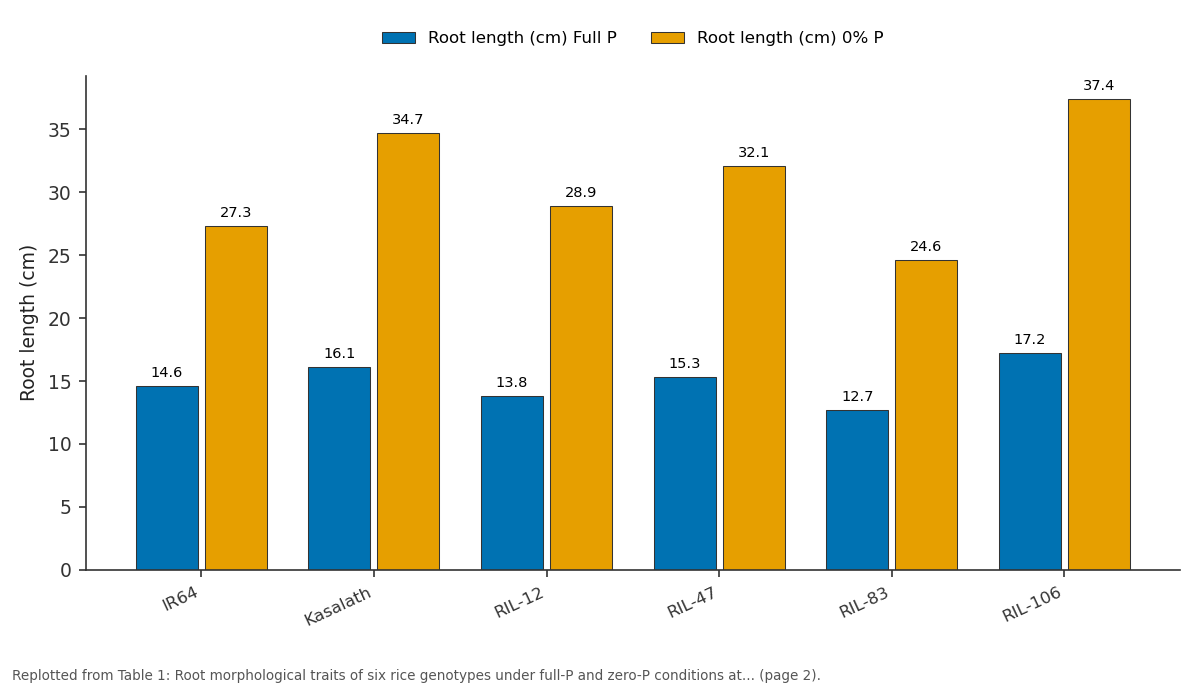
Root length (cm) Full P and Root length (cm) 0% P: IR64 vs Kasalath vs RIL-12 vs RIL-47 vs RIL-83
Replotted from Table 1 (page 2) of the original paper. Every bar is the paper's own table value.
View source evidence ↗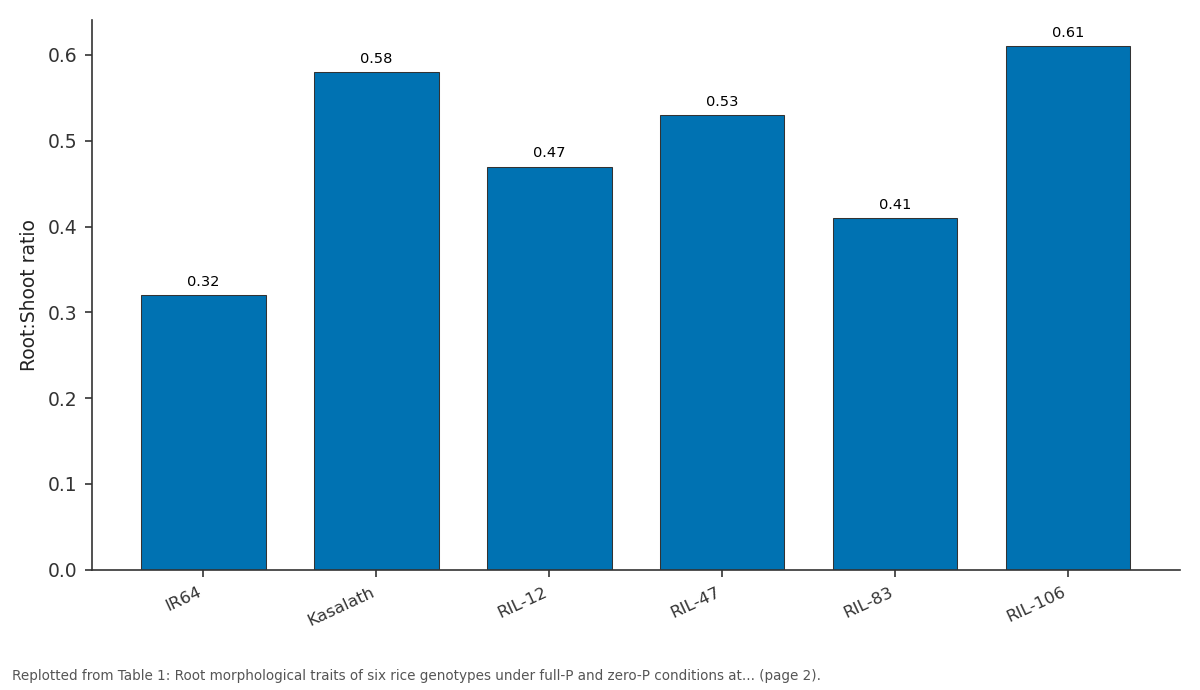
Root:Shoot 0% P: IR64 vs Kasalath vs RIL-12 vs RIL-47 vs RIL-83
Replotted from Table 1 (page 2) of the original paper. Every bar is the paper's own table value.
View source evidence ↗Figures & tables
From the original paper Table 1
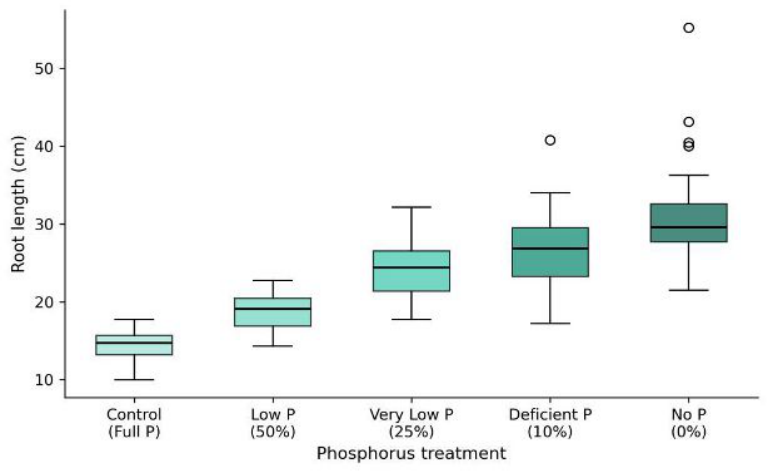 Figure 1
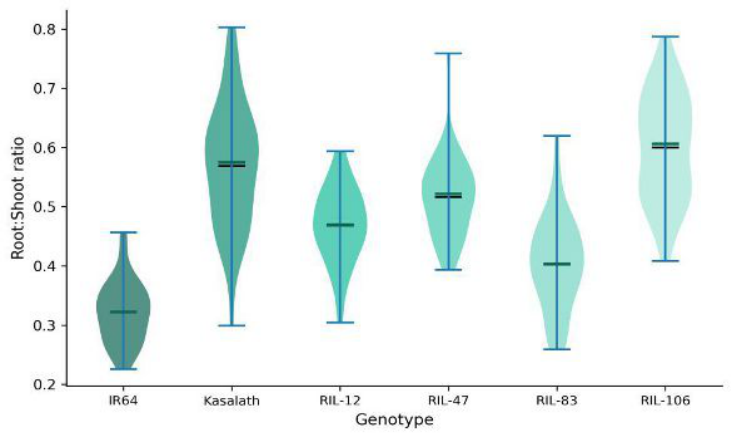 Figure 2
Introduction
Root architecture plasticity can be defined as the heritable ability of a plant to alter the spatial arrangement, branching pattern, and surface area of its root system in response to changes in soil nutrient status [1] . In rice, this plasticity is especially relevant for phosphorus acquisition because P is immobile in most tropical soils and plants must grow roots directly to where P is located rather than relying on mass flow [2] . Phosphorus deficiency affects an estimated 50% of global rice-growing soils, and the problem is worse in weathered tropical and subtropical soils where P is fixed into insoluble forms by iron and aluminium oxides [3] . Conventional responses-applying mineral P fertiliser-are costly for smallholders and contribute to eutrophication when excess P reaches waterways [4] . Breeding rice varieties that extract more P from low-P soils through improved root systems is a more sustainable alternative. Several root traits have been linked to P efficiency in rice: longer total root length, higher lateral root density, longer root hairs, and greater exudation of organic acids such as citrate and malate that mobilise bound P [5,6] . But how these traits interact across a gradient of P supply-and which traits matter most-is still debated. Some genotypes increase root length without changing branching, while others invest in root hairs at the expense of lateral roots [7] . This research characterised root responses across five P levels in six contrasting genotypes to identify which architectural changes best predict P uptake under deficiency.
Materials and Methods
Materials and Methods
Crop Growth Stage Documentation
Plants were monitored through three growth stages during the experiment. Seedlings were established for 14 days in full-nutrient solution before P treatments were imposed (vegetative stage V3, three-leaf). Measurements began at 7 days after treatment (DAT) and continued at 14, 21, 35, and 42 DAT, spanning the active tillering phase. Final destructive harvests were done at 42 DAT, corresponding to the early panicle initiation stage in the earliest genotypes. Growth stages were documented using the BBCH scale for rice [8] .
Materials
The research was carried out in the controlled-environment greenhouse of Qassim Agricultural University, Qassim, Saudi Arabia (26.31° N, 43.77° E), from September 2022 to April 2024. Institutional approval was obtained from the University's Research Ethics Board (Ref. QAU/REB-2022-041, August 2022). Six rice genotypes were tested: IR64 (Pefficient indica), Kasalath (P-efficient aus-type landrace), and four RILs (RIL-12, RIL-47, RIL-83, RIL-106) selected from an IR64 × Kasalath mapping population for contrasting root traits. Seeds were surface-sterilised with 1% sodium hypochlorite and germinated on moist filter paper for five days before transfer to 12-L hydroponic tanks containing modified Yoshida nutrient solution [9] .
Methods
Five P treatments were applied by adjusting NaH₂PO₄ concentration: full P (0.32 mM, control), 50% P (0.16 mM), 25% P (0.08 mM), 10% P (0.032 mM), and 0% P. Each treatment × genotype combination was replicated four times in a completely randomised design. Solutions were renewed every three days. At each sampling point, root length was measured by digital image analysis (WinRHIZO Pro), lateral root density was counted per cm of seminal root, and root hair length was measured under a stereo microscope at 40× magnification. Organic acid exudation (citrate and malate) was collected over 6-h trapping periods and quantified by HPLC. Shoot and root P concentrations were determined by the vanadomolybdate colorimetric method after dry-ashing. Data were analysed with two-way ANOVA (genotype × P level) and Pearson correlation was used to relate root traits to total P uptake [10] .
Nutrient Budget
A simplified P budget was calculated for each genotype under each treatment: total P input (from solution renewals), total plant P uptake (shoot P + root P at harvest), and apparent P recovery efficiency (uptake/input × 100). Under the 0% P treatment, residual P from seed reserves was estimated by analysing P content of ungerminated seeds and subtracting it from total plant P at harvest. All genotypes increased root length under P deprivation, but the magnitude varied from 87% (RIL-83) to 117% (RIL-106) (Table 1). Lateral root density roughly doubled in most genotypes. RIL-106 and Kasalath showed the highest rootto-shoot ratios under zero-P, indicating a strong reallocation of carbon to below-ground growth.
| Genotype | Root length (cm) Full P | Root length (cm) 0% P | Lateral roots (/cm) Full P | Lateral roots (/cm) 0% P | Root:Shoot 0% P |
|---|---|---|---|---|---|
| IR64 | 14.6 | 27.3 | 3.8 | 7.2 | 0.32 |
| Kasalath | 16.1 | 34.7 | 4.6 | 9.8 | 0.58 |
| RIL-12 | 13.8 | 28.9 | 3.4 | 6.4 | 0.47 |
| RIL-47 | 15.3 | 32.1 | 4.1 | 8.7 | 0.53 |
| RIL-83 | 12.7 | 24.6 | 3.1 | 5.9 | 0.41 |
| RIL-106 | 17.2 | 37.4 | 5.2 | 10.6 | 0.61 |
Table text extracted from the original PDF; superscript letters are shown inline. The original table image is below.
View original table image
Results
Results
Comprehensive Interpretation
Root length increased progressively as P supply decreased (Figure 1), with the widest variation under the zero-P and 10% P treatments. The violin plot (Figure 2) shows that Kasalath and RIL-106 had not only higher median root-toshoot ratios but also narrower distributions, suggesting more consistent reallocation under stress. Correlation analysis found that lateral root density (r = 0.83) and root hair length (r = 0.79) were the strongest predictors of total P uptake, together accounting for 63.8% of uptake variation in a multiple regression model.
Discussion
The 87-117% increase in root length under zero-P conditions falls within the range reported for indica rice in hydroponic systems (70-150%), but the genotypic spread is notable [5] . RIL-106 and Kasalath represent the upper end of plasticity, and both share the Kasalath-derived allele at the Pup1 locus on chromosome 12, which has been associated with root elongation under P stress [6] . IR64, despite being classified as P-efficient, showed comparatively modest root elongation, relying instead on higher organic acid exudation to mobilise P-a different but complementary strategy. The finding that lateral root density and root hair length together explained 63.8% of P uptake variation is consistent with modelling work suggesting that root hairs can account for up to 70% of P absorption in low-P soils because they increase the effective root surface area at minimal carbon cost [7] . This means breeders should prioritise these two traits over total root length when selecting for P efficiency. A limitation of hydroponic screening is that it removes the soil matrix, which mediates P availability through adsorption and desorption dynamics. Field validation using low-P soils would confirm whether the genotypic rankings hold under more complex conditions. The controlledenvironment setting in Qassim also meant that temperature and light were constant, whereas field-grown rice experiences fluctuations that can alter root plasticity responses [2] .
Conclusion
Root architecture plasticity varied markedly among the six rice genotypes, with root length increases of 87-117% under phosphorus deprivation. Lateral root density and root hair length were the strongest predictors of P uptake, accounting for 63.8% of variation. RIL-106 and Kasalath consistently showed the highest plasticity and P acquisition efficiency. These findings support screening for lateral root density and root hair traits in rice breeding programmes aimed at lowinput systems. Field validation on low-P soils and integration of root trait selection with molecular markers at the Pup1 locus are recommended as practical next steps.
Acknowledgement
Acknowledgements Funding SourcesThis research was funded by the Deanship of Scientific Research at Qassim Agricultural University. The funding body had no role in research design, data collection, or manuscript preparation.
References
15 in the original paper- Lynch JP. Root architecture and plant productivity. Plant Physiology. 1995;109(1):7-13.
- Wissuwa M. How do plants achieve tolerance to phosphorus deficiency? Small causes with big effects. Plant Physiology. 2003;133(4):1947-1958.
- Holford ICR. Soil phosphorus: Its measurement, and its uptake by plants. Australian Journal of Soil Research. 1997;35(2):227-239.
- Cordell D, Drangert JO, White S. The story of phosphorus: Global food security and food for thought. Global Environmental Change. 2009;19(2):292-305.
- Gamuyao R, Chin JH, Pariasca-Tanaka J, Pesaresi P, Catausan S, Dalid C, et al. The protein kinase Pstol1 from traditional rice confers tolerance of phosphorus deficiency. Nature. 2012;488(7412):535-539.
- Wissuwa M, Ae N. Genotypic variation for tolerance to phosphorus deficiency in rice and the potential for its exploitation in rice improvement. Plant Breeding. 2001;120(1):43-48.
- Gahoonia TS, Nielsen NE. Root hairs and phosphorus acquisition of wheat and barley cultivars. Plant and Soil. 1997;191(2):181-188.
- Lancashire PD, Bleiholder H, Boom TVD, Langelüddeke P, Stauss R, Weber E, et al. A uniform decimal code for growth stages of crops and weeds. Annals of Applied Biology. 1991;119(3):561-601.
- Yoshida S, Forno DA, Cock JH, Gomez KA. Laboratory manual for physiological studies of rice. International Rice Research Institute. 1976;3:1-83.
- Murphy J, Riley JP. A modified single solution method for the determination of phosphate in natural waters. Analytica Chimica Acta. 1962;27:31-36.
- Rose TJ, Wissuwa M. Rethinking internal phosphorus utilization efficiency: A new approach is needed to improve PUE in grain crops. Advances in Agronomy. 2012;116:185-217.
- Lambers H, Shane MW, Cramer MD, Pearse SJ, Veneklaas EJ. Root structure and functioning for efficient acquisition of phosphorus: Matching morphological and physiological traits. Annals of Botany. 2006;98(4):693-713.
- Vejchasarn P, Lynch JP, Brown KM. Genetic variability in phosphorus responses of rice root phenotypes. Rice. 2016;9(1):29.
- Richardson AE, Lynch JP, Ryan PR, Delhaize E, Smith FA, Smith SE, et al. Plant and microbial strategies to improve the phosphorus efficiency of agriculture. Plant and Soil. 2011;349(1):121-156.
- Pariasca-Tanaka J, Vandamme E, Mori A, Segda Z, Saito K, Rose TJ, et al. Does reducing phosphorus uptake still negatively impact rice grain yield in a phosphorus deficient environment? Plant and Soil. 2015;393(1):283-293.