
Research article · 2025 · Full text
International Journal of Agriculture and NutritionSocio-economic impact of contract farming on smallholder poultry producers
Volume 7(11) · Pages 101–103 · DOI: 10.33545/26646064.2025.v7.i11b.486 ↗
Research areasLivestock and Poultry ManagementLivestock Farming and ManagementAgricultural Development and Management
Abstract
Author-writtenContract farming in poultry has expanded rapidly in western India, but whether smallholder producers genuinely benefit or become trapped in asymmetric arrangements is debated. This research compared the socio-economic outcomes of 80 contract and 80 independent smallholder broiler producers in the Ratnagiri and Sindhudurg districts of Maharashtra during 2022-2023. Contract farmers earned 28.4% higher net income per batch (₹48,620 vs. ₹37,840), experienced 34.2% lower price risk, and had 92.5% market access certainty. However, they retained less decision-making autonomy (score 3.2 vs. 4.6 on a 5-point scale) and reported higher dependency on the integrator company. Technical support from integrators improved feed conversion ratio by 11.8% and reduced mortality by 4.2 percentage points. Tobit regression showed that contract participation, flock size, and access to veterinary services were the strongest predictors of net income. These results indicate that contract farming offers tangible income and market access benefits to smallholder poultry producers but requires regulatory safeguards to prevent exploitative terms.
Summary
Source-checkedPlain-language reading of the full paper, prepared with AI and checked against the text. Each point links to the authors' own words.
Why it matters
- In broiler production, the integrator model of contract farming involves a company providing essential inputs like chicks, feed, and vaccines, while the farmer manages labor and housing. View evidence ↗
- Poultry farming is a viable livelihood for marginal farmers in Maharashtra's Konkan region who have limited land for traditional crops. View evidence ↗
- There is ongoing debate and mixed evidence regarding whether contract farming truly improves the welfare of smallholders or merely shifts risk and extracts value. View evidence ↗
The question
- The study aimed to provide empirical clarity in the Konkan region by comparing income, risk, market access, and autonomy between contract and independent poultry producers. View evidence ↗
What they did
- The study took place in the Ratnagiri and Sindhudurg districts of Maharashtra from September 2022 to June 2023. View evidence ↗
- The sample consisted of 80 contract farmers (from Venky's and Suguna) and 80 independent producers, selected via stratified random sampling based on flock size. View evidence ↗
- A Tobit regression was used to analyze net income per batch, considering variables such as contract status, flock size, education, and veterinary access. View evidence ↗
What they found
- Contract farmers achieved a 28.4% higher net income per batch compared to independent producers (₹48,620 vs. ₹37,840). View evidence ↗
- Contract farmers had 34.2% lower price risk (CV 12.4% vs 18.9%) and significantly higher market access certainty (92.5% vs 64.8%). View evidence ↗
- Integrator technical support led to a better feed conversion ratio (1.72 vs 1.94) and a lower mortality rate (4.8% vs 9.0%) for contract farmers. View evidence ↗
- Contract farmers had significantly less decision-making autonomy, scoring 3.2 on a 5-point scale compared to 4.6 for independent producers. View evidence ↗
- The strongest predictors of net income were contract participation, flock size, and access to veterinary services. View evidence ↗
- The primary constraint for contract farmers was low growing charges (score 72.4), whereas independent producers were most concerned with price fluctuations (score 78.6). View evidence ↗
What it means
- The authors conclude that while contract farming provides clear technical, market, and income benefits, the loss of autonomy and dependency on integrators require policy intervention. View evidence ↗
- The authors recommend strengthening legislation to ensure transparent quality grading, timely payments, and fair pricing formulas to protect smallholders. View evidence ↗
Visual summary
2 visualsIllustrations explain the paper; charts are replotted from the paper's own table values.
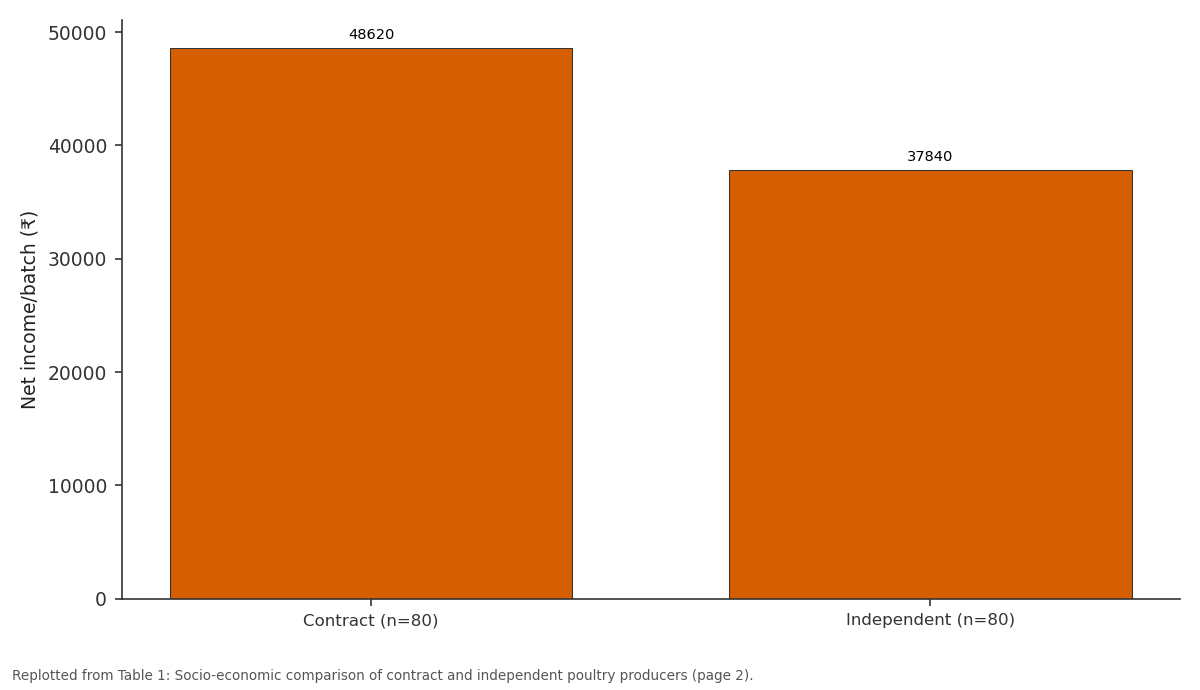
Net income/batch (₹): Contract (n=80) vs Independent (n=80)
Replotted from Table 1 (page 2) of the original paper. Every bar is the paper's own table value.
View source evidence ↗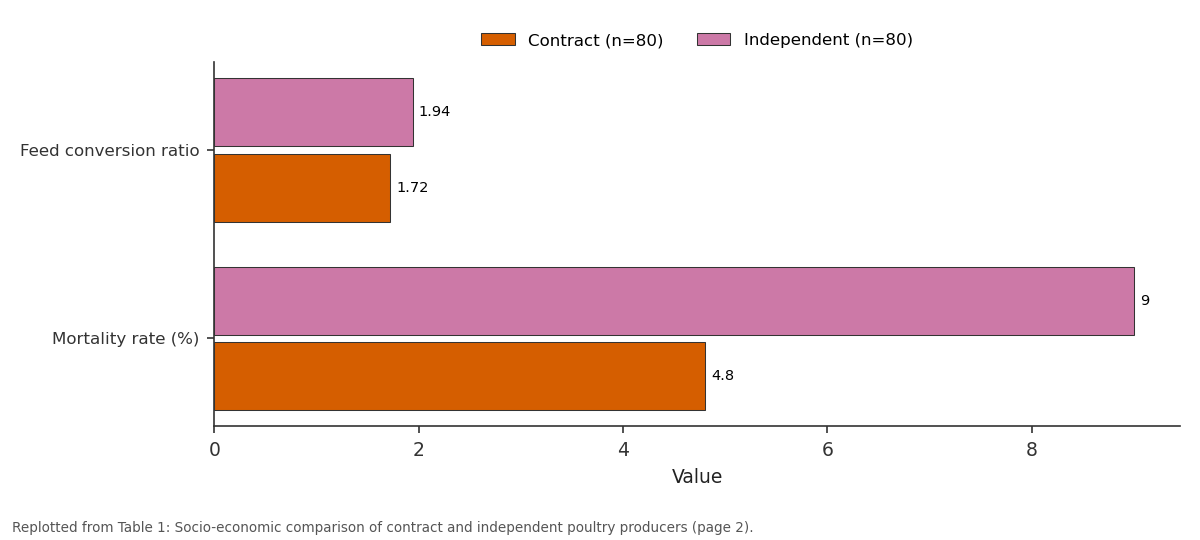
Contract (n=80) and Independent (n=80): Feed conversion ratio vs Mortality rate (%)
Replotted from Table 1 (page 2) of the original paper. Every bar is the paper's own table value.
View source evidence ↗Figures & tables
From the original paper Table 1
 Table 2
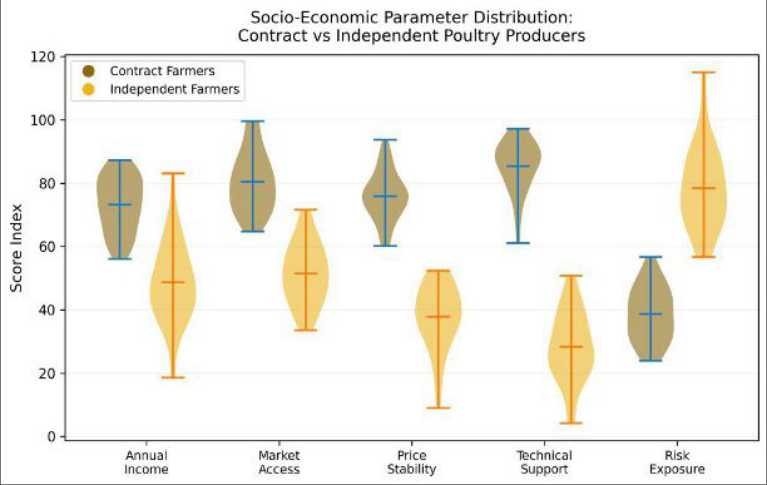 Figure 1
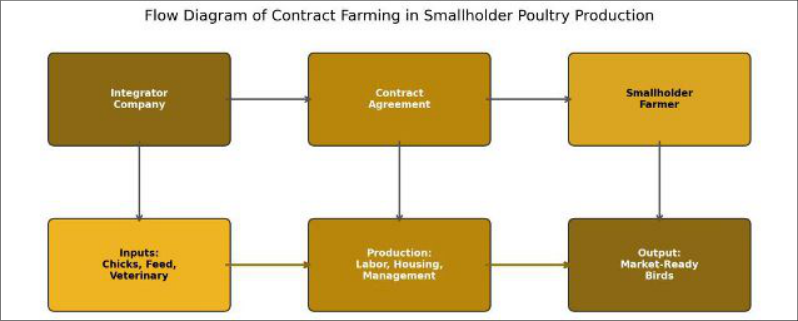 Figure 2
Introduction
For a smallholder poultry farmer in coastal Maharashtra, the decision to sign a contract with an integrator company is not just a business arrangementit reshapes the entire household economy. Contract farming in broiler production follows the integrator model, where the company supplies day-old chicks, feed, vaccines, and technical guidance, while the farmer provides labor, housing, and day-to-day management [1] . The farmer is paid a fixed growing charge per bird delivered at the agreed weight, insulating them from market price fluctuations but also capping their upside potential [2] . India's poultry sector has grown at 8-10% annually over the past decade, and contract farming now accounts for roughly 70% of commercial broiler production [3] . In the Konkan region of Maharashtra, poultry keeping has become an attractive livelihood option for marginal farmers who lack sufficient land for crop-based income. But evidence on whether contract arrangements actually improve smallholder welfare, or simply transfer production risk while extracting value, remains mixed [4] . This research compared income, risk exposure, market access, and autonomy between contract and independent producers to provide empirical clarity for this region.
Theoretical Framework
The analysis draws on the theory of the firm and transaction cost economics [5] , which predicts that vertical coordination through contracts emerges when market transaction costs (search, negotiation, enforcement) are high and asset specificity locks producers into narrow market channels. In poultry, the perishability of broilers and the specialized infrastructure needed for production create conditions favoring contractual arrangements. The expected benefits to smallholders include reduced market risk, guaranteed input supply, and technical knowledge transfer, while potential costs include loss of autonomy, dependency, and unequal bargaining power [6] . The empirical comparison tested these theoretical predictions using household-level data.
Material and Methods Material
The research was conducted in Ratnagiri and Sindhudurg districts of the Konkan region, Maharashtra (16.98° N, 73.31° E), between September 2022 and June 2023. Eighty contract farmers associated with two integrator companies (Venky's and Suguna) and 80 independent producers were selected using proportionate stratified random sampling based on flock size (small: <1,000; medium: 1,000-3,000; large: >3,000 birds). Data were collected through structured interview schedules covering flock management, economics, market arrangements, and subjective welfare indicators [7] .
Methods
Net income per batch was calculated as gross receipts minus variable costs. Price risk was measured as the CV of perbird realization over six consecutive batches. Market access certainty was the proportion of batches sold without delay. Decision-making autonomy was assessed on a 5-point scale across eight management decisions. A Tobit regression with net income per batch as the dependent variable included contract status, flock size, experience, education, veterinary access, and feed conversion ratio as independent variables [8] . Garrett ranking was used to rank constraints. Group differences were tested by independent t-test and Mann-Whitney U test as appropriate.
Results
Table The top constraint for contract farmers was low growing charges, while price fluctuation was the main concern for independent producers (Table 2). Disease outbreaks ranked high for both groups.
| Constraint | Contract Rank | Independent Rank | Contract Score | Indep. Score |
|---|---|---|---|---|
| Low growing charges | 1 | — | 72.4 | — |
| Price fluctuation | — | 1 | — | 78.6 |
| Delayed payments | 2 | — | 68.2 | — |
| High feed cost | 3 | 2 | 62.8 | 74.2 |
| Disease outbreaks | 4 | 3 | 58.4 | 68.6 |
| Lack of technical support | — | 4 | — | 64.8 |
Table text extracted from the original PDF; superscript letters are shown inline. The original table image is below.
View original table image
Discussion
The 28.4% income advantage for contract farmers is at the upper end of estimates from Indian studies [1,3] and largely reflects the combination of lower mortality, better FCR, and guaranteed market outlet. The integrator's technical support effectively substitutes for formal education and experience, which explains why these variables lost significance in the regression. However, the autonomy deficit is a legitimate concern, as contract farmers reported having little say in chick quality, feed brand, or selling price [4] . The constraint analysis reveals an interesting asymmetry: contract farmers are dissatisfied with growing charges (a fixed term), while independents struggle with price volatility (a market risk). This suggests that a middle pathperhaps through producer cooperatives that negotiate collectively with integratorscould address both issues [2,6] .
Conclusion
Contract farming offers clear income, market access, and technical benefits to smallholder poultry producers in coastal Maharashtra. But the trade-off in decision-making autonomy and the risk of dependency on integrator companies warrant policy attention. Strengthening contract farming legislation to mandate fair pricing formulas, timely payments, and transparent quality grading would protect smallholders while preserving the efficiency gains of vertical coordination.
Figures and tables from the paper
| Parameter | Contract (n=80) | Independent (n=80) | Difference (%) | Significance |
|---|---|---|---|---|
| Net income/batch (₹) | 48,620 | 37,840 | +28.4 | ** |
| Price risk (CV %) | 12.4 | 18.9 | -34.2 | ** |
| Market access certainty (%) | 92.5 | 64.8 | +42.7 | ** |
| Feed conversion ratio | 1.72 | 1.94 | -11.3 | ** |
| Mortality rate (%) | 4.8 | 9.0 | -46.7 | ** |
| Decision autonomy (1-5) | 3.2 | 4.6 | -30.4 | ** |
Table text extracted from the original PDF; superscript letters are shown inline. The original table image is below.
View original table image
References
18 in the original paper- Birthal PS, Jha AK, Singh H. Linking farmers to markets for high-value agricultural commodities. Agricultural Economics Research Review. 2007;20:425-439.
- Singh S. Contract farming for agricultural development. Journal of International Development. 2002;14(4):529559.
- Mehta R, Nambiar RG, Singh SK. Livestock industrialization, trade and social-health-environment impacts in developing countries. FAO Phase II Report. 2003;1:1-68.
- Ramaswami B, Birthal PS, Joshi PK. Grower heterogeneity and the gains from contract farming. Indian Growth and Development Review. 2009;2(1):56-74.
- Williamson OE. The economic institutions of capitalism. Free Press. 1985;1:1-450.
- Key N, Runsten D. Contract farming, smallholders, and rural development in Latin America. World Development. 1999;27(2):381-401.
- Singh AK. Poultry farming in India: opportunities and challenges. Indian Journal of Animal Sciences. 2014;84(2):123-131.
- Greene WH. Econometric analysis. Prentice Hall. 2012;7:1-1188.
- Eaton C, Shepherd AW. Contract farming: partnerships for growth. FAO Agricultural Services Bulletin. 2001;145:1-182.
- Warning M, Key N. The social performance and distributional consequences of contract farming. World Development. 2002;30(2):255-263.
- Bellemare MF. As you sow, so shall you reap: the welfare impacts of contract farming. World Development. 2012;40(7):1418-1434.
- Prowse M. Contract farming in developing countries: a review. A Savoir Report, AFD. 2012;12:1-95.
- Little PD, Watts MJ. Living under contract: contract farming and agrarian transformation. University of Wisconsin Press. 1994;1:1-284.
- Oya C. Contract farming in sub-Saharan Africa: a survey of approaches, debates and issues. Journal of Agrarian Change. 2012;12(1):1-33.
- Simmons P, Winters P, Patrick I. An analysis of contract farming in East Java. Agricultural Systems. 2005;83(1):99-115.
- Catelo MAO, Costales AC. Contract farming and other market institutions as mechanisms for integrating smallholder livestock producers. PPLPI Working Paper. 2008;45:1-20.
- Narayanan S. The microfoundations of crop yield: an analysis of risk in Indian agriculture. Indian Economic Review. 2013;48(1):129-152.
- Delgado CL, Narrod CA, Tiongco MM. Determinants and implications of the growing scale of livestock farms. IFPRI Discussion Paper. 2008;157:1-46.