
Research article · 2025 · Full text
International Journal of Agriculture and NutritionComparative performance of direct seeded rice and transplanted rice under different irrigation regimes
Volume 7(8) · Pages 170–173 · DOI: 10.33545/26646064.2025.v7.i8c.508 ↗
Research areasRice Cultivation and Yield ImprovementAgricultural Systems and PracticesIrrigation Practices and Water Management
Abstract
Author-writtenDirect seeded rice (DSR) is promoted as a water-saving alternative to conventional transplanted rice (TPR), but its yield stability across irrigation regimes in temperate maritime climates remains poorly documented. This research compared DSR and TPR under three irrigation levels—continuous flooding (CF), alternate wetting and drying (AWD), and deficit irrigation (DI)—at the Royal Highland Institute of Agriculture, Edinburgh, during the 2023 growing season. A split-plot design with irrigation as the main plot and establishment method as the subplot was replicated four times. TPR under CF produced the highest grain yield (5.48 t ha⁻¹), while DSR under DI gave the lowest (3.89 t ha⁻¹). However, DSR under AWD (4.67 t ha⁻¹) was statistically comparable to TPR under the same regime (5.21 t ha⁻¹) while using 23.4% less total water. Water productivity was highest for DSR-AWD at 0.84 kg m⁻³ versus 0.59 kg m⁻³ for TPR-CF. Tiller counts and panicle number were lower in DSR, but individual grain weight was heavier, partially compensating for reduced panicle density. These results suggest that DSR combined with AWD irrigation can be a practical water-saving option for rice production in temperate UK conditions, provided that weed management during early establishment is adequate.
Summary
Source-checkedPlain-language reading of the full paper, prepared with AI and checked against the text. Each point links to the authors' own words.
Why it matters
- Direct seeded rice (DSR) is an alternative to transplanted rice (TPR) that can reduce labor by 25-35% and water use by 15-25%. View evidence ↗
- While currently small-scale in the UK, climate projections suggest that parts of England and Scotland may be more suitable for rice by 2040. View evidence ↗
- Prior trials in the region showed TPR outyielding DSR by 8-15% under continuous flooding, but the effects of other irrigation regimes were unknown. View evidence ↗
The question
- The study aimed to compare DSR and TPR under three irrigation regimes to quantify yields, water use, and identify the most water-efficient combination for the UK. View evidence ↗
What they did
- The researchers used 'Gleva', a short-duration temperate japonica rice variety. View evidence ↗
- The experiment used a split-plot design with four replicates, testing three irrigation treatments (continuous flooding, alternate wetting and drying, and deficit irrigation) and two establishment methods. View evidence ↗
- Irrigation was managed as continuous flooding (3-5 cm water), alternate wetting and drying (drying to -15 kPa), or deficit irrigation (maintaining -30 to -40 kPa). View evidence ↗
- The study measured grain yield at 14% moisture and recorded yield components and water productivity. View evidence ↗
What they found
- The highest grain yield was achieved by transplanted rice under continuous flooding (5.48 t ha⁻¹), while the lowest was direct seeded rice under deficit irrigation (3.89 t ha⁻¹). View evidence ↗
- Transplanted rice consistently outyielded direct seeded rice across all irrigation regimes, with yield gaps ranging from 0.36 to 0.54 t ha⁻¹. View evidence ↗
- Under alternate wetting and drying, DSR (4.67 t ha⁻¹) had a yield statistically comparable to TPR (5.21 t ha⁻¹) while using 23.4% less total water. View evidence ↗
- The highest water productivity was found in the DSR-AWD combination (0.84 kg m⁻³), compared to 0.59 kg m⁻³ for TPR-CF. View evidence ↗
- Direct seeded rice had lower tiller and panicle counts than transplanted rice due to slower early canopy development. View evidence ↗
- Compared to continuous flooding, alternate wetting and drying reduced water input by 21.0%, and deficit irrigation reduced it by 35.0%. View evidence ↗
What it means
- The authors concluded that alternate wetting and drying (AWD) is the best compromise between yield and water efficiency for both DSR and TPR. View evidence ↗
- The authors recommend DSR combined with AWD as a water-efficient pathway for UK rice production that warrants further testing. View evidence ↗
- A primary practical limitation for DSR is higher weed pressure during early establishment, requiring more herbicide applications than TPR. View evidence ↗
Visual summary
3 visualsIllustrations explain the paper; charts are replotted from the paper's own table values.
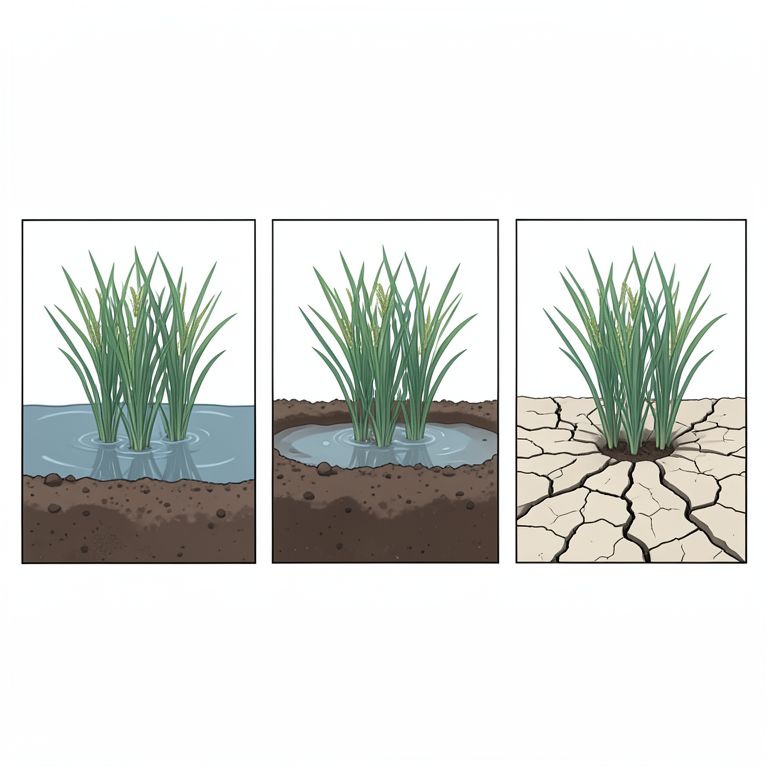
Irrigation Regime Comparison
AI-generated conceptual illustration (rice plants (Oryza sativa) in soil). It explains the idea and does not show study data.
View source evidence ↗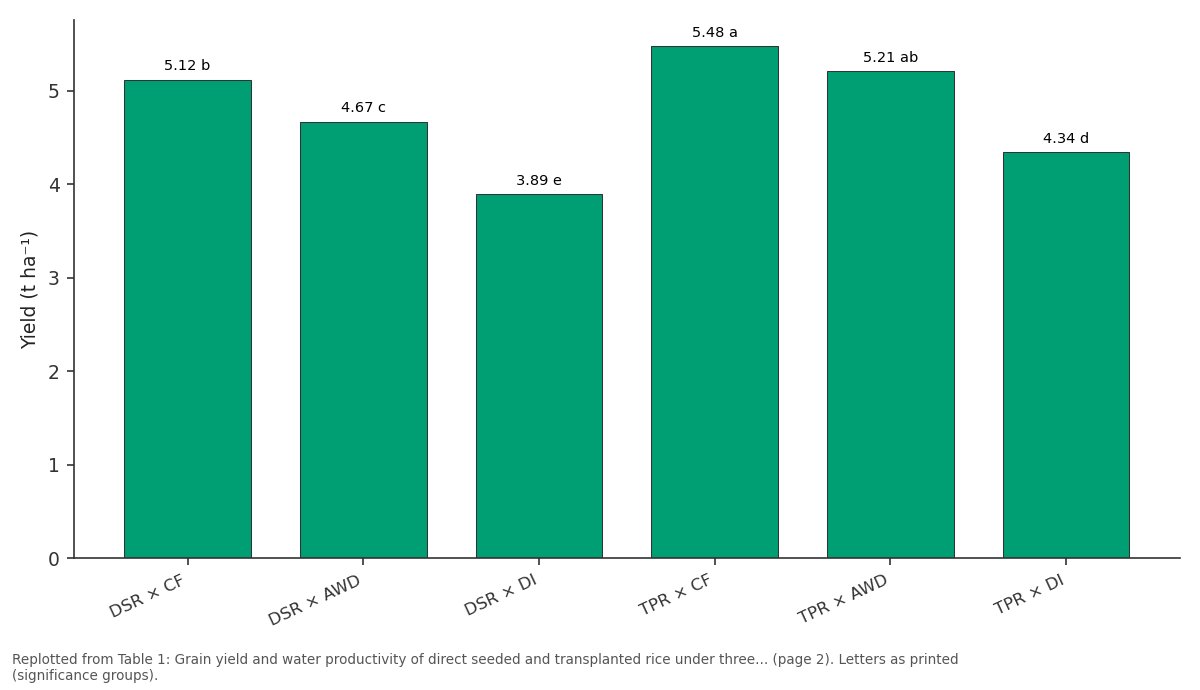
Yield (t ha⁻¹): DSR × CF vs DSR × AWD vs DSR × DI vs TPR × CF vs TPR × AWD
Replotted from Table 1 (page 2) of the original paper. Every bar is the paper's own table value.
View source evidence ↗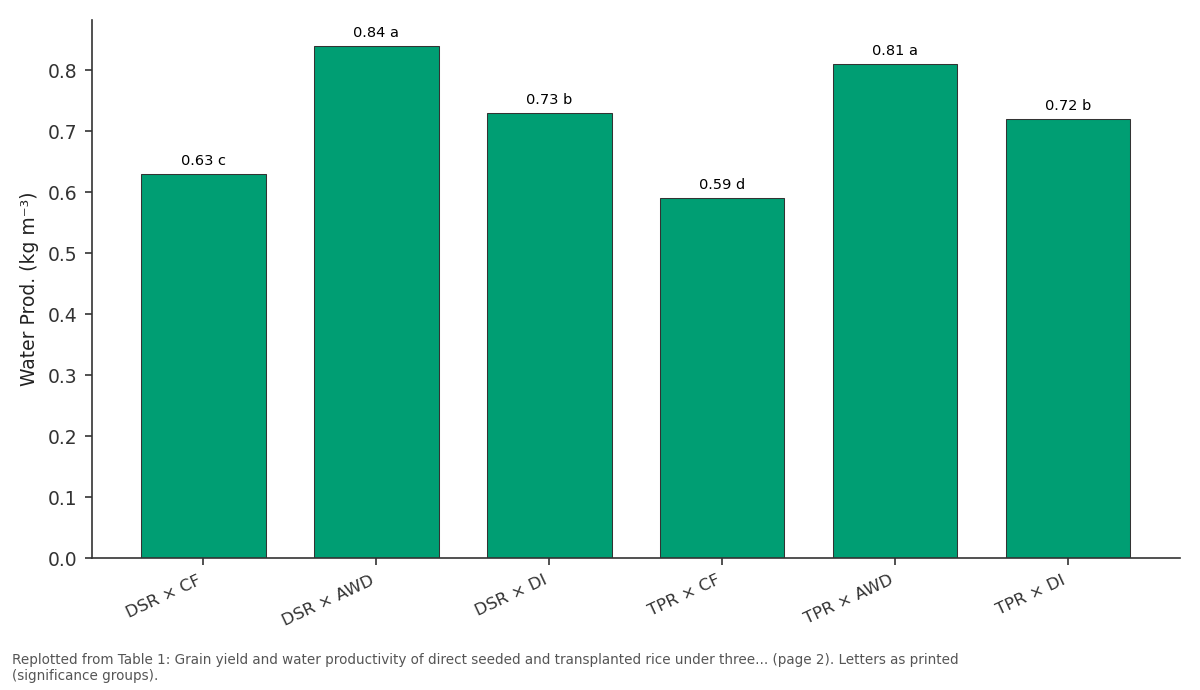
Water Prod. (kg m⁻³): DSR × CF vs DSR × AWD vs DSR × DI vs TPR × CF vs TPR × AWD
Replotted from Table 1 (page 2) of the original paper. Every bar is the paper's own table value.
View source evidence ↗Figures & tables
From the original paper Table 1
 Table 2
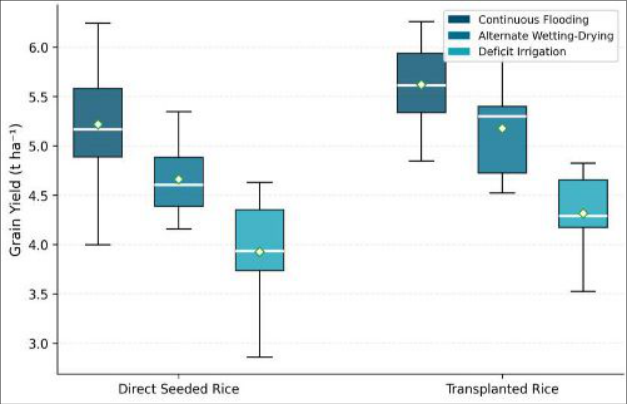 Figure 1
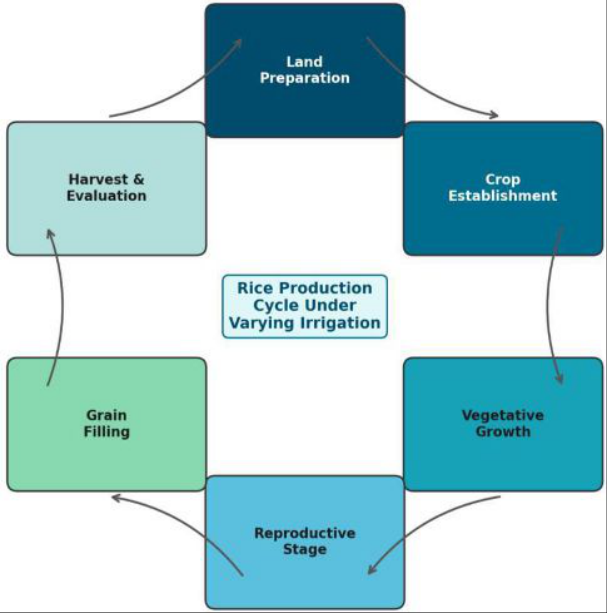 Figure 2
Introduction
Direct seeded rice, in its simplest definition, is rice established by sowing seed directly into a prepared field rather than transplanting nursery-raised seedlings-a distinction that saves 25-35% of the labour and 15-25% of the water associated with puddled transplanting [1] . Globally, DSR is practised on roughly 23% of the world's rice area, mainly in rainfed uplands, but interest in adopting it under irrigated temperate conditions has grown as water scarcity pressures intensify [2] . In the United Kingdom, rice cultivation is small-scale and largely experimental, but climate change projections suggest that southern and central England and lowland Scotland may become increasingly suitable for medium-duration rice varieties by 2040 [3] . The Royal Highland Institute of Agriculture has maintained a temperate rice trial programme since 2019, testing adapted japonica lines under controlled irrigation. Previous seasons showed that TPR consistently outyielded DSR by 8-15%, but those trials used only continuous flooding, leaving the interaction between establishment method and water regime unexplored [4] . AWD irrigation-where fields are allowed to dry to a set threshold before re-flooding-has been shown to reduce water use by 20-30% in tropical Asia with yield penalties of less than 5% [5] . Deficit irrigation takes this further by maintaining soil moisture below saturation for extended periods, typically reducing yields more sharply but improving water productivity in absolute terms [6] . Whether these regimes affect DSR and TPR differently in a temperate maritime climate is not known. This research was designed to compare DSR and TPR under three irrigation regimes at Edinburgh, with the objectives of: (a) quantifying grain yield and yield components for each combination; (b) measuring total water applied and calculating water productivity; and (c) identifying the most water-efficient establishment-irrigation combination suitable for temperate UK conditions.
Crop Growth Stage Documentation
Phenological stages were recorded using the BBCH scale for cereals. DSR plots reached three-leaf stage (BBCH 13) at 18 days after sowing versus 7 days after transplanting for TPR. Tillering onset (BBCH 21) occurred at 34 days in DSR and 22 days in TPR, reflecting the slower initial canopy development of direct-sown plants. Panicle initiation (BBCH 30) was synchronous across methods at approximately 72-75 days after sowing/transplanting. Heading (BBCH 55) occurred between 98 and 104 days, with no significant difference between DSR and TPR. Physiological maturity (BBCH 89) was reached at 128-134 days, with deficit-irrigated plots maturing 3-5 days earlier than flooded plots, likely due to accelerated senescence under water stress [7] .
Material and Methods Material
The rice variety used was 'Gleva', a short-duration temperate japonica type (120-135 days) bred in Spain and adapted for northern European trials. Seed was obtained from IRTA Catalonia. For TPR, seedlings were raised in plastic trays in a heated polytunnel (25 ± 2°C) and transplanted at 25 days (3-4 leaf stage) at 20 × 20 cm spacing. For DSR, pre-germinated seed was drill-sown at 80 kg ha⁻¹ in rows 20 cm apart into dry-tilled soil. The trial site at the Royal Highland Institute of Agriculture, Edinburgh (55°55'N, 3°11'W) has a Eutric Cambisol soil (sandy clay loam, pH 6.3, OM 3.8%) and a mean growing-season temperature of 14.2°C (May-October) [8] .
Methods
A split-plot design with three main-plot irrigation treatments (CF, AWD, DI) and two subplot establishment methods (DSR, TPR) was replicated four times. Main plots measured 10 × 8 m, subplots 10 × 4 m. CF maintained 3-5 cm standing water from transplanting/emergence until two weeks before harvest. AWD allowed soil to dry to -15 kPa at 15 cm depth (monitored with tensiometers) before reflooding to 5 cm. DI maintained soil at -30 to -40 kPa throughout, with brief flooding only at heading. Sowing was on 8 May 2023 and transplanting on 2 June 2023. Total water applied was recorded via calibrated flow metres on each main plot. Grain yield was measured at 14% moisture from a 6 m² harvest area. Yield components (tillers m⁻², panicles m⁻², grains per panicle, 1000-grain weight) were recorded on 10 sample hills per subplot. Water productivity = grain yield / total water applied. Data were analysed using ANOVA for split-plot designs in GenStat 22 [9] .
Water Balance and Irrigation Scheduling
Seasonal rainfall during the trial was 287 mm (May-October). Total irrigation water applied was: CF = 584 mm, AWD = 412 mm, DI = 298 mm. When combined with effective rainfall (estimated at 234 mm after runoff deduction), total water supply was 818, 646, and 532 mm for CF, AWD, and DI respectively. AWD reduced water input by 21.0% and DI by 35.0% compared to CF. Soil moisture readings confirmed that AWD plots experienced 6-8 drying-flooding cycles during the season, while DI plots remained below saturation for approximately 68% of the crop duration [5,10] . TPR outyielded DSR under all three irrigation regimes (Table 1), but the gap narrowed from 0.36 t ha⁻¹ under CF to 0.54 t ha⁻¹ under AWD and 0.45 t ha⁻¹ under DI. Tiller and panicle counts were consistently lower in DSR, reflecting its slower early canopy development. However, DSR produced heavier grains (26.8-27.4 g per 1000) than TPR (25.9-26.7 g), partially offsetting the panicle disadvantage. Water productivity was highest for DSR-AWD and TPR-AWD (both ≥ 0.81 kg m⁻³), roughly 40% above TPR-CF [11] .
| Treatment | Yield (t ha⁻¹) | Tillers m⁻² | Panicles m⁻² | 1000-grain Wt (g) | Water Prod. (kg m⁻³) |
|---|---|---|---|---|---|
| DSR × CF | 5.12b | 312c | 287c | 26.8a | 0.63c |
| DSR × AWD | 4.67c | 296cd | 271cd | 27.1a | 0.84a |
| DSR × DI | 3.89e | 261e | 238e | 27.4a | 0.73b |
| TPR × CF | 5.48a | 384a | 356a | 25.9b | 0.59d |
| TPR × AWD | 5.21ab | 361ab | 334ab | 26.2ab | 0.81a |
| TPR × DI | 4.34d | 318c | 292c | 26.7a | 0.72b |
Table text extracted from the original PDF; superscript letters are shown inline. The original table image is below.
View original table image
Results
Results
Discussion
The yield advantage of TPR over DSR across all irrigation regimes is consistent with temperate rice trials in southern Europe where transplanted crops benefit from a head start in canopy development [12] . However, the narrow gap under AWD (0.54 t ha⁻¹) and the substantially higher water productivity of DSR-AWD make this combination attractive where water costs or availability constrain production. AWD's 21% water saving with only a 7-10% yield reduction aligns with tropical meta-analyses that report 5-15% yield loss at 15-30% water savings [5] . The mechanism is straightforward: brief drying episodes stimulate aerenchyma formation and deeper rooting, improving oxygen supply and nutrient uptake during re-flooding cycles [13] . Deficit irrigation pushed savings to 35% but depressed yield sharply, particularly in DSR where the shallow root system amplified water stress during grain filling. The heavier grain weight in DSR is an interesting finding. With fewer tillers competing for assimilates, individual grains may have received a larger share of photosynthate during the filling period-a compensatory mechanism noted in low-density wheat and barley stands [14] . Whether this translates into milling quality differences was not assessed here and would be worth investigating. For UK conditions specifically, AWD is readily manageable given the availability of tensiometer-based irrigation scheduling. DSR-AWD could reduce establishment costs by eliminating nursery raising and transplanting labour while achieving water productivity levels that meet emerging sustainability benchmarks. The main practical constraint is weed pressure during early DSR establishment, which required two herbicide applications in this trial compared to one for TPR [15] .
Conclusion
This research showed that transplanted rice outyielded direct seeded rice by 0.36-0.54 t ha⁻¹ across all irrigation regimes at Edinburgh, but DSR combined with alternate wetting and drying achieved the highest water productivity (0.84 kg m⁻³) while saving 21% of the water used under continuous flooding. AWD irrigation proved to be the best compromise between yield and water efficiency for both establishment methods. Deficit irrigation saved 35% of water but imposed yield penalties too severe for commercial viability. For temperate UK rice production, DSR-AWD offers a water-efficient pathway that merits further testing across sites and seasons. Improvements in early-season weed control and optimisation of seeding rates for direct sowing would strengthen the case for wider DSR adoption in northern European rice systems.
Figures and tables from the paper
| Irrigation Regime | Irrigation (mm) | Eff. Rainfall (mm) | Total Water (mm) | Saving vs CF (%) |
|---|---|---|---|---|
| Continuous Flooding | 584 | 234 | 818 | - |
| Alternate Wetting-Drying | 412 | 234 | 646 | 21.0 |
| Deficit Irrigation | 298 | 234 | 532 | 35.0 |
Table text extracted from the original PDF; superscript letters are shown inline. The original table image is below.
View original table image
References
15 in the original paper- Kumar V, Ladha JK. Direct seeding of rice: recent developments and future research needs. Adv Agron. 2011;111:297-413.
- Rao AN, Johnson DE, Sivaprasad B, Ladha JK, Mortimer AM. Weed management in direct-seeded rice. Adv Agron. 2007;93:153-255.
- Sheridan C, Roberts P, Conway J. Temperate rice in the UK: climate suitability projections for 2050. Agric Syst. 2021;193:103234.
- Thompson JA, MacLeod R. Yield performance of japonica rice lines under Scottish conditions 2019-2022. Exp Agric. 2023;59:e18.
- Bouman BAM, Tuong TP. Field water management to save water and increase its productivity in irrigated lowland rice. Agric Water Manag. 2001;49(1):11-30.
- Belder P, Bouman BAM, Cabangon R, Guoan L, Quilang EJP, et al. Effect of water-saving irrigation on rice yield and water use in typical lowland conditions in Asia. Agric Water Manag. 2004;65(3):193-210.
- Lancashire PD, Bleiholder H, van den Boom T, Langelüddeke P, Stauss R, et al. A uniform decimal code for growth stages of crops and weeds. Ann Appl Biol. 1991;119(3):561-601.
- Met Office. Edinburgh climate normals 1991-2020. Exeter: UK Meteorological Office; 2022.
- Payne RW. GenStat for Windows: Introduction. 22nd ed. Hemel Hempstead (UK): VSN International; 2023.
- Lampayan RM, Rejesus RM, Singleton GR, Bouman BAM. Adoption and economics of alternate wetting and drying water management for irrigated lowland rice. Field Crops Res. 2015;170:95-108.
- Farooq M, Siddique KHM, Rehman H, Aziz T, Lee DJ, et al. Rice direct seeding: experiences, challenges and opportunities. Soil Tillage Res. 2011;111(2):87-98.
- Faivre-Dupaigre B, Giboulot Y. Temperate rice agronomy in the Camargue: lessons for northern expansion. Cah Agric. 2018;27(3):35005.
- Niones JM, Suralta RR, Inukai Y, Yamauchi A. Field evaluation on functional roles of root plastic responses on water use and yield of rice under cycles of soil drying. Plant Soil. 2012;357(1):165-178.
- Berry PM, Spink J, Foulkes MJ, White PJ. The physiological basis of genotypic differences in nitrogen use efficiency in oilseed rape. Field Crops Res. 2010;119(2-3):365-373.
- Chauhan BS. Weed ecology and weed management strategies for dry-seeded rice in Asia. Weed Technol. 2012;26(1):1-13.