
Research article · 2025 · Full text
International Journal of Agriculture and NutritionEffect of potassium and sulphur nutrition on growth and oil content of sunflower
Volume 7(12) · Pages 112–114 · DOI: 10.33545/26646064.2025.v7.i12b.522 ↗
Research areasSunflower and Safflower CultivationNitrogen and Sulfur Effects on BrassicaAgricultural Science and Fertilization
Abstract
Author-writtenSunflower oil quality hinges on two nutrients that many fertiliser programmes overlook: potassium and sulphur. This research examined how four potassium levels (0, 40, 80, 120 kg K₂O ha⁻¹) and three sulphur levels (0, 20, 40 kg S ha⁻¹) affected growth, seed yield, and oil content of sunflower (cv. LS-234) on an alluvial loam near Nanjing, China. The experiment followed a factorial randomised block design with three replications during the 2023 spring season. Seed oil content rose from 31.2% in the unfertilised control to 42.3% at the highest K-S combination (K₃S₄₀), a 35.6% relative increase. Seed yield peaked at 80 kg K₂O + 40 kg S ha⁻¹ (2.86 t ha⁻¹), beyond which additional potassium gave only marginal returns. The K × S interaction was significant for oil content (p = 0.008) but not for seed yield (p = 0.17), suggesting that the two nutrients influence oil biosynthesis through complementary metabolic pathways. These data support including both potassium and sulphur in balanced fertiliser recommendations for oilseed sunflower in the lower Yangtze region.
Summary
Source-checkedPlain-language reading of the full paper, prepared with AI and checked against the text. Each point links to the authors' own words.
Why it matters
- Potassium is critical for oilseed crops because it activates more than 60 plant enzymes, including those involved in fatty-acid synthesis. View evidence ↗
- Sulphur acts as an important co-factor by providing methionine and cysteine required for the proteins in oil-body membranes. View evidence ↗
- In the lower Yangtze alluvial belt of Jiangsu, sunflower is grown on paddy-rotation fields that often lack sufficient exchangeable potassium and available sulphur. View evidence ↗
The question
- The study aimed to quantify how potassium and sulphur, both separately and combined, affect the growth, yield, and oil content of sunflowers in the Nanjing area. View evidence ↗
What they did
- The experiment used a factorial randomised block design with 36 plots, testing four potassium levels (0, 40, 80, 120 kg K₂O ha⁻¹) and three sulphur levels (0, 20, 40 kg S ha⁻¹). View evidence ↗
- Hybrid sunflower LS-234 was planted on March 18, 2023, with a standard basal application of 80 kg N ha⁻¹ and 60 kg P₂O₅ ha⁻¹. View evidence ↗
- Seed oil content was measured using Soxhlet extraction with petroleum ether. View evidence ↗
- The researchers used two-way ANOVA and Tukey’s HSD (p = 0.05) to analyze the data. View evidence ↗
What they found
- Seed oil content increased by 35.6% relatively, rising from 31.2% in the control group to 42.3% with the highest potassium and sulphur combination. View evidence ↗
- The highest seed yield of 2.86 t ha⁻¹ was achieved at 80 kg K₂O and 40 kg S ha⁻¹, with further potassium providing little benefit. View evidence ↗
- The interaction between potassium and sulphur significantly affected oil content (p = 0.008) but did not significantly impact seed yield (p = 0.17). View evidence ↗
- The most economically efficient treatment was 80 kg K₂O and 40 kg S ha⁻¹, which yielded the highest benefit-cost ratio (BCR) of 3.8. View evidence ↗
What it means
- The authors conclude that applying 80 kg K₂O and 40 kg S ha⁻¹ with a standard NP base maximizes both oil content and economic returns for sunflowers in Nanjing's low-S alluvial loam. View evidence ↗
- The authors recommend including both potassium and sulphur in routine fertilizer programs to cost-effectively improve oil yield in the lower Yangtze region. View evidence ↗
- The authors note that the strong response to sulphur was due to low baseline soil levels (8.6 mg kg⁻¹), and soils with higher native sulphur might see smaller gains. View evidence ↗
Visual summary
3 visualsIllustrations explain the paper; charts are replotted from the paper's own table values.
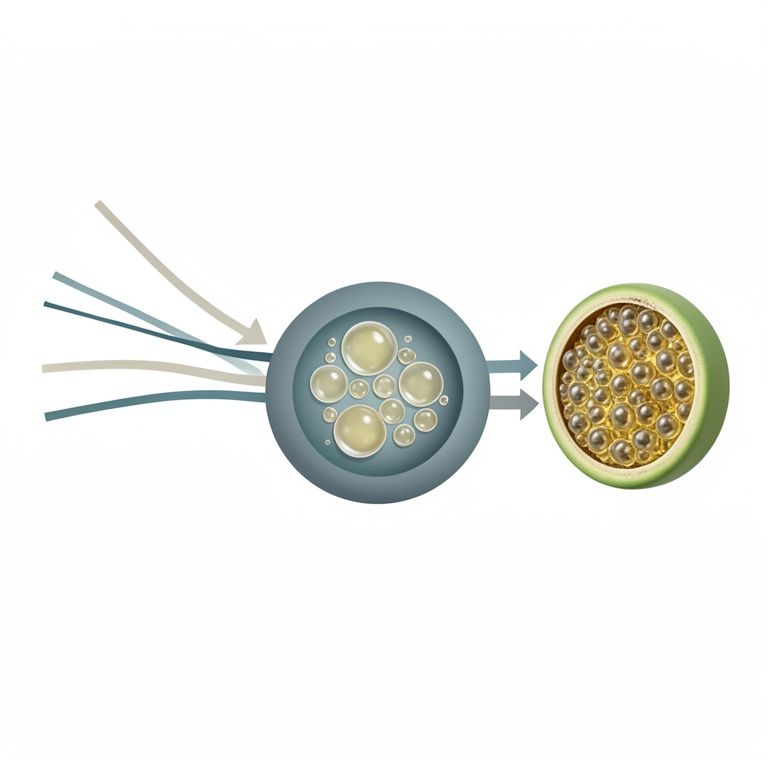
Nutrient Synergy in Oil Synthesis
AI-generated conceptual illustration (sunflower plant cells and seeds). It explains the idea and does not show study data.
View source evidence ↗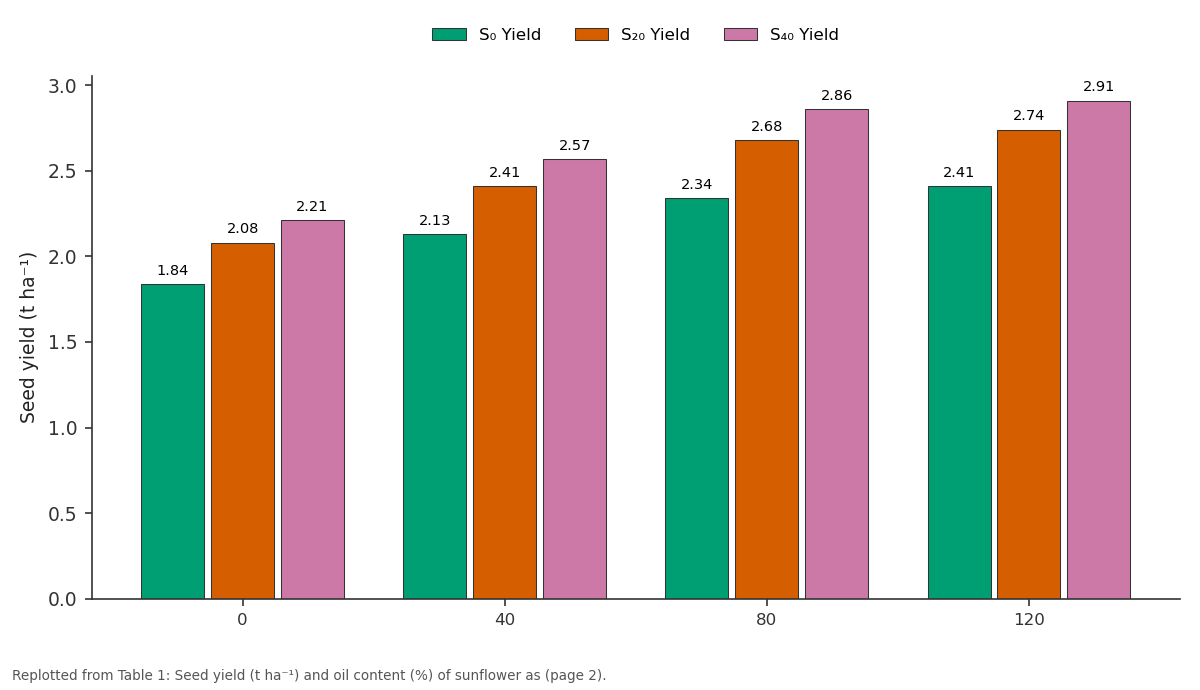
S₀ Yield and S₂₀ Yield and more: 0 vs 40 vs 80 vs 120
Replotted from Table 1 (page 2) of the original paper. Every bar is the paper's own table value.
View source evidence ↗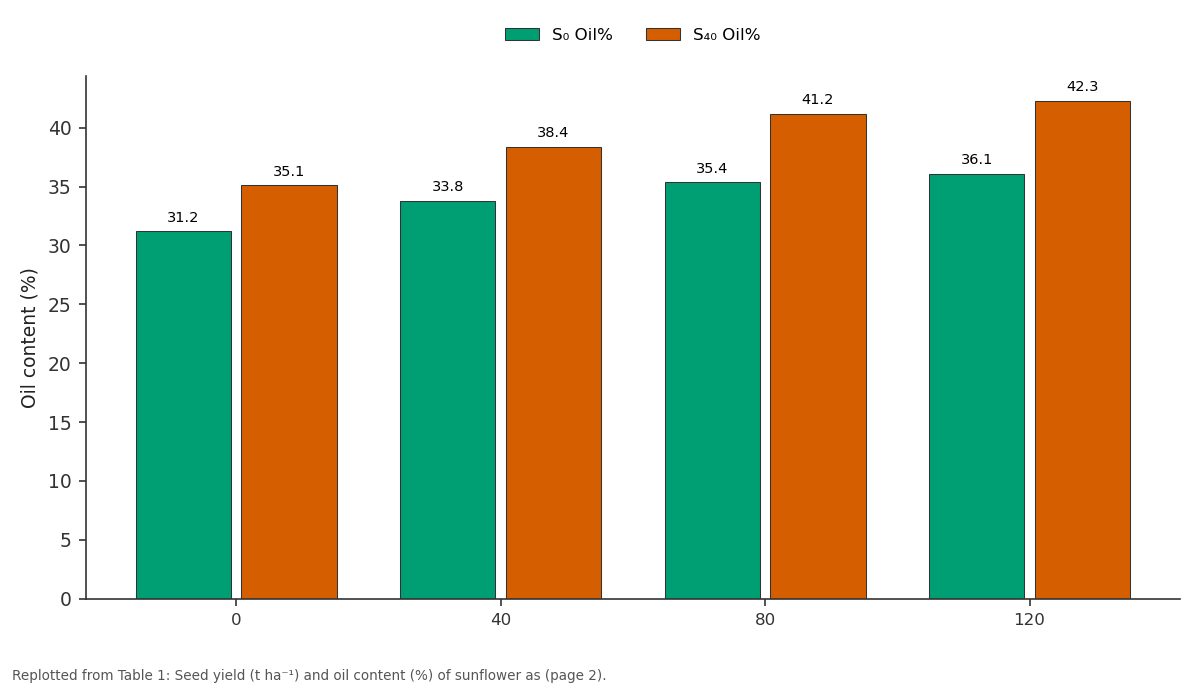
S₀ Oil% and S₄₀ Oil%: 0 vs 40 vs 80 vs 120
Replotted from Table 1 (page 2) of the original paper. Every bar is the paper's own table value.
View source evidence ↗Figures & tables
From the original paper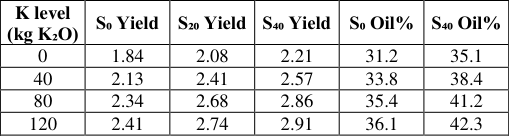 Table 1
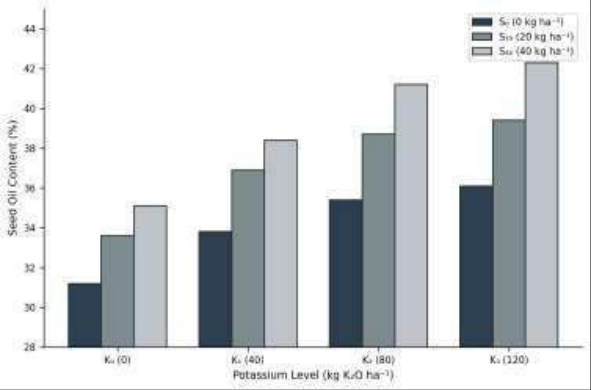 Figure 1
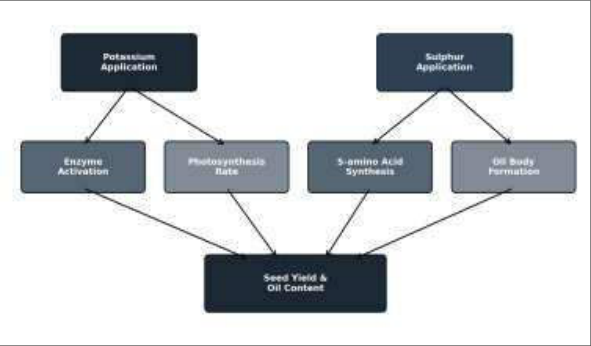 Figure 2
Introduction
"Potassium is the quality element," crop nutritionists are fond of saying, and for oilseed crops the label fits better than for most [1] . Potassium activates over 60 enzymes in plants, including several in the fatty-acid synthesis chain, and its deficiency has been linked to reduced oil concentration in sunflower, soybean, and groundnut [2] . But potassium seldom works alone in determining oil qualitysulphur, which feeds into the methionine and cysteine pools needed for oil-body membrane proteins, appears to be an equally important co-factor [3] . Sunflower is China's third-ranked oilseed crop after rapeseed and soybean, with about 0.8 million hectares sown annually, mostly in the northern and central provinces [4] . In Jiangsu's lower Yangtze alluvial belt, sunflower is grown as a spring cash crop on paddy-rotation fields. These soils are typically well supplied with nitrogen and phosphorus from the preceding rice crop but can be marginal in both exchangeable K and available S, especially after years of imbalanced NPK fertilisation [5] . Despite this, most regional fertiliser recommendations for sunflower cover only N and P, leaving K and S to soil reserves that may no longer be adequate. This research tested the separate and combined effects of potassium and sulphur on growth, yield, and oil content, aiming to quantify the interaction and guide balanced nutrient management for sunflower in the Nanjing area.
Baseline Soil Characterisation
The experimental field, located at Jiangnan College of Agricultural Technology, Nanjing (32°04′N, 118°46′E; 12 m elevation), had been under a rice-wheat rotation for the previous eight years. Pre-sowing soil analysis (0-20 cm) showed: pH 6.7, organic carbon 1.12%, available N 186 kg ha⁻¹, available P (Olsen) 21.4 mg kg⁻¹, exchangeable K 118 mg kg⁻¹, and available S (0.15% CaCl₂ extractable) 8.6 mg kg⁻¹. The exchangeable K value is classified as medium, and available S as low, for alluvial loam soils in the Yangtze Delta [6] . Soil texture was silt loam (sand 22%, silt 56%, clay 22%).
Material and Methods
Material and Methods
Material
The trial used a factorial randomised block design: 4 K levels (0, 40, 80, 120 kg K₂O ha⁻¹ as muriate of potash) × 3 S levels (0, 20, 40 kg S ha⁻¹ as elemental sulphur), replicated three times (36 plots). Plot size was 5 m × 4 m. Hybrid sunflower LS-234 (oil-type, 95-100 days) was sown on 18 March 2023 at 60 × 30 cm spacing. A uniform basal dose of 80 kg N ha⁻¹ (urea) and 60 kg P₂O₅ ha⁻¹ (DAP) was applied. Potassium and sulphur were incorporated at sowing. Irrigation was given twice (at star-bud and flowering) by furrow method.
Methods
Growth parameters (plant height, head diameter, leaf area) were recorded at flowering from five tagged plants per plot. Seed yield was harvested from the net plot (4 m × 3 m) and adjusted to 8% moisture. Oil content was determined by Soxhlet extraction using petroleum ether (40-60 °C boiling range) on finely ground seed samples [7] . Oil yield (kg ha⁻¹) was calculated as seed yield × oil percentage. Data were analysed by two-way ANOVA in R (v4.3.1), with treatment means separated by Tukey's HSD at p = 0.05.
Economic and Sustainability Assessment
Partial budgets were calculated for each K-S combination. Input cost included fertiliser price (MOP: ¥4.2 kg⁻¹; elemental S: ¥3.8 kg⁻¹) plus application labour. Revenue was based on the prevailing Nanjing market price for sunflower seed (¥6,200 t⁻¹). The benefit-cost ratio (BCR) and marginal rate of return for each step increase in K and S were computed. The most economically efficient treatment was identified as the one with the highest BCR above 2.0, ensuring that every yuan invested returned at least two yuan in additional revenue. carboxylase and S by supplying methionine for oil-body membrane assembly [3] . For seed yield, however, the interaction was not significant; yield responses to K and S were additive. The highest BCR (3.8) was achieved at 80 kg K₂O + 40 kg S ha⁻¹, making it the economically optimal treatment.
Results
Results
Discussion
The 35.6% relative increase in oil content from the unfertilised control to K₃S₄₀ is larger than most singlenutrient studies have reported. Tiwari [8] found a 12-18% oil-content rise with S alone (0-45 kg ha⁻¹) in Indian sunflower, and Mengel and Kirkby [1] documented 8-14% gains from K in oilseed rape. The additive or synergistic effect of combining the two nutrients explains why our combined treatment exceeded either nutrient's individual ceiling.
The plateau in seed yield between 80 and 120 kg K₂O suggests that exchangeable K of 118 mg kg⁻¹ was already borderline adequate for yield, and 80 kg K₂O sufficed to push it over the threshold. Oil content, being a concentration trait rather than a mass trait, continued to respond because additional K enhanced per-seed oil loading without increasing seed number [9] . The low baseline S (8.6 mg kg⁻¹) ensured a strong sulphur response; soils with higher native S might show a smaller gain.
Conclusion
Applying 80 kg K₂O and 40 kg S ha⁻¹ alongside a standard NP base maximised both oil content (41.2%) and economic return (BCR = 3.8) for sunflower on low-S alluvial loam at Nanjing. The significant K × S interaction for oil content confirms that these two nutrients work together in the fattyacid synthesis pathway. Including both elements in routine fertiliser programmes for oilseed sunflower is a straightforward, cost-effective way to improve oil yield per hectare in the lower Yangtze region.
Figures and tables from the paper
| K level (kg K₂O) | S₀ Yield | S₂₀ Yield | S₄₀ Yield | S₀ Oil% | S₄₀ Oil% |
|---|---|---|---|---|---|
| 0 | 1.84 | 2.08 | 2.21 | 31.2 | 35.1 |
| 40 | 2.13 | 2.41 | 2.57 | 33.8 | 38.4 |
| 80 | 2.34 | 2.68 | 2.86 | 35.4 | 41.2 |
| 120 | 2.41 | 2.74 | 2.91 | 36.1 | 42.3 |
Table text extracted from the original PDF; superscript letters are shown inline. The original table image is below.
View original table image
References
14 in the original paper- Mengel K, Kirkby EA. Principles of plant nutrition. 5th ed. Dordrecht: Kluwer Academic Publishers; 2001. p. 1-849.
- Marschner H. Marschner's mineral nutrition of higher plants. 3rd ed. London: Academic Press; 2012. p. 1651.
- Ahmad A, Khan I, Anjum NA, Diva I, Abdin MZ, Iqbal M. Effect of timing of sulfur fertilizer application on growth and yield of rapeseed. J Plant Nutr. 2005;28(6):1049-1059.
- NBSC. China statistical yearbook 2023. Beijing: National Bureau of Statistics of China; 2023.
- Tan DS, Jin JY, Jiang LG, Huang SW, Liu ZH. Potassium assessment of grain-producing soils in North China. Agric Ecosyst Environ. 2012;148:65-71.
- Lu RK. Analytical methods for soil and agricultural chemistry. Beijing: China Agricultural Science and Technology Press; 2000. p. 1-638.
- AOAC. Official methods of analysis. 18th ed. Arlington: Association of Official Analytical Chemists; 2005.
- Tiwari RK. Effect of sulphur and micronutrients on yield and oil content of sunflower. Indian J Agric Res. 2014;48(2):157-160.
- Abbadi J, Gerendas J. Nitrogen use efficiency of safflower and sunflower. Nutr Cycl Agroecosyst. 2009;83(2):149-158.
- Nasreen S, Haq SMI, Hossain MA. Sulphur effects on growth responses and yield of onion. Asian J Plant Sci. 2003;2(12):897-902.
- Aulakh MS, Malhi SS. Interactions of nitrogen with other nutrients and water: effect on crop yield and quality, nutrient use efficiency, carbon sequestration, and environmental pollution. Adv Agron. 2005;86:341409.
- Rathke GW, Christen O, Diepenbrock W. Effects of nitrogen source and rate on productivity and quality of winter oilseed rape. Field Crops Res. 2005;94(2-3):6982.
- Bahl GS, Tiwari KN. Potassium and its role in sustainable crop production in India. Indian J Fertilisers. 2007;3(10):19-27.
- Islam MR, Hossain MZ, Karim MR. Effect of potassium and sulphur on yield of sunflower. Bangladesh J Sci Ind Res. 2016;51(4):317-324.