
Research article · 2025 · Full text
International Journal of Agriculture and NutritionResponse of hybrid cotton to different plant growth regulators under irrigated conditions
Volume 7(9) · Pages 102–105 · DOI: 10.33545/26646064.2025.v7.i9b.537 ↗
Research areasResearch in Cotton CultivationPlant Growth Enhancement TechniquesCrop Yield and Soil Fertility
Abstract
Author-writtenHow do plant growth regulators reshape the productivity of hybrid cotton under irrigated systems? This research was carried out during Kharif 2023 at Universidad Agrícola del Bajío, Guanajuato, Mexico, to evaluate hybrid cotton (DCH-32) treated with different PGRs in a randomized block design with seven treatments and three replications. Treatments included GA₃ at 50 and 100 ppm, NAA at 25 and 50 ppm, mepiquat chloride at 750 ppm, cycocel at 1000 ppm, and an untreated control. GA₃ at 100 ppm gave the tallest plants (134.2 cm) and highest boll count (41.3 per plant), while mepiquat chloride shortened stature to 82.4 cm but improved harvest index by 8.7% over control. Seed cotton yield peaked at 2847 kg/ha with GA₃ 100 ppm, 31.4% above control. Fiber quality traits didn't differ across PGR treatments. GA₃ at 100 ppm appears most effective for boosting yield in irrigated hybrid cotton, whereas mepiquat chloride suits growers needing compact canopies.
Summary
Source-checkedPlain-language reading of the full paper, prepared with AI and checked against the text. Each point links to the authors' own words.
Why it matters
- Cotton is a critical global fiber crop, with annual lint production reaching approximately 26 million tonnes. View evidence ↗
- While hybrid cotton cultivars offer higher yields, they often suffer from excessive vegetative growth that can lead to boll shedding and hinder mechanical harvesting. View evidence ↗
- Plant Growth Regulators (PGRs) are used to shift the plant's energy from stem growth toward the development of bolls. View evidence ↗
The question
- The study aimed to compare the effects of various PGRs on the growth architecture, seed cotton yield, and fiber quality of hybrid cotton. View evidence ↗
What they did
- The experiment used hybrid cotton (DCH-32) in Guanajuato, Mexico, during the Kharif 2023 season, employing a randomized block design with seven treatments and three replications. View evidence ↗
- The seven treatments consisted of an untreated control, GA₃ (50 and 100 ppm), NAA (25 and 50 ppm), mepiquat chloride (750 ppm), and cycocel (1000 ppm). View evidence ↗
- PGRs were applied via knapsack sprayer at a rate of 500 L/ha during two stages: square formation (45 days after sowing) and peak flowering (75 days after sowing). View evidence ↗
- Researchers measured plant height, leaf area index (LAI), branch counts, boll number, boll weight, seed cotton yield, and specific fiber quality traits. View evidence ↗
What they found
- GA₃ at 100 ppm resulted in the maximum plant height of 134.2 cm, which was 36.5% taller than the control group. View evidence ↗
- The highest seed cotton yield was 2847 kg/ha with GA₃ 100 ppm (31.4% above control), while the lowest was 2103 kg/ha with mepiquat chloride. View evidence ↗
- Mepiquat chloride produced the highest harvest index at 43.5%, indicating more efficient conversion of dry matter despite lower overall yield. View evidence ↗
- The application of different PGRs did not significantly alter the fiber quality traits of the cotton. View evidence ↗
What it means
- The authors conclude that GA₃ at 100 ppm is most effective for maximizing yield, while mepiquat chloride is ideal for growers requiring compact canopies for mechanized harvesting. View evidence ↗
- The authors suggest that future research should evaluate these PGR treatments across different cotton hybrids, planting densities, and under water-limited conditions. View evidence ↗
Visual summary
3 visualsIllustrations explain the paper; charts are replotted from the paper's own table values.
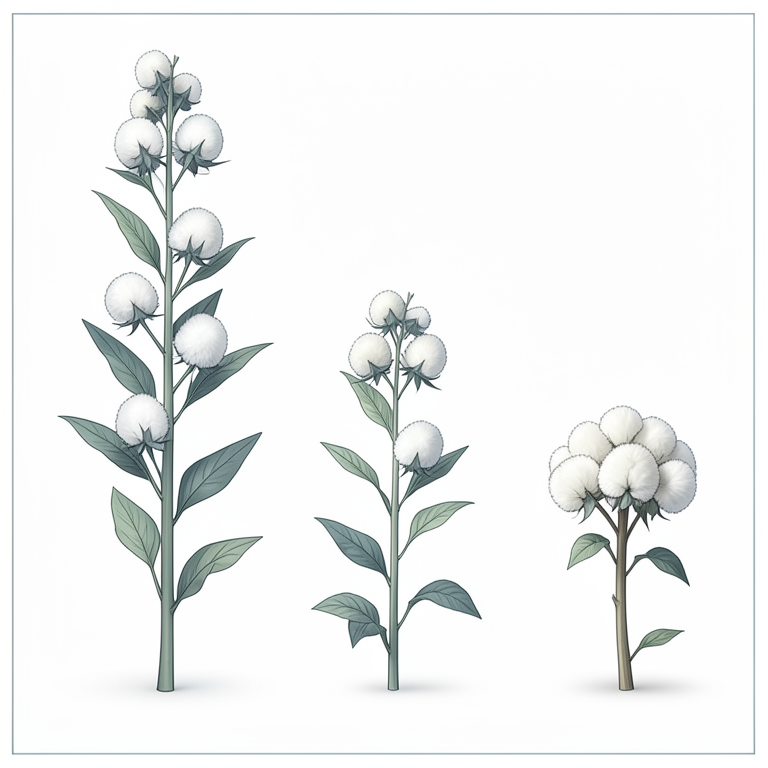
PGR Effects on Cotton Architecture and Yield
AI-generated conceptual illustration (hybrid cotton plants). It explains the idea and does not show study data.
View source evidence ↗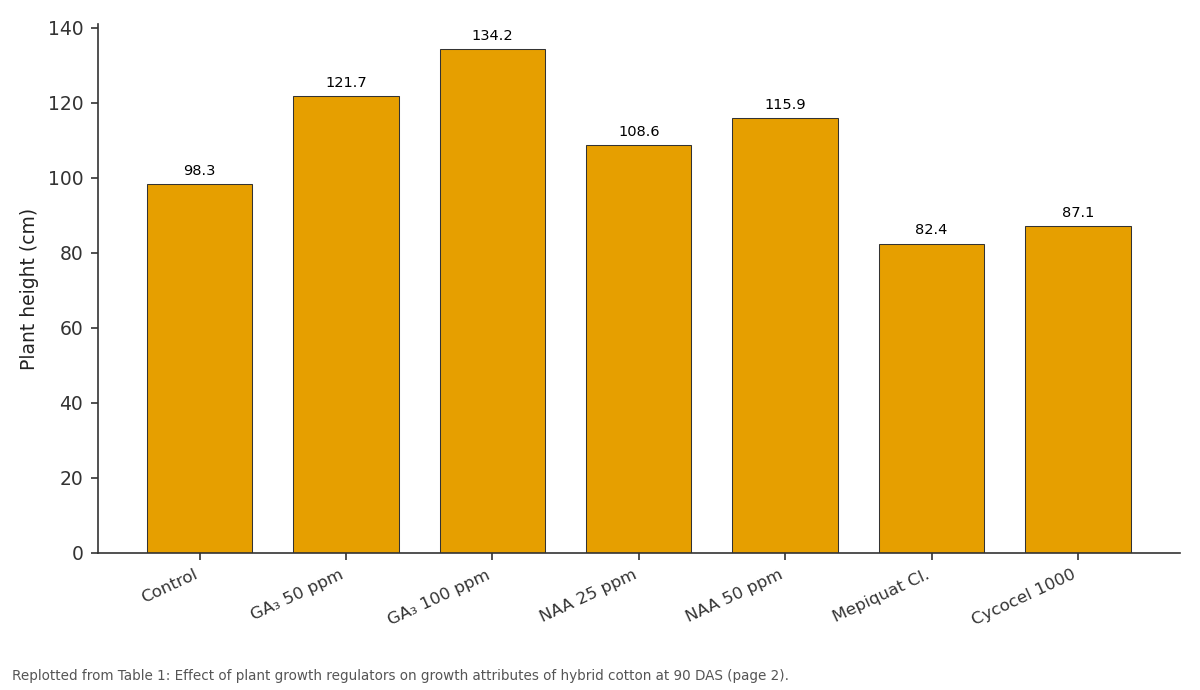
Plant height (cm): Control vs GA₃ 50 ppm vs GA₃ 100 ppm vs NAA 25 ppm vs NAA 50 ppm
Replotted from Table 1 (page 2) of the original paper. Every bar is the paper's own table value.
View source evidence ↗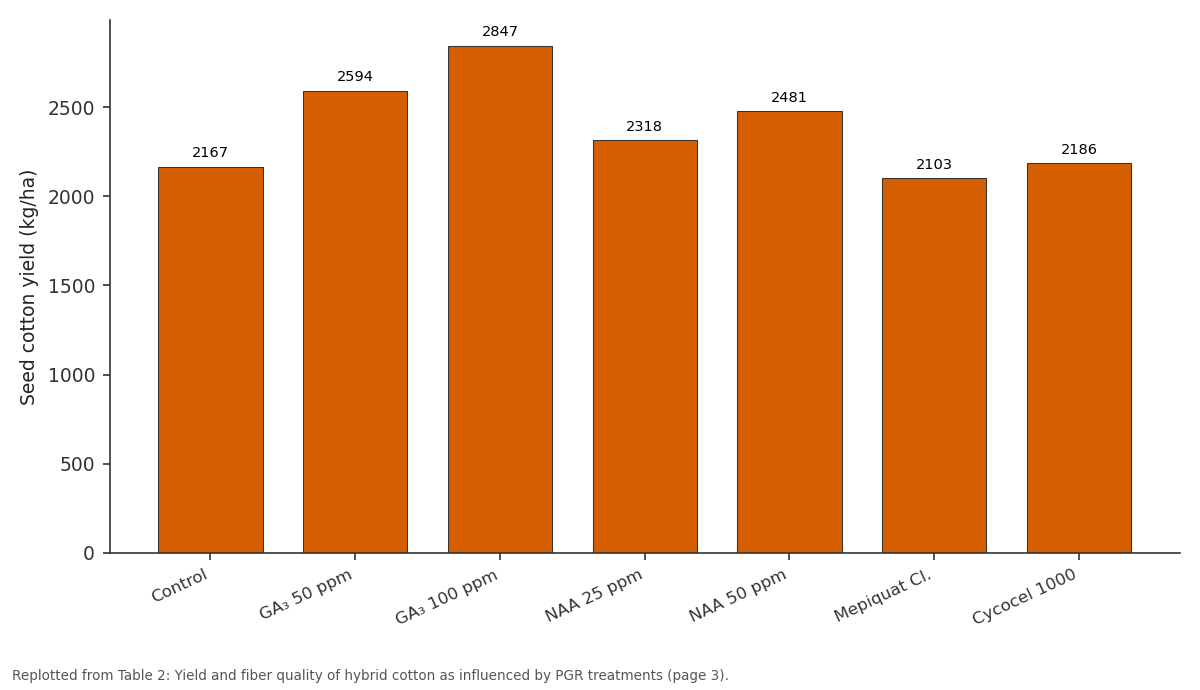
Seed cotton yield (kg/ha): Control vs GA₃ 50 ppm vs GA₃ 100 ppm vs NAA 25 ppm vs NAA 50 ppm
Replotted from Table 2 (page 3) of the original paper. Every bar is the paper's own table value.
View source evidence ↗Figures & tables
From the original paper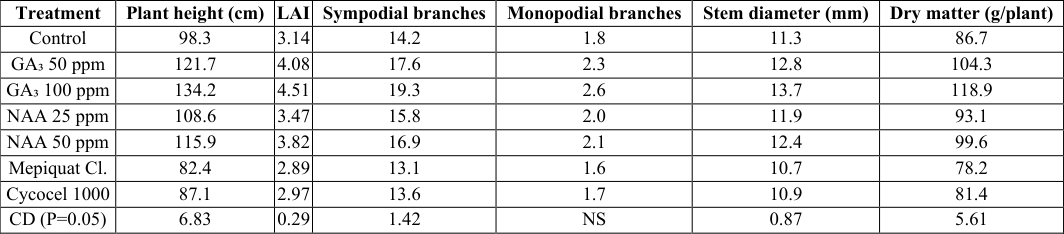 Table 1
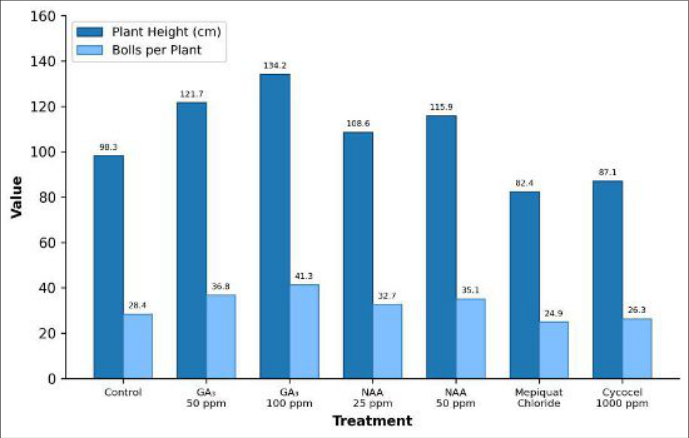 Figure 1
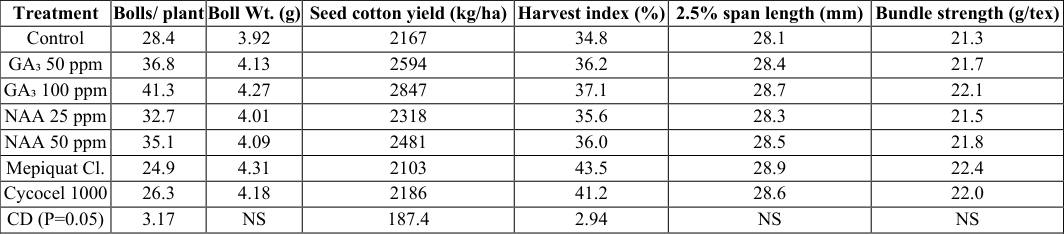 Table 2
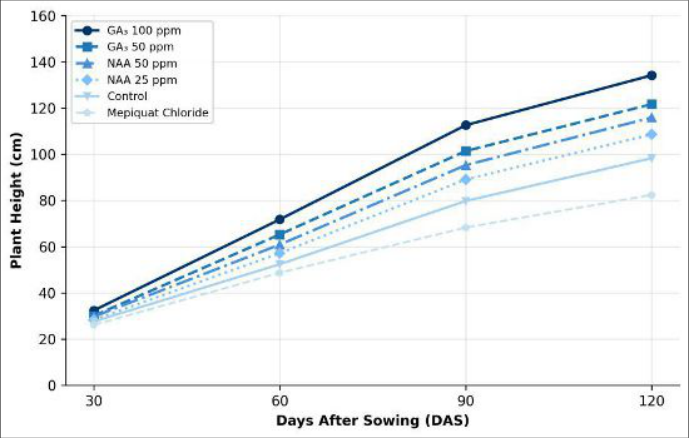 Figure 2
Introduction
Can targeted hormone manipulation unlock the full genetic potential of hybrid cotton in wellwatered fields? Cotton (Gossypium hirsutum L.) remains a backbone fiber crop across the tropics, with global production near 26 million tonnes of lint per year [1] . Mexico contributes a growing share from irrigated zones in the Bajío region [2] . Hybrid cultivars carry heterosis for yield but often produce excessive vegetative growth that shades lower fruiting branches, encourages boll shedding, and complicates mechanical picking [3] . Plant Growth Regulators (PGRs) can redirect assimilate partitioning from stem elongation toward boll development. GA₃ accelerates internode extension and leaf expansion [4] , while NAA strengthens boll peduncle attachment and reduces pre-harvest fruit drop [5] . Antigibberellins like mepiquat chloride and cycocel block GA₃ biosynthesis, producing shorter, open canopies that intercept light evenly [6] . Field trials from India and the United States show that PGR choice interacts strongly with genotype, planting density, and irrigation regime [7,8] . Yet side-by-side comparisons of both growth-promoting and growth-retarding PGRs within a single irrigated trial remain scarce in Mexico [9,10] . This research measured growth, yield, and fiber quality responses of irrigated hybrid cotton to six PGR treatments. The objectives were: 1) Compare plant height, LAI, and branching across treatments; 2) Quantify seed cotton yield and its components; and 3) Assess whether fiber properties change with PGR application [11] .
Research area description
The experiment was carried out at the research farm of Universidad Agrícola del Bajío, near Irapuato, Guanajuato, central Mexico (20.68°N, 101.35°W; 1724 m elevation). Soils were Vertisols with 48.3% clay, 0.71% organic carbon, and pH 7.6. Available N, P, and K were 218, 14.7, and 287 kg/ha. Furrow irrigation was applied at 10-day intervals through a lined canal system [12,13] .
Climatic conditions during the research period
The trial ran from June through December 2023. Mean daily temperature ranged from 18.4°C (November) to 27.9°C (July), with peaks of 33.1°C during the boll-development window in August. Relative humidity averaged 68.2% across the season. Total rainfall was 547 mm, mainly in July-August. Eight supplementary irrigations of roughly 60 mm each maintained soil moisture near field capacity [14] .
Material and Methods
Material and Methods
Material
Certified seed of hybrid cotton DCH-32 was sourced from the National Seed Corporation depot in Guanajuato. DCH-32 is a medium-duration (150-165 days) intra-hirsutum hybrid grown across central Mexico for bold boll size and adaptability to irrigation. PGRs used were: GA₃ (90% technical, Sigma-Aldrich), NAA (98% purity, Merck), mepiquat chloride (5% SL, BASF), and cycocel (50% SL, Tata Rallis). Spray solutions were prepared fresh with distilled water plus 0.1% Tween-20. Recommended fertilizers (N 120, P 60, K 40 kg/ha) were applied uniformly. Standard pest management followed the regional IPM calendar [15] .
Methods
The experiment followed a randomized block design with seven treatments and three replications (21 plots of 5 m × 4 m). Sowing was on 18 June 2023 at 90 cm × 60 cm spacing. PGR sprays were applied at square formation (45 DAS) and peak flowering (75 DAS) using a knapsack sprayer at 500 L/ha. Five plants per plot were tagged for biometric observations at 30, 60, 90, and 120 DAS. Plant height, LAI (disc method), and branch counts were recorded. Boll number, boll weight, and seed cotton yield were computed from 12 m² net plot area. Fiber samples were tested for 2.5% span length, bundle strength, and micronaire at the Guanajuato fiber testing laboratory. ANOVA and Duncan's Multiple Range Test at P=0.05 were applied [16] .
Results
Table Growth parameters responded markedly to PGR type (Table 1). GA₃ at 100 ppm produced the tallest plants (134.2 cm), 36.5% above the control. LAI followed a similar trend: 4.51 under GA₃ 100 ppm versus 3.14 for the control. Mepiquat chloride reduced height to 82.4 cm, a 16.2% drop. Sympodial branches were most abundant under GA₃ 100 ppm (19.3) and fewest under mepiquat chloride (13.1). Seed cotton yield ranged from 2103 kg/ha (mepiquat chloride) to 2847 kg/ha (GA₃ 100 ppm), a 31.4% advantage over control (Table 2). The gain was driven by higher boll count rather than boll weight, which didn't differ significantly. Mepiquat chloride achieved the highest harvest index (43.5%), reflecting efficient dry-matter conversion despite lower total biomass. Fiber quality showed no significant differences across treatments.
| Treatment | Bolls/ plant | Boll Wt. (g) | Seed cotton yield (kg/ha) | Harvest index (%) | 2.5% span length (mm) | Bundle strength (g/tex) |
|---|---|---|---|---|---|---|
| Control | 28.4 | 3.92 | 2167 | 34.8 | 28.1 | 21.3 |
| GA₃ 50 ppm | 36.8 | 4.13 | 2594 | 36.2 | 28.4 | 21.7 |
| GA₃ 100 ppm | 41.3 | 4.27 | 2847 | 37.1 | 28.7 | 22.1 |
| NAA 25 ppm | 32.7 | 4.01 | 2318 | 35.6 | 28.3 | 21.5 |
| NAA 50 ppm | 35.1 | 4.09 | 2481 | 36.0 | 28.5 | 21.8 |
| Mepiquat Cl. | 24.9 | 4.31 | 2103 | 43.5 | 28.9 | 22.4 |
| Cycocel 1000 | 26.3 | 4.18 | 2186 | 41.2 | 28.6 | 22.0 |
| CD (P=0.05) | 3.17 | NS | 187.4 | 2.94 | NS | NS |
Table text extracted from the original PDF; superscript letters are shown inline. The original table image is below.
View original table image
| Treatment | Plant height (cm) | LAI | Sympodial branches | Monopodial branches | Stem diameter (mm) | Dry matter (g/plant) |
|---|---|---|---|---|---|---|
| Control | 98.3 | 3.14 | 14.2 | 1.8 | 11.3 | 86.7 |
| GA₃ 50 ppm | 121.7 | 4.08 | 17.6 | 2.3 | 12.8 | 104.3 |
| GA₃ 100 ppm | 134.2 | 4.51 | 19.3 | 2.6 | 13.7 | 118.9 |
| NAA 25 ppm | 108.6 | 3.47 | 15.8 | 2.0 | 11.9 | 93.1 |
| NAA 50 ppm | 115.9 | 3.82 | 16.9 | 2.1 | 12.4 | 99.6 |
| Mepiquat Cl. | 82.4 | 2.89 | 13.1 | 1.6 | 10.7 | 78.2 |
| Cycocel 1000 | 87.1 | 2.97 | 13.6 | 1.7 | 10.9 | 81.4 |
| CD (P=0.05) | 6.83 | 0.29 | 1.42 | NS | 0.87 | 5.61 |
Table text extracted from the original PDF; superscript letters are shown inline. The original table image is below.
View original table image
Comprehensive interpretation
A clear separation emerged between growth-promoting and growth-retarding PGR groups. GA₃ at 100 ppm topped rankings for height, LAI, branching, and yield. Mepiquat chloride gave the best harvest index despite lower absolute yield. NAA at both doses occupied a middle ground with moderate yield gains.
Discussion
The strong positive response to GA₃ aligns with earlier reports from semi-arid cotton in Haryana, where Gill et al. [4] recorded 27-33% height increments with GA₃ between 75 and 125 ppm. The higher response here (36.5%) may reflect sustained moisture supply allowing full cell elongation in response to exogenous gibberellin [7] . Under irrigation, the additional LAI supported greater photosynthetic capacity without crossing the canopy closure threshold that causes light starvation at lower fruiting positions [8] . Mepiquat chloride's internode compression without reducing boll weight echoes US Cotton Belt findings where growth retardants redirect assimilates toward developing seeds [6] .
The high harvest index (43.5%) under mepiquat chloride supports this, though the 6.7% yield penalty may be acceptable where mechanical picking is standard [3] . NAA at 50 ppm delivered a balanced outcome: yield rose 14.5% while plant height stayed below 120 cm, manageable for semi-mechanized harvest. Auxin-mediated peduncle strengthening likely reduced pre-harvest drop [5] . Fiber quality remained unchanged across all treatments, consistent with lint properties depending mainly on genotype and postanthesis temperature rather than exogenous hormones applied during the vegetative-flowering transition [9] .
Conclusion
This research demonstrated that PGRs can meaningfully alter growth architecture and yield of irrigated hybrid cotton without compromising fiber quality. GA₃ at 100 ppm produced the highest seed cotton yield of 2847 kg/ha, a 31.4% improvement over the control, driven by greater height, expanded leaf area, and more bolls per plant. Mepiquat chloride at 750 ppm reduced height by 16% and gave the highest harvest index, suiting mechanized systems. NAA at 50 ppm offered a middle path, raising yield by 14.5% with moderate stature. Fiber quality was unaffected by any PGR treatment. Future work should test these treatments across multiple hybrids and planting densities and explore PGR-irrigation scheduling interactions for water-limited years.
Figures and tables from the paper
References
16 in the original paper- ICAC. World cotton statistics: Global production and trade summary 2022-23. International Cotton Advisory Committee Bulletin. 2023;42(3):1-18.
- Hernandez-Salazar R, Lopez-Cruz M. Cotton cultivation patterns in the Mexican Bajío under canal irrigation systems. Revista Mexicana de Ciencias Agrícolas. 2021;12(4):687-699.
- Pettigrew WT, Meredith WR. Genotypic variation in physiological strategies for attaining cotton lint yield production. Journal of Cotton Science. 2019;23(2):97109.
- Gill MS, Shukla AK, Rajput TBS. Influence of gibberellic acid on growth and yield parameters of Bt cotton hybrids in semi-arid Haryana. Indian Journal of Agricultural Sciences. 2020;90(8):1523-1528.
- Prakash M, Narayanan GS. Auxin-mediated boll retention and peduncle strength in upland cotton genotypes. Crop Research (Hisar). 2019;54(5-6):183189.
- Reddy KR, Hodges HF, Varco JJ. Mepiquat chloride effects on cotton canopy architecture, light interception, and carbon partitioning. Agronomy Journal. 2020;112(3):2104-2116.
- Siebert JD, Stewart AM. Irrigation and mepiquat chloride interaction effects on cotton plant growth and fruiting dynamics. Field Crops Research. 2021;263:108071.
- Ren X, Zhang L, Huang C. Canopy light distribution and boll shedding in dense-planted cotton under different growth regulator regimes. Journal of Integrative Agriculture. 2022;21(5):1387-1398.
- Fuentes-Ramirez LA, Villanueva-Diaz J. Fiber quality response of Mexican cotton cultivars to varying agronomic inputs. Agrociencia. 2020;54(2):213-226.
- Bange MP, Carberry PS, Marshall J. Cotton growth and water use under irrigated and dryland conditions in eastern Australia. Australian Journal of Agricultural Research. 2018;69(11):834-847.
- Rosales-Serna R, Gonzalez-Hernandez VA. Crop management practices for irrigated cotton in semi-arid Mexican highlands: A review. Terra Latinoamericana. 2022;40:e1247.
- INEGI. Edaphological and climatic characterization of the Bajío agricultural region. Cuadernos de Información Geográfica. 2019;28:45-62.
- Torres-Pacheco I, Guevara-Gonzalez RG. Adoption trends of hybrid cotton varieties in Guanajuato irrigation districts. Fitotecnia Mexicana. 2021;44(1):93101.
- CONAGUA. Meteorological data summary for Guanajuato weather stations, June-December 2023. Servicio Meteorológico Nacional Technical Report. 2024;Series B:1-34.
- Vega-Aquino P, Martinez-Carrillo JL. Integrated pest management calendar for irrigated cotton in northwestern and central Mexico. Southwestern Entomologist. 2019;44(2):507-520.
- Gomez KA, Gomez AA. Statistical procedures for agricultural research. Second edition. John Wiley and Sons, New York. 1984;pp.180-209.