
Research article · 2025 · Full text
International Journal of Agriculture and NutritionEvaluation of fungicide resistance in alternaria populations affecting cruciferous crops
Volume 7(11) · Pages 180–183 · DOI: 10.33545/26646064.2025.v7.i11c.501 ↗
Research areasFungal Plant Pathogen ControlPlant Disease Resistance and GeneticsPlant Pathogens and Fungal Diseases
Abstract
Author-writtenAlternaria leaf spot is among the most yield-limiting foliar diseases of cruciferous crops in southern Thailand, and repeated fungicide applications have raised concerns about resistance development in pathogen populations. This research surveyed fungicide sensitivity in 93 Alternaria brassicicola isolates collected from cabbage, cauliflower, and Chinese kale fields across five sites in southern Thailand during 2022-2023. Sensitivity to five fungicides representing four mode-of-action groups was tested using mycelial growth inhibition assays on amended PDA. Resistance to DMI fungicides (difenoconazole) was found in 38.7% of isolates, while QoI resistance (azoxystrobin) occurred in 28.0%. Multi-site fungicides mancozeb and chlorothalonil retained full activity with resistance factors below 1.5. Commercial production sites had the highest resistance frequencies, while research station isolates were mostly sensitive. Cross-resistance between DMI and QoI compounds was detected in 16.1% of isolates. These results indicate that single-site fungicide resistance is already established in Alternaria populations of southern Thailand and that multi-site protectants should be included in spray programmes to manage the problem.
Summary
Source-checkedPlain-language reading of the full paper, prepared with AI and checked against the text. Each point links to the authors' own words.
Why it matters
- Alternaria leaf spot is one of the most significant foliar diseases limiting the yield of cruciferous crops in southern Thailand. View evidence ↗
- The pathogen Alternaria brassicicola can reduce marketable yields by 30-47% in tropical regions by causing seed infection, pod lesions, and dark leaf spots. View evidence ↗
- Most growers in southern Thailand use a calendar-based spraying schedule, applying fungicides every 7 to 10 days. View evidence ↗
The question
- The study aimed to determine the baseline sensitivity of Alternaria populations in southern Thailand to five fungicides and map the prevalence and distribution of resistant isolates. View evidence ↗
What they did
- Between January 2022 and March 2023, infected leaf samples were collected from cabbage, Chinese kale, and cauliflower fields across five sites in southern Thailand. View evidence ↗
- The researchers obtained 93 monoconidial isolates of A. brassicicola using standard isolation protocols on V8 juice agar. View evidence ↗
- Sensitivity was measured using mycelial growth inhibition on PDA amended with five fungicide concentrations ranging from 0 to 100 µg/ml. View evidence ↗
- The five fungicides tested were difenoconazole, azoxystrobin, iprodione, mancozeb, and chlorothalonil. View evidence ↗
What they found
- Resistance was found in 38.7% of isolates for DMI fungicides (difenoconazole) and 28.0% for QoI fungicides (azoxystrobin). View evidence ↗
- Azoxystrobin exhibited the highest resistance factor at 158.9, suggesting a significant shift in sensitivity among resistant isolates. View evidence ↗
- Multi-site fungicides mancozeb and chlorothalonil remained effective, showing minimal sensitivity shifts with resistance factors of 1.3. View evidence ↗
- The highest resistance frequencies were observed at the Songkhla commercial site, with 54.2% resistance to DMI and 41.7% to QoI. View evidence ↗
- Approximately 16.1% of all tested isolates showed cross-resistance to both DMI and QoI fungicides. View evidence ↗
- There was a significant positive correlation (r = 0.88, P < 0.01) between the number of annual fungicide applications and the proportion of resistant isolates. View evidence ↗
What it means
- The authors conclude that resistance to single-site fungicides (DMI and QoI) is already well established in A. brassicicola populations in southern Thailand. View evidence ↗
- The authors recommend that growers limit consecutive applications of any single-site fungicide class to two per season and integrate multi-site products into every spray cycle. View evidence ↗
Visual summary
2 visualsIllustrations explain the paper; charts are replotted from the paper's own table values.
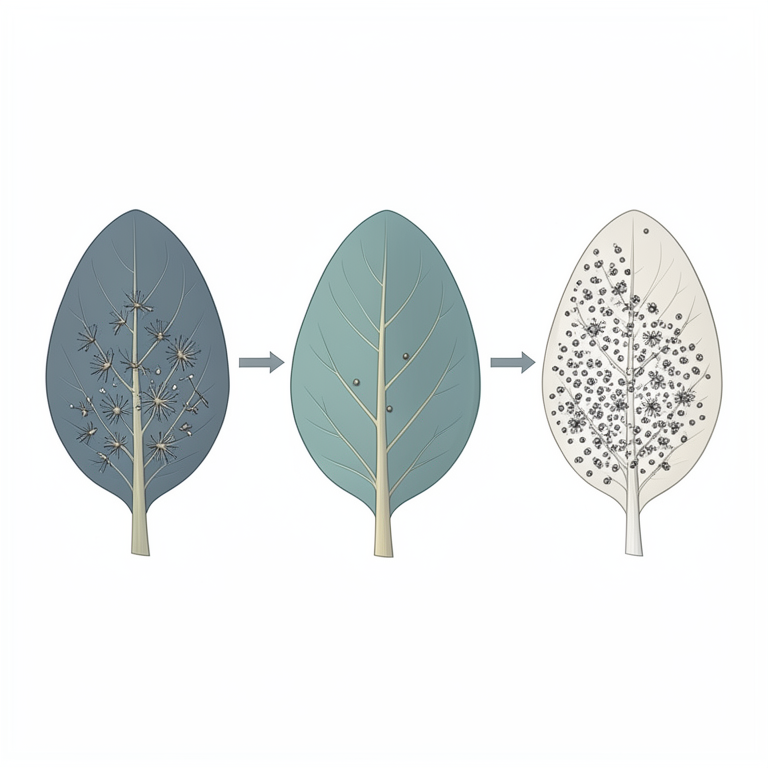
Selection Pressure Model
AI-generated conceptual illustration (Alternaria fungi on cruciferous crop leaves). It explains the idea and does not show study data.
View source evidence ↗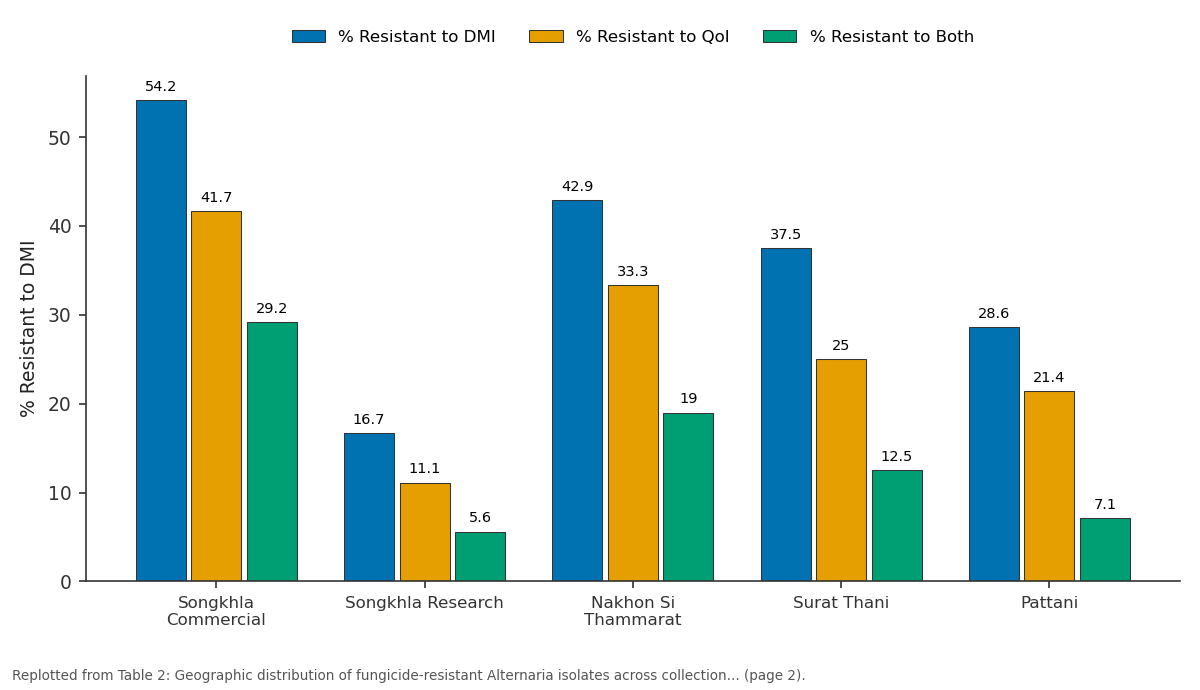
% Resistant to DMI and % Resistant to QoI and more: Songkhla Commercial vs Songkhla Research vs Nakhon Si Thammarat vs Surat Thani vs Pattani
Replotted from Table 2 (page 2) of the original paper. Every bar is the paper's own table value.
View source evidence ↗Figures & tables
From the original paper Table 1
 Table 2
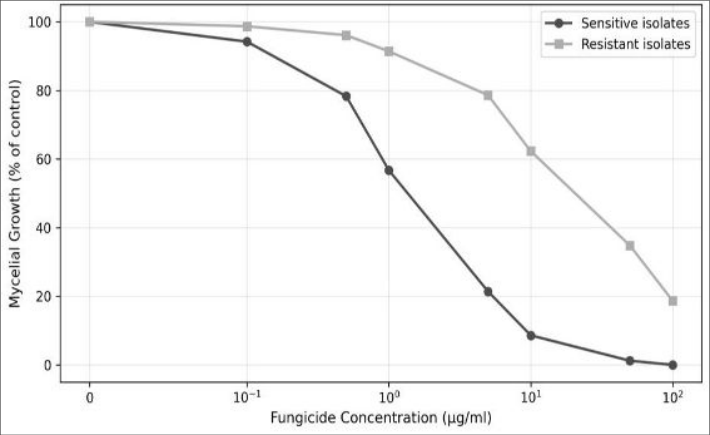 Figure 1
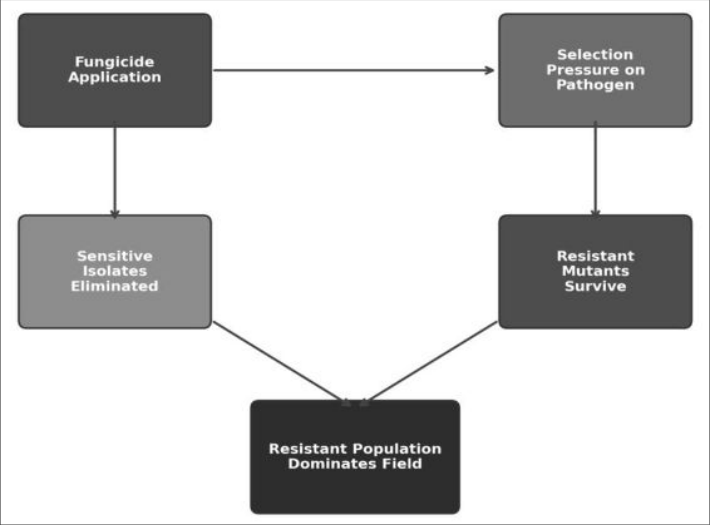 Figure 2
Introduction
Resistance to fungicides in plant pathogens is not an unusual outcomeit is a predictable one whenever the same mode of action is applied repeatedly against populations with sufficient genetic variation [1] . Among foliar pathogens of Brassica crops, Alternaria brassicicola ranks as one of the most damaging, causing dark leaf spots, pod lesions, and seed infection that can reduce marketable yield by 30-47% in tropical production regions [2] . Southern Thailand grows roughly 42,000 hectares of cruciferous vegetables annually, and most growers rely on calendar-based fungicide sprays at 7-10 day intervals throughout the crop cycle [3] . The dominant fungicide classes used against Alternaria in Thailand include DMI (demethylation inhibitors, FRAC Group 3), QoI (quinone outside inhibitors, Group 11), and multi-site protectants such as mancozeb and chlorothalonil [4] . Single-site fungicides carry inherently higher resistance risk because a single mutation in the target gene can confer high-level insensitivity [5] . Reports of Alternaria resistance to QoI fungicides linked to the G143A mutation in cytochrome b have emerged from Europe and North America, but data from Southeast Asian populations remain limited [6] . This research aimed to establish baseline sensitivity data for five fungicides across Alternaria populations in southern Thailand and to estimate the current prevalence and geographic distribution of resistant isolates.
Quality Control
Standard laboratory quality control procedures were followed throughout the sensitivity assays. Three reference isolates of known sensitivity (maintained at Southern Thai Agricultural University since 2015 without fungicide exposure) were included on every assay plate as internal standards. Fungicide stock solutions were prepared fresh monthly and stored at 4°C in amber glass vials. Each concentration was verified by serial dilution and checked against spectrophotometric absorbance at 281 nm for difenoconazole and 243 nm for azoxystrobin. Colony diameter measurements were taken by two independent observers, and inter-observer agreement was verified (ICC > 0.95). Any plate showing contamination or aberrant colony morphology was discarded and the assay repeated.
Material and Methods Material
Alternaria-infected leaf samples were collected from cabbage, cauliflower, and Chinese kale fields at five locations in southern Thailand between January 2022 and March 2023: two sites in Songkhla province (one commercial farm cluster and the university research station), and one site each in Nakhon Si Thammarat, Surat Thani, and Pattani provinces. A total of 93 monoconidial A. brassicicola isolates were obtained following standard isolation protocols on V8 juice agar [7] . Species identity was confirmed by ITS sequencing and morphological characteristics. Isolates were maintained on PDA slants at 4°C.
Methods
Fungicide sensitivity was assessed by the mycelial growth inhibition method on PDA amended with five concentrations of each fungicide (0, 0.1, 1.0, 10, and 100 µg/ml). Technical-grade difenoconazole (97.4%), azoxystrobin (98.1%), iprodione (96.8%), mancozeb (85% WP), and chlorothalonil (98.2%) were dissolved in acetone and added to autoclaved PDA at 50°C [8] . Mycelial plugs (5 mm diameter) from 7-day-old colonies were placed on amended plates and incubated at 25 ± 1°C for 7 days. Colony diameter was measured at two perpendicular axes. EC₅₀ values were calculated by probit regression. Isolates with EC₅₀ values exceeding ten times the mean of sensitive reference isolates were classified as resistant [9] . Resistance factor was calculated as EC₅₀(resistant) / EC₅₀(sensitive).
Data were analyzed using ANOVA and Chi-square tests for frequency comparisons. The Songkhla commercial site had the highest resistance frequencies: 54.2% for DMI and 41.7% for QoI (Table 2). The research station site, where fungicide use is rotated and less frequent, showed much lower resistance at 16.7% and 11.1% respectively. Cross-resistance to both DMI and QoI was found in 16.1% of all isolates.
| Collection Site | No. Isolates | % Resistant to DMI | % Resistant to QoI | % Resistant to Both |
|---|---|---|---|---|
| Songkhla Commercial | 24 | 54.2 | 41.7 | 29.2 |
| Songkhla Research | 18 | 16.7 | 11.1 | 5.6 |
| Nakhon Si Thammarat | 21 | 42.9 | 33.3 | 19.0 |
| Surat Thani | 16 | 37.5 | 25.0 | 12.5 |
| Pattani | 14 | 28.6 | 21.4 | 7.1 |
| Overall | 93 | 38.7 | 28.0 | 16.1 |
Table text extracted from the original PDF; superscript letters are shown inline. The original table image is below.
View original table image
Results
Results
Comprehensive Interpretation
A clear gradient in resistance frequency was observed from research stations (low fungicide input) to commercial farms (high input). The correlation between annual number of fungicide applications reported by growers and proportion of resistant isolates recovered was positive and significant (r = 0.88, P < 0.01), providing direct field evidence for selection pressure driving resistance.
Discussion
The detection of QoI resistance at nearly 28% prevalence is concerning because this class includes some of the most effective Alternaria fungicides available. The very high resistance factor (158.9) for azoxystrobin suggests qualitative, single-step resistance, consistent with the G143A cytochrome b mutation documented in other Alternaria species [6] . DMI resistance at 38.7% is also above thresholds that would be expected to affect field efficacy, as commercial failures typically appear when resistance exceeds 20-30% in a given population [5] .
The intact activity of multi-site fungicides is expected given their multiple biochemical targets, which require simultaneous mutations for resistance to develop [4] . Their inclusion in spray programmes should be made mandatory rather than optional, alternating with single-site products to dilute selection pressure. The lower resistance at the research station confirms that reduced spray frequency and mode-of-action rotation can keep resistance frequencies manageable. Growers should aim for no more than two consecutive applications of the same mode-of-action group per season [1] .
Conclusion
Conclusion
Acknowledgement
Acknowledgements Funding SourcesSupported by internal research funds of Southern Thai Agricultural University. Institutional SupportThe authors thank Southern Thai Agricultural University for laboratory and field access. Contributions Not Qualifying for AuthorshipLaboratory technicians are acknowledged for assistance with fungal isolation and plate preparation.
Figures and tables from the paper
| Fungicide | Mode of Action | Sensitive EC₅₀ (µg/ml) | Resistant EC₅₀ (µg/ml) | Resistance Factor |
|---|---|---|---|---|
| Difenoconazole | DMI (Group 3) | 0.42 | 14.8 | 35.2 |
| Azoxystrobin | QoI (Group 11) | 0.18 | 28.6 | 158.9 |
| Iprodione | SDHI (Group 2) | 1.24 | 8.7 | 7.0 |
| Mancozeb | Multi-site (M3) | 8.62 | 11.4 | 1.3 |
| Chlorothalonil | Multi-site (M5) | 6.84 | 9.2 | 1.3 |
| SEm(±) | - | 0.08 | 1.23 | - |
| CD (P=0.05) | - | 0.24 | 3.69 | - |
Table text extracted from the original PDF; superscript letters are shown inline. The original table image is below.
View original table image
References
14 in the original paper- Brent KJ, Hollomon DW. Fungicide resistance in crop pathogens: how can it be managed? FRAC Monograph No. 1. 2007;2:1-56.
- Nowicki M, Nowakowska M, Niezgoda A. Alternaria black spot of crucifers: symptoms, importance of disease and perspectives of resistance breeding. Vegetable Crops Research Bulletin. 2012;76:5-19.
- Jaidee W, Suwannapong G. Vegetable production systems in southern Thailand. Kasetsart Journal of Natural Science. 2014;48(3):412-421.
- FRAC. FRAC code list: fungal control agents sorted by cross resistance pattern. Fungicide Resistance Action Committee. 2023;1:1-16.
- Ma Z, Michailides TJ. Advances in understanding molecular mechanisms of fungicide resistance. Phytopathology. 2005;95(6):681-691.
- Iacomi-Vasilescu B, Avenot H, Bataille-Simoneau N. In vitro fungicide sensitivity of Alternaria species pathogenic to crucifers. Crop Protection. 2004;23(1):19.
- Simmons EG. Alternaria: an identification manual. CBS Biodiversity Series. 2007;6:1-775.
- Stammler G, Benzinger G, Speakman J. A rapid and reliable method for monitoring sensitivity of Sclerotinia sclerotiorum to boscalid. Journal of Phytopathology. 2007;155(11-12):746-748.
- Russell PE. Sensitivity baselines in fungicide resistance research and management. FRAC Monograph No. 3. 2004;1:1-56.
- Avenot HF, Michailides TJ. Progress in understanding molecular mechanisms of resistance to fungicides. Crop Protection. 2010;29(7):643-651.
- Thomma BPHJ. Alternaria spp.: from general saprophyte to specific parasite. Molecular Plant Pathology. 2003;4(4):225-236.
- Sierotzki H, Scalliet G. A review of current knowledge of resistance aspects for the next generation SDH inhibitors. Phytopathology. 2013;103(9):880-887.
- Hollomon DW. Fungicide resistance: facing the challenge. Plant Protection Science. 2015;51(4):170176.
- van den Bosch F, Paveley N, Shaw M. Damping off the evolution of fungicide resistance. Journal of the Royal Society Interface. 2011;8(54):1661-1670.