
Research article · 2025 · Full text
International Journal of Agriculture and NutritionEffect of plant growth regulators on flowering synchrony and hybridization efficiency in pigeon pea
Volume 7(5) · Pages 83–86 · DOI: 10.33545/26646064.2025.v7.i5b.553 ↗
Research areasGenetic and Environmental Crop StudiesFlowering Plant Growth and CultivationPlant Reproductive Biology
Abstract
Author-writtenWhile pigeon pea breeders can identify promising parent combinations on paper, the success of actual crosses hinges on whether both parents flower at the same time—and they often don’t. This research examined the effect of gibberellic acid (GA₃), naphthalene acetic acid (NAA), and ethrel on flowering synchrony and hybridization efficiency in three pigeon pea cross combinations at Universitas Pertanian Nusantara, Bogor, Indonesia, during kharif 2022 and 2023. Eight PGR treatments plus an untreated control were tested in a randomized block design with three replications. GA₃ + NAA combination (100 + 25 mg L⁻¹) advanced flowering in the late parent by 21 days and achieved the highest flowering synchrony index (91.3%). Hybridization success rate reached 42.1% in the GA₃+NAA treatment versus 12.4% in the control. Ethrel at 400 mg L⁻¹ was the best single-PGR treatment, with 34.8% success. Pod set per cross ranged from 1.6 (control) to 4.3 (GA₃+NAA). These results demonstrate that PGR-mediated flowering manipulation can more than triple hybridization efficiency in pigeon pea.
Summary
Source-checkedPlain-language reading of the full paper, prepared with AI and checked against the text. Each point links to the authors' own words.
Why it matters
- Pigeon pea is a critical grain legume in tropical regions, but its genetic improvement has not kept pace with major cereals. View evidence ↗
- Controlled crossing in pigeon pea is difficult due to the plant's self-pollinating nature and fragile flowers, leading to low success rates of 10–20%. View evidence ↗
- Flowering asynchrony, where early and late genotypes may differ by 3–4 weeks, often makes crossing physically impossible without intervention. View evidence ↗
The question
- The study aimed to evaluate whether eight different plant growth regulator (PGR) treatments could synchronize flowering and improve hybridization success in pigeon pea parents. View evidence ↗
What they did
- The experiment used three cross combinations featuring early (62 days to flower), late (86 days to flower), and medium-duration (74 days) parents. View evidence ↗
- Researchers measured days to first and 50% flowering, the flowering synchrony index (FSI), and the hybridization success rate based on pod set. View evidence ↗
What they found
- NAA applied alone did not significantly advance flowering time, though it did slightly improve the retention of pods. View evidence ↗
- Pod set per cross increased from 1.6 in the control group to 4.3 in the GA₃+NAA treatment group. View evidence ↗
- A strong negative correlation (r = -0.94) was found between days to 50% flowering and crossing success, with each day of earlier flowering adding approximately 1.4% to the success rate. View evidence ↗
What it means
- The authors conclude that foliar sprays of GA₃ (100 mg L⁻¹) and NAA (25 mg L⁻¹) at 30 and 40 DAS are the most effective for improving synchrony and hybridization efficiency. View evidence ↗
- The authors recommend applying these findings to breeding programs that struggle with timing barriers between early and late flowering parents. View evidence ↗
- A limitation of this method is the requirement for precise application timing, which necessitates detailed knowledge of the phenology of each genotype. View evidence ↗
Visual summary
3 visualsIllustrations explain the paper; charts are replotted from the paper's own table values.
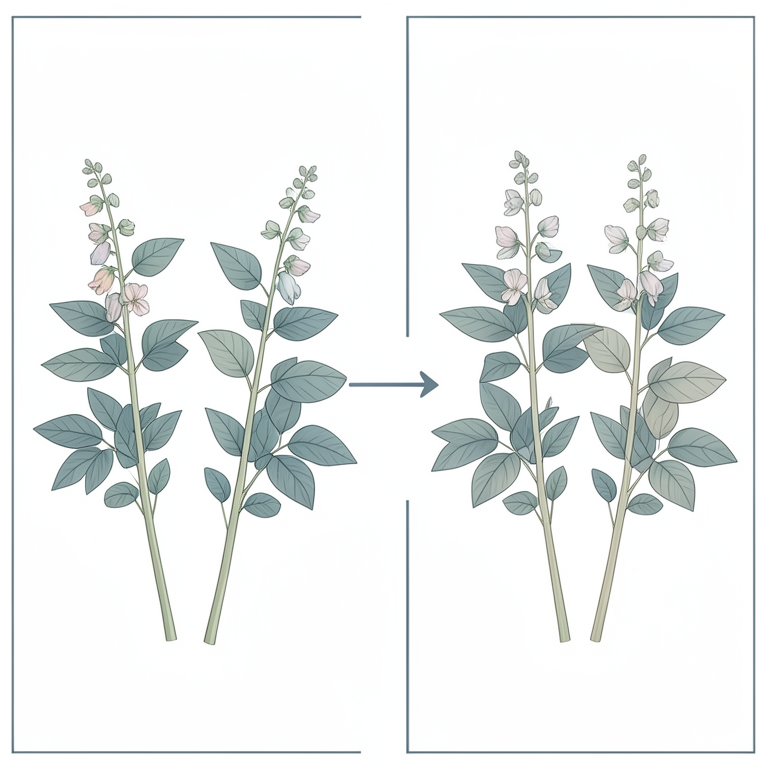
Impact of PGRs on Flowering Overlap
AI-generated conceptual illustration (pigeon pea plants). It explains the idea and does not show study data.
View source evidence ↗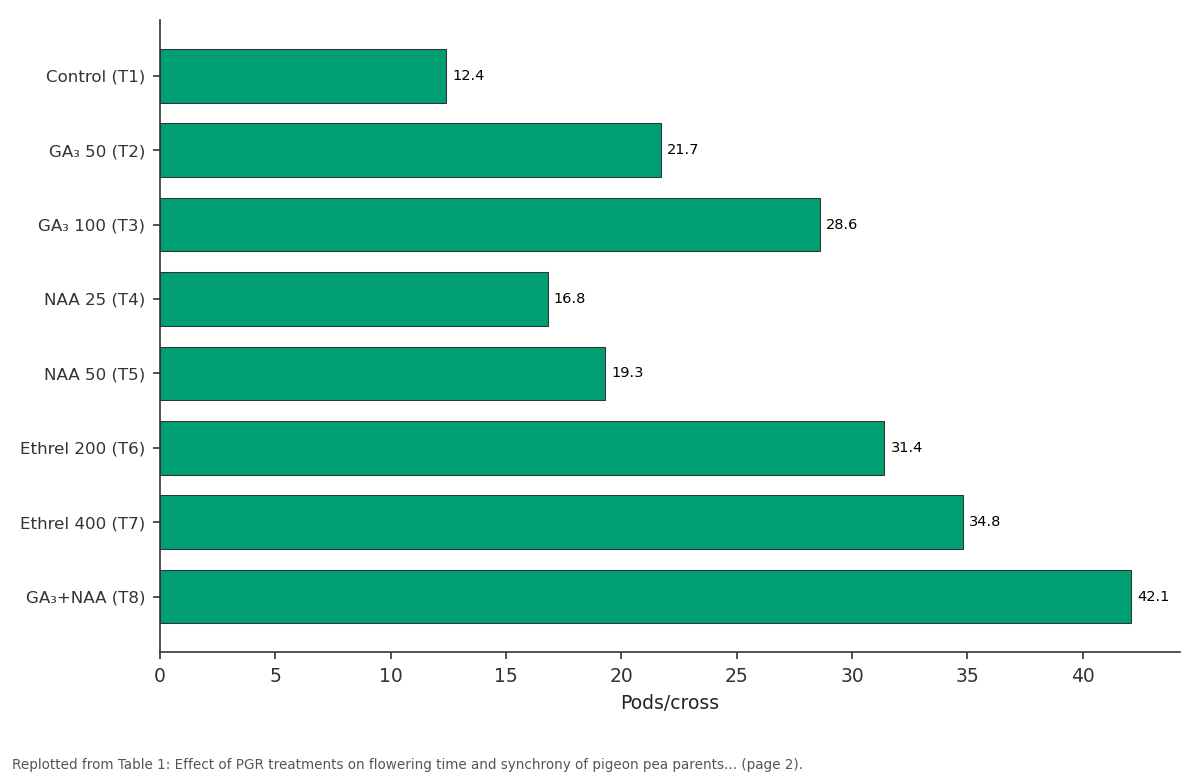
Success rate (%): Control (T1) vs GA₃ 50 (T2) vs GA₃ 100 (T3) vs NAA 25 (T4) vs NAA 50 (T5)
Replotted from Table 1 (page 2) of the original paper. Every bar is the paper's own table value.
View source evidence ↗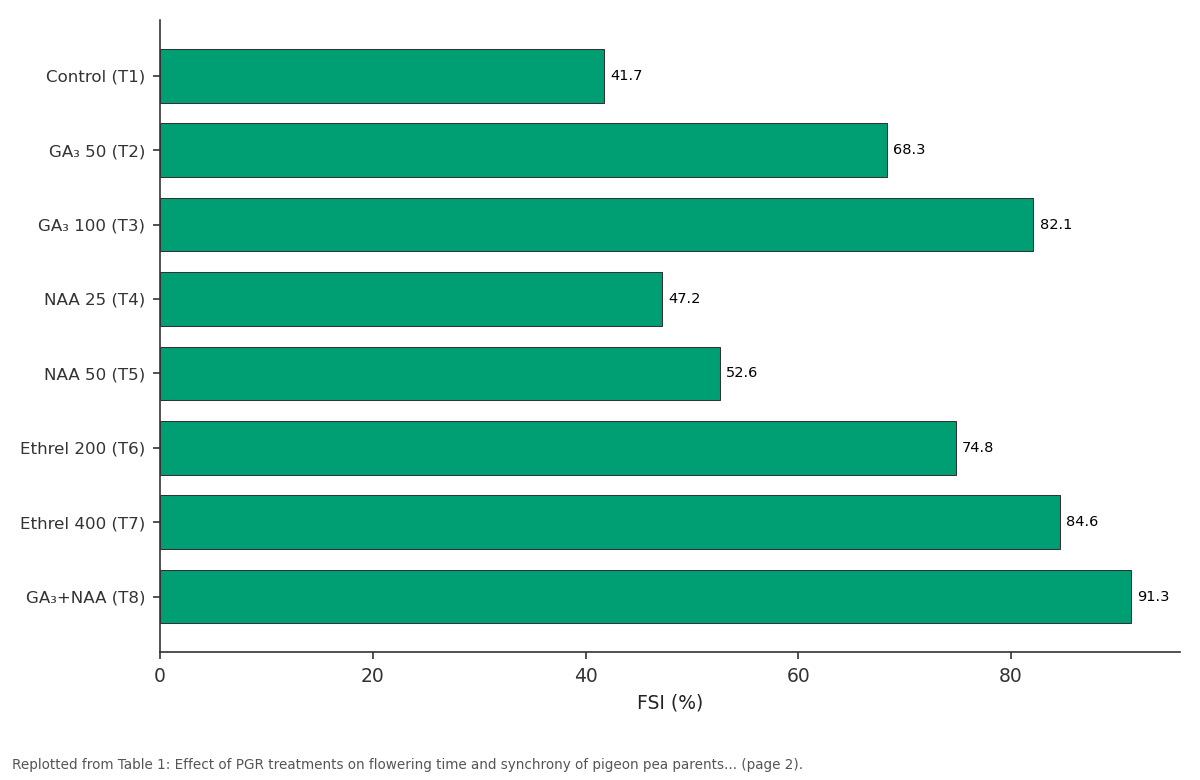
FSI (%): Control (T1) vs GA₃ 50 (T2) vs GA₃ 100 (T3) vs NAA 25 (T4) vs NAA 50 (T5)
Replotted from Table 1 (page 2) of the original paper. Every bar is the paper's own table value.
View source evidence ↗Figures & tables
From the original paper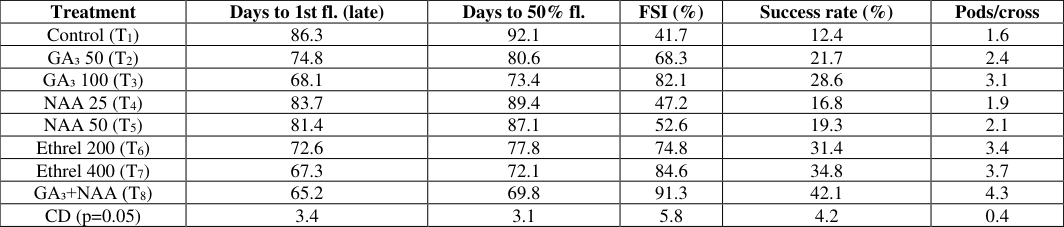 Table 1
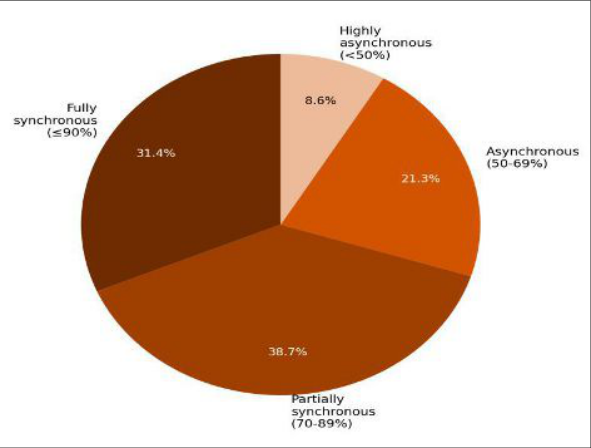 Figure 1
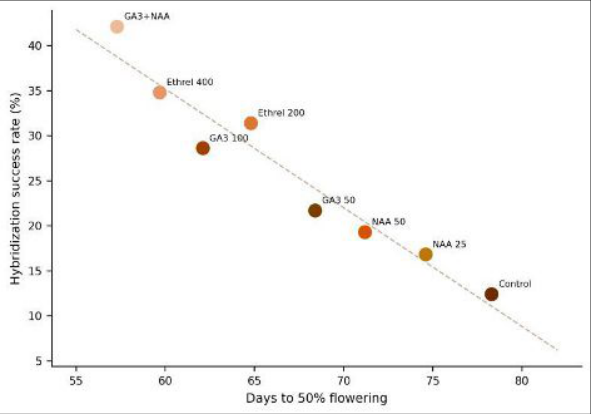 Figure 2
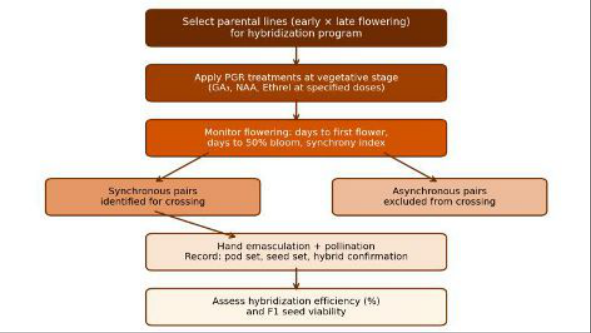 Figure 3
Introduction
Pigeon pea (Cajanus cajan L. Millsp.) is the second most important grain legume in the tropics, yet its genetic improvement lags far behind cereals like rice and wheat. One reason is the difficulty of making controlled crosses. Pigeon pea is predominantly self-pollinated, with small, fragile flowers that are tricky to emasculate, and crossing success rates in most breeding programs range from only 10-20% [1,2] . An added complication is flowering asynchrony between parents: early and late genotypes may differ by 3-4 weeks in days to first bloom, making it physically impossible to cross them without intervention [3] . Plant growth regulators (PGRs) offer a way to manipulate flowering time and synchronize bloom periods. Gibberellic acid (GA₃) can promote early flowering by overriding the juvenility period in indeterminate species [4] . Ethrel (ethephon) accelerates floral bud development and has been used to synchronize anthesis in sorghum and pearl millet crosses [5] . NAA, an auxin analogue, can delay flower abscission and improve pod retention after pollination [6] . Combining PGRs with different modes of action might achieve both synchronization and improved pod set simultaneously. However, systematic evaluation of PGR types and doses for pigeon pea hybridization under tropical conditions is limited. Most published data come from semi-arid Indian environments, and whether the same treatments work in the humid tropics of Indonesia is unclear [7,8] . This research tested eight PGR treatments-including GA₃, NAA, and ethrel individually and in combination-for their ability to synchronize flowering between early and late pigeon pea parents and improve hybridization success at Bogor, West Java.
Physiological Basis of PGR Action on Flowering
Flowering in pigeon pea is controlled by a complex interaction of photoperiod sensitivity, temperature response, and endogenous hormone balance [3,4] . GA₃ promotes the transition from vegetative to reproductive meristems by activating floral identity genes such as LFY and AP1 homologs. In short-day plants like pigeon pea, exogenous GA₃ can partially substitute for the inductive photoperiod signal, effectively advancing flowering under noninductive conditions [4] . Ethrel releases ethylene upon hydrolysis in plant tissues, which
Flowering Synchrony Scoring
The flowering synchrony index was categorized as fully synchronous (≥90% overlap), partially synchronous (70-89%), asynchronous (50-69%), and highly asynchronous (<50%). Each cross combination was scored independently.
The overlap window was calculated as the number of days when both parents had ≥20% of their flowers open simultaneously, expressed as a percentage of the shorter parent's total bloom period.
Results
Table 1). Ethrel at 400 mg L⁻¹ was the best single-PGR treatment, advancing flowering by 19 days.
| Treatment | Days to 1st fl. (late) | Days to 50% fl. | FSI (%) | Success rate (%) | Pods/cross |
|---|---|---|---|---|---|
| Control (T1) | 86.3 | 92.1 | 41.7 | 12.4 | 1.6 |
| GA₃ 50 (T2) | 74.8 | 80.6 | 68.3 | 21.7 | 2.4 |
| GA₃ 100 (T3) | 68.1 | 73.4 | 82.1 | 28.6 | 3.1 |
| NAA 25 (T4) | 83.7 | 89.4 | 47.2 | 16.8 | 1.9 |
| NAA 50 (T5) | 81.4 | 87.1 | 52.6 | 19.3 | 2.1 |
| Ethrel 200 (T6) | 72.6 | 77.8 | 74.8 | 31.4 | 3.4 |
| Ethrel 400 (T7) | 67.3 | 72.1 | 84.6 | 34.8 | 3.7 |
| GA₃+NAA (T8) | 65.2 | 69.8 | 91.3 | 42.1 | 4.3 |
| CD (p=0.05) | 3.4 | 3.1 | 5.8 | 4.2 | 0.4 |
Table text extracted from the original PDF; superscript letters are shown inline. The original table image is below.
View original table image
NAA alone had minimal effect on flowering time but slightly improved pod retention.
Comprehensive Interpretation
The scatter plot (Figure 2) reveals a strong negative relationship (r = -0.94) between days to 50% flowering and crossing success-every day of earlier flowering in the late parent translated to roughly 1.4% higher hybridization success. The pie chart (Figure 1) shows that PGR treatments shifted most cross combinations from the asynchronous to the partially or fully synchronous category.
Discussion
The 21-day flowering advance achieved by GA₃+NAA in the late parent is among the largest reported for pigeon pea and exceeds the 10-15 day advances seen with GA₃ alone in Indian trials [4,7] . The tropical conditions at Bogor-warm temperatures (25-32 °C) and near-equatorial day lengthmay have amplified the GA₃ response, since pigeon pea is a quantitative short-day plant and the slight photoperiod difference at 6°S may not provide strong flowering cues naturally [3] .
NAA alone didn't advance flowering appreciably, but its combination with GA₃ was synergistic: the GA₃+NAA treatment had both the best synchrony and the highest pod set per cross (4.3 vs. 1.6 in control). This supports the idea that NAA's role is post-pollination-reducing abscission of developing pods through auxin-mediated delay of the abscission zone activation [6] . Ethrel showed strong flowering advancement, likely through ethylene-mediated acceleration of meristem maturation [5] . A practical limitation is that PGR application requires precise timing (30 and 40 DAS) relative to the late parent's growth stage, which demands knowledge of each genotype's phenology. Large breeding programs with dozens of cross combinations would need careful scheduling. That said, the threefold improvement in hybridization efficiency would substantially reduce the number of crosses needed to generate a given number of F1 seeds.
Conclusion
Combined application of GA₃ (100 mg L⁻¹) and NAA (25 mg L⁻¹) as foliar sprays at 30 and 40 DAS on the lateflowering parent was the most effective treatment for improving flowering synchrony and hybridization efficiency in pigeon pea. This combination advanced flowering by 21 days, achieved 91.3% flowering synchrony, and increased crossing success from 12.4% to 42.1%. Ethrel at 400 mg L⁻¹ was the best single-PGR option. NAA alone didn't affect flowering time but improved pod retention after crossing. These findings can be applied directly in pigeon pea breeding programs facing flower timing barriers between early and late parents.
Figures and tables from the paper
References
20 in the original paper- Saxena KB. Genetic improvement of pigeon pea: a review. Tropical Plant Biology. 2008;1(2):159-178.
- Bohra A, Jha UC, Adhimoolam P, Bisht D, Singh NP. Cytoplasmic male sterility in pigeon pea: current status and future prospects. Plant Breeding Reviews. 2016;40:279-321.
- Silim SN, Omanga PA. The response of short-duration pigeon pea to variation in temperature and photoperiod under field conditions in Kenya. Field Crops Research. 2001;72(2):97-108.
- Turnbull CGN. Gibberellins and the regulation of flowering in cereals and legumes: a comparison. Flowering Newsletter. 1989;7:3-11.
- Rosenow DT, Quisenberry JE, Wendt CW, Clark LE. Drought tolerant sorghum and cotton germplasm. Agricultural Water Management. 1983;7(1-3):207-222.
- Sexton R, Roberts JA. Cell biology of abscission. Annual Review of Plant Physiology. 1982;33:133-162.
- Saxena KB, Kumar RV, Srivastava N, Shiying B. A cytoplasmic-nuclear male-sterility system derived from a cross between Cajanus cajanifolius and Cajanus cajan. Euphytica. 2005;145(3):289-294.
- Wanjari KB, Patil AN. Pigeon pea improvement at Akola: a historical perspective. Indian Journal of Genetics. 2003;63(2):87-92.
- Ariyanayagam RP, Rao AN, Zaveri PP. Cytoplasmic genic male sterility in interspecific matings of Cajanus. Crop Science. 1995;35(4):981-985.
- Green JM, Sharma D, Reddy LJ, Saxena KB, Gupta SC. Pigeon pea breeding at ICRISAT. Proceedings of International Workshop on Pigeonpea. 1981;1:39-48.
- Sharma D, Green JM. Prospects of pigeon pea hybrids in Indian agriculture. Indian Farming. 1980;30(3):4044.
- Ratnaparkhe MB, Gupta VS, Ven Murthy MR, Ranjekar PK. Genetic fingerprinting of pigeon pea cultivars using RAPD markers. Theoretical and Applied Genetics. 1995;91(6-7):893-898.
- Kumar CVS, Singh IP, Vijaykumar R, Patil SB. Pigeon pea perspective in India. Legume Perspectives. 2015;7:17-19.
- Reddy LJ, Green JM, Bisen SS. Genetic male sterility in pigeon pea. Crop Science. 1978;18(3):362-364.
- Dalvi VA, Saxena KB, Madrap IA. Fertility restoration in cytoplasmic-nuclear male-sterile lines derived from three wild relatives of pigeon pea. Journal of Heredity. 2008;99(6):671-673.
- Choudhary AK, Sultana R, Pratap A, Nadarajan N, Jha UC. Breeding for abiotic stresses in pigeon pea. Journal of Food Legumes. 2011;24(3):165-174.
- Nadarajan N, Gunasekaran M. Quantitative genetics and biometrical techniques in plant breeding. Kalyani Publishers. 2005;New Delhi.
- Gwata ET, Silim SN, Mgonja M. Impact of a new early maturing pigeon pea variety on smallholder farming systems in semi-arid Tanzania. Experimental Agriculture. 2006;42(2):185-193.
- Vales MI, Srivastava RK, Sultana R, Singh S, Singh I, Singh G. Breeding for earliness in pigeon pea: development of new determinate and nondeterminate lines. Crop Science. 2012;52(6):2507-2516.
- Upadhyaya HD, Reddy KN, Gowda CLL, Singh S. Phenotypic diversity in the pigeon pea core collection. Genetic Resources and Crop Evolution. 2006;53(6):1285-1297.