
Research article · 2025 · Full text
International Journal of Agriculture and NutritionInfluence of planting time and spacing on flower yield of African marigold
Volume 7(11) · Pages 98–100 · DOI: 10.33545/26646064.2025.v7.i11b.485 ↗
Research areasFlowering Plant Growth and CultivationPlant Growth and Agriculture TechniquesGrowth and nutrition in plants
Abstract
Author-writtenAfrican marigold cultivation for loose flower markets depends heavily on getting two things right: when to plant and how far apart to space the transplants. This research evaluated three planting dates (15 June, 1 July, and 15 July) and three spacing levels (30×30 cm, 30×45 cm, and 45×45 cm) in a factorial randomized block design for their effects on growth, flower yield, and quality of African marigold (Tagetes erecta L. cv. Pusa Narangi Gainda) at Swarnim Gujarat Agricultural University, Gandhinagar, during the kharif seasons of 2022 and 2023. The 1 July planting at 30×45 cm spacing produced the highest flower yield of 12.34 t/ha, flower diameter of 7.82 cm, and carotenoid content of 184.6 µg/g fresh weight. The earliest planting (15 June) suffered from excessive vegetative growth with reduced flower number, while the latest date (15 July) had a shortened growing period that limited cumulative flower production. Closer spacing (30×30 cm) gave the highest plant population but smaller flowers due to competition. These results recommend 1 July transplanting at 30×45 cm spacing as the optimum combination for maximizing both flower yield and quality in the Gujarat plains.
Summary
Source-checkedPlain-language reading of the full paper, prepared with AI and checked against the text. Each point links to the authors' own words.
Why it matters
- India is the global leader in marigold production, with an annual output of over 18 lakh tonnes from approximately 3.5 lakh hectares. View evidence ↗
- In Gujarat, kharif season marigold is specifically timed to ensure peak flowering coincides with the Navratri and Diwali festivals between September and November. View evidence ↗
- Planting date and spacing are critical management factors that affect the balance of plant growth, light and air access, and the resulting quality and quantity of flowers. View evidence ↗
The question
- The study aimed to determine the optimal combination of planting dates and spacing levels for African marigold grown in the Gujarat plains. View evidence ↗
What they did
- The research was conducted over the kharif seasons of 2022 and 2023 at the Swarnim Gujarat Agricultural University Research Farm in Gandhinagar, Gujarat. View evidence ↗
- The study used a factorial randomized block design with three planting dates (June 15, July 1, and July 15) and three spacing levels (30×30 cm, 30×45 cm, and 45×45 cm), resulting in nine treatment combinations with three replicates. View evidence ↗
- Researchers measured various growth and quality parameters, including plant height, flower yield per hectare, flower diameter, and carotenoid content measured via spectrophotometry at 450 nm. View evidence ↗
What they found
- The combination of July 1 planting and 30×45 cm spacing (D2S2) achieved the maximum flower yield of 12.34 t/ha, a flower diameter of 7.82 cm, and a carotenoid content of 184.6 µg/g. View evidence ↗
- Planting on June 15 led to taller plants due to excessive vegetative growth, which resulted in a lower number of flowers per plant. View evidence ↗
- The July 15 planting date consistently underperformed because the shortened growing period limited the total flower production. View evidence ↗
- While the closest spacing (30×30 cm) increased the plant population, it resulted in smaller flowers because of competition between plants. View evidence ↗
- The widest spacing (45×45 cm) with 49,000 plants/ha produced the largest individual flowers, but the overall yield per hectare was lower than the optimal spacing. View evidence ↗
What it means
- The authors conclude that for the Gujarat plains, the optimal combination for maximizing yield, quality, and profit is planting on July 1 with 30×45 cm spacing. View evidence ↗
Visual summary
3 visualsIllustrations explain the paper; charts are replotted from the paper's own table values.
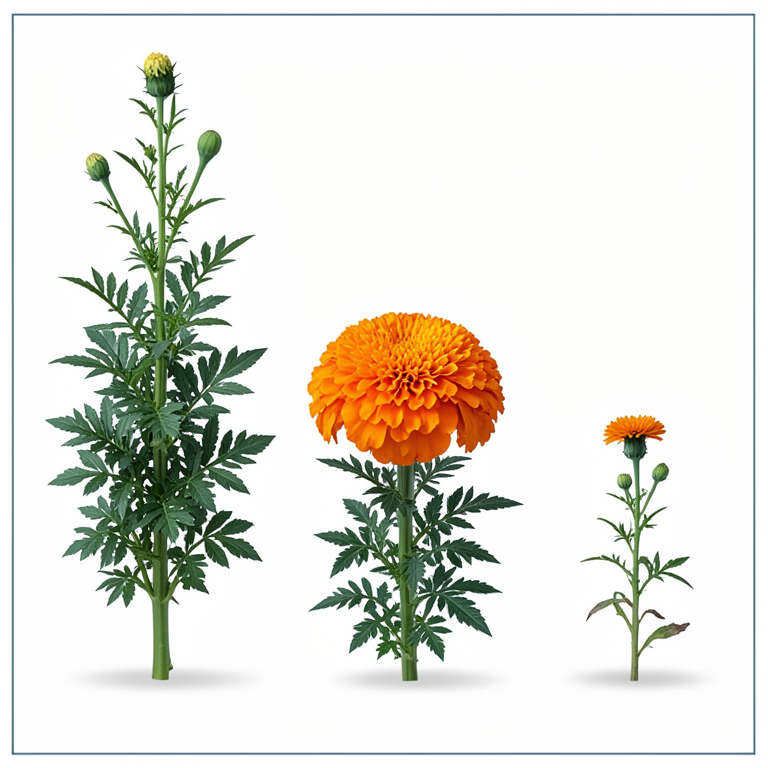
Planting Date Impact
AI-generated conceptual illustration (African marigold plants). It explains the idea and does not show study data.
View source evidence ↗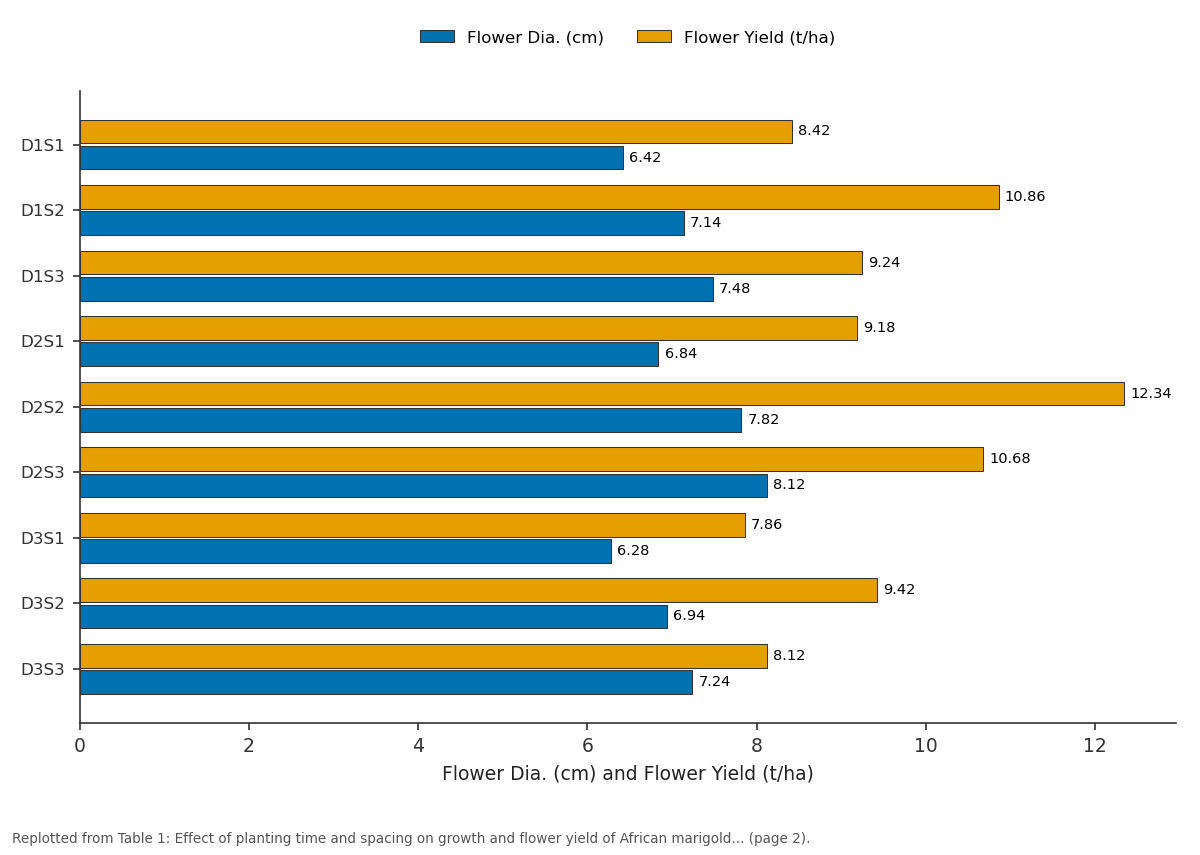
Flower Dia. (cm) and Flower Yield (t/ha): D1S1 vs D1S2 vs D1S3 vs D2S1 vs D2S2
Replotted from Table 1 (page 2) of the original paper. Every bar is the paper's own table value.
View source evidence ↗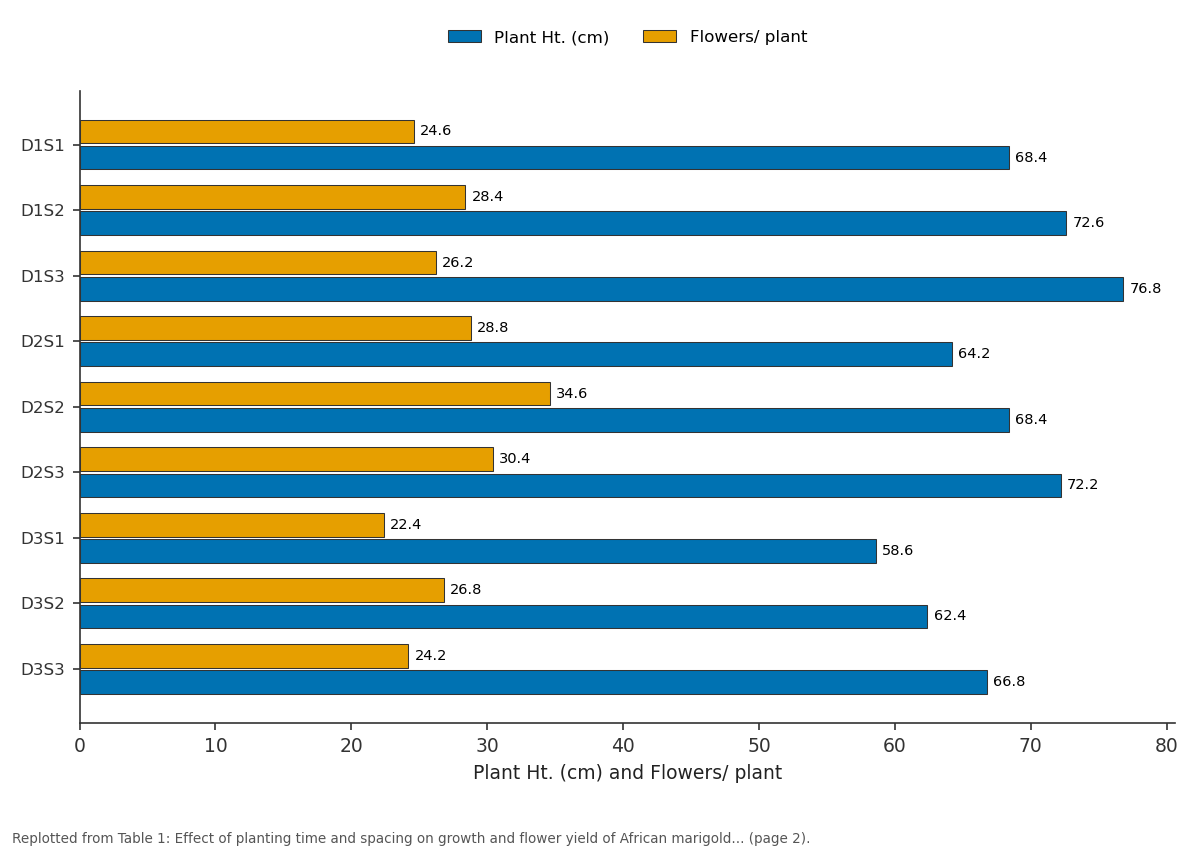
Plant Ht. (cm) and Flowers/ plant: D1S1 vs D1S2 vs D1S3 vs D2S1 vs D2S2
Replotted from Table 1 (page 2) of the original paper. Every bar is the paper's own table value.
View source evidence ↗Figures & tables
From the original paper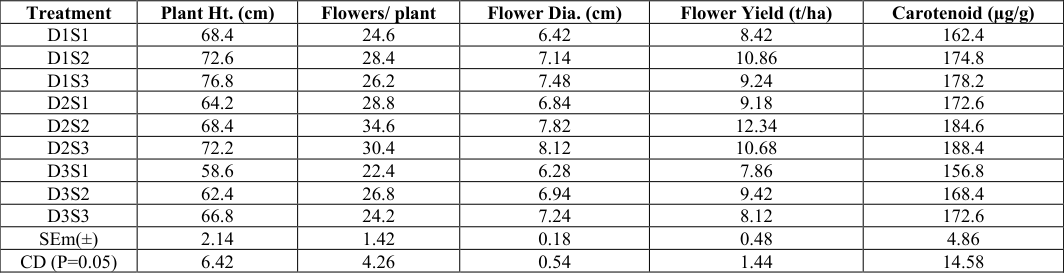 Table 1
 Table 2
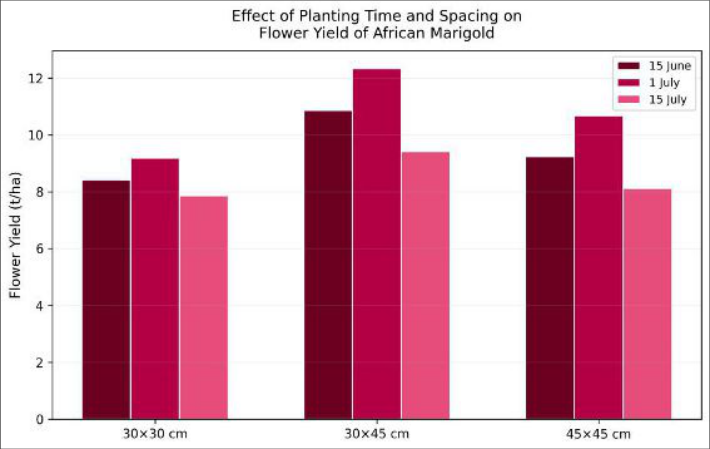 Figure 1
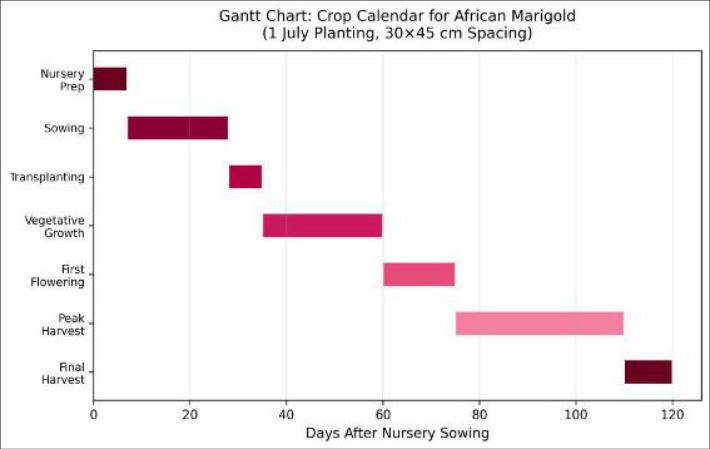 Figure 2
Introduction
Walk through any Indian flower market during the festival season and you will find African marigold in every shade from lemon yellow to deep orange, piled in enormous heaps that are sold by weight for garlands, religious offerings, and decorations. India is the world's largest producer of marigold, cultivating roughly 3.5 lakh hectares with an output exceeding 18 lakh tonnes of loose flowers annually [1] . In Gujarat, marigold is grown mainly during kharif and rabi seasons, with kharif plantings timed to produce peak flowering during the Navratri and Diwali festival period from September through November [2] . Planting date and spacing are among the simplest management decisions available to growers, yet they strongly influence the balance between vegetative and reproductive growth, light interception, air circulation, and ultimately the number and size of marketable flowers [3] . Too early a planting can push the crop into excessive vegetative growth before the shorter days and cooler nights trigger flower initiation, while too late a planting truncates the flowering window [4] . Spacing affects competition for light, water, and nutrients among plants; closer spacing increases plant density and potentially total yield per hectare, but may reduce individual flower size and increase disease incidence [5] . This research tested combinations of three planting dates and three spacing levels to identify the optimal package for African marigold under Gujarat plains conditions.
Crop Growth Stage Documentation
Seedlings were raised in pro-trays filled with cocopeat and transplanted to the main field at the 4-5 true leaf stage (about 28 days after sowing). First flower bud appearance was recorded at 32-38 days after transplanting depending on the planting date and spacing. First harvest of fully opened flowers began at 58-65 days after transplanting. Peak flowering occurred between 75 and 95 days after transplanting for the 1 July planting. Total harvesting spanned 45-55 days across multiple pickings at 3-4 day intervals. The crop was terminated when fewer than 10 marketable flowers per plot were available per picking [6] .
Material and Methods
Material and Methods
Material:
The experiment was conducted at the Research Farm of Swarnim Gujarat Agricultural University, Gandhinagar, Gujarat (23.22° N, 72.68° E, elevation 81 m), during kharif 2022 and 2023. The soil was sandy loam with pH 7.4 and organic carbon 0.52%. African marigold cv. Pusa Narangi Gainda was used. A factorial RBD with three planting dates (D1: 15 June, D2: 1 July, D3: 15 July) and three spacings (S1: 30×30 cm, S2: 30×45 cm, S3: 45×45 cm) gave nine treatment combinations replicated three times. Plot size was 4 m × 3 m [7] . A uniform dose of 120:80:80 kg N:P₂O₅:K₂O per hectare was applied.
Methods
Observations were recorded on plant height, branches per plant, days to first flower, flowers per plant, flower diameter, individual flower weight, flower yield per plot and per hectare, shelf life of harvested flowers, and carotenoid content (by spectrophotometric estimation at 450 nm after petroleum ether extraction) [8] . Flower yield was computed from the cumulative weight of all harvested flowers across all pickings. Data were pooled over two seasons and analyzed by factorial ANOVA at P = 0.05 with Duncan's test for mean separation. D2S2 gave the highest net income (₹1,58,200/ha) and B:C ratio (2.79) (Table 2). The closer spacing D2S1 had higher cultivation cost due to more seedlings and labor but lower returns per rupee invested.
| Treatment | Gross Income (₹/ha) | Cost of Cultivation (₹/ha) | Net Income (₹/ha) | B:C Ratio |
|---|---|---|---|---|
| D1S2 | 2,17,200 | 86,400 | 1,30,800 | 2.51 |
| D2S1 | 1,83,600 | 92,800 | 90,800 | 1.98 |
| D2S2 | 2,46,800 | 88,600 | 1,58,200 | 2.79 |
| D2S3 | 2,13,600 | 82,400 | 1,31,200 | 2.59 |
| D3S2 | 1,88,400 | 86,400 | 1,02,000 | 2.18 |
Table text extracted from the original PDF; superscript letters are shown inline. The original table image is below.
View original table image
Results
Results
Comprehensive Interpretation
The interaction between planting date and spacing was significant (p< 0.05) for flower yield, flower diameter, and carotenoid content. The 1 July date optimized the vegetative-to-reproductive transition by ensuring that plants reached the flower initiation stage during the declining daylength period of August-September, while the 30×45 cm spacing provided sufficient space for lateral branching without wasting land area.
Discussion
The superiority of the 1 July planting reflects the favorable synchronization between the plant's developmental requirements and the seasonal pattern of temperature and photoperiod in Gujarat [2,4] . The 15 June planting experienced longer days during early growth, which promoted excessive stem elongation at the expense of flower bud initiation. The 15 July planting, while avoiding this problem, simply ran out of time before the onset of cool, dry weather in late November curtailed growth [3] . At the 30×45 cm spacing, the plant population of approximately 74,000 per hectare balanced individual plant productivity with population density. The wider 45×45 cm spacing (49,000 plants/ha) produced the largest individual flowers but lower total yield per hectare because fewer plants couldn't compensate for the bigger blooms. The highest carotenoid content in wider spacings may reflect better light penetration into the canopy, as carotenoid biosynthesis is light-dependent [5,8] .
Conclusion
Planting African marigold on 1 July at 30×45 cm spacing is the optimum combination for the Gujarat plains, producing the highest flower yield (12.34 t/ha), good flower quality, and the best economic returns (B:C 2.79). Growers targeting the Navratri-Diwali festival market should adopt this package to maximize both yield and profit. Earlier planting wastes the vegetative potential on stem growth, while later planting shortens the productive harvest window.
Figures and tables from the paper
| Treatment | Plant Ht. (cm) | Flowers/ plant | Flower Dia. (cm) | Flower Yield (t/ha) | Carotenoid (µg/g) |
|---|---|---|---|---|---|
| D1S1 | 68.4 | 24.6 | 6.42 | 8.42 | 162.4 |
| D1S2 | 72.6 | 28.4 | 7.14 | 10.86 | 174.8 |
| D1S3 | 76.8 | 26.2 | 7.48 | 9.24 | 178.2 |
| D2S1 | 64.2 | 28.8 | 6.84 | 9.18 | 172.6 |
| D2S2 | 68.4 | 34.6 | 7.82 | 12.34 | 184.6 |
| D2S3 | 72.2 | 30.4 | 8.12 | 10.68 | 188.4 |
| D3S1 | 58.6 | 22.4 | 6.28 | 7.86 | 156.8 |
| D3S2 | 62.4 | 26.8 | 6.94 | 9.42 | 168.4 |
| D3S3 | 66.8 | 24.2 | 7.24 | 8.12 | 172.6 |
| SEm(±) | 2.14 | 1.42 | 0.18 | 0.48 | 4.86 |
| CD (P=0.05) | 6.42 | 4.26 | 0.54 | 1.44 | 14.58 |
Table text extracted from the original PDF; superscript letters are shown inline. The original table image is below.
View original table image
References
15 in the original paper- NHB. Indian horticulture database. National Horticulture Board, Gurgaon. 2022;1:1-340.
- Bose TK, Yadav LP, Pal P. Commercial flowers. Naya Udyog. 2003;2:1-780.
- Nain S, Beniwal BS, Dalal RPS. Effect of date of transplanting and pinching on growth and flower production of African marigold. Haryana Journal of Horticultural Sciences. 2003;32(3-4):236-238.
- Yadav PK, Singh S, Dhaka RS. Effect of sowing dates and plant spacings on growth and yield of African marigold. Haryana Journal of Horticultural Sciences. 2004;33(1-2):137-139.
- Beniwal BS, Dahiya MS, Sharma R. Effect of row spacing and nitrogen on growth and flower yield of marigold. Crop Research. 2003;26(2):326-329.
- Bharathi TU, Jawaharlal M. Evaluation of African marigold genotypes for growth and flower yield under tropical conditions. Asian Journal of Horticulture. 2014;9(1):212-216.
- Panse VG, Sukhatme PV. Statistical methods for agricultural workers. ICAR, New Delhi. 1985;4:1-347.
- Ranganna S. Handbook of analysis and quality control for fruit and vegetable products. Tata McGraw-Hill. 1986;2:1-1112.
- Rao TS, Raghava SPS. Evaluation of marigold genotypes for growth and flower characters. Indian Journal of Horticulture. 2000;57(4):362-365.
- Kumar R, Ram M, Gaur GS. Effect of GA3 and ethrel on growth and flowering of African marigold. Indian Journal of Horticulture. 2010;67(3):362-366.
- Swathi KS, Rajendra VB, Prabhuling G. Studies on the effect of varieties and planting dates on growth and flower quality of marigold. Karnataka Journal of Agricultural Sciences. 2014;27(2):238-240.
- Singh AK, Sisodia A, Sisodia V. Role of spacing and bio-fertilizers on growth and flowering of African marigold. International Journal of Plant Sciences. 2014;9(1):126-129.
- Vasudevan SN, Sudarshan JS, Kurdikeri MB. Influence of pinching of apical bud and chemicals on seed yield of African marigold. Karnataka Journal of Agricultural Sciences. 2002;15(1):175-177.
- Arora JS, Khanna K. Effect of nitrogen and pinching on growth and flower production of marigold. Indian Journal of Horticulture. 1985;42(3-4):278-282.
- Singh MK, Kumar R, Singh D. Effect of integrated nutrient management on growth and floral attributes of marigold cv. Pusa Narangi Gainda. HortFlora Research Spectrum. 2014;3(3):265-268.